

Fidson Healthcare was incorporated in 1995 and commenced business in the same year. It was listed on the Nigerian Exchange in 2008. Its principal business is the manufacturing and distribution of pharmaceutical products. The company has developed from a pharmaceutical importer/distributor into a major local manufacturer.
Current price: N84.20
Rating: Buy
Price projection: N130 and N160
Technical Analysis
In this report, we shall use the following tools and analysis methods:
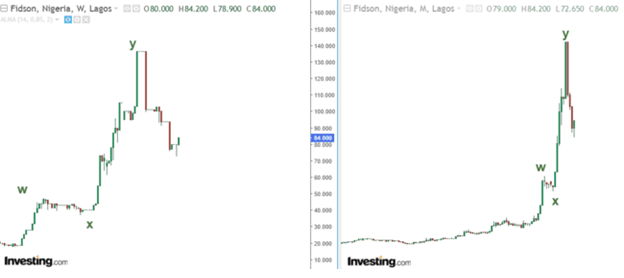
Elliott’s wave theory to understand the overall market sentiment
Fibonacci tools to determine support and resistance levels
The Relative Strength Index and volume to evaluate the market’s strength
The Money Flow Index to determine the market liquidity
Moving average and MACD to understand the nature of the trend
Top-down analysis to know the best investment position
Elliott wave analysis
Weekly chart: Market overview
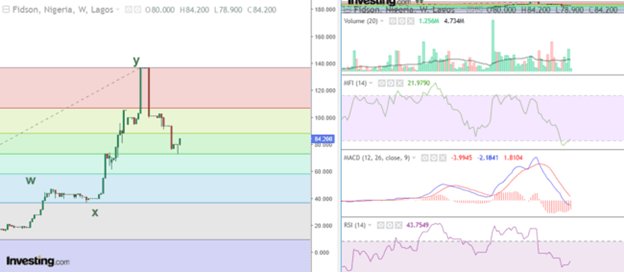
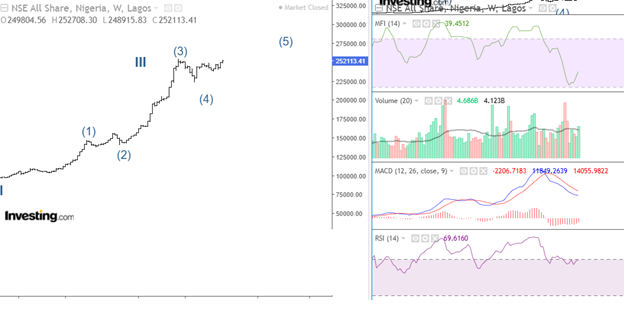
Fidson retraced to the 0.5 Fibonacci level and began recovery. For the past four week, the stock experienced strong bullish momentum. In line with this performance, its liquidity, volume and momentum improved, sustaining MACD’s divergence signal.
Daily chart: Investment opportunity
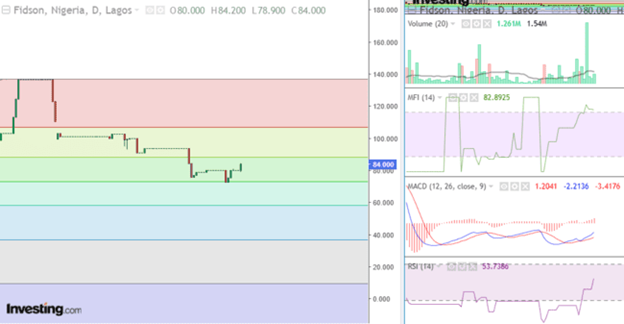
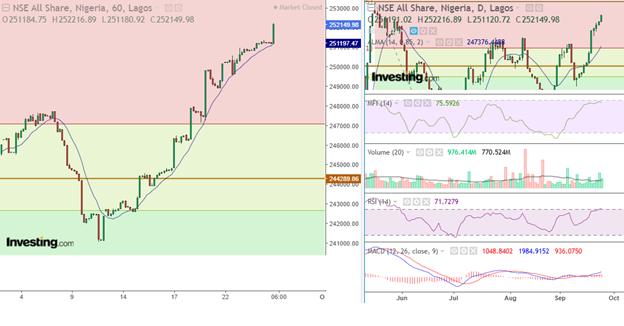
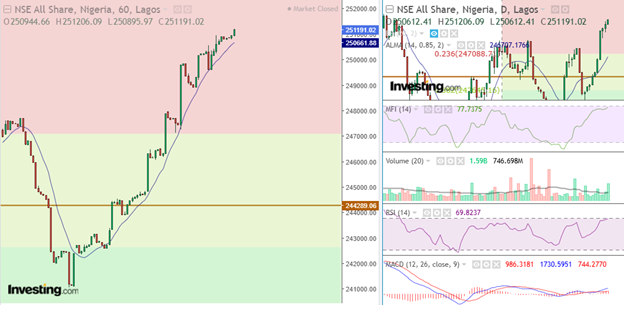
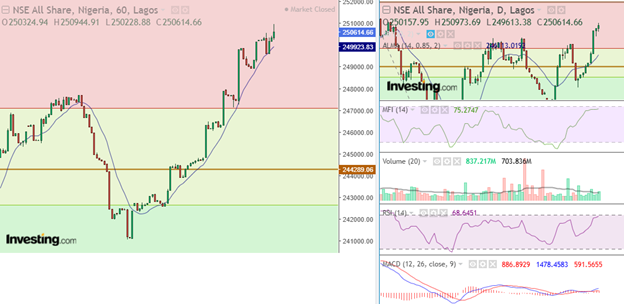
On the daily chart, Fidson sustained its strong bullish momentum. In line with this performance, the stock’s liquidity, momentum, and volume remained strong, inviting investment opportunities. Thus, investors should watch N70 and N80 as potential resistance levels, with prices projected at N130 and N160
SWOT Analysis
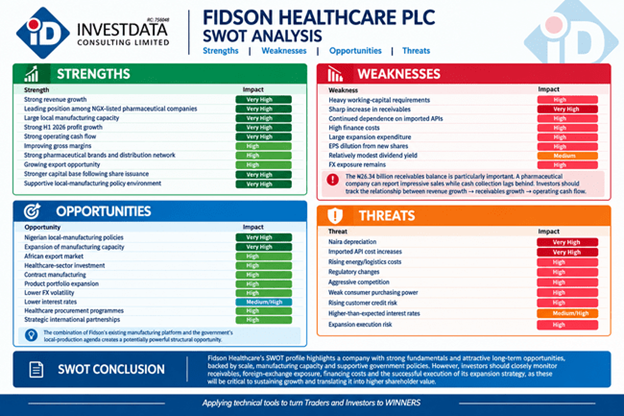
Fidson Healthcare has a strong fundamental position, supported by robust revenue and profit growth, significant manufacturing capacity, strong operating cash flow and an established position in Nigeria’s pharmaceutical industry. The company’s scale also positions it to benefit from government policies promoting local pharmaceutical production and from growing healthcare demand across Nigeria and other African markets.
However, key challenges include foreign-exchange exposure, rising production and operating costs, increased trade receivables and the significant capital required to fund its expansion. Effective working-capital management and successful execution of its manufacturing expansion will therefore be critical.
Overall, Fidson’s long-term prospects remain supported by strong earnings momentum, manufacturing expansion and favourable industry policies, but investors should closely monitor cash-flow conversion, receivables, EPS growth, financing costs and capacity utilisation to determine whether the company’s growth can be sustained and translated into stronger shareholder value.