
Market Update For November 10, 2026
The Nigerian equities market closed marginally lower on Tuesday, November 10, 2026, as renewed profit-taking in selected heavyweight and mid-cap stocks outweighed sustained buying interest across several counters, resulting in a slight reversal of the previous session’s gains. The market’s performance reflected a cautious trading environment, with investors balancing opportunities in fundamentally attractive stocks against the need to secure profits following the recent recovery in share prices.
The marginal decline suggests that the market is gradually entering a consolidation phase after recording a strong rebound on Monday. Although buying interest remained evident across several listed companies, losses in selected highly capitalised stocks limited the benchmark’s upward movement. This indicates that investors are becoming increasingly selective, with portfolio adjustments influenced by prevailing valuations, earnings expectations, liquidity conditions and the broader economic environment.
The performance of the banking sector remained an important factor influencing the direction of the market. Selected financial stocks experienced renewed selling pressure as investors reduced exposure to counters that had recorded significant price appreciation. FIRSTHOLDCO, STANBIC, ZENITHBANK, FIDELITYBK and WEMABANK were among the stocks that closed lower, reflecting cautious positioning across parts of the financial services sector.
The banking sector continues to command significant attention because of its influence on market capitalisation, trading liquidity and institutional portfolio positioning. However, the recent fluctuations in selected banking stocks suggest that investors are becoming more conscious of valuation levels and the possibility of short-term corrections after strong price movements. While the sector remains strategically important to the overall market, the direction of individual banking stocks will increasingly depend on earnings performance, capital adequacy, dividend expectations and the ability of financial institutions to sustain profitability in a changing interest-rate environment.
The industrial and consumer-related sectors also recorded mixed performances, reflecting divergent investor expectations across listed companies. Selling pressure in selected counters was partly offset by renewed demand for other equities, indicating that investors were not withdrawing from the market entirely but were instead rotating funds towards stocks offering more attractive entry opportunities.
This pattern of sector and stock rotation is particularly relevant in a market that has recorded substantial year-to-date gains. As valuations rise, investors tend to become more sensitive to price movements and corporate fundamentals, creating opportunities for profit-taking in stocks that have experienced significant rallies. At the same time, counters that have lagged the broader market may attract bargain-hunting where investors identify favourable earnings prospects or potential recovery opportunities.
Despite the marginal decline in the benchmark index, the broader market maintained a positive tone. The higher number of advancing stocks compared with decliners suggests that buying interest remained relatively strong outside some of the heavyweight counters. This divergence between the All-Share Index and market breadth indicates that the day’s weakness was concentrated in selected stocks rather than representing a widespread deterioration in market sentiment.
The continued participation of investors in selected small and mid-cap equities also highlights the growing importance of stock-specific opportunities in the current trading environment. While heavyweight stocks remain essential to the direction of the benchmark index, smaller counters can provide additional opportunities for investors seeking capital appreciation. Nevertheless, liquidity, corporate earnings and price volatility remain important considerations when assessing these stocks.
Another notable development was the emergence of new 52-week highs and lows, reflecting the contrasting fortunes of companies listed on the exchange. HONYFLOUR reached a new 52-week high of ₦32.20, suggesting sustained demand and improving price momentum. On the other hand, LIVINGTRUST and SUNUASSUR recorded new 52-week lows of ₦2.58 and ₦2.62, respectively. These movements demonstrate the uneven distribution of investment flows across the market and reinforce the importance of company-specific fundamentals in determining share price performance.
Trading activity remained relatively active, with investors maintaining interest in selected banking, industrial and consumer stocks. NEIMETH attracted the highest volume of transactions, accounting for a significant proportion of the shares exchanged during the session. The continued activity in FIRSTHOLDCO and other actively traded financial stocks also reflected the importance of banking counters to market liquidity.
The concentration of trading in selected equities suggests that investors remain engaged despite the market’s intermittent weakness. However, the sustainability of the current market recovery will require broader participation, particularly from institutional investors and portfolio managers whose transactions often influence the direction of highly capitalised stocks. Increased turnover accompanied by positive price movements would provide stronger confirmation of renewed demand, while rising volume during declining sessions could signal intensifying distribution.
Technical Analysis and Market Outlook
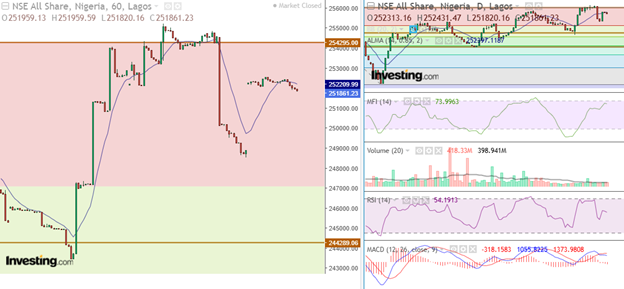
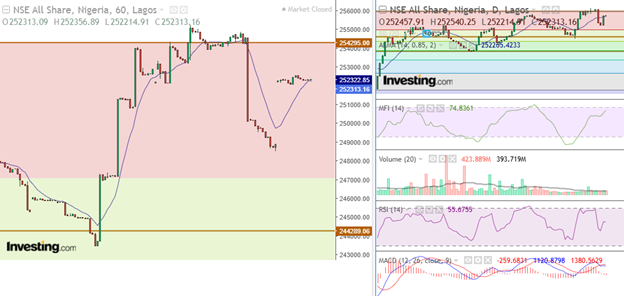
From a technical perspective, the Nigerian equities market appears to be consolidating after Monday’s strong upward movement. The marginal decline recorded on Tuesday indicates that the market is encountering some resistance as investors lock in gains and reassess their exposure to selected counters. Nevertheless, the benchmark index remains above the psychological 250,000-point level, suggesting that the broader bullish structure remains intact for now.
The 250,000-point region represents an important psychological support zone that investors will be watching closely in the coming sessions. The market’s ability to sustain trading above this level could encourage renewed bargain-hunting and provide the foundation for another recovery attempt. A successful defence of this support region would also strengthen confidence that the recent decline represents a temporary pause rather than the beginning of a deeper correction.
On the upside, the 254,000–255,000-point range remains an immediate resistance zone. The market needs sustained buying interest and improved participation in heavyweight stocks to overcome this barrier. A decisive breakout above the resistance region, supported by stronger trading volume and positive market breadth, could reinforce bullish momentum and create room for further appreciation.
However, repeated attempts to break above the resistance zone without sufficient buying pressure could prolong the current consolidation. In such a situation, investors may continue to take profits in stocks that have recorded substantial gains, while directing funds towards counters with stronger relative performance and more attractive valuations.
A sustained movement below the 250,000-point support level would weaken the short-term technical outlook and potentially expose the market to additional selling pressure. Such a development could encourage a more defensive investment strategy, particularly if accompanied by declining market breadth and increased selling volume.
The relationship between market breadth and index performance will therefore remain important in assessing the sustainability of the current trend. Positive breadth, as recorded during Tuesday’s session, suggests that buying interest remains present across several counters. However, the market needs stronger participation from large-cap stocks to translate this underlying demand into a more convincing benchmark recovery.
Investors should also monitor the direction of trading volume, turnover and sectoral performance. An improvement in these indicators alongside a sustained upward movement in the index would strengthen the bullish outlook. Conversely, weakening turnover, negative market breadth and continued losses in heavyweight equities could indicate that the market requires a longer consolidation period before establishing its next direction.
In the near term, the market is likely to remain sensitive to corporate earnings announcements, dividend expectations, monetary policy developments and changes in domestic liquidity conditions. The prevailing interest-rate environment will also influence portfolio allocation decisions, particularly as investors compare the potential returns from equities with opportunities in fixed-income securities and money-market instruments.
The significant year-to-date appreciation recorded by the Nigerian equities market has improved investor wealth but also increased the possibility of intermittent profit-taking. Consequently, the next phase of the market’s performance may depend less on broad speculative demand and more on the ability of listed companies to sustain earnings growth, improve operational efficiency and deliver attractive returns to shareholders.
Fundamentally strong companies with consistent revenue growth, resilient profit margins, manageable debt levels and attractive dividend prospects may continue to attract long-term investment interest. However, investors should remain cautious about chasing stocks after sharp price increases, particularly where valuations have moved ahead of underlying earnings performance. Selective accumulation during periods of weakness may offer better risk-reward opportunities than aggressive buying during short-term rallies.
Oil Market
Developments in the international crude oil market also remained important to the broader investment outlook, particularly given Nigeria’s dependence on petroleum exports for foreign exchange earnings and government revenue. Oil prices extended their previous session’s losses on Tuesday as easing concerns over a renewed military confrontation between the United States and Iran reduced the geopolitical risk premium in the market.
Brent crude futures declined by 3.15% to $89.65 per barrel, while US West Texas Intermediate fell 2.68% to $84.52 per barrel. The decline followed substantial losses recorded in the previous session, pushing Brent below the $90 threshold for the first time since August 31.
The downward movement followed comments by US President Donald Trump indicating that he was unlikely to authorise additional military strikes against Iran while diplomatic efforts to resolve the conflict continued. Appeals from regional countries, including Qatar, also contributed to expectations of reduced military escalation.
The market’s reaction highlights the influence of geopolitical developments on crude oil pricing, particularly when tensions threaten supply routes in the Middle East. The Strait of Hormuz remains strategically important to global energy trade, making any disruption to shipping activities a potential source of volatility in international oil prices.
Although attacks on shipping around the Strait continue to attract attention, the absence of a significant escalation has limited the immediate supply-risk premium. Market participants are increasingly weighing the possibility of improved diplomatic relations against expectations of adequate global supply and concerns about demand conditions.
For Nigeria, sustained weakness in crude oil prices could have implications for government revenue, foreign exchange inflows and external sector stability. Petroleum exports remain a major source of foreign currency earnings, meaning that a prolonged decline in international prices could place pressure on the country’s fiscal assumptions, particularly if domestic crude production fails to improve sufficiently.
Lower oil prices could also influence foreign exchange market expectations by moderating the volume of dollar inflows available to the economy. While improved domestic production and stronger export volumes could help cushion the impact, the interaction between crude oil prices, production levels and foreign exchange earnings will remain important to Nigeria’s macroeconomic outlook.
The development also has implications for listed companies operating in the energy, industrial, manufacturing and consumer sectors. Changes in crude oil prices can influence production costs, transportation expenses, energy-related inputs and foreign exchange requirements. Companies with significant exposure to imported raw materials or energy-intensive operations may therefore experience changes in operating margins depending on the direction of global commodity prices and domestic exchange-rate conditions.
For the equities market, the combination of domestic liquidity conditions, interest-rate expectations, corporate earnings and international commodity prices will remain central to investment decisions. Investors will continue to assess how these factors influence the profitability and valuation outlook of listed companies.
Market Outlook
Overall, the Nigerian equities market continues to maintain a positive broader structure despite Tuesday’s marginal decline. The ability of the index to remain above the 250,000-point psychological support level, alongside positive market breadth, provides some encouragement for the bullish outlook. However, the market’s next major movement will depend on renewed demand for heavyweight stocks, improved trading liquidity and the ability of investors to absorb profit-taking pressure.
The current environment favours a more selective investment strategy, with attention shifting towards companies demonstrating earnings resilience, sustainable business models and attractive valuations. Although short-term volatility may persist, the underlying investment opportunities in fundamentally strong companies remain relevant as investors position for the final stretch of the year.
The NGX All-Share Index declined by 143.58 points, representing a 0.06% loss, to close at 252,313.16 points, while market capitalisation shed ₦93.24 billion to settle at ₦163.82 trillion. Total trading activity stood at 423.89 million shares valued at ₦18.13 billion in 31,470 deals, while the year-to-date return moderated to 62.14%. Market breadth remained positive, with 35 advancers against 25 decliners, while 86 equities closed unchanged. NEIMETH dominated trading volume with 79.86 million shares, while ZENITHBANK recorded the highest transaction value. On the gainers’ chart, CHAMPION advanced by 10.00% to ₦9.35, HONYFLOUR gained 9.90% to ₦32.20, CMFC rose 8.75% to ₦3.23, SOVRENINS appreciated by 8.41% to ₦2.32, while UPL added 8.33% to ₦4.55. Conversely, NAHCO led the decliners with a 9.99% loss to ₦136.10, followed by REDSTAREX, down 9.85% to ₦12.35, LIVINGTRUST, which shed 9.79% to ₦2.58, ABBEYBANK, down 5.22% to ₦6.35, and CAVERTON, which declined by 4.29% to ₦3.35 per share.