
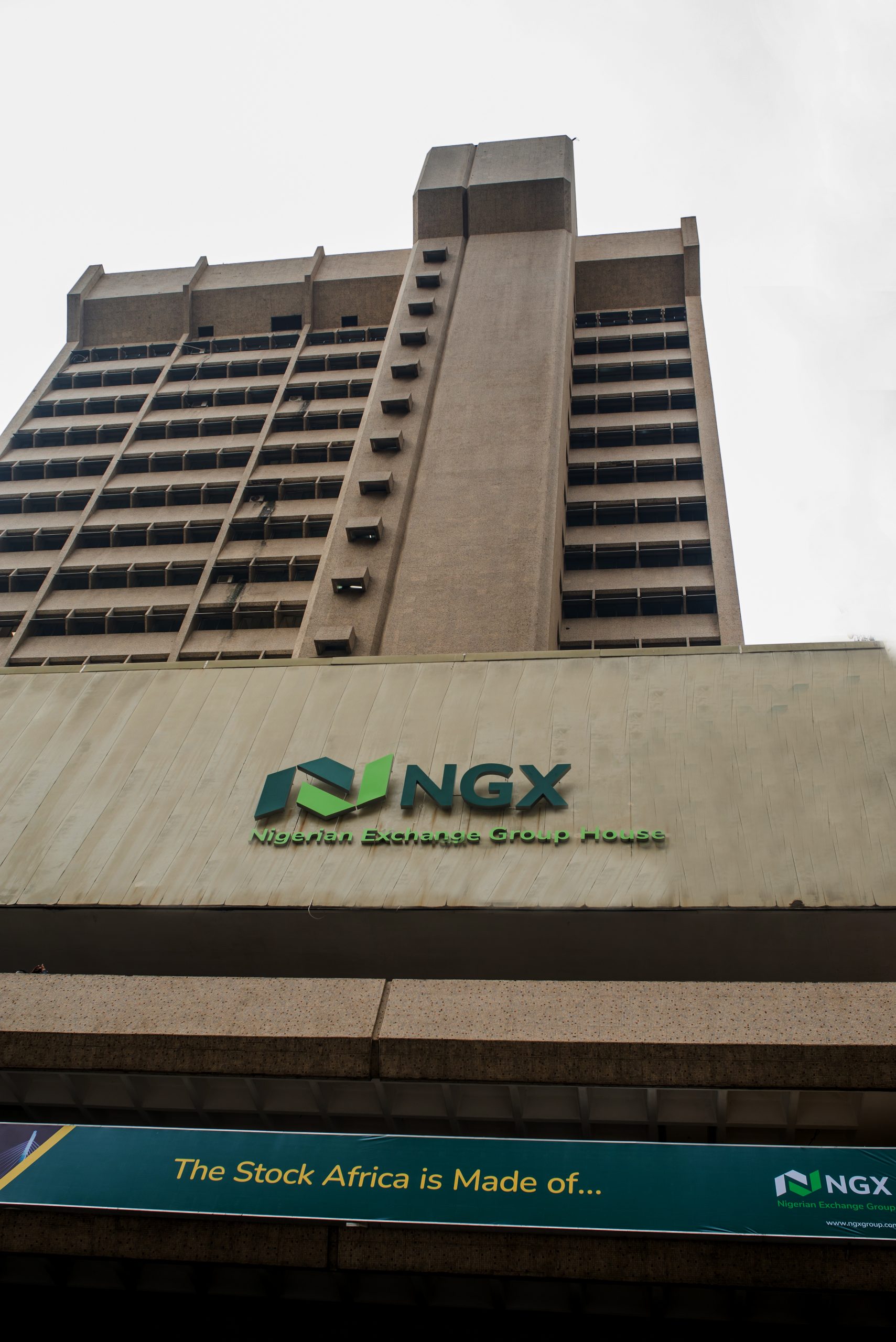
Market Update For November 11, 2026
The Nigerian equities market extended its bearish performance on Wednesday, November 11, 2026, as sustained profit-taking in heavyweight and selected mid-cap stocks eclipsed buying interest in a number of counters. The continued decline reflected growing caution among investors, with selling pressure across key sectors preventing the market from recovering its recent losses.
The session highlighted the growing influence of portfolio repositioning following the significant appreciation recorded in the Nigerian Exchange over the past several months. With the market maintaining a strong year-to-date return, some investors appear increasingly willing to secure accumulated gains, particularly in stocks that have experienced substantial price increases. This shift in trading behaviour has introduced additional volatility into the market, as buying interest becomes more selective and investors reassess their exposure to equities.
The weakness in the market was largely driven by losses across selected banking, consumer goods and industrial stocks. The banking sector remained a major source of downward pressure, as declines in FIRSTHOLDCO, UBA, ACCESSCORP, ZENITHBANK, FIDELITYBK and GTCO reflected continued profit-taking in some of the market’s most actively traded equities. Given the significant contribution of banking stocks to market capitalisation and trading activity, sustained weakness in these counters could continue to influence the direction of the benchmark index.
The consumer goods sector also faced selling pressure, with NASCON and MAYBAKER recording notable declines. The performance of these stocks suggests that investors are becoming more cautious about extending their positions in selected equities following previous price advances. In the industrial segment, the broader weakness in selected counters further reinforced the negative market direction.
However, the downturn was not entirely reflective of a lack of buying interest. Selected equities continued to attract demand, indicating that investors were still identifying opportunities despite the broader market weakness. This divergence in stock performance suggests that market participants are increasingly adopting a stock-specific investment strategy, focusing on company fundamentals, earnings potential, liquidity and prevailing market valuations.
HONYFLOUR was among the notable performers during the session, reaching a new 52-week high of ₦33.00. Its performance points to sustained demand in the stock, even as other equities experienced profit-taking. The development also highlights the importance of identifying companies with positive price momentum and improving market interest in an environment characterised by mixed sectoral performance.
Trading activity moderated during the session, with both volume and value of transactions declining. The reduction in turnover suggests that some investors are taking a more cautious approach rather than aggressively increasing their market exposure. Nevertheless, the substantial volume recorded in selected equities indicates that liquidity remains concentrated in a number of actively traded stocks.
GTCO maintained its position as the leading stock by transaction value, while HONYFLOUR dominated volume transactions. This pattern reflects the continued importance of liquid banking and consumer-related stocks in overall market activity. The concentration of transactions in these counters also suggests that institutional and retail investors remain focused on equities capable of accommodating relatively large trading positions.
The negative market breadth further reinforced the cautious sentiment. Although some stocks recorded impressive gains, the number of declining equities exceeded advancing stocks, indicating that selling pressure was relatively widespread. This is particularly important because market breadth provides an indication of the underlying strength of market movements beyond the performance of the largest listed companies.
The market’s latest decline therefore reflects a combination of profit-taking, selective buying and reduced trading participation. While the broader bullish trend remains supported by the substantial year-to-date appreciation, the market may require renewed demand in heavyweight equities to regain upward momentum.
Technical Analysis and Market Outlook
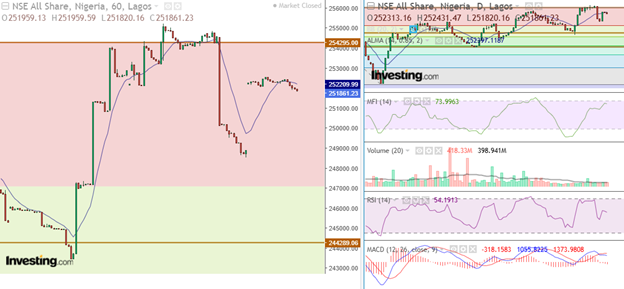
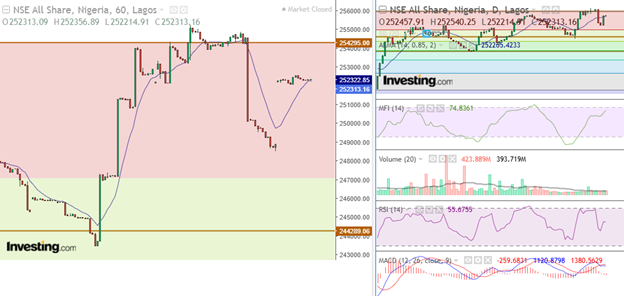
From a technical standpoint, the Nigerian equities market is showing signs of consolidation following its recent upward movement. The inability of the All-Share Index to sustain its position above the 252,000-point region suggests that bullish momentum is weakening, while repeated selling pressure indicates that some investors are becoming increasingly cautious at prevailing price levels.
The current movement also raises the possibility of a short-term correction as the market attempts to establish a stronger support base. Following the significant gains recorded in previous months, some degree of profit-taking is expected, particularly where valuations have moved ahead of near-term earnings expectations.
The 250,000-point psychological level remains a critical support zone to monitor. A sustained hold above this level could encourage bargain hunting, particularly in fundamentally sound equities that have experienced recent price corrections. However, a decisive break below this threshold could expose the market to further downside pressure as short-term traders and momentum-driven investors adjust their positions.
On the upside, the 252,500–254,000-point range represents the immediate resistance area. A recovery above this region, supported by stronger trading volume and improved market breadth, would provide a more convincing indication that buying interest is returning. Such a development could restore confidence and create room for renewed upward movement in the benchmark index.
The direction of the banking sector will also remain important to the market’s overall performance. The sector’s influence on market capitalisation and liquidity means that sustained recovery in major banking stocks could provide the necessary support for a broader market rebound. Conversely, continued selling in these counters may limit the ability of the index to recover meaningfully.
Investors will also be monitoring developments in the consumer goods and industrial sectors, particularly companies with improving earnings prospects, stronger cash flows and sustainable dividend policies. These factors could become increasingly important as market participants shift their attention from price appreciation alone to the underlying financial performance of listed companies.
Market breadth will be another important indicator in the coming sessions. A sustained improvement in advancing stocks would suggest that buying interest is spreading across the market, while persistent negative breadth could signal that the current weakness is becoming more established.
For the next trading session, the outlook remains cautious, with investors likely to maintain selective positions while monitoring the performance of heavyweight stocks and the sustainability of recent price movements. Corporate earnings, dividend expectations, macroeconomic developments and portfolio rebalancing will continue to influence market sentiment.
Nevertheless, the ongoing correction does not necessarily signal the end of the market’s broader bullish trend. Rather, it could represent a period of consolidation following substantial gains. The ability of the market to defend key support levels and attract fresh demand will be important in determining whether the current weakness remains temporary or develops into a deeper correction.
Investors should therefore prioritise fundamentally sound companies with attractive valuations, sustainable earnings, strong balance sheets and positive cash-flow prospects. Although market corrections can create opportunities for long-term investors, disciplined entry points and appropriate risk management remain essential in navigating the current environment.
Oil Market
International crude oil prices recovered by approximately 1% on Wednesday after falling to two-month lows in the previous trading session, as renewed uncertainty surrounding diplomatic engagements between the United States and Iran revived concerns about potential disruptions to global energy supplies.
Brent crude futures advanced by $1.22, representing a 1.3% increase, to $92.71 per barrel, while US West Texas Intermediate crude gained $1.09, or 1.3%, to $87.13 per barrel as of 1412 GMT.
The recovery followed comments from Iran’s security chief indicating that Tehran would not permit enriched nuclear material to leave the country. The position complicated expectations of an immediate diplomatic breakthrough, particularly as Washington maintained that nuclear issues must form part of the initial negotiations aimed at ending the US-Israeli war involving Iran.
Oil prices had initially declined by more than $3 per barrel during the previous session after US officials played down the need for additional military action against Iran. The comments temporarily eased concerns about prolonged supply disruptions in the Middle East, triggering a sell-off in crude futures.
However, prices later recovered some of their losses after an Iranian security official indicated that no negotiations were taking place between the two countries. The conflicting signals have left the market uncertain about the prospects of de-escalation and the potential implications for global oil supplies.
According to UBS analyst Giovanni Staunovo, fading expectations of an immediate de-escalation are providing support for crude prices. This reflects the continued sensitivity of the energy market to geopolitical developments, particularly where they involve major oil-producing regions and critical supply routes.
Beyond geopolitical risks, investors remain concerned about the possibility of oversupply in the global oil market. Expectations surrounding production levels, demand growth and inventory movements will continue to influence price direction, particularly if diplomatic developments reduce the geopolitical risk premium currently embedded in crude prices.
For Nigeria, the recovery in international oil prices could provide some support for government revenue, foreign exchange earnings and the country’s external position. Higher crude prices generally improve export receipts and fiscal prospects, although the actual benefits depend heavily on domestic production volumes, export capacity and the country’s ability to meet its production targets.
However, the relationship between rising crude prices and domestic economic performance remains complex. Higher international oil prices can support government revenue but may also increase domestic energy costs and inflationary pressures, depending on developments in the downstream petroleum market.
Consequently, developments in the global oil market will remain relevant to Nigeria’s macroeconomic outlook, particularly as policymakers continue to balance foreign exchange stability, fiscal revenue, energy costs and domestic investment requirements.
NGX Market Summary
The Nigerian Exchange All-Share Index declined by 451.92 points, representing a loss of 0.18%, to close at 251,861.24 points against 252,313.16 points recorded in the previous session. Market capitalisation shed ₦293.43 billion to settle at ₦163.53 trillion, while the year-to-date return moderated to 61.85%. Trading activity recorded 418.33 million shares valued at ₦22.82 billion in 30,864 deals, with HONYFLOUR accounting for the highest volume of 75.96 million shares, while GTCO led transaction value with ₦4.57 billion. Market breadth remained negative, with 25 advancing stocks against 33 decliners, while 88 equities closed unchanged, reflecting the dominance of selling pressure. Major market movers on the downside included OKOMUOIL (-10.00%), ENAMELWA (-9.96%), NASCON (-8.99%), FIRSTHOLDCO (-3.74%), MAYBAKER (-3.61%), UBA (-2.38%), ACCESSCORP (-1.63%), NEM (-0.52%), ZENITHBANK (-0.52%), FIDELITYBK (-0.40%), GTCO (-0.33%) and TIP (-0.19%). On the positive side, UPL advanced 9.89% to ₦5.00, CAVERTON gained 8.96% to ₦3.65, ABBEYBANK rose 8.66% to ₦6.90, CHAMPION appreciated 8.56% to ₦10.15, while ETI added 6.93% to ₦74.85. The top losers were OKOMUOIL (-10.00%) at ₦1,148.60, ENAMELWA (-9.96%) at ₦33.00, NASCON (-8.99%) at ₦167.00, FTNCOCOA (-8.36%) at ₦6.80 and VFDGROUP (-6.67%) at ₦11.20 each.