

Nigeria’s equity market closed the week in the red, extending its bear-run amid sustained profit-taking in banking, consumer goods and other heavyweight stocks. Although the market recorded losses from Monday to Wednesday, buying interest in selected equities supported a modest recovery in the two sessions that followed.
Weekly Index Performance and Market Capitalisation
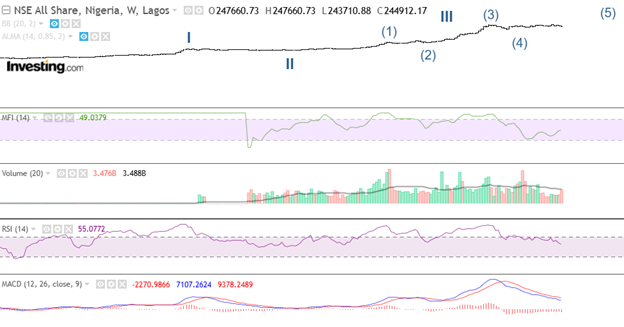
Despite the late-week recovery, the NGX All-Share Index declined by 1.11%, falling from 247,660.74 points recorded on November 20 to 244,912.17 points on November 27. Market capitalisation also decreased by 1.11% to close at ₦159.019tn, reflecting sustained selling pressure across major equities.
Sectoral Performance and Market Breadth
Sectoral performance was largely negative, although the NGX Insurance, NGX MERI Growth and NGX Oil & Gas indices recorded gains of 1.25%, 3.52% and 0.43%, respectively. The NGX Commodity Index remained unchanged. Market breadth weakened during the week, with 27 equities appreciating against 55 decliners. Meanwhile, 64 equities closed unchanged, highlighting the dominance of selling pressure despite the recovery recorded towards the end of the week.
Week-to-date, the All-Share Index has lost 1.11%, NGX 30 has lost 1.13%, the Banking Index has decreased by 0.80%, the Pension Index decreased by 1.33%, the Insurance Index inclined by 1.25%, the Consumer Goods Index decreased by 2.12%. However, the Oil and Gas Index recorded a negative return of 0.43%. Year-to-date, the All-Share Index has gained 57.39%, NGX 30 is up by 58.88%, the Banking Index has increased by 50.51%, the Pension Index increased by 69.97%, the Insurance Index declined by 6.46%, the Consumer Goods Index decreased by 0.83%. However, the Oil and Gas Index recorded a positive return of 114.84%.
Specifically, trading on Monday extended its losing streak as profit-taking in banking and heavyweight stocks dragged the All-Share Index (ASI) down 0.48% to 246,478.90 points. Market capitalisation declined by ₦767.36bn, while year-to-date (YTD) return eased to 58.39%. Market breadth was negative, with 20 gainers against 39 losers. Trading volume increased by 44.32% to 441.07 million shares valued at ₦15.49bn in 38,846 deals. AIICO led trading volume, while GTCO recorded the highest traded value.
On Tuesday, selling pressure persisted, particularly in banking and consumer goods stocks, pushing the ASI down 0.32% to 245,685.87 points. Market capitalisation shed ₦514.91bn, while YTD return moderated to 57.88%. Market breadth recorded 22 gainers against 29 losers. Trading volume rose by 10.96% to 489.44 million shares worth ₦28.18bn in 31,609 deals. AIICO led trading volume, while PRESCO recorded the highest transaction value at ₦6.01bn.
At midweek, the bearish sentiment intensified as sell-offs across major sectors dragged the ASI down 0.69% to 243,995.29 points. Market capitalisation declined by approximately ₦1.10tn, while YTD return fell to 56.80%. Market breadth closed negative, with 24 gainers against 35 losers. Trading volume surged by 236.52% to 1.65 billion shares valued at ₦40.92bn in 29,850 deals. FCMB led trading volume, while FIDELITYBK recorded the highest traded value at ₦13.52bn.
On Thursday, the market staged a modest rebound, ending its seven-session losing streak as gains in banking and oil and gas stocks lifted the ASI by 0.04% to 244,089.47 points. Market capitalisation added ₦61.15bn, while YTD return improved to 56.86%. However, market breadth remained negative, with 21 gainers against 28 losers. Trading volume declined by 6.28% to 1.54 billion shares valued at ₦102.99bn in 29,326 deals. FIRSTHOLDCO dominated trading activity, recording 580.18 million shares worth ₦55.17bn and leading both volume and value.
The last trading session of the week, extended its recovery, advancing by 0.34% to close at 244,912.17 points, supported by gains in banking, oil and gas and insurance stocks. Market capitalisation increased by ₦534.17bn, while YTD return rose to 57.39%. Market breadth turned positive, with 27 gainers against 12 losers. OANDO led the gainers, while MCNICHOLS recorded the biggest decline. Trading volume fell by 69.67% to 468.18 million shares valued at ₦32.15bn in 28,642 deals.
Trading Activity and Sectoral Contribution
Investors traded a total of 4.589 billion shares valued at ₦219.720bn in 158,207 deals during the week, compared with 2.366 billion shares worth ₦106.363bn in 159,759 deals recorded in the previous week. The Financial Services Industry dominated trading activity, accounting for 4.019 billion shares valued at ₦154.850bn in 75,870 deals. The sector contributed 87.57% of total equity turnover volume and 70.48% of transaction value. The Consumer Goods Industry ranked second, recording 163.732 million shares worth ₦9.512bn in 17,412 deals, while the Services Industry occupied third position with 113.047 million shares valued at ₦1.467bn in 8,845 deals.
Most Actively Traded Equities
FCMB Group Plc, First Holdco Plc and Fidelity Bank Plc emerged as the three most actively traded equities by volume. Collectively, they recorded 2.488 billion shares valued at ₦101.307bn in 11,344 deals, representing 54.22% of total trading volume and 46.11% of total transaction value.
Top Price Gainers and Losers
FCMB Holding Plc
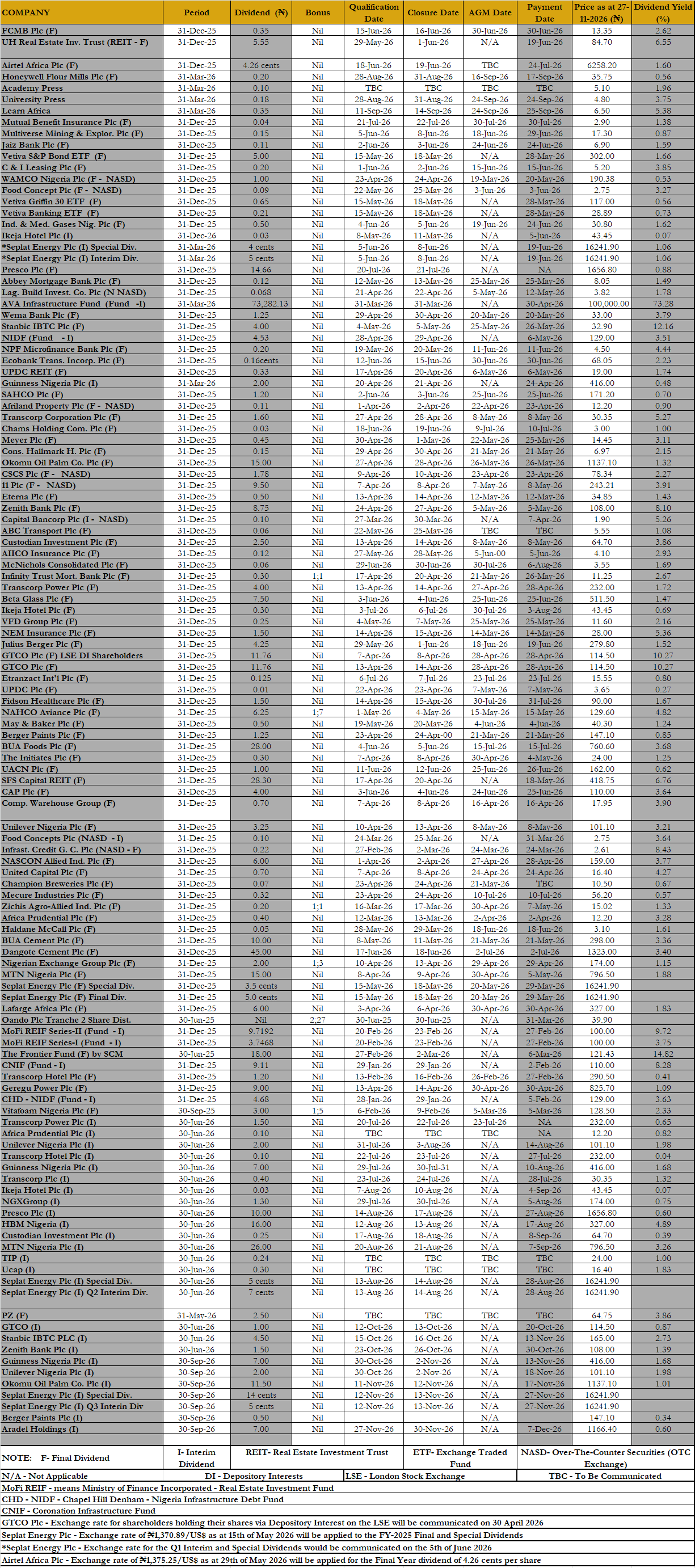
FCMB Group Plc led the gainers, appreciating by 21.92% from an opening price of ₦10.95 to close at ₦13.35, representing a gain of ₦2.40. Cornerstone Plc advanced by 20.00%, rising from ₦5.00 to ₦6.00, with an increase of ₦1.00. Oando Plc gained ₦5.40, or 15.65%, to close at ₦39.90 from ₦34.50. Linkage Assurance Plc rose by 14.38%, moving from ₦1.53 to ₦1.75, a gain of ₦0.22, while Africa Prudential Plc appreciated by 12.96%, advancing from ₦10.80 to ₦12.20, up ₦1.40.
McNichols Consolidated Plc McNichols Consolidated Plc recorded the highest decline, shedding 21.98% from ₦4.55 to ₦3.55, a loss of ₦1.00; Sovereign Trust Insurance Plc fell by 19.53%, dropping from ₦2.56 to ₦2.06, down ₦0.50. Livestock Feeds Plc lost 16.06%, sliding from ₦13.70 to ₦11.50, a loss of ₦2.20. Learn Africa Plc decreased by 15.58%, falling from ₦7.70 to ₦6.50, down ₦1.20, while Fortis Global Insurance Plc lost 13.89%, declining from ₦1.80 to ₦1.55, representing a loss of ₦0.25.
NGX Weekly Comparative Analysis
The Nigerian stock market extended its bearish run in the week ended November 27, 2026, as the NGX All-Share Index (ASI) declined by 1.11% to 244,912.17 points, compared with a 1.83% loss in the previous week. Market capitalisation fell by 1.11% to ₦159.019tn from ₦160.804tn, while year-to-date (YTD) return eased to 57.39% from 59.15% a week earlier.
Trading activity improved significantly, with 4.589 billion shares valued at ₦219.720bn traded in 158,207 deals, compared with 2.366 billion shares worth ₦106.363bn in 159,759 deals previously. Trading volume and value increased by 94.00% and 106.57%, respectively, while the number of deals declined slightly by 0.97%.
Market breadth weakened, with 27 gainers against 55 losers, compared with 39 gainers and 43 losers in the preceding week. The Financial Services sector dominated trading, accounting for 87.57% of total volume and 70.48% of transaction value. Overall, the market’s decline moderated from the previous week, supported by a late-week recovery. However, the broader negative market breadth and continued profit-taking indicate that investor sentiment remains cautious.
Technical Analysis View
The Nigerian equities market remained under bearish pressure during the week, with the NGX All-Share Index shedding 1.11% to close at 244,912.17 points. The index extended its losses early in the week before recovering slightly on Thursday and Friday. This late-week rebound could not sufficiently offset the earlier declines. The 244,000-point region remains an important support level, while the 246,000–248,000-point range represents immediate resistance. Sustained buying interest will be necessary to push the index above this resistance zone and strengthen recovery prospects.
Market Outlook
The market is expected to remain cautious in the coming week as investors balance bargain-hunting opportunities against continued profit-taking. Banking and other heavyweight stocks are likely to influence market direction, going forward, while improved buying interest could support a possible but gradual recovery. Overall, sentiment may remain mixed, with investors expected to focus on fundamentally sound stocks and attractive valuations. A sustained break above the immediate resistance zone could improve the market outlook, while renewed selling pressure may expose the index to further declines.
Trending in the Economy: Nigeria’s Central Bank has retained its benchmark interest rate at 23% to sustain efforts to curb inflation and stabilise prices. The decision follows a decline in headline inflation to 14.06% in October from 14.63% in September, although rising energy costs and election-related spending remain potential risks.
Nigeria’s oil revenue fell 15.45% to ₦7.88 trillion in H1 2026, from ₦9.32 trillion a year earlier, despite a 41.23% rise in crude oil prices. Revenue also missed the ₦18.65 trillion target by ₦10.78 trillion, due to production challenges, oil theft, pipeline vandalism and insecurity.
Global Market and Oil: Global equities rebounded on Friday, November 28, as Chinese stocks recovered from a one-year low and US and European markets posted gains ahead of the weekend. Japan’s Nikkei 225 advanced 2.1%, while MSCI’s Asia-Pacific index excluding Japan rose 1.8%. European stocks gained 1%, extending Thursday’s advance. In the US, the Nasdaq Composite climbed 1.5%, while the S&P 500 added 1.1% at the opening of a shortened trading session following Thanksgiving.
The recovery provided some relief after a volatile November, particularly for technology stocks. South Korea’s Kospi has lost 14% this month, Japan’s Nikkei 9%, the Nasdaq Composite 6%, while the STOXX 600 declined by less than 1%. MSCI’s All-Country World Index was also down approximately 5% for the month. The Nasdaq 100 traded about 20% below its October record high on Wednesday before recovering later in the session.
China’s CSI 300 surged 4.2% after touching its lowest level since June 2025. The rally followed fresh government support for capital markets, including calls for greater participation by state-backed institutional investors, popularly known as the national team. Concerns over the sustainability of artificial intelligence valuations and future corporate earnings have contributed to recent market volatility. Nvidia remained a major source of investor uncertainty following developments surrounding its leadership. The company’s shares surged 31% after Jensen Huang’s return on Monday but remained down 27% for November. The $3.6 trillion chipmaker also faced pressure after S&P placed its credit rating on watch for a possible downgrade.
Despite Friday’s recovery, analysts cautioned that the rebound might not signal a sustained market turnaround. Shane Oliver, chief economist at AMP, warned that the risk of a deeper correction over the next six months remained high, despite resilient US economic growth, strong corporate earnings and the historically favourable seasonal performance of equities in December.
In the fixed-income market, US Treasury yields moved higher as investors shifted back towards equities. The benchmark 10-year Treasury yield rose five basis points to 4.90%, leaving it broadly flat for the week following a sharp decline the previous week. Bond yields move inversely to prices.
The US dollar was largely unchanged on Friday but remained on course for a third consecutive monthly gain, taking it to its highest level since March 2025. Expectations surrounding a possible Federal Reserve rate increase in December and demand for safe-haven assets supported the currency. Futures markets indicated a 99% probability of a December rate increase, although expectations of a 50-basis-point hike had weakened. Investors remained cautious about the possibility of further monetary tightening if economic growth and inflation stayed firm.
In Europe, the euro was little changed following news that former Spanish central bank governor Pablo Hernández de Cos would become the next president of the European Central Bank, a development largely viewed as supportive of policy continuity. European government bond yields edged higher.
Meanwhile, oil prices were heading for their first weekly gain in four weeks amid renewed concerns over potential supply disruptions. Brent crude futures briefly climbed to $98 per barrel, their highest level in more than two weeks, before retreating to around $95. Despite the recovery, Brent remained approximately 19% lower for November.
Global Market Outlook:
The world equity markets may experience a gradual recovery in the coming weeks, supported by bargain hunting and renewed buying interest in technology stocks. However, volatility is likely to persist as investors assess AI valuations, corporate earnings prospects and the direction of US monetary policy. The Federal Reserve’s expected December rate increase, elevated Treasury yields and a stronger dollar could limit further gains, particularly in growth stocks. Meanwhile, Chinese government support may provide additional impetus to Asian equities, while oil prices will remain sensitive to geopolitical developments and supply disruptions. Overall, market sentiment is likely to remain cautious as investors monitor inflation data, central bank decisions and corporate earnings for clearer direction.