
Quarter Under Preview: 12 MONTHS Unaudited 2025
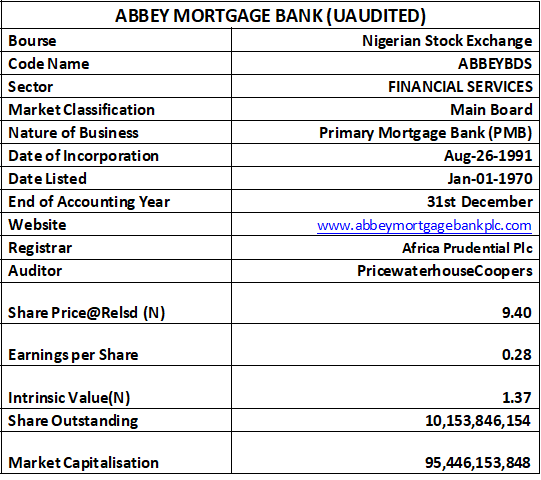
Current Share Price: N10.30
Price At Release Date: N9.40
Latest Final Dividend: N0.06
Latest Interim Dividend:
Estimated Beta Value: 0.38x
Estimated Intrinsic Value: N1.37
Rating: Hold
Analyst: Jeariogbe Tunde Segun
The Bank
The bank was incorporated in Nigeria as a private limited liability company on August 26, 1991, obtained its license to operate as a mortgage bank on 20 January 1992, and commenced operation on March 11, 1992. It converted to a public limited liability company 15 years later in September 2007. On October 21, 2008, it became officially listed on the Nigerian Stock Exchange. Following the approval of the Central Bank of Nigeria (CBN), the Bank changed its name from Abbey Building Society Plc to Abbey Mortgage Bank Plc on January 16, 2014.
The company focus on helping individuals and businesses with housing finance and mortgage products. Over the years, it has expanded into broader retail and investment banking.
Today, Abbey Mortgage Bank offers a wide range of services, including; Mortgage loans, savings, current, and fixed deposit accounts, digital banking services, financial advisory services, and retail and investment banking products. Abbey bank also specialized in loans, including financing for women-owned real estate ventures.
A Review Of The Unaudited 2025 Full Year Performance
Judging from its recent past, the bank is expected to release its audited full year performance indices towards the end of March. Nevertheless, we have compared the unaudited 2025 full-year numbers released in January with that of the previous year. Abbey Mortgage reported a N20.016 billion Gross Earnings, against the N12.433 billion of the corresponding period of 2024. Of this amount, Interest Income contributed the lion’s share at N18.976 billion, compared to the N11.954 billion announced in the 20024 full-year. Interest Expenses amounted to N13.914 billion, versus N8.557 billion in the prior year, leaving a Net Interest Income of N5.061 billion, versus N3.396 billion estimate of 2024.
Operating Expenses for the period was valued at N2.760 billion, a 17.79% increase from the previous N2.343 billion, Profit before Tax stood at N3.060 billion higher than the N1.228 billion achieved in the previous year. Total Tax Expenses reported is N180.59 million, slightly above the N160.75 million of last year. Profit for the year is estimated at N2.880 billion, versus N1.068 billion. See the table below for details:
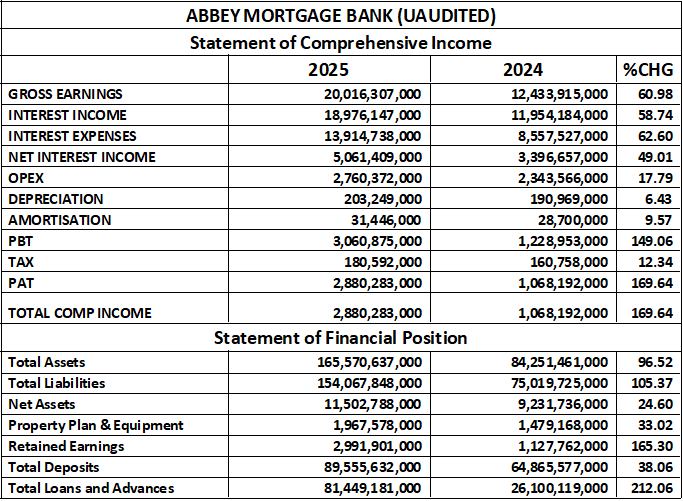
At the end of the 2025 business session, Total Assets of Abbey Mortgage Bank was valued at N165.570 billion, a 96.52% growth over the N84.251 billion estimated in 2024. Total Liabilities on the other hand is N154.067 billion against N75.019 billion, Net Assets estimate stood at N11.502 billion, higher than the N9.231 billion in the corresponding year.
Retained Earnings improved by a significant 165.30% to N2.991 billion, from N1.127 billion. Total Deposits received is N89.555 billion from the previous N64.865 billion, while Total Loans and Advances through the financial year amounted to N81.449 billion, from N26.100 billion. See the table above for details.
Financial Strength/Solvency Ratios
- Debt Ratio shows the percentage of total assets financed by liabilities. At 93.05%, the bank is highly leveraged, meaning the bulk of its assets are funded by debt (which is typical of banks due to the fact that deposits are classified as liabilities). However, the increase from 89.04% to 93.05% suggests a higher reliance on borrowed funds and customer deposits, just as the increased financial leverage also shows a slightly higher solvency risk, compared to the scenario in 2024.
It is important to understand that for a Mortgage bank, a high leverage is normal. However, such upward movement should be monitored carefully.
- Total Debt to Equity Ratio: The change seen in this ratio is a significant jump. For every N1 of equity in 2025, the bank carries N13.39 in debt compared to N8.13 in 2024. This is a very sharp increase in leverage, with such implications as: aggressive assets exploitation, equity growth did not keep pace with its debt counterpart, just as it also shows a higher sensitivity to interest rate or asset quality shocks. This level of increase of almost 65% is material and suggests the bank’s 2025 expansion was heavily debt-driven.
- Equity Ratio shows a drop of 36.60%, confirming what we saw earlier. The equity ratio shows a percentage of assets financed by shareholders’ funds. Thus, a drop from 10.96% to 6.95% means: The capital buffer of Abbey Mortgage Bank has thinned, shareholders’ cushion against losses has reduced, and as such financial flexibility has weakened. This is the most concerning movement within the solvency group.
- Beta Value: A beta value of 0.38x suggests: Low volatility relative to the market, and that the stock moves less aggressively relative to the overall market. Investors may see this stock as relatively defensive. However, a low Beta does not eliminate balance sheet risk, it only reflects market price behaviour.
Overall Financial Strength Verdict: The ratios show a strong asset base growth, which was funded primarily through increased leverage. It shows that the capital buffer weakened significantly, while risk profile increased year-on-year.
As noted above, for a mortgage bank, a high leverage is normal, but the speed of such leverage expansion in 2025 is the key concern.

Profitability Ratios
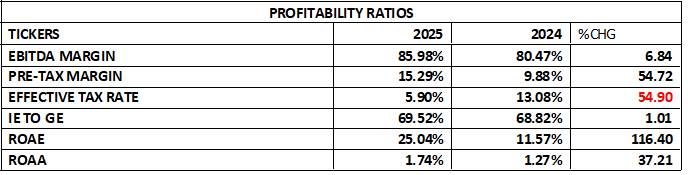
- EBITDA Margin: An EBITDA Margin of 85.98% is very high, which is typical of financial institutions, since operating cost structures differ from manufacturing firms. The increase suggests: a strong revenue growth relative to operating costs, good cost discipline, and improved operating efficiency. It is important to note that this is a positive signal.
- Pre-Tax Margin: This is another major improvement as the bank significantly improved its profit before tax. A 54% jump indicates: high interest income, or improved asset yields, better spread management, and possibly improved non-interest income. This also suggests that the 2025 expansion translated to stronger earnings, which partly explains the aggressive leverage we saw earlier.
- Interest Expense to Gross Earnings Ratio: Interest cost remains high and slightly increased. This aligns with the sharp rise in leverage. The bank is: funding growth through deposits and borrowings, and paying more in funding costs. Though the increase is marginal. At nearly 70%, interest expense consumes a large portion of earnings. Yes, it’s typical of banks, efficiency of funding mix remains critical.
- Return on Average Equity: The over 100% change is very strong. ROAE more than doubled. However, we must interpret this carefully, since equity ratio fell significantly, the thinner capital base mechanically boosts ROE. So, we can say, the strong ROE is partly genuine profit growth, but amplified by higher leverage. Please understand that, high ROE with falling equity ratio confirms leverage-driven profit expansion.
- Return on Average Assets is a cleaner profitability indicator since it is less distorted by leverage. The improvement from 1.27% to 1.74% suggests: A better asset yield, improved operational efficiency, and strong core profitability. This confirms that earnings growth was not purely leverage driven, just as operational performance also improved though slightly.
Overall Profitability Verdict: The 2025 performance shows a very strong profit rebound, while the aggressive balance sheet expansion seemingly translates to higher earnings. However, the quality of earnings depends on: sustainability of low tax rate, stability of funding costs, and asset quality.
Efficiency Ratios
- Operating Expenses to Gross Earnings: This ratio shows a drop of 26.83%, which in our opinion is a strong improvement. The bank reduced operating cost intensity significantly indicative of: better cost control, improved operational leverage, and revenue growth outpacing cost growth. This aligns with the improved EBITDA margin we analyze earlier.
- Gross Earnings to Total Assets: This ratio declined by 18.08%, meaning that asset productivity slightly weakened, as the bank generated less income per Naira of assets in 2025, compared to 2024. Possible reasons include: rapid asset growth (that is: denominator expands faster than income), lower yield assets added to balance sheet, and more liquidity or conservative asset allocation. This ties back to the aggressive leverage expansion. Assets grew quickly, but earnings yield did not scale proportionately. We recommend that this is something the management should monitor keenly.
- Loan-to-Deposit Ratio: The increase of 126.03% is a dramatic shift. In 2024 the bank was conservative, only about 40% of deposits were deployed as loans. But in 2025, deposits are now actively deployed, as asset utilization improved significantly, and the bank is taking more credit exposure. In our opinion, A Loan-to-Deposit ratio of around 90% is aggressive, but not extreme for a mortgage focused bank. However, this speed of increase is quite significant.
Overall Efficiency Verdict: The efficiency picture shows that 2025 was an expansion year as seen in the higher deployment of funds, improved cost management, plus a strong operational leverage. On the other hand, it is important to point out the higher balance sheet risk and the more aggressive loan book positioning.

Investment Ratios
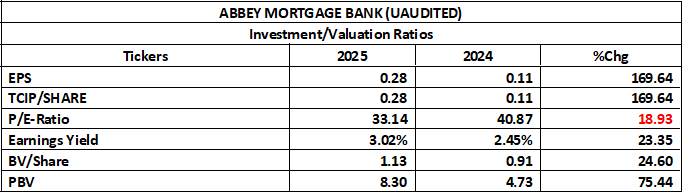
- Earnings Per Share: The increase of 169.64% is a massive improvement. EPS almost tripled, reflecting; strong net profit growth, and higher profitability, translating to shareholders. On the negative side, this is supported by thinner equity base leverage effect.
- P/E-Ratio: The ratio declined, suggesting that: Earnings grew faster than share price. However, 33xP/E is still very high for a mortgage bank in Nigeria, as it implies: that the market is pricing in the stock’s future growth, or its price is stretched relative to fundamentals.
- Earnings Yield: Earnings yield improved but remains low. At 3.02%, investors are earning roughly 3% on current earnings. This is relatively modest, compared to its fixed income alternatives in Nigeria, suggesting that valuation is still premium, just as market expectations are extremely high.
- Book Value per Share: As shown in the table below, Book Value increased positively. This means that, retained earnings improved, and shareholders equity grew in absolute terms. But the same grew slower than liabilities as earlier shown in equity ratio decline.
Overall Conclusion:
2025 was clearly a year of aggressive expansion and profitability year for Abbey Mortgage Bank. The bank leveraged up significantly, deployed deposits aggressively, improved margins, and delivered strong EPS growth. However, capital adequacy weakened, risk profile increased, and valuation is premium and leaves little margin for error.
In our opinion, if 2026 delivers sustained earnings growth without further weakening capital ratios, valuation may be justified. But if, on the contrary, asset quality deteriorates or earnings normalize, downside risk exists. On the strength of the observed ratios, we rate Abbey Mortgage Bank a Hold.