
Period Under Preview: FULL YEAR 2025
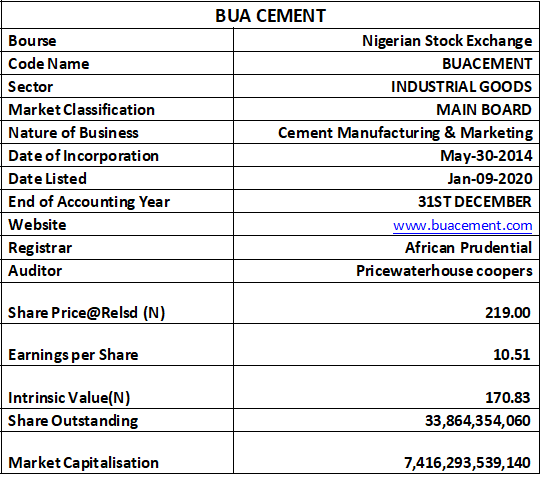
Current Share Price: N247.30
Price At Release Date: N219.00
Latest Final Dividend: N10.00
Latest Interim Dividend:
Estimated Beta Value: 0.11x
Estimated Intrinsic Value: N170.83
Rating: Buy (Long-Term View)
Analyst: Jeariogbe Tunde Segun
The Company
BUA Cement Plc was incorporated as a private limited liability company on May 30, 2014 and commenced operations in August 2015. It was re-registered as a public limited liability company almost four years later on May 16, 2019. Following the successful completion of a business combination with the defunct Cement Company of Northern Nigeria Plc (CCNN) through a scheme of merger concluded on December 23, 2019, the company was listed on the Nigerian Exchange Limited on January 9, 2020. It operates two major cement complexes in Nigeria: Obu Plant in Edo State with capacity of about 9 million tonnes per year; and the 8 million tonnes per year Sokoto Plant at Kalambaina, making a combined capacity of roughly 17 million metric tonnes per year.
The company’s key business strength are: the presence of large limestone depots near its plants, an integrated power and logistics system, and strong demand from Nigeria’s construction and infrastructure sector. Its principal activities are the manufacture, sale, and distribution of cement and related products in Nigeria and international markets.
As of the date of this report, the company’s market capitalization stands at approximately ₦6.05 trillion.
The Released Numbers
According to the full year 2025 business performance presented, the management of BUA Cement announced a Turnover of N1.179 trillion over the previous year’s N879.469 billion. Despite this large improvement, Direct Cost of Sales dropped marginally to N575.263 billion from N576.212 billion announced in the previous full-year. Operating Profit is valued at N504.554 billion from N144.294 billion, while Operating Expenses less Depreciation and Amortisation stood at N91.436 billion versus N64.920 billion in the previous year. Finance Cost stood at N56.288 billion from N60.041 of comparable year, while Net Finance Cost remained negative at N39.278 billion, from N41.851 billion.
Profit before Tax estimate is NN465.276 billion against N99.630 billion. Tax Expenses through the year is N109.237 billion versus N25.720 billion, leaving Profit for the year at N356.038 billion, significantly outpacing the N73.909 billion of the corresponding year by 381.72%. Total Comprehensive Income amounted to N353.773 billion versus N71.052 billion. See the table below for details:
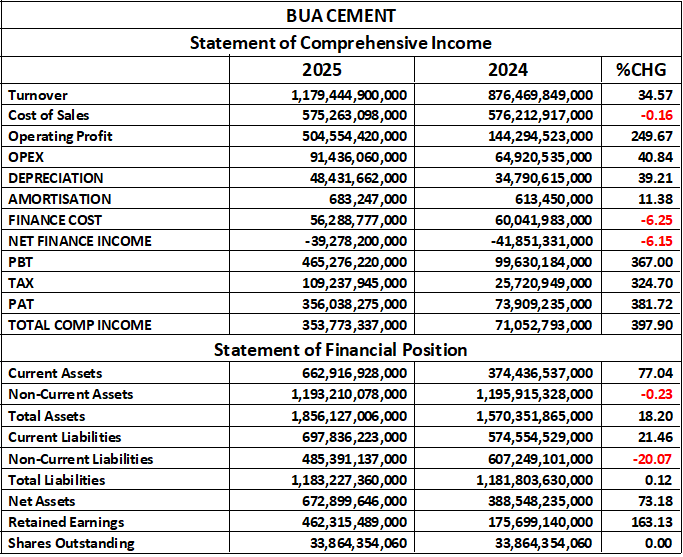
At the end of the 2025 business year, the Current Asset of BUA Cement was valued at N662.916 billion against N374.436 billion in the prior year, while Non-Current Asset stood at N1.193 trillion, representing a marginal drop from the N1.195 trillion of last year. Consequently, Total Asset amounted to N1.856 trillion against the previous N1.570 trillion. On the other hand, Current Liabilities at the end of the year is N697.836 billion, compared to N574.554 billion of the previous year, just as Non-Current Liabilities is N485.391 billion versus N607.249 billion. Thus, Total Liability stood at N1.183 trillion versus N1.181 trillion of last year. Net Assets, therefore came to N672.899 billion, up from N388.548 billion, and Retained Earnings value is N462.315 billion versus N175.699 billion. See the table above for details..
Financial Strength
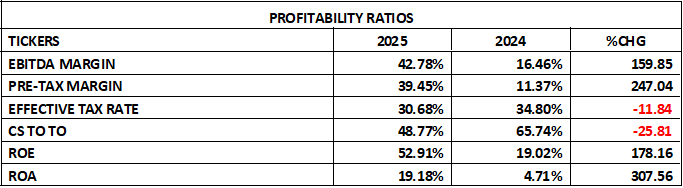
- Debt Ratio showed a decline of 15.29%, an indication that BUA Cement reduced its reliance on borrowed funds for its operations. This is a positive development because: the company now finances more of its assets internally, while financial risk has reduced significantly, a situation that improves long-term solvency and resilience in the event of an economic shock. That notwithstanding, however, 63.75% is still relatively high as it shows debt still finances a significant portion of the company’s assets.
- Total Debt to Equity Ratio shows how much debt exists relative to shareholder’s fund. The drop seen from 304% to 176% is a very significant improvement as it means that for every N1 of equity, the company previously had N3.03 debt, which has now reduced to N1.76 per every N1 equity. It also confirms the board and management’s aggressive debt reduction drive, in addition to a stronger balance sheet, and lower financial pressure from lenders. For capital-intensive industries like cement manufacturers debt is common, but this improvement recorded by BUA Cement is very encouraging.
- Equity Ratio: This is the ratio that shows the proportion of assets financed by shareholders’ fund. The rise from 24.74% to 36.25% tells us that: shareholders now finance a larger portion of the company assets than before, financial stability has improved, and the company now boasts of stronger capital base, which is a major solvency improvement.
- Beta Value measures the volatility of a stock compared to the overall market. Therefore, at beta of 0.11, the stock is very stable, moves much less than the market, and is suitable for risk-averse investors. However, low beta stocks sometimes move slowly even when the market rallies.
Overall Financial Strength Verdict: BUA Cement’s solvency position improved significantly in 2025. That is: the company is moving towards a healthier capital structure, though debt levels remain typical for a player in the capital-intensive cement industry. But it is relatively high. We therefore conclude that BUA Cement’s financial strength is improving.
Profitability Ratios
This ratio evaluates how efficiently the company converts revenue into profit and how well it rewards shareholders.
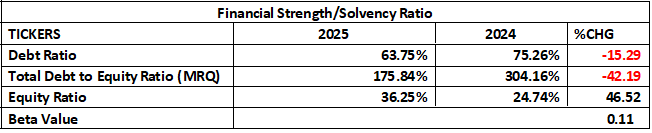
- EBITDA Margin: This ratio shows a growth of 159.85%, a very significant improvement over the level of previous year. The jump from 16.46% to 42.78% suggest: a strong revenue growth, improved cost control, better operational efficiency, and possible improvement in cement pricing. It is, however, important to noted that for a cement company, a margin above 40% is extremely strong.
- Pre-Tax Margin: This margin also revealed a jump of 247.004%, which is one of the most dramatic improvements in the report and means that out of every N100 revenue, BUA Cement now keeps about N39.45 before tax. Before now the company kept N11.37. Possible factors responsible for this move include: higher cement demand, price adjustment in the market, lower production costs relative to revenue growth, and better debt cost management. This is a strong earnings recovery and expansion for BUA Cement
- Cost of Sales to Turnover: This shows a drop in expenses to turnover of 25.81% and represents a major efficiency gain and tells us that in 2024, about 66% of revenue went into production cost, but in 2025, cost of sales gulped only 49% of revenue. This suggests: lower production cost relative to revenue, improved manufacturing efficiency, and better economies of scale. It is expected that, lower cost ratio directly boosts profit margins.
- Return on Equity-ROE: This ratio shows an exceptionally strong stance, as it grows over the previous year by 178.16%. Please understand that a 52.9% ROE means that every N1 invested by shareholders generated N0.53 profit. In our opinion, anything above 20% is usually considered excellent. As such, 52% is outstanding.
- Return on Assets-ROA: At 19.18% the performance on this ratio surpassed that of last year by a whooping 307.56%, this is very commendable. The improvement indicates; better asset utilization, higher productivity of plant and equipment, and strong revenue growth relative to asset base.
Overall Profitability Verdict: The above ratios show that BUA Cement’s profitability improved dramatically in 2025. We observed, massive improvement in operating margin, strong increase in pre-tax profitability, significant cost efficiency gains, and exceptional ROE and ROA growth. This suggests that the company experienced a very strong earnings rebound and operational efficiency improvement.
Efficiency Ratio
- Operating Expenses to Turnover: This ratio shows the proportion of revenue consumed by operating expenses such as administration, marketing, and distribution, plus general expenses. The slight increase of 4.66% tells us that: the company spent a little more on operating expenses activities this year relative to revenue. However, the increase is very small and still within a healthy range. Possible reasons are: expansion activities, distribution network growth, and inflation in administrative costs. But overall, the company maintains a strong cost discipline.
- Turnover to Total Assets: This ratio measures how efficiently the company uses its assets to generate revenue. The increase of 13.85% between the two compared years indicates that assets are being utilized more productively, it also signifies that: every N1 of assets now generates N0.64 revenue, compared to N0.56 previously generated. This improvement suggests: better utilization of cement plants and equipment, higher production capacity usage, and stronger demand for cement.
Overall Efficiency Verdict: BUA Cement demonstrates good operational efficiency; operating cost remain very well controlled, asset productivity improved significantly, and revenue generation from assets strengthened. The company appears to be scaling production efficiently while maintaining cost discipline.

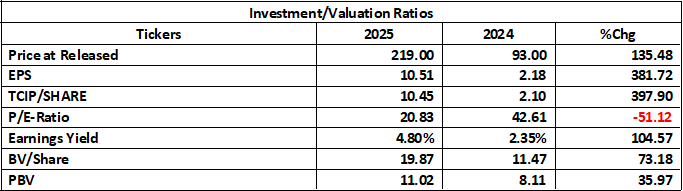
- Share price at Release Date: Records shows that the price of BUA Cement moved from N93.00 of last year to N219 as at the time the result was made available to the investing public. Thus, the share price more than doubled within the year. This sharp increase reflects; strong investor confidence in the stock, significant earnings growth, and strong demand for the stock in the market. However, such a rapid price increase also means investors must examine valuation carefully to ensure the stock is not overpriced.
- Earnings per Share-EPS: The Ratio shows a growth of 381.72% when compared to the previous year estimate. This is an extraordinary earnings improvement. EPS increased almost five times meaning that the company generated significantly higher profits for each unit of shares. As noted above, likely drivers include: higher cement sales, price increase in the market, lower cost structure, and strong operational efficiency. For investors, rising EPS directly increases shareholders’ value.
- Total Comprehensive Income per Share: This ratio also grew by an outstanding 397.90%, reflecting strong cash earnings performance per share. It also indicates that the cash-generating capacity of the company improved significantly, thereby strengthening its dividend paying ability and financial sustainability.
- Price Earnings Ratio-PE/Ratio: The PE/Ratio dropped significantly despite the sharp increase in share price. This means, earnings grew much faster than the stock price, it also indicates that the stock became cheaper relative to its earnings.
- Earnings Yield: This ratio increased over the previous year by 104.57%, this increase means: investors now earn more profit relative to the share price, and the stock is offering a better value. Note that this is a positive signal for long-term investors.
- Book Value per Share: Though the Book Value is small relative to the share price, the increase of 73.18% increase over the previous year shows an expansion of shareholders’ equity, confirmed retained earnings growth, and confirms the stronger balance sheet. This means the intrinsic value of the company is rising.
- Price to Book Value: The ratio shows that the market values the company far above its book value. A price to book value of 10 indicates: strong investor confidence, high growth expectations, and premium market valuation. However, it also suggests the stock is not cheap relative to assets.
Overall Investment Verdict: BUA Cement shows very strong investment fundamentals; massive EPS growth, rising book value, improved earnings yield, and lower P/E ratio despite price surge. However, price to book value indicates premium valuation, meaning the market already prices in strong future expectations.
Dividend Ratios
- Total Dividend: The management proposed a dividend of N10.00 against the N2.05 of the previous year, an increase of 387.80%. The dividend increase reflects: massive profit growth, strong cash generation, and management confidence in earnings sustainability. It also shows the company is rewarding shareholders generously after a strong performance year.
- Dividend Payout Ratio: The Ratio shows how much of earnings is paid out as dividends. A payout ratio of 95% means the company distributes almost all its profits to shareholders. This is very attractive for income investors, and it is a strong shareholders reward policy. However, very high payout leaves little retained earnings for reinvestment and expansions.
- Dividend Yield: Dividend yield more that doubled, meaning investors now earn higher cash return relative to the share price. This makes BUA Cement appealing to dividend investors and long-term institutional investors.
- Sustainable Growth Rate: The improvement in this ratio means: the company can now sustain higher internal growth, and that profitability improvements support expansion potential. However, the very high payout ratio limits long-term reinvestment capacity.

Final Verdict: our Recommendation for BUA Cement is a Buy, as we rate it a strong company. Our reasons are: explosive earnings growth, excellent profit margins, improving balance sheet, strong dividend payout, and efficient asset utilization. Please note that; key risk remains, high valuation multiples and payout ratio, these two factors could limit future flexibility if not properly attended.’