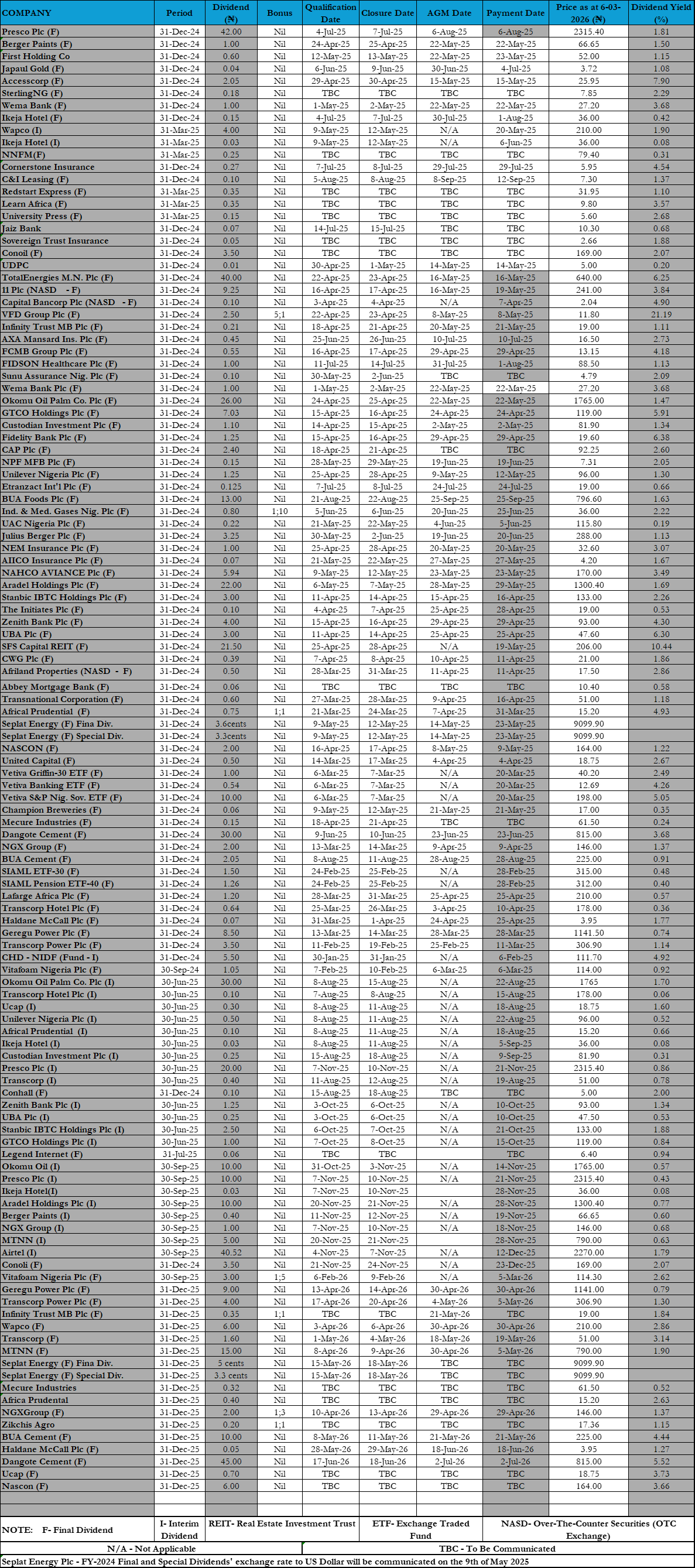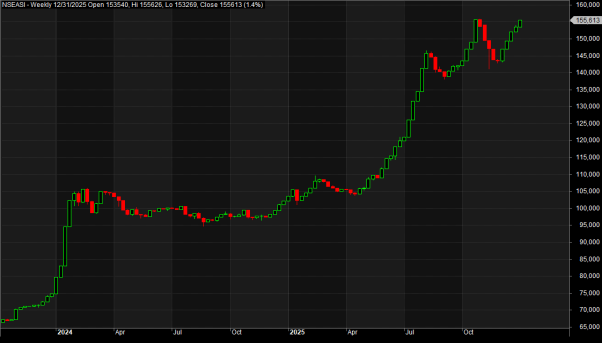

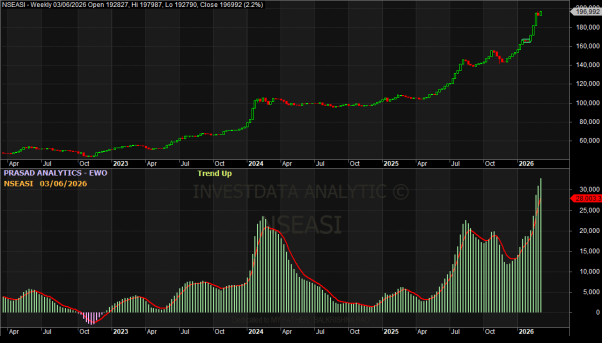
The first full trading week in the month of March on the Nigerian equities’ market closed positive, reversing previous week’s loss on the back of impressive audited accounts receivd from some blue-chip companies, especially those who rewarded their investors handsomely for the 2025 full-year. This very much expected given that the strong corporate earnings and dividend growth transcend market cycle and support price movement.
Historically, companies that consistently pay and increase dividends have delivered strong long-term returns, often with less volatility than the broader market. So, focus on companies with these qualities, established and resilient business models, reliable cash flow generation, disciplined capital allocation and management teams committed to returning capital.
NGXASI Daily Index Action
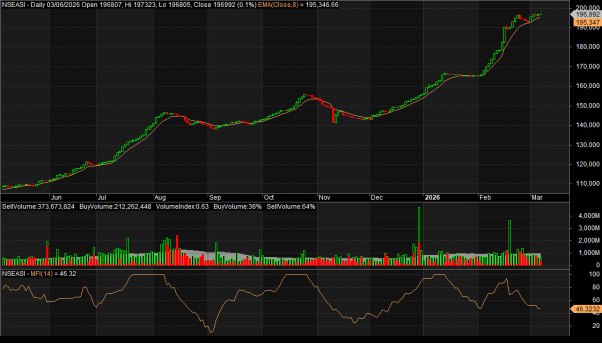
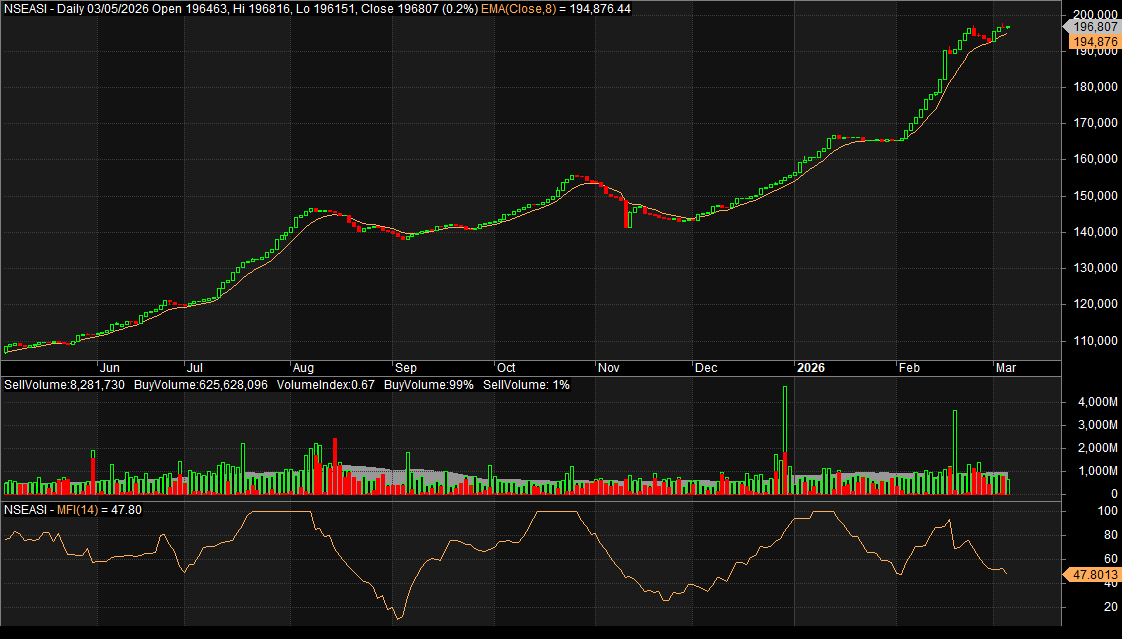
Trading on the Nigerian Exchange opened the week on a positive note as the benchmark index gained 1.39% on Monday when the All-Share Index (ASI) rose to 195,514.00 points from 192,826.78 points, while market capitalisation added ₦1.72 trillion to close at ₦125.49 trillion. Year-to-date return improved to 25.64% that day, while market sentiment was neutral with 31 gainers and 31 losers. Nigerian Exchange Group led the advancers, while Custodian Investment Plc topped the laggards. Aradel Holdings Plc, while PZ Cussons Nigeria Plc and FTN Insurance Company Plc traded above their 52-week highs. Trading activity, however, softened, with volume dropping 4.12% to 789.85 million shares worth ₦35.08 billion in 84,259 deals.
The market extended its bull-run on Tuesday when the ASI rose 0.57% to 196,621.96 points, lifting market capitalisation by ₦710.97 billion to ₦126.20 trillion and pushing year-to-date return to 26.35%. Breadth was positive with 39 gainers and 35 losers, led by UACN Plc and SUNU Assurances Nigeria Plc, while FIDSON Healthcare Plc topped the losers. UACN Plc, FTN Insurance and Aradel also traded above their 52-week highs. Trading activity strengthened as 880.01 million shares worth ₦44.51 billion were exchanged.
By midweek, the composite NGXASI slipped by a marginal 0.08% to 196,463.22 points, halting the rebound, just as market capitalisation dropped by ₦101.80 billion to ₦126.10 trillion. Year-to-date return eased to 26.25%. Market breadth turned negative, recording 37 losers against 22 gainers, with PREMPAINTS leading advancers and Dangote Sugar Refinery Plc and Jaiz Bank Plc among the biggest losers. Trading remained strong at 880.01 million shares valued at ₦44.51 billion.
The market retraced up on Thursday, with ASI rising 0.18% to 196,807.15 points and market capitalisation increasing by ₦220.75 billion to ₦126.32 trillion. Year-to-date return improved to 26.47%. However, market breadth stayed negative with 38 losers and 32 gainers, led by ETERNA Plc and Nigeria Police Microfinance Bank, while Tripple Gee & Company Plc topped the decliners. Trading volume fell to 634.01 million shares worth ₦29.11 billion.
The mixed sentiment was extended at the last trading session of week, with the benchmark NGXASI recording a marginal gain of 0.08% to 196,968.15 points, pushing market capitalisation to ₦126.44 trillion and year-to-date return to 26.58%. Breadth was slightly positive with 35 gainers and 33 losers, led by ETERNA, while Royal Exchange Plc was among the worst performers. PREMPAINTS, FTN Insurance and Custodian Investment Plc traded above 52-week highs. Trading activity slowed, with 586.16 million shares valued at ₦30.64 billion.
The week’s total transactions stood at 3.695 billion shares worth ₦177.69 billion, down from 5.494 billion shares valued at ₦196.71 billion last week. Financial services dominated activities with 2.44 billion shares worth ₦72.03 billion, representing 66.14% of volume and 40.54% of value. The oil and gas sector followed with 326.07 million shares worth ₦39.51 billion, while services recorded 218.37 million shares worth ₦2.01 billion.
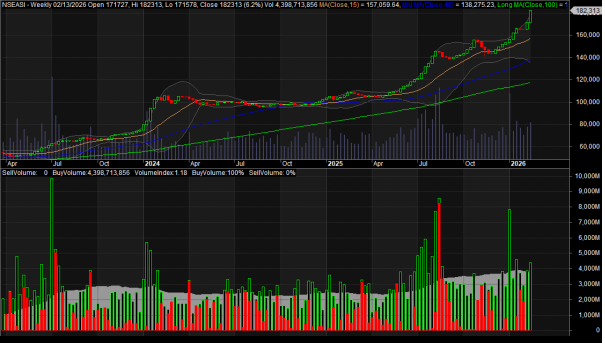
The top traded stocks by volume were Jaiz Bank Plc, FTN Insurance and Access Holdings Plc, accounting for 17.90% of total volume and 4.54% of total value. Overall, the NGX All-Share Index gained 2.15% for the week, with market capitalisation rising 2.16%. Most sector indices closed higher, except the insurance, value, consumer goods, growth and sovereign bond indices.
Fortis Global Insurance Plc Chart
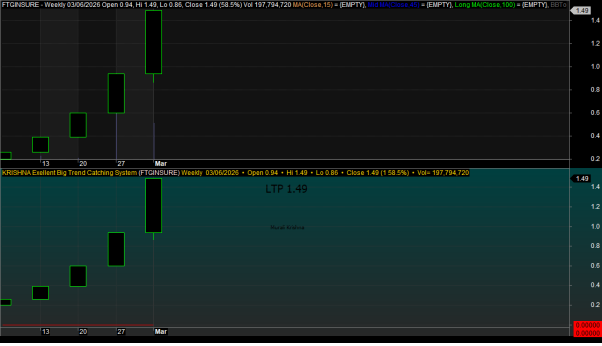
On the gainers’ chart, Fortis Global Insurance Plc, a Nigerian underwriter that provides both life and general insurance services, advanced from ₦0.94 to ₦1.49, gaining ₦0.55 or 58.51%, while Premier Paints Plc rose from ₦11.00 to ₦14.60, up ₦3.60 or 32.73%. Eterna Plc increased from ₦32.90 to ₦42.35, adding ₦9.45 or 28.72%, as Nigerian Exchange Group moved from ₦124.00 to ₦150.95, gaining ₦26.95 or 21.73%. UACN Plc also climbed from ₦96.00 to ₦115.80, up ₦19.80 or 20.63%.
McNichols Plc Chart
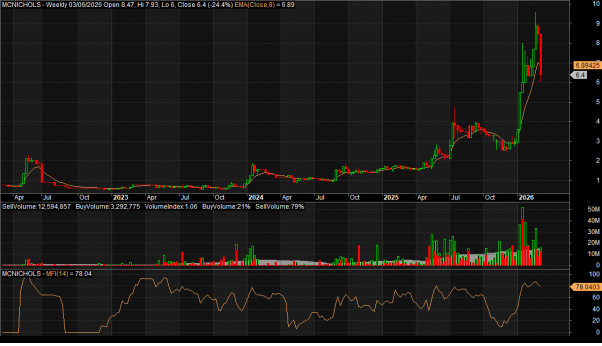
On the losers’ table, McNichols Plc, a Nigerian fast-moving consumer goods’ (FMCG) company involved in manufacturing, packaging, marketing, and distribution of food and beverage products across Nigeria, declined from ₦8.47 to ₦6.40, losing ₦2.07 or 24.44%, while Mecure Industries Plc dropped from ₦75.85 to ₦61.50, down ₦14.35 or 18.92%. Multiverse Mining and Exploration Plc fell from ₦22.70 to ₦18.45, shedding ₦4.25 or 18.72%, as Jaiz Bank Plc slipped from ₦12.63 to ₦10.30, down ₦2.33 or 18.45%. Omatek Ventures Plc also declined from ₦2.60 to ₦2.20, losing ₦0.40 or 15.38%.
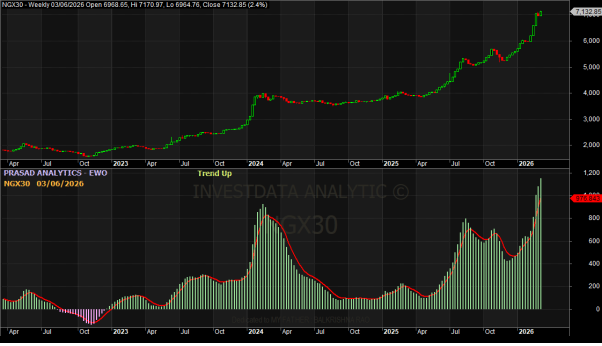
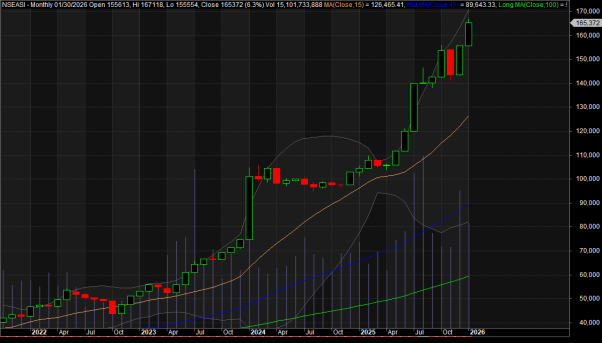
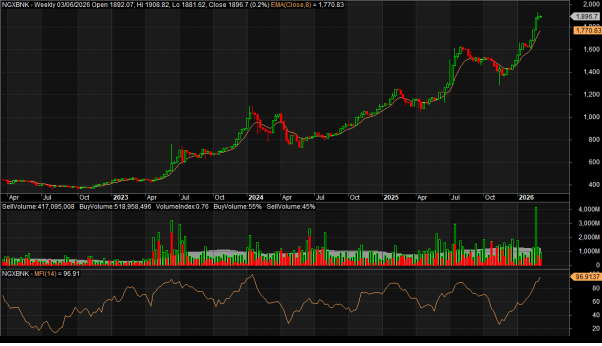
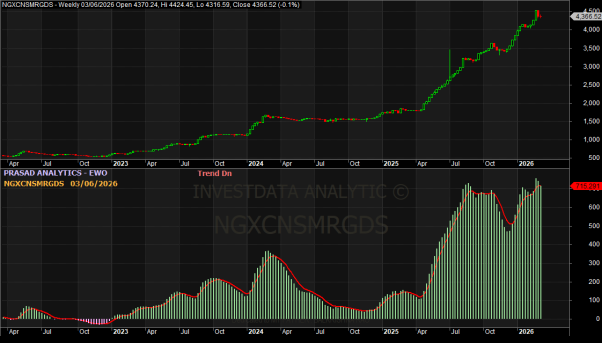
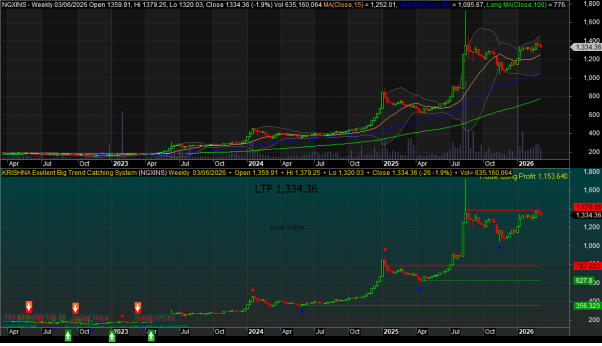
Week-to-date, the All-Share Index has gained 2.15%, NGX 30 is up by 2.36%, the Banking Index has increased by 0.24%, the Pension Index increased by 2.68%, the Insurance Index declined by 1.88%, the Consumer Goods Index decrease by 0.09%. However, the Oil and Gas Index recorded a positive return of 9.43%. Year-to-date, the All-Share Index has gained 26.58%, NGX 30 is up by 25.74%, the Banking Index has increased by 25.12%, the Pension Index index increased by 35.65%, the Insurance Index inclined by 12.20%, the Consumer Goods Index increase by 9.84%. However, the Oil and Gas Index recorded a positive return of 66.41%. In terms of market breadth, 44 stocks advanced, while 58 declined.
Technical Analysis View
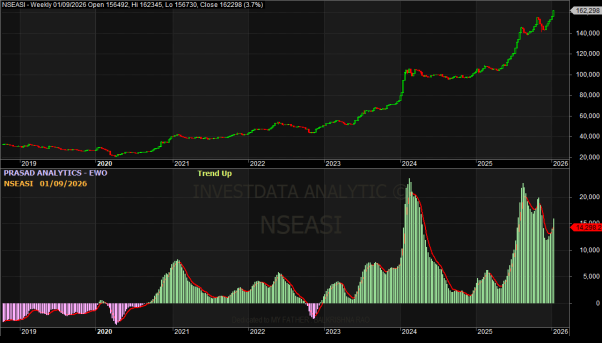
The market maintained a mildly bullish structure during the week, with the benchmark index gaining 2.15% week-on-week. Price action remained range-bound but upward-tilted, trading mainly within the 195,000–196,900 points zone, suggesting gradual accumulation rather than aggressive buying. Trading volume weakened toward the weekend, indicating cautious participation and limited conviction behind the rally. Immediate technical support is expected around the 195,000 level, while the 197,000–197,500 region serves as the near-term resistance zone. A decisive break above 197,500 points could trigger a move toward the 200,000 psychological level. Momentum indicators point to moderate bullish strength without overbought pressure.
Market Outlook
Looking ahead, market direction will be influenced by global monetary policy expectations, particularly potential rate adjustments by the Federal Reserve, and geopolitical developments affecting oil prices. Domestic fundamentals in Nigeria remain supportive, but volatility may persist due to external shocks and intermittent profit-taking. Overall, the market is likely to sustain a cautious bullish bias in the short term, with breakout confirmation above 197,000–200,000 required to strengthen the uptrend.
Trending in the Economy: Nigeria’s economy recorded slightly faster growth in Q4 2025, expanding 4.07% year-on-year from 3.98% in the previous quarter, driven by stronger performance in both oil and non-oil sectors. The oil sector grew 6.79%, while the non-oil economy rose 3.99%. Since 2023, Bola Tinubu has pursued subsidy removal, exchange-rate reforms and tax changes to improve public finances, though these policies have pushed up living costs. Average oil output during the quarter was about 1.58 million barrels per day.
Meanwhile, Nigeria’s net foreign-exchange reserves rose to $34.8 billion by the end of 2025, up from $23.11 billion a year earlier and $3.99 billion two years ago, according to Olayemi Cardoso. Gross reserves also increased to $45.71 billion, supported by stronger forex inflows, better reserve management and efforts to stabilise the currency market. The central bank said it would maintain adequate buffers and keep the foreign-exchange system steady.
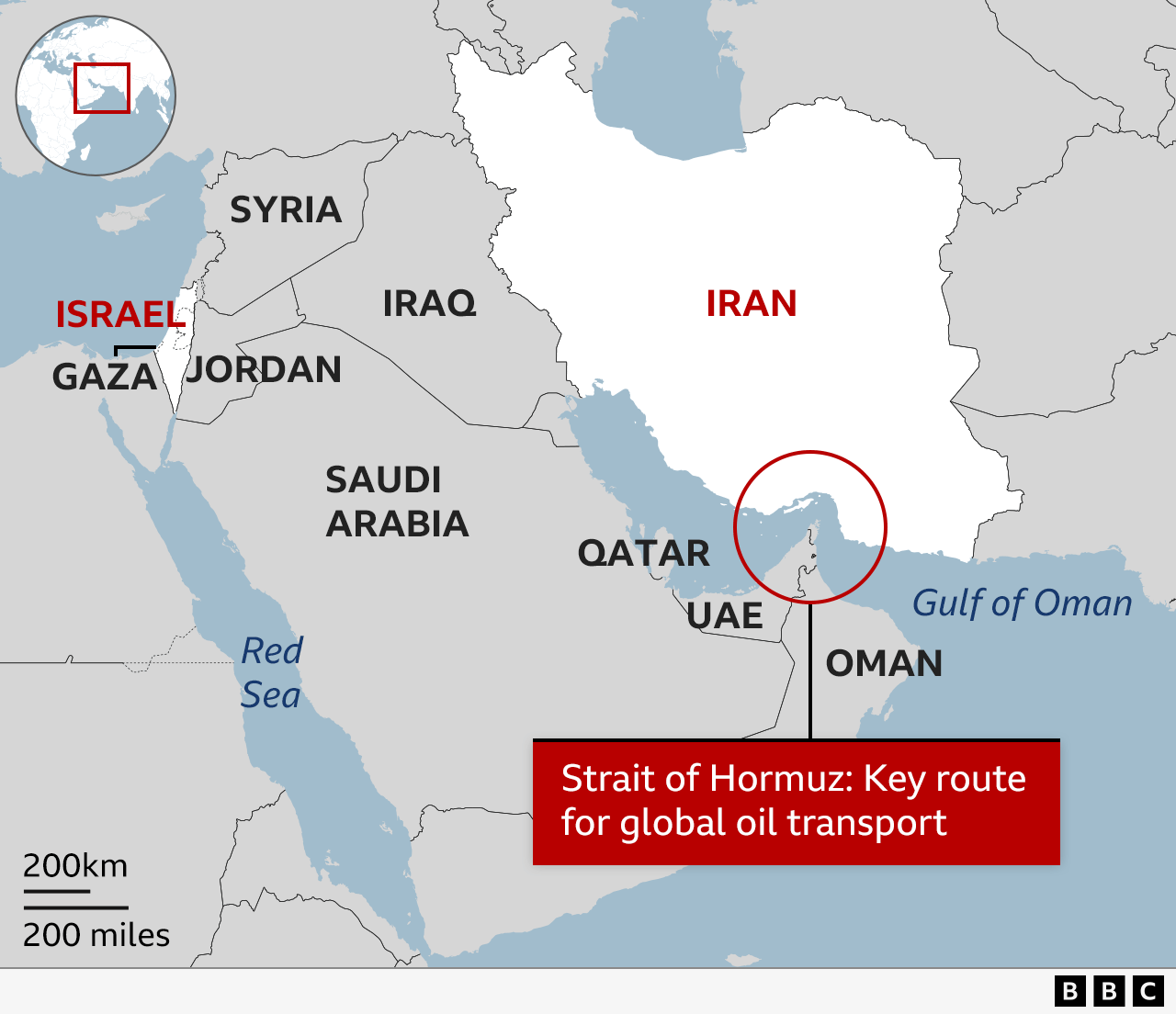
Global Market and Oil: Global markets ended the week under pressure as geopolitical risks and weaker economic data drove volatility. In the United States and Europe, equities recorded losses of over 1% on Friday after rising tensions between Israel and Iran pushed oil futures to levels not seen since 2023. At the same time, a weaker-than-expected U.S. labour report increased hopes that the Federal Reserve could cut interest rates later in the year, though growth concerns remained.
The U.S. February non-farm payroll report showed job losses of 92,000 compared with economists’ forecast of 59,000 job additions. January’s payroll data was also revised downward to 126,000 from earlier estimates. The unemployment rate rose slightly to 4.4% from 4.3%, reflecting softness in the labour market.
Oil prices surged sharply as Middle East conflict threatened global energy supply. U.S. crude oil futures jumped 12.21%, or $9.89, to settle at $90.90 per barrel—its biggest one-day gain since 2020 during the COVID-19 pandemic. The intraday peak reached $92.61, the highest since September 2023. Brent crude gained 8.52%, or $7.28, to close at $92.69 per barrel after also hitting its strongest level since 2023. Weekly, Brent rose about 24% while West Texas Intermediate (WTI) advanced nearly 30%.
The rally was driven by fears of supply disruption as military tensions escalated across the Middle East. Statements from energy officials in Qatar suggested that Gulf energy exporters could potentially suspend exports within weeks, which could push oil prices toward $150 per barrel if disruptions persist.
Global stock markets reacted negatively. The Dow Jones Industrial Average fell 453.19 points, or 0.95%, to 47,501.55. The S&P 500 declined 1.33% (90.69 points) to 6,740.02, while the Nasdaq Composite lost 1.59% (361.31 points) to close at 22,387.68. For the week, the S&P 500 lost 2.02%, the Nasdaq fell 1.24%, and the Dow recorded a 3.01% weekly decline.
Global equity sentiment was also weak. The MSCI World Index dropped 10.36 points, or 1.01%, to 1,017.77. Europe’s STOXX Europe 600 fell 1.02% on Friday and posted a weekly loss of about 5.5%, its largest decline in nearly a year.
Market anxiety increased as volatility rose. The CBOE Volatility Index climbed 5.74 points to close at 29.49, its highest level since April 22.
Currency markets reflected a flight to safety. The U.S. dollar weakened 0.56% against the Swiss franc to 0.776 franc, while the euro slipped about 0.5% to 0.9019 franc. The dollar index fell 0.16% to 98.89. Against the euro, the dollar was up 0.06% at $1.1614, and it strengthened 0.18% against the Japanese yen to 157.86.
Cryptocurrency markets also fell, with bitcoin declining 4.22% to $68,141.59 and ethereum dropping 4.89% to $1,978.74.
Bond trading was mixed as investors assessed the outlook for monetary policy amid slowing employment growth and persistent inflation risks. The yield on 10-year U.S. Treasury notes fell slightly by 0.4 basis points to 4.142%, while the 30-year yield rose 1.2 basis points to 4.7646%. The 2-year yield, which is sensitive to rate expectations, declined 4.3 basis points to 3.556%.
Market expectations for rate cuts shifted slightly, with traders betting the first cut could come around July. The probability that rates would remain unchanged in June fell to 55.6% from 66.7% a day earlier.
Gold prices gained as softer payroll data supported hopes of monetary easing. Spot gold rose 1.81% to $5,168.59 per ounce, while U.S. gold futures climbed 1.43% to $5,137.50 per ounce. Spot silver also increased 2.45% to $84.14 per ounce.
In the energy market, the week marked one of the strongest crude oil rallies in recent years as geopolitical uncertainty intensified across the Middle East, highlighting persistent risks to global supply stability.
Sectorial Indexes Weekly Charts
NGX Banking Index Chart
NGX Consumer Goods Chart
NGX Insurance Index Chart
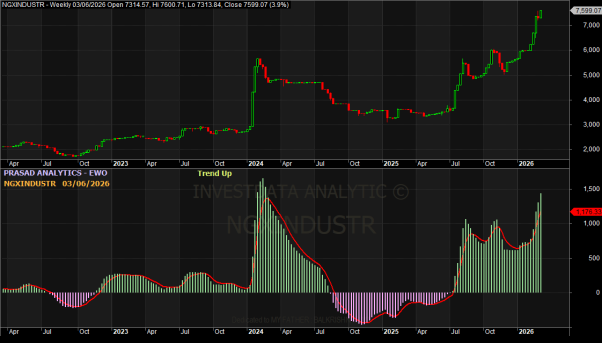
NGX Industrial Goods Index Chart
NGX Oil & Gas Index Chart
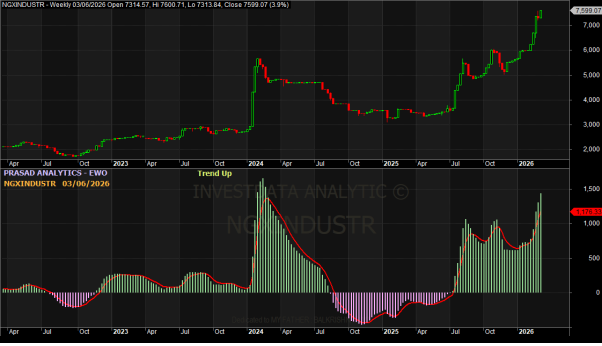
NGX 30 Index Chart