

Quarter Under Preview: 9-Months
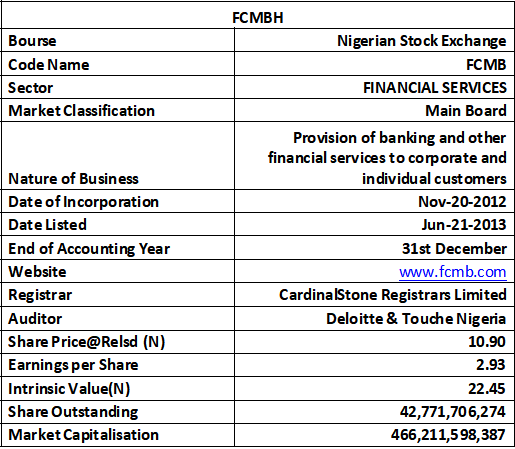
Current Share Price: N10.90
Price At Released: N10.90
Latest Final Dividend: N0.55
Latest Interim Dividend: Nil
Estimated Beta Value: 0.32x
Estimated Intrinsic Value: N22.45
Analyst: Jeariogbe Tunde Segun
The Bank
The origins of FCMB Group Plc date back to 1977 with the founding of City Securities Limited (CSL – a combined stockbroking and issuing house business) by Otunba Michael Olasubomi Balogun, who transcended to eternal glory on the May 18th, 2023. The success of CSL in the Nigerian capital markets, prompted Otunba Balogun to establish the then First City Merchant Bank Limited as the first independent merchant bank founded by a Nigerian. At the time and in the years that followed, FCMB proved a formidable competitor in the investment banking space dominated by foreign players including International Merchant Bank (IMB) with American links, NAL Merchant Bank (formerly Nigerian Acceptances Limited, a wholly owned subsidiary John Holt (Liverpool) Limited, a British company, and ICON Limited (Merchant Bankers). They were later joined by other local and foreign players.
FCMB has since expanded and evolved into a financial services group, with operating companies divided along four business lines: The Banking Group (First City Monument Bank Limited, FCMB Bank UK Limited, and FCMB Microfinance Limited; Consumer Finance (Credit Direct Limited); Investment Banking (FCMB Capital Markets Limited and CSL Stockbrokers Limited); and Investment Management (FCMB Pensions Limited, FCMB Asset Management Limited and FCMB Trustees Limited).
Listed on the Nigerian Stock Exchange (NSE), now Nigerian Exchange Limited (NGX), by way of introduction on December 21, 2004 as First City Monument Bank Plc with the ticker symbol -‘FCMB,’FCMB Group Plc currently has 42.771 billion ordinary shares held by over 565,764 shareholders, following its recently concluded capital raisin exercise to meet the new Central Bank of Nigeria capital base of N200 billion.
The Released Financials
At the end of the first nine months of 2025, the Gross Earnings of FCMB Holdings stood at N828.128 billion versus N587.773 billion in the corresponding quarter. Of this, Interest Income stood at N734.106 billion against N445.789 billion in the similar period of 2024. Interest Expenses through the period was valued at N383.279 billion, versus N271.990 billion. Thus, Net Interest Income is estimated at N350.826 billion, higher than that of the corresponding period of last year by 101.86%. Operating expenses through the period is valued at N226.464 billion against N159.025 billion, while Depreciation and Amortization stood at N12.491 billion against N10.100 billion. Thus, Profit before Tax is valued at N134.497 billion against N82.394 billion in the corresponding quarter. In all, the management of FCMB Holdings announced a total of N125.450 billion as Profit for the period, 52.26% above the N82.394 billion achieved at the end of 2024 third quarter. See the table below for details:
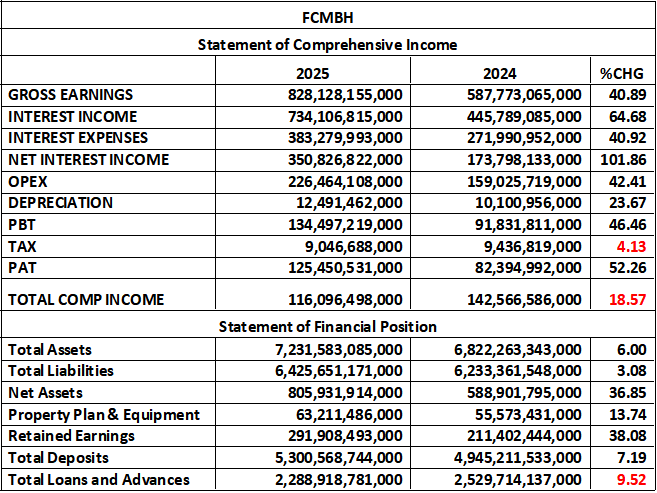
At the end of the session, the Total Assets of FCMBH is valued at N7.231 trillion versus N6.882 billion, a marginal 6% improvement. Total Liabilities estimate stood at N6.425 billion against N6.233 billion in the similar quarter of 2024. Thus, the holding company’s Net Assets is estimated at N805.931 billion against N588.901 billion estimate of last year. Retained Earnings of the bank stood at N291.908 billion versus N211.402 billion in the corresponding quarter of 2024. The total Deposits through the nine months stood at N5.300 trillion, versus N4.945 trillion in the same quarter of last year. Out of this, the bank released N2.288 trillion as Loans and Advances to customers, this is slightly below the N2.529 trillion of the comparable period of 2024. See above for details.
Financial Ratios
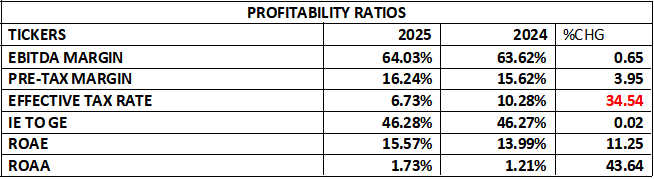
- Debt Ratio: This declined from 91.37% to 88.86%, meaning assets are now funded slightly less by liabilities. Although still high, it is typical for banks, thus, the reduction is meaningful. This improvement reflects:
- Impact of the fresh equity injection from the offer done recently
- Better capital buffers and lower reliance on borrowed funds
- A lower debt ratio, therefore, means FCMB is becoming more resilient and better cushioned against shocks
- Equity Ratio: This ratio rising from 8.63% to 11.14% is indeed a big positive signal and indicates stronger shareholder funding and lower financial risk. It is also an excellent sign of:
- Capital adequacy
- Absorption capacity, and
- Ability to support future asset growth
Thus, we can conclusively say that FCMB’s balance sheet strength is improving materially due to the equity offer
- Beta Value: a beta of 0.24x means FCMB stock is far less volatile than the overall market. The implications are:
- Lower systematic risk, which makes it more attractive to institutional investors
- FCMB may not swing sharply with market cycles, just as
- It also indicates defensive characteristics, as a stable and less speculative stock
- For investors, this is attractive in uncertain markets, but may also mean moderate upside volatility.
Profitability Ratios
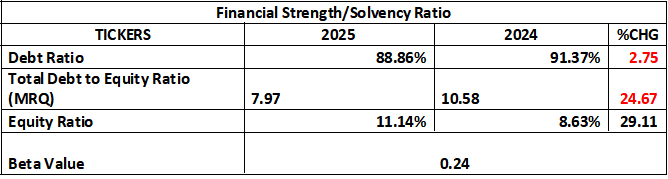
- EBITDA Margin improved marginally from 63.62% to 64.03%. This indicates good cost discipline and strong core banking earnings. Even with expanded operations and higher capital, FCMB maintained strong operational profitability. In our opinion, this is a sign of healthy underlying business strength.
- Pre-Tax Margin improved from 15.62% to 16.24%, showing better ability to convert revenue into profit. This suggests:
- Improved cost control
- Higher quality earnings
- Lower loan impairment pressure or better income mix
FCMB is becoming more efficient at generating bottom-line earnings.
- Interest Expenses to Gross Earnings Ratio: Judging by the two-year estimate, the ratio is almost unchanged, indicating that:
- Cost of funds remains high
- Interest expenses are consuming nearly half of gross earnings
- Despite this being typical in the current Nigeria rate environment, FXMB has not yet significantly reduced funding costs. It is important to understand that this ratio continues to be a pressure point, though not worsening
- Return on Average Equity (ROAE): This ratio improved despite the ownership dilution, rising from 13.99% to 15.57%, a very positive development, especially if we consider the fresh equity injection, which normally dilutes ROE. The fact that ROAE still increased means:
- Profit growth outpaced equity growth
- Management is deploying new capital effectively
- The bank is generating strong shareholders’ returns. This is a major red flag for investors.
- Return on Average Assets (ROAA): This is significantly better. ROAA improved strongly from 1.21% to 1.73%. This shows:
- Better assets utilization
- Improved assets quality, and
- More efficient balance sheet management.
For a Nigerian bank, ROAA above 1.5% is generally considered strong, and makes FCMB look more productive per Naira of assets
We can therefore conclude that FCMB’s profitability has significantly strengthened across board. It is more profitable, more efficient, and more resilient. This is very good, especially in a year of capital restructuring.
Efficiency Ratios
- Operating Expenses to Gross Earnings: Although this ratio increased slightly, it also reflects mild pressure. Operating Expenses consumed 27.35% of Gross Earnings, slightly higher than 27.06% in the corresponding quarter. This indicates a mild upward pressure on costs. However, the movement is very small and does not indicate a loss of cost control. In summary, efficiency is intact, but cost pressure is present and should be monitored closely.
- Gross Earnings to Total Assets: This is one of FCMB’s best efficiency indicators. It shows that Gross Earnings generated per unit of assets increased sharply from 8.62% to 11.45%. This means that, FCMB is now:
- Extracting more income from every N1.00 of assets
- Deploying assets more productively, and
- Improving balance sheet efficiency
This strongly supports the improved ROAA shown above. Overall, we can safely conclude that FCMB’s assets are working harder and producing much stronger returns.
- Loan to Deposit Ratios: This ratio dropped significantly and presents a conservative positioning. LDR dropped from 51.15% to 43.18%, which is a material reduction. This means FCMB is:
- Lending less aggressively
- Holding more liquidity, and
- Taking a more conservative credit stance.
The implications of this are:
- Short term effect: lower LDR reduces Interest Income from loans, but strengthens liquidity.
- Medium term effect: Possible strong deposit growth, cautious lending to manage risk, regulatory/credit consideration, and impact of fresh equity on balance sheet expansion.
- The lower LDR is safer, but also signals untapped earnings capacity going forward.

Investment Ratios
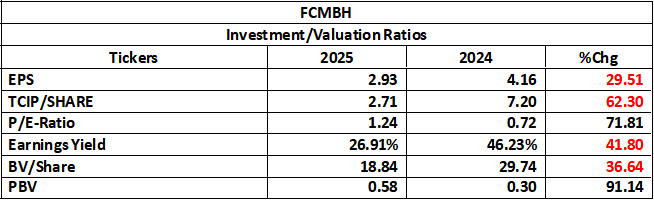
- Earnings per Share (EPS): The EPS declined as expected due to equity dilution. As shown in the table below, EPS dropped from N4.16 to N2.93 each. please note that this is not a sign of weaker performance. This is the implication of the new shares recently added. Although the number of shares increased, profit did not immediately grow at the same pace. This causes automatic EPS dilution, even when the underlying business is improving, Given the level of productivity recorded by the asset, we are of the strong opinion that EPS will recover as FCMB deploys the fresh capital more aggressively in the coming months. Thus, this decline should not be viewed negatively.
- Total Comprehensive Income per Share: This also follows the same trend for the similar reasons given above. Technically it can be said that comprehensive income fell because:
- Of the increased number of shares in issue
- Market to market gains/losses, Fx positions, and OCI items may have shifted.
- As noted above, the decline does not reflect a collapse in performance, but the mechanical effect of fresh equity.
- PE-Ratio: The PE increased from 0.72x to 1.24x, meaning that:
- Investors are now willing to pay more for each Naira of FCMB earnings
- This is a market confidence signal, not deterioration
The two technical reasons for the rise are:
- EPS dilution. So, P/E must rise even if share price stays constant
- Improved fundamentals (ROA, ROE margins) justify a higher valuation
- Even at 1.24x, FCMB is still extremely cheap relative to intrinsic value.
- Earnings Yield: Because PE increased, yield reduced from 46.23% to 26.91%. even at approximately 27%, this is still a high return relative to Nigerian equities and fixed income. In our opinion, this is still a buy friendly valuation metrics.
- Book Value per Share: Book value dropped strongly because;
- Equity increased due to fresh offer
- Number of shares increased much faster than the book value growth
- So, Book Value Per Share declines even when total equity strengthens
Note that this decline is not negative, but a normal effect of raising new capital at a discount or Par Value. The important thing is that: Capital Adequacy improved, and financial strength increased.
FCMB is transitioning from a dilution phase to a value-building one. Valuation remains cheap, offering significant upside once the new capital is fully deployed.
General Verdict/Rating: FCMB has shown strong improvement in profit, efficiency, and capital strength despite equity dilution. The bank is now more resilient, more productive, and still extremely undervalued. Short-term per share metrics fell due to capital raise, but core performance is clearly stronger. Overall, FCMB is positioned for solid future growth with a safer balance sheet. We therefore Rate FCMB a Buy.