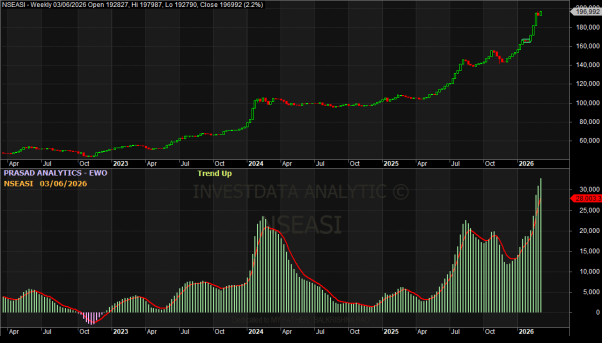

February turned out to be a defining month for the Nigerian stock market. From the very first trading session, there was a noticeable shift in sentiment as investors returned with renewed confidence, positioning in fundamentally sound stocks across banking, oil and gas, industrial goods, and other selected mid-caps. What followed was three consecutive weeks of strong upward movement before the market paused to catch its breath toward month-end.
NGXASI Weekly Index Action
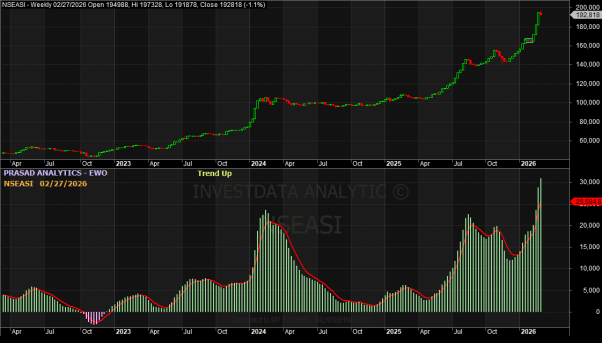
The month opened on a steady but optimistic note. Although the first trading day delivered only a marginal gain, the tone was clear, as buyers were gradually building positions. The first week progressed, momentum strengthened, especially at themidweek, when demand broadened across key sectors. By the close of that week, the All-Share Index had climbed to 171,727.49 basis points, up 3.84 percent week-on-week. Market capitalisation in the period expanded to ₦110.24 trillion, adding ₦1.11 trillion to investors’ wealth. Year-to-date return improved to 10.36 percent. Trading activities were vibrant, with 3.86 billion shares valued at ₦128.58 billion exchanged, reflecting growing participation. Financial services stocks remained the heartbeat of the rally, accounting for over half of total traded volume.
The second week saw the rally gather real pace. Confidence deepened, liquidity improved, and buyers became more aggressive. The market advanced steadily through the week, with particularly strong sessions on Tuesday and Friday. By the week’s end, the index closed at 182,313.08 points, representing a 6.16 percent gain, while market capitalisation surged to ₦117.03 trillion. In just one week, ₦5.37 trillion was added to market value. Year-to-date return rose sharply to 17.16 percent.
Activity levels reflected the heightened enthusiasm, as 4.65 billion shares worth ₦193.33 billion were traded across 286,751 deals. The financial services sector once again dominated, while services and consumer goods stocks also attracted notable interest. Market breadth remained largely positive, a sign that gains were not limited to a handful of heavyweights but were spread across the board.
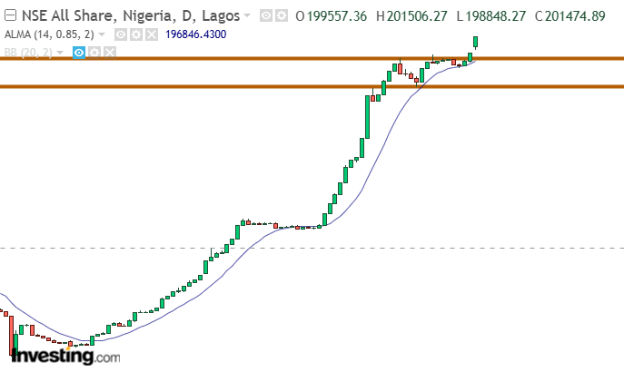
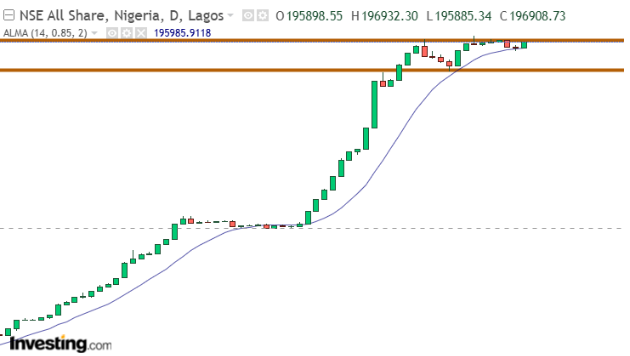
By the third week, the market was clearly in full bullish mode, opening with a strong surge and, although there was a brief pullback on Tuesday as some investors locked in profits, the overall trend remained intact. Buyers quickly regained control, pushing the index higher through the rest of the week. The ASI closed at 194,989.77 points, marking a 6.95 percent weekly gain. Market capitalisation rose to ₦125.16 trillion, and year-to-date return peaked at 25.30 percent during the week. Trading reached its highest level for the month, with 7.66 billion shares valued at ₦252.57 billion exchanged in 345,118 deals. Financial stocks continued to lead the charge, contributing the bulk of trading volume and value. The market structure at this stage reflected strong momentum, with consistent higher highs reinforcing confidence among participants.
After three weeks of strong gains, the final week brought a more cautious tone. The index initially pushed higher to 196,263.55 points but gradually retraced as profit-taking set in, particularly in banking and consumer counters. Investors who had ridden the rally began trimming positions, leading to mild volatility midweek. Despite this, liquidity remained healthy. The market eventually closed the month at 192,827 points. Market capitalisation settled at ₦123.76 trillion, while year-to-date return moderated to 23.91 percent from its intra-month high of 26.12 percent. The final trading session recorded 823.8 million shares worth ₦34.75 billion across 63,759 deals, showing that participation remained solid even during consolidation.
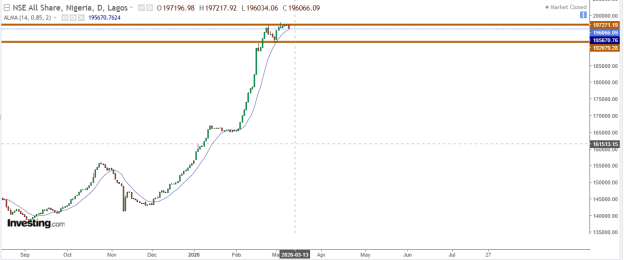
Looking at the month as a whole, the numbers tell a compelling story. The index started February around 165,384 points and ended at 192,827 points, delivering an approximate monthly gain of 16.6 percent. Over ₦13 trillion in market value was added at the peak before settling slightly lower by month-end. February stood out as one of the strongest months in recent memory, driven by improved liquidity, sector rotation, and growing investor confidence.
While the late pullback suggests the possibility of short-term consolidation, the broader tone of the market remains constructive. The resilience shown throughout February indicates that investor appetite for Nigerian equities is strengthening, especially in fundamentally sound names. As the market moves into a new month, attention will likely shift to earnings releases and macroeconomic signals, but February has clearly reset sentiment on a bullish note.
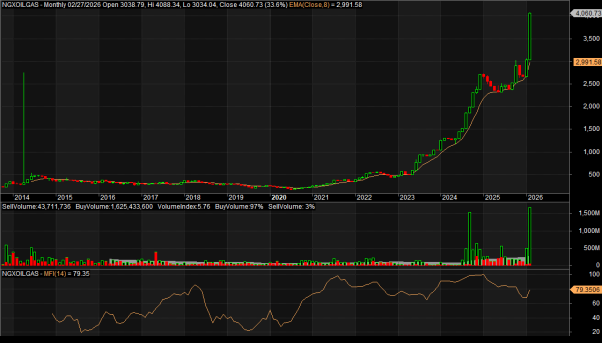
Month-to-date, the All-Share Index has gained 6.95%, NGX 30 is up by 6.96%, the Banking Index has increased by 5.68%, the11 Pension Index increased by 7.16%, the Insurance Index inclined by 4.73%, the Consumer Goods Index increase by 6.10%. However, the Oil and Gas Index recorded a positive. return of 8.66%. Year-to-date, the All-Share Index has gained 25.30%, NGX 30 is up by 24.37%, the Banking Index has increased by 23.93%, the Pension Index index increased by 31.94%, the Insurance Index inclined by 15.06%, the Consumer Goods Index increase by 13.88%. However, the Oil and Gas Index recorded a positive return of 52.73%.
Technical Analysis and Outlook
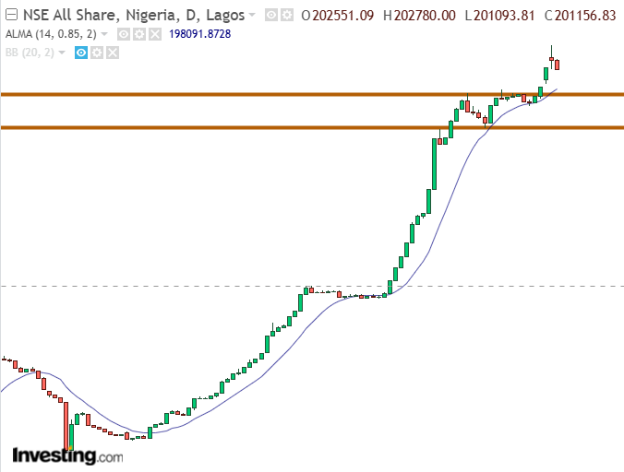
Index’s action in February was clearly a strongly bullish for the Nigerian equities. The index moved in a steady upward trend for most of the period, printing higher highs and higher lows — a classic sign that buyers were firmly in control.
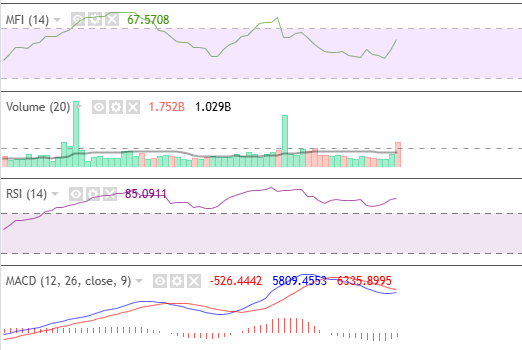
The breakout above 170,000 early in the month set the tone, and once the market crossed 180,000, momentum accelerated. Volume expanded noticeably during weeks two and three, which suggests that the rally was supported by real participation, not just light speculative trading. That kind of volume-backed move usually gives a trend more credibility.
By the final week, however, the pace of gains slowed. The index tested the 196,000 zone but struggled to hold above it, triggering some profit-taking. The pullback toward 192,827 points appears more like healthy consolidation after a sharp run, rather than a sign of a major reversal.
Market Outlook
Looking ahead, the 190,000–192,000 area is now an important support zone, and for as long as the market stays above this range, the broader uptrend remains intact. On the upside, 196,000 to 200,000 remains the key resistance band. A strong break above that level, backed by improved volume, could trigger another leg higher.
In the near term, the market may move sideways as investors digest February’s gains. Some rotation across sectors is likely, especially within banking and oil-related stocks. Overall, the structure still favors the bulls, but fresh momentum and sustained liquidity will be needed to extend the rally further.
FTGINSURE Monthly Chart
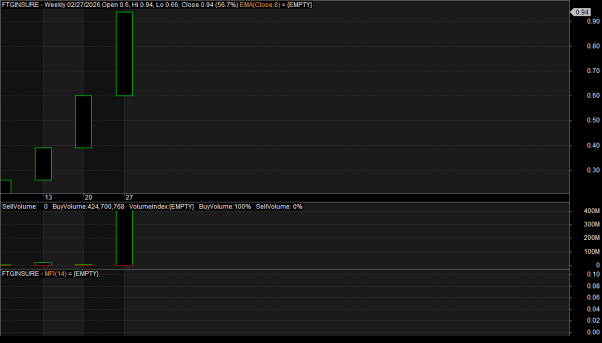
So far this month, the Nigerian Exchange has seen notable rallies across select counters. Leading the chart is FTGINSURE, which climbed to ₦0.94, delivering a remarkable 370% gain. It is followed by ZICHTS at ₦17.36, up by 314.32%. INFINITY advanced to ₦19, reflecting a 111.11% increase, while UNIONDICON rose to ₦16.60 with an 89.71% appreciation. Rounding out the top performers is RTBRISCOE, which settled at ₦12.51, posting a 59.16% gain month-to-date.
SOVRENINS Monthly Chart
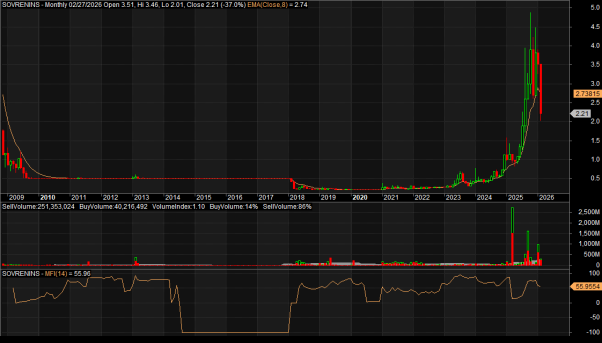
On the downside, several stocks recorded significant declines during the same period. SOVRENINS fell to ₦2.21, representing a 37.04% drop. TRIPPLEG declined to ₦4.73, shedding 35.12%, while MECURE closed at ₦75.85 after losing 27.07%. UHOMREIT retreated to ₦69.25, down 26.99%, and DEAPCAP completed the list at ₦7.20, marking a 23.32% month-to-date loss.
Trending in the Economy: The Central Bank of Nigeria cut its Monetary Policy Rate by 50 basis points to 26.50%, slightly higher than the 26% projection, after holding it steady at its November meeting level. Inflation eased to 15.10% year-on-year in January, extending its decline for the 10th consecutive month. Governor Olayemi Cardoso attributed the continued moderation to earlier policy tightening, exchange rate stability and improved food supply. Capital Economics projects cumulative rate cuts of 750 basis points this year, which could lower the benchmark rate to 19%.
Meanwhile, Nigerian crude now trades around $71 per barrel, above the Federal Government’s 2026 benchmark of $64.85, though 0.7% below $72.30. Prices remain supported by tensions around the Strait of Hormuz, even as the US Energy Information Administration forecasts a potential 3.1 million barrels per day rise in global inventories this year. Nigeria is targeting oil output of 1.84 million barrels per day in 2026, up from roughly 1.48 millionbpd in January 2025. The Dangote Refinery is operating above 650,000 bpd, supplying about 60–65 million litres of petrol daily and exporting roughly 20 million litres, while the government has offered 50 oil and gas blocks in a bid to attract more than $10 billion in investment.
Global Market and Oil: Global equities ended Friday on a cautious note as investors grappled with elevated valuations, particularly in the technology and semiconductor space, alongside lingering concerns about the broader disruptive impact of artificial intelligence on corporate earnings.
Despite delivering earnings that beat market expectations, Nvidia saw its shares tumble 3.5%, extending losses from the previous session. The pullback reflects profit-taking in a sector that has surged more than 100% over the past year, with many analysts arguing that a significant amount of positive news had already been priced in. The broader semiconductor index slipped 1.2%, signaling a cooling phase for the once red-hot AI-driven rally.
On Wall Street, major benchmarks closed lower. The S&P 500 declined 0.43%, the Dow Jones Industrial Average dropped 1.05%, and the tech-heavy Nasdaq Composite lost 0.92%. The weakness came as investors reassessed risk exposure in high-growth names amid stretched valuations.
Globally, the MSCI All Country World Index fell 0.25% on Friday. However, the broader picture remained relatively resilient, with the index up 0.35% for the week and nearly 1.2% for the month of February. In Europe, the STOXX 600 managed a modest gain of 0.11%, reflecting selective buying across sectors.
Geopolitics added another layer of uncertainty. Markets closely monitored developments in ongoing U.S.-Iran nuclear negotiations, as Washington deployed additional military resources to the Middle East. An Omani mediator offered an optimistic assessment of the latest discussions held in Switzerland, but there were no clear signs of a breakthrough. U.S. President Donald Trump maintained a firm stance, expressing dissatisfaction with Iran and reiterating the possibility of force if talks fail to yield an agreement. Omani Foreign Minister Sayyid Badr Albusaidi confirmed that both sides plan to resume negotiations after consultations in their respective capitals.
Oil markets reacted strongly to the uncertainty. Traders priced in potential supply disruptions, pushing crude prices higher. Brent crude futures rose $1.73, or 2.45%, to settle at $72.48 per barrel. U.S. West Texas Intermediate (WTI) climbed $1.81, or 2.78%, to close at $67.02 per barrel.
In the bond market, yields moved lower as investors sought safety. The U.S. 10-year Treasury yield declined 6.3 basis points to 3.96%, while the 2-year yield also fell 6.3 basis points to 3.385%. In Europe, Germany’s benchmark 10-year Bund yield eased 1 basis point to 2.644%.
Currency markets showed mixed performance. Sterling slipped 0.07% to $1.34471 after the Labour Party, led by Prime Minister Keir Starmer, suffered a local election setback in Greater Manchester, an area long considered a party stronghold.
In Asia, Japanese data revealed cooling inflation in Tokyo and weaker-than-expected factory output, complicating the case for near-term interest rate hikes by the Bank of Japan. The yen trimmed earlier gains and was down 0.03% at 156.18 per dollar.
The U.S. dollar index, which tracks the greenback against a basket of major currencies, dipped 0.06% to 97.67. The euro strengthened 0.14% to trade at $1.1813 against the dollar.
Precious metals benefited from heightened geopolitical risks and softer bond yields. Spot gold rose 1.5% to $5,263.59 per ounce, while spot silver surged 6.1% to $93.74 per ounce.
Overall, Friday’s market action reflected a blend of profit-taking in overheated sectors, cautious positioning ahead of geopolitical developments, and renewed interest in safe-haven assets amid persistent global uncertainty.
Sectorial Indexes Monthly Chart Position
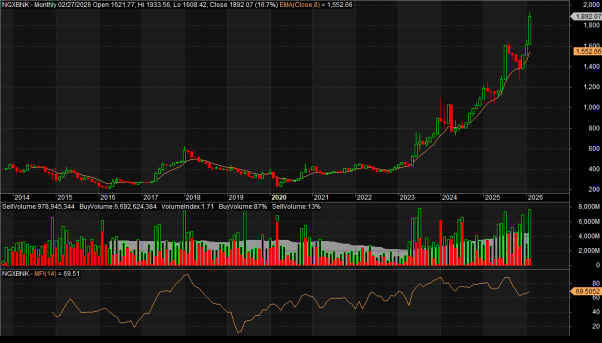
NGX Banking Index Chart
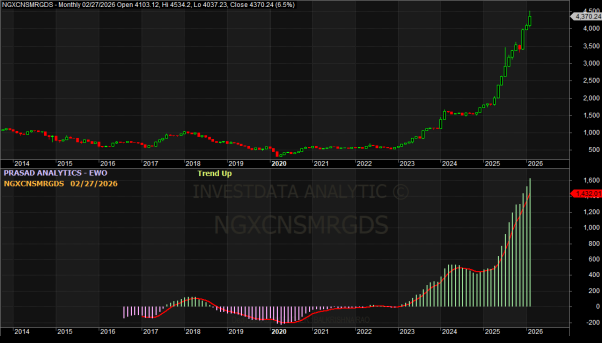
NGX Consumer Goods Index Chart
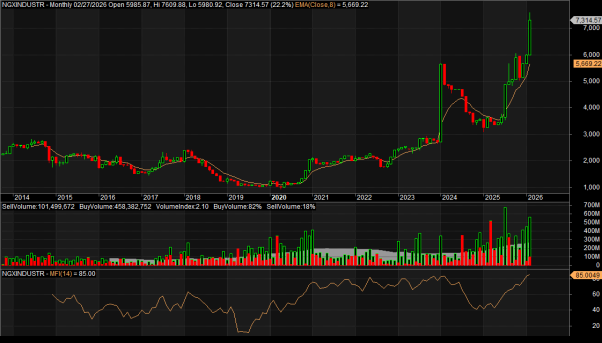
NGX Industrial Goods Index Chart
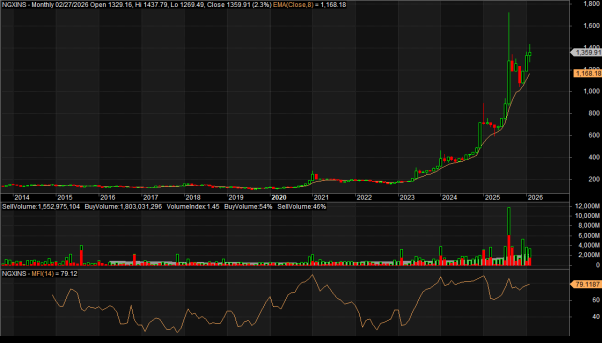
NGX Insurance Index Chart
NGX Oil & Gas Index Chart
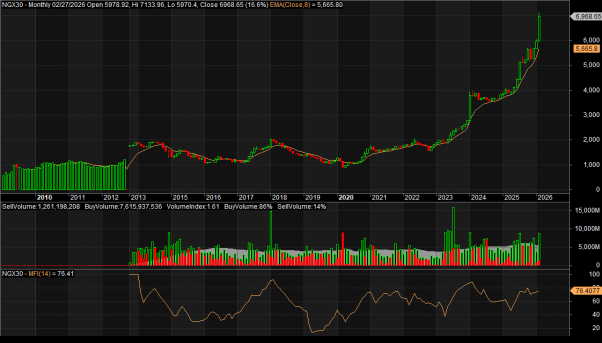
NGX 30 Index Chart