

Quarter Under Preview: 9-Months
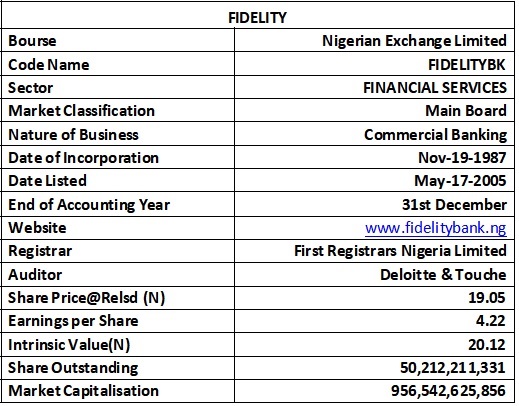
Current Share Price: N19.10
Price At Released: N19.05
Latest Final Dividend: N1.25
Latest Interim Dividend: Nil
Estimated Beta Value: 0.45x
Estimated Intrinsic Value: N20.12
Analyst: Jeariogbe Tunde Segun
The Bank
Fidelity Bank is a full-fledged commercial bank operating in Nigeria, with over 7.2 million customers, serviced across its 250 business offices and various other digital banking channels. It focuses on select niche corporate banking sectors as well as Micro Small and Medium Enterprises (MSMEs). Quoted on the Nigerian Stock Exchange (now Nigerian Exchange Limited), Fidelity Bank Plc (then Fidelity Union Merchant Bank Limited) was incorporated as a private limited company on November 19, 1987, and obtained a merchant banking license some weeks later on December 31. Its does were opened to customers on June 3, 1988. In 1999, the bank changed business model, exchanging its license for a commercial type on July 16, when it became a Universal Bank in February 2001. The current enlarged Fidelity Bank is a result of the merger with the former FSB International Bank Plc and Manny Bank Plc (formerly Manufacturers Merchant Bank) in 2005.
The Released Financials
At the end of the nine-month period, the management of Fidelity Bank Plc reported Gross Earnings of N1.114 trillion, a 44.32% improvement on the N772.465 billion posted at the end of the similar period of 2024. Of this, Interest Income stood at N979.455 billion versus N705.716 billion in the preceding nine-month period, while Interest Expenses rose to N414.201 billion from N235.226 billion in the corresponding quarter of 2024. Thus, Net Interest Income is estimated at N565.254 billion, against N470.490 billion in the similar period of last year.
Operating Expenses was valued at N326.236 billion, same as 41.81% above the N230.048 billion in the corresponding quarter of 2024. Total Depreciation and Amortization value reported was N18.056 billion versus N7.380 billion last year. Thus, Profit before Tax is valued at N268.198 billion, slightly below the N281.414 billion of the previous year. Having considered the Tax expenses, Total Profit for the year is N211.727 billion, same as 5.73% below the N224.603 billion achieved in the corresponding period of 2024. See the below table for details:
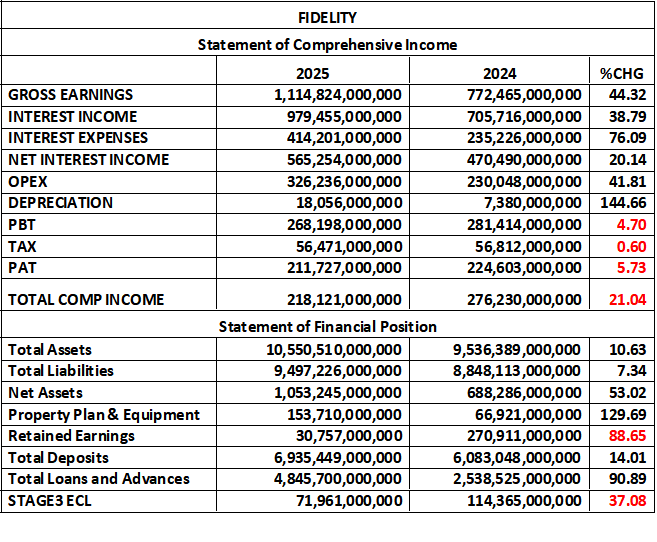
At the end of the period under review, the Total Assets of Fidelity Bank is valued at N10.550 trillion, higher than the N9.536 trillion estimated at the end of the 2024 nine-month. Total Liabilities at the end of the period stood at N9.497 trillion versus N8.848 trillion. Net Assets is valued at N1.053 trillion versus N688.286 billion. Retained Earnings stood lower at N30.757 billion from N270.911 billion in the corresponding period. Total Customer Deposit is valued at N6.935 trillion versus N6.083 trillion, while the Total Loans and Advances to Customers is N4.845 trillion against N2.538 trillion. See the above table for details.
Financial Strength Ratios
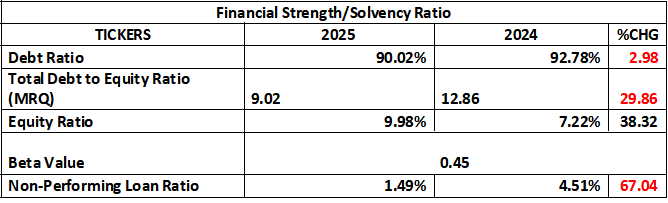
- Debt Ratio: This Ratio moved from 92.78% to 90.02%. Note that a decline in debt ratio means the bank is now less leveraged compared to the preceding nine month period. This is expected after a capital raise, because new equity reduces relative reliance on liabilities. Nevertheless, in our opinion, a 90% debt ratio is still high. Although for a bank, this is yet within tolerable limit and normal, since deposits are classified as liabilities. We can therefore say, Fidelity Bank’s balance sheet is slightly stronger and less risky than in the prior nine months.
- Equity Ratio: This can be said to be significantly better. A jump from 7.22% to 9.98% signals a strong improvement in capital adequacy, driven by the rights issue and public offer. Higher equity capital provides better protection against loan losses and regulatory shocks.
Recall that the Central Bank of Nigeria’s recapitalization guideline requires banks to grow equity, and we can say Fidelity Bank is responding well in this regard. This is a major improvement that shows the bank is getting more resilient. - Asset Quality/Risk Profile: Non-Performing Loan (NPL) Ratio shows a very strong improvement within the compared periods. A drop to 1.49% is excellent, being far below the CBN threshold of 5%. This suggests better risk management framework, improved loan recoveries, or effective loan restructuring. Lower NPL means less pressure on profitability through impairment charges. In summary, Credit Risk has reduced drastically; the loan book is healthier and more stable now.
- Market Risk Indicator: Beta is estimated at 0.45x. It is important to understand that a Beta below 1 means the stock is less volatile than the overall market. Thus, at 0.45x, Fidelity Bank is considered defensive and stable, reacting less to market swings. This is common with well-capitalized banks and those with strong retail deposit bases. It is therefore safe to say the stock is relatively low-risk for investors with limited downside volatility.
Overall Financial Strength Assessment: The bank is financially stronger, safer, and more stable than the comparable period. The key driver of this improvement is the successfully completed capital raise, which boosted equity and reduced leverage risk.
Profitability Ratios
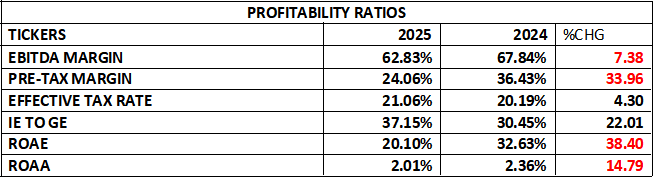
- EBITDA Margin: This dropped by a marginal 5% to 62.83% from 67.84%, indicating higher operating costs relative to income. This is normal after a major capital raising because:
- Expenses for offer-related activities may hit operating costs
- A larger balance sheet and expansion initiatives temporarily elevate costs.
Nevertheless, it safe to conclude that the banks profitability in this regard is still very strong at 62.83%, showing robust core banking profitability, even if slightly weakened.
- Pre-Tax Margin: This shows the largest drop among the profitability indicators. Possible drivers include:
- Higher operating expenses
- Lower yields on some assets
- Dilution impacts after capital increase, and
- Possible increase in provisions or other deductions
We conclude that: Profit before tax is under pressure, a key area of monitor. The bank is still profitable, but at a much lower efficiency level.
- Interest Expenses to Gross Earnings Ratio: This shows higher cost of funds as it currently stands at 37.15% from 30.45%. A rise indicates that costs are eating deeper into earnings. Possible causes include:
- Increased competition for deposits
- Higher interest rates environment, or
- Changes in deposit mix (more expensive deposits)
In all, we conclude that cost of funds is rising, putting pressure on net interest margin, which partly explains the weaker margins above.
- Return on Average Equity (ROAE): This buttresses our previously expected decline which fell to 20.10% from 32.63%. The slide is steep but completely expected after the Rights issue and public offer. This is because, equity base increased significantly, and profit did not grow at the same pace. As such, ROAE naturally drops. Note that even after the dilution, a 20% ROE is still strong for a Nigerian Bank. Fidelity Bank therefore remains efficient in generating returns
- Return on Average Assets (ROAA): This indicator shows a moderate decline from 2.36% to 2.01% due to the expansion in asset base faster than profits, while margins tightened due to the rising interest expense. Thus, ROA remains above the 2% mark, which is strong for the banking sector. Despite pressure, the bank is still extracting solid returns from its asset portfolio.
Overall Verdict on Profitability Ratios: Fidelity Bank remains a strongly profitable institution, but the 2025 9-month numbers show margin pressure due to higher costs and the expected dilution from capital raising. The fundamentals are still solid, but profitability efficiency has weakened compared to the previous period.
Efficiency Ratios
- Operating Expenses (OPEX) to Gross Earnings: This ratio shows slight improvement at 29.26% from 29.78%. This shows that operating expenses consumed a smaller percentage of Gross Earnings compared to the corresponding quarter of 2024. This shows better cost discipline and improved operational efficiency. Even though profitability margins declined elsewhere, the bank is controlling its operating costs effectively.
- Now, to make this picture clearer, the pressure seen above and this cost efficiency noted, we must understand how both realities fit. Profitability pressure is coming from the top line side. Specifically, the areas where Fidelity experienced pressure are mostly income and micro-driven, not due to internal-inefficiency. The pressure came from:
- Higher interest expenses-Cost of funds increased
- Dilution after capital raise- reduced ROE and ROA
- Lower pretax margin- higher interest cost, not wasteful spending.
- Now, to make this picture clearer, the pressure seen above and this cost efficiency noted, we must understand how both realities fit. Profitability pressure is coming from the top line side. Specifically, the areas where Fidelity experienced pressure are mostly income and micro-driven, not due to internal-inefficiency. The pressure came from:
The pressure is happening above operating expenses, mostly around funding costs and capital expansion
- Gross Earnings to Total Assets: This equally shows a strong improvement, and this is a very positive indicator, it means each N1 of assets is now generating more income than previously. This improved ratio suggests;
- Better asset utilization
- Higher performing assets in the portfolio, and
- An expanded asset base that is not idle but productive
Asset productivity improved significantly. After the capital raise increased total assets, the bank successfully deployed them to generate stronger earnings.
- Loan to Deposit Ratio: A jump from 41.73% to 69.87% shows greater lending activities relative to deposits, which is a very healthy development because:
- It indicates better revenue-generating asset allocation
- The bank is putting more customer deposits to productive use, and
- Higher loan creation supports higher interest income.
It is also important to note that: an LDR between 60%-80% is typically considered optimal, considering that the previous 41.73% was see as too conservative, meaning that large deposits were idle or deployed in lower-yield assets. In conclusion we say, the bank moved from a conservative lending stance to a more balanced and income-generating asset strategy, which aligns with improved asset productivity above.
Final Verdict on Efficiency: Fidelity Bank’s efficiency profile at the end of the quarter is strong and improving. The positive signals are: Opex is well managed, assets productivity is much better now, lending efficiency has greatly improved and overall, the bank is using deposits and assets more effectively to generate income.

Investment Ratios
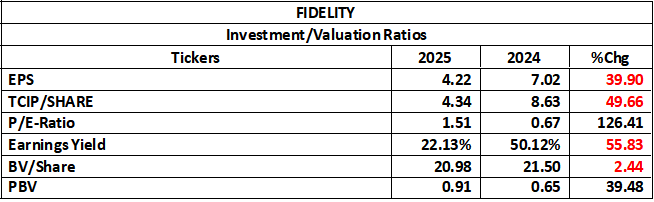
- Earnings per Share (EPS): As expected EPS declined to N4.22 from N7.02, this is because;
- The bank raised fresh capital, that is, number of shares increased significantly
- Profit did not grow at the same pace as share count (EPS dilution)
- Profit margins were also pressured by higher interest expenses.
This is not a sign of weakness, because it is the normal and unavoidable effect of a massive capital raise to meet the new CBN minimum capital requirements.
- Total Comprehensive Income: Also, as expected, this indicator dropped to N4.34 from N8.36, due to same reason as in the case of EPS above. The core profitability is still strong, the drop only reflects a dilution, not operational failure.
- PE-Ratio: PE rising from 0.67x to 1.51x means the market price has adjusted upward relative to earnings. Even at 1.51x, Fidelity is still extremely undervalued by global and even local standards. This means that, investors are beginning to price in the improve strength and recapitalization progress, thus, the stock is still very cheap relative to earnings.
- Earnings Yield: Though earnings yield is still very high at 22.13%. the drop occurred because PE doubled (1.51x to 0.67x). But a 22% earnings yield is still far above:
- Inflation adjusted returns
- Treasury yields, and
- Most banking sector averages
The stock still offers high earnings returns to investors.
- Book Value per Share: Shows slight decline from N21.50 to N20.98. This small decline is normal because the capital raise increased, but:
- Offer-related cost
- Revaluation movements, and
- Expanded asset base may temporarily reduce Book Value per share.
Thus: Book Value Per Share remains strong. Shareholders’ funds have increased, even though BVPS slightly adjusted due to dilution.
Final Verdict on Investment Ratios: Fidelity bank’s valuation remains highly attractive due to the following reasons;
- Undervalued share price relative to earnings and book value
- Strong capital position post-right issue
- Resilient performance despite dilution
- High earnings yield signals opportunity for long-term investors
The bank is in the post-recapitalization temporary dip phase where per-share metrics fall, but intrinsic strength increases.
Overall Verdict on Fidelity Bank: We Rated Fidelity Bank Shares a Strong Buy (long–term) on the following conclusions:
Fidelity Bank remains fundamentally strong despite the dilution effects of the recapitalization. Financial strength has improved with a much larger capital base, profitability remains solid even though per-share metrics dropped (which is normal after a major capital raise), efficiency is stable despite higher funding costs, and valuation remains extremely attractive with a very low PE and high earnings yield. Overall, the bank is still well-positioned for growth, and showing rising investor confidence. Nevertheless, our estimated intrinsic value remains very conservative as shown above (N20.12), considering the ongoing economic metrics adjustments.