
Quarter Under Preview: FULL YEAR 2025
Current Share Price: N213.90
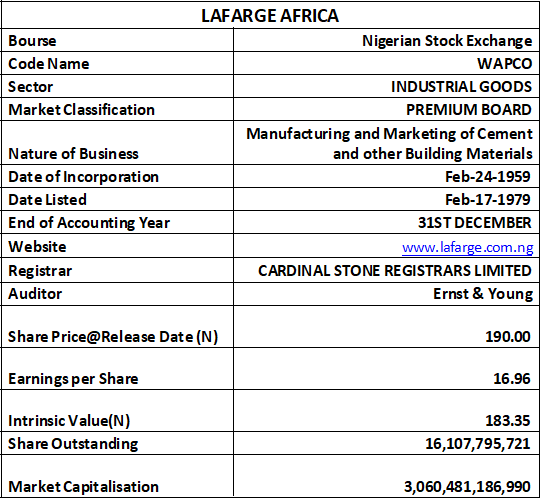
Price At Release Date: N190.00
Latest Final Dividend: N6.00
Latest Interim Dividend: N4.00
Estimated Beta Value: -0.01x
Estimated Intrinsic Value: N183.35
Rating: Buy Hold/Buy on Dip
Analyst: Jeariogbe Tunde Segun
The Company
Lafarge Africa, originally known as West African Portland Cement (WAPCO), and was established in 1959, with one of its earliest plants in Ewekoro, Ogun State Nigeria. The name changed to Lafarge Africa in 2014 after restructuring and expansion when it merged the Nigerian operations of LAFARGE with other assets like United Cement Company of Nigeria (UNICEM), Ashaka Cement, Atlas Cement, into the Lafarge Africa operations. The new name ‘Africa’ reflects its Pan-African ambition and not just Nigeria, as well as a larger and consolidated cement group.
Lafarge Africa is one of the major cement manufacturing companies in Nigeria, producing cement, aggregates, and ready-mix concrete used in construction works. It is listed on the Nigerian Exchange under the ticker Wapco. Its popular products includes Elephant Cement, Supaset, PowerMax, and Ashaka Cement.
The Released Numbers
At the end of the 2025 financial year, the management of Lafarge Africa released impressive numbers for the period with Turnover growing by 53.04% to N1.066 trillion from N696.757 billion in the previous year. Direct Cost of Sales was valued at N448.936 billion, against N350.047 billion in the corresponding period of last year, while Operating Profit was estimated at N392.099 billion, versus N193.005 billion. Operating Expenses increased to N229.506 billion against N160.569 billion. Finance Cost through the year was valued at N11.006 billion, lower than the N42.547 billion of prior year, resulting in a positive Net Finance Cost of N19.216 billion as against the negative of N40.486 billion in 2024. Profit before Tax stood at N411.316 billion against N152.264 billion, while Tax Expenses more than doubled at N138.196 billion versus N52.119 billion. Profit for the year stood at N273.120 billion, a growth of 172.2% over the N100.145 billion achieved in 2024 financial year. See the table below for details:

At the end of the year, Lafarge Africa’s Current Assets amounted to N559.502 billion from N152.264 billion in the comparable year. Non-Current Assets estimate is N648.521 billion against N576.506 billion. Total Assets for the year was N1.208 trillion versus N990.509 billion in the corresponding year. Current Liabilities on the other hand is N417.362 billion against N408.845 billion, while Non-Current Liabilities stood at N96.666 billion as against N77.023 billion, in other words, Total Liability for the year is N514.028 billion compared to N485.867 in the similar year. Net Assets is valued at 693.995 billion, while Retained Earnings improved by 60% to stand at the current N504.922 billion. See the above table for details.
Financial Strength
- Debt Ratios: This dropped from 49.05% to 42.55%, which in our opinion is a significant decline, indicating that the company is now financing less of its assets with debt. A move below 50% is psychologically and structurally important and indicates a reduced financial risk, and stronger balance sheet resilience.
- Debt-to-Equity Ratio also shows a drastic change, moving from 96.28% to 74.07%, which represents a major improvement that can be interpreted to mean that the company is now previously close to a 1:1 leverage, which is aggressive. It can also be said that the company is now at 0.74:1 which is moderate and healthy. Please understand that this is a big deal, because of lower exposure to interest rate shock, and better capacity to raise future financing if needed.
- Equity Ratio equally revealed a strong increase, showing that: more than half of the company’s assets are now funded by equity- a very strong solvency position. Note that this signals a strong retained earnings growth, and increased shareholders value backing the business.
Overall Financial Strength Verdict: Now this is it, deleveraging is clearly in progress, equity base is strengthening, and financial risk is dropping significantly. This confirms that the profit growth is not just accounting, it is being used to reduce debt, and strengthen the balance sheet.

Profitability Ratio
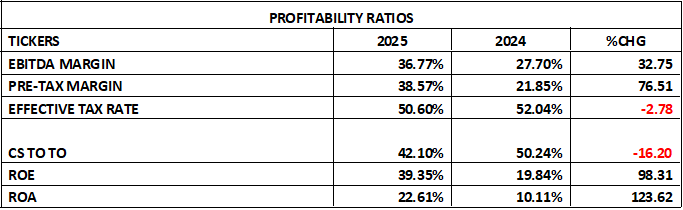
- EBITDA Margin: The ratio moved to 36.77% from N27.70%, a positive change of 32.75%. This indicates a massive improvement in core operating efficiency. Cement companies are strong when above 30%. We can therefore say that, there is a better cost control in the energy, distribution, and production session of the business. Also we can conclude that there is ongoing a strong pricing power, as prices of cement had maintained an upward turn due to the volatility in the nation’s economy and world economy at larger.
- Pre-Tax Margin: This ratio shows an extraordinary expansion, moving from N21.85% to the current 38.57%. This confirms that not just the operations is improving, financial cost reduction is also a major driver.
- Cost of Sales to Turnover: Here we observe a strong decline, as it moved to 42.10% from 50.24% which be explain as: Cost of production has dropped significantly relative to revenue, a powerful signal that it portends: improved production efficiency, and possibly better energy mix versus cost management.
- Return on Equity (ROE): The 98.31% improvement is a top-tier performance, it is important to understand that anything above 25% is excellent, and 40% is near elite level.
- Return on Assets: Here, we also saw a growth of 123.62% showing that Assets are now generating more than double the returns, it also implies improved assets utilization, and strong operational efficiency.
Overall Profitability Verdict: The profitability ratios show a stand out point in, margin expansion across all levels, in addition to significant improvement in cost efficiency, finance cost reduction which amplified profits, leading to exceptionally high returns (ROE, & ROA).
Efficiency Ratios
- Operating Expenses to Turnover: The ratio declined by 6.60% to 21.52% from 23.05% which can be interpreted as: operating expenses are declining relative to revenue. In our opinion, this is very positive, as it defends our previous assertion of improving cost discipline, apart from that scale advantage is kicking in, and management is controlling overheads effectively.
- Turnover to Total Assets: Lafarge Africa is generating more revenue per unit of assets, a sign of improved efficiency which also confirms better utilization of plants and equipment, and higher production throughout or better sales conversion.
Final Efficiency Verdict: What we have seen here is not just inflation driven performance, it is a cost efficiency move, which yielded intentional Asset productivity results. The combination of these two drives sustainable margin expansion.

Investment Ratios
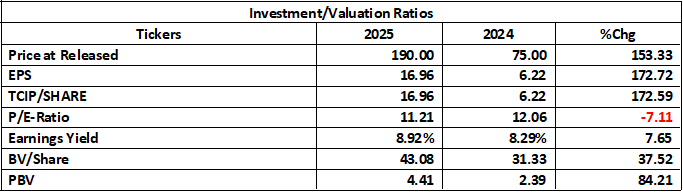
- Price Movement: In the two financial years compared, the price of Lafarge Africa moved from N75 per share to N190 each, a difference of 153%, meaning that the market has already reacted strongly to the turnaround efforts seen above. A lot of the good news is already priced into the share price.
- Earnings per Share (EPS): This also achieved a whopping 173% growth, moving from N6.22 to N16.96 each, depicting that earnings growth is even stronger than price. This is a key performance indicator, just as the rally is fundamentally justified, not a mere speculation.
- P/E-Ratio: Despite the jump in price, P/E declined slightly, meaning that earnings growth has kept valuation reasonable, even as the stock is not overvalued on earnings basis.
- Earnings Yields: At 8.92% we can conclude a solid return to price, the stock is relatively attractive compared to other Nigerian equities.
- Book Value per Share: The Book Value is now estimated at N43.08 from N31.33, which can be interpreted as: strong growth in intrinsic value, backed by retained earnings and balance sheet strength. Though the intrinsic value will still stay below the current market price, the price is still very much justified and valid for onward improvement of financial performance over the coming years.
- Price-to-Book Ratio: This reflects our assertion above. The ratio now stands at N4.41 from N2.39. This is where caution comes in, a PBV is high, it means the market is pricing in future growth expectations, at the current market price, the stock is no longer cheap on asset basis.
Verdict: The stock is now cheap on earnings basis, but expensive on the assets side. The combination of these typically means: a high quality company, but longer bargain.
Dividend Analysis
Total Dividend grew by over 400% from N1.20 to N6.00 per share, which is massive. This is a step change in dividend policy. The Pay-out-Ratio is now 35.39% compared to the 19.30% of last year, this means the company is sharing more earnings with shareholders now. This is still within the healthy range, it is not over paying, and still rating earnings for growth. The dividend yield of almost 3.16% against 1.60% shows that yield has almost doubled, thus, the company had moved from a low yield stock to moderate yield stock.

Final Verdict: We rate the stock Strong Hold, and recommend a Buy on Dip approach of investments. The performance revealed a quality stock; balance sheet is strong, profitability is elite, Efficiency is improving, and dividend is growing rapidly.