

Period Under Preview: FULL YEAR 2025
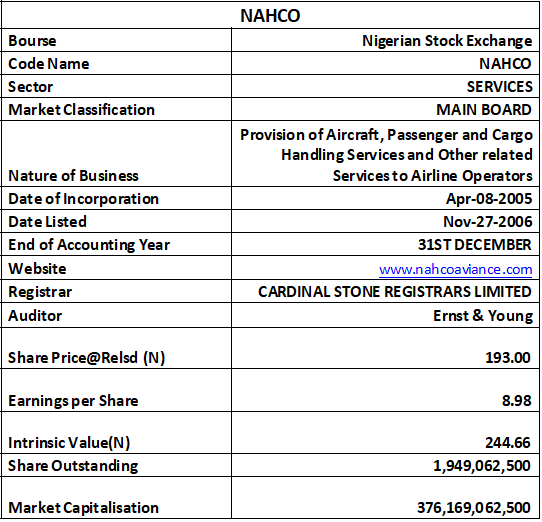
Current Share Price: N189.95
Price At Release Date: N193.00
Latest Final Dividend: N6.25
Scrip: 1:7
Estimated Beta Value: 0.52x
Estimated Intrinsic Value: N855.79
Rating: Hold
Analyst: Jeariogbe Tunde Segun
The Company
Nigerian Aviation Handling Company Plc (NAHCO Plc) was incorporated in 1979 as a ground handling service provider in Nigeria’s aviation sector. It was established to deliver cargo handling, aircraft handling, passenger facilitation, and related logistics services to airlines operating within the country. NAHCO began full operations in 1980 and quickly became a key player at major Nigerian airports, providing essential support services to both domestic and international airlines. Over time, the company expanded its service offerings to include warehousing, freight forwarding, and aviation training.
In 2005, NAHCO was privatized under the Federal Government’s reforms programme, marking a significant transition from government ownership to a publicly quoted company. It was subsequently listed on the Nigerian Exchange Limited (then Nigerian Stock Exchange), a move that significantly improved its corporate governance outlook, and transparency, while giving it access to capital.
Since the privatization, NAHCO has become more competitive, pursuing strategic expansion, operational efficiency, just as it has modernized its equipment and facilities. The company has also diversified into export processing and logistics services, strengthening its position within the aviation value chain. Today, NAHCO Plc is one of the leading aviation ground handling companies in Nigeria, serving multiple international and domestic airlines, with operations across major airports in the country.
The Released Numbers
The company recorded a turnover of ₦65.82 billion in 2025, representing a 22.93% increase from ₦53.54 billion in 2024. This growth reflects improved business activities and increased service demand within the sector. Cost of sales rose to ₦27.04 billion, up by 32.17% from ₦20.46 billion in the prior year following which cost pressures increased at a faster rate than revenue. Despite this, operating profit stood at ₦25.01 billion, representing a 26.09% growth from ₦19.84 billion recorded in 2024, indicating strong operational performance.
Operating expenses remained relatively flat at ₦13.79 billion compared to ₦13.82 billion in 2024, reflecting a marginal decline of 0.23%, which suggests effective cost control at the administrative level. Depreciation expense increased significantly to ₦2.50 billion from ₦125.49 million, representing a substantial rise of 1,889.33%, likely due to the recent capital investments and asset base expansion. Finance costs increased to ₦2.19 billion from ₦1.28 billion, a 70.60% rise, indicating higher borrowing costs or lease-related expenses. However, the Company recorded an improvement in net finance position, with net finance loss narrowing to ₦734.35 million from ₦1.14 billion in 2024, a reflection of better treasury management and increased finance income.
Profit before tax (PBT) increased significantly to ₦24.28 billion, a 29.83% growth from ₦18.70 billion in 2024. Tax expense rose to ₦6.78 billion, up by 16.17%, in line with higher profitability. Consequently, profit after tax (PAT) grew strongly by 36.02% to ₦17.50 billion, compared to ₦12.86 billion in the prior year. Total comprehensive income for the year stood at ₦17.50 billion, a 36.02% increase from ₦12.86 billion recorded in 2024.
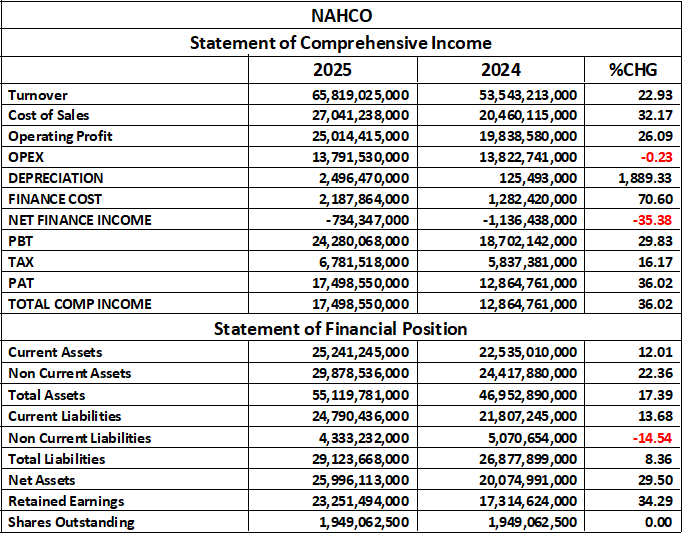
The company’s total assets was up by 17.39% to ₦55.12 billion in 2025 from ₦46.95 billion in 2024, a further confirmation of the continued expansion in company’s asset base. Non-current assets stood at ₦29.88 billion, reflecting a 22.36% increase from the prior year, suggesting an ongoing capital investment in property, plant, equipment, and operational infrastructure. Current assets rose to ₦25.24 billion, up by 12.01% from ₦22.54 billion in 2024, supported by improved liquidity and working capital levels. Total liabilities increased moderately to ₦29.12 billion, representing an 8.36% rise from ₦26.88 billion in 2024. Current liabilities stood at ₦24.79 billion, up by 13.68%, indicating higher short-term obligations, possibly driven by increased operational activity. In contrast, non-current liabilities declined significantly to ₦4.33 billion, a 14.54% reduction from ₦5.07 billion in 2024, reflecting debt repayment and improved long-term financial positioning.
Net assets (total equity) increased strongly to ₦25.99 billion, representing a 29.50% growth from ₦20.07 billion in 2024. Retained earnings rose significantly to ₦23.25 billion, up by 34.29%, driven by the Company’s strong profitability during the year. Share capital remained unchanged, with 1.95 billion shares outstanding, indicating no dilution during the reporting period. NAHCo continues to maintain a balanced capital structure, with equity growth outpacing liabilities. The reduction in non-current liabilities combined with strong retained earnings highlights improved financial stability and reduced leverage risk.
Financials Strength/Solvency Ratio
- Debt Ratio: 2025 at 52.84%, and 2024: 57.24%, a change of negative 7.70%, is an indication that total liabilities now fund a smaller portion of assets which can be interpreted as: Reduced in financial risk, improved balance sheet quality, and stronger asset backing by equity.
- Debt-to-Equity Ratio: 2025: 1.12x and 2024: 1.34x for a negative change of 16.32%, the company is less leveraged than prior year. That is: it recorded lower dependence on debt financing, pointing to an improved solvency and financial flexibility, just as it also implies a better capacity to withstand economic shocks.
- Equity Ratio: 2025: 47.16% to 2024: 42.76%, a positive change of 10.31% tells that nearly half of the company’s assets are now financed by equity. This shows: stronger capital base, increased shareholder backing, and reduced creditor dominance.
- Beta Value at 0.52 indicates low volatility relative to the market. We can say, the stock is defensive/less risky, just as it shows lower sensitivity to market swings, and remains attractive for conservative investors.
Overall Financial Strength Verdict: The strong improvement in solvency, deleveraging is clearly visible, equity position strengthened significantly, and that the risk profile has reduced. The business is still moderately leveraged, but trending positively with a healthy mix of debt and equity.

Profitability Ratios
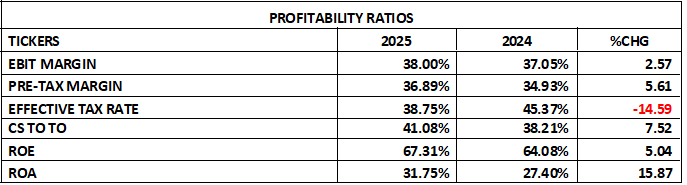
- EBIT Margin: 2025: 38.00% and 2024: 37.05%, a positive change of 2.57% tells that the company is generating more operating profit per ₦1 of revenue, which means a stronger operational efficiency and good cost control at core operations level.
- Pre-Tax Margin: 2025: 36.89% and 2024: 34.93%- a percentage change of positive 5.61%: Profitability improved despite the finance costs. This is interpreted as better earnings quality, and strong expansion in core profitability.
- Effective Tax Rate: 2025: 38.75% and 2024: 45.37%- a negative change of 14.59%: This is lower tax burden relative to earnings. A sign of improved tax efficiency, and positive boost to net profit
- Cost of Sales to Turnover (CS/TO): 2025: 41.08% and 2024: 38.21%- a change of positive 7.52% is a key concern, pointing to the fact that direct costs are rising faster than revenue. This puts pressure on gross margin, and is a sign of possible inflation/operational cost push increases.
- Return on Equity (ROE): 2025: 67.31% and 2024: 64.08% for a positive change of 5.04%: this is extremely strong. It proves excellent returns to shareholders, and confirms the efficient use of equity capital
- Return on Assets (ROA): 2025: 31.75% and 2024: 27.40% for a positive change of 15.87%: Again this is very impressive which can be explained as strong asset utilization, and high efficiency in generating profits from assets
Overall Profitability Verdict: The observed major strengths are: strong margin expansion (EBIT & Pre-tax), exceptional ROE and ROA, improved tax efficiency, and high earnings quality. Nevertheless, the key Area to watch out for is the rising cost of sales (margin pressure risk). Aside this we conclude that NAHCo is highly profitable, efficient in capital utilization, and delivering strong shareholder returns.
Efficiency Ratios
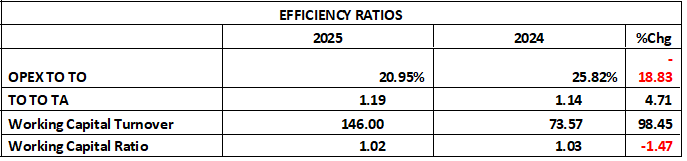
- OPEX to Turnover: 2025: 20.95% and 2024: 25.82% for a negative percentage change of 18.83%: This is a major improvement which means lower operating expenses relative to revenue, strong cost discipline, plus a better operational efficiency. This trend supports the strong EBIT margin we noted earlier.
- Turnover to Total Assets (Asset Turnover): 2025: 1.19x and 2024: 1.14x for a positive percentage change of 4.71% the company is generating more revenue per ₦1 of assets. This shows; improved asset utilization, and efficient deployment of capital investments.
- Working Capital Turnover: 2025: 146.00x and 2024: 73.57x for a percentage change of positive 98.45%. This is an extremely strong improvement. It means; very efficient use of working capital, faster cash conversion cycle, and strong operational liquidity management style. Note also that this level is very high, it could also indicate tight working capital base. Therefore, we suggest that sustainability should be monitored.
- Working Capital Ratio (Current Ratio): 2025: 1.02 and 2024: 1.03x for a negative percentage change of 1.47%: There is a slight decline but, in our opinion it is still stable. Just above minimum safe level (1.0x), the company can meet short-term obligations, but with limited buffer.
Overall Efficiency Verdict: The Strengths observed here are: a significant improvement in cost efficiency (OPEX/TO ↓), better asset utilization, and and exceptional working capital efficiency. On the other hand, the Watch Areas are: Tight liquidity position (Current ratio ~1.0x), and the fact that the extremely high Working Capital turnover may signal pressure on working capital. Else, we agree that NAHCO demonstrates: Efficient operations, strong cost management, and Improved capital utilization.
Investment/Valuation Ratios
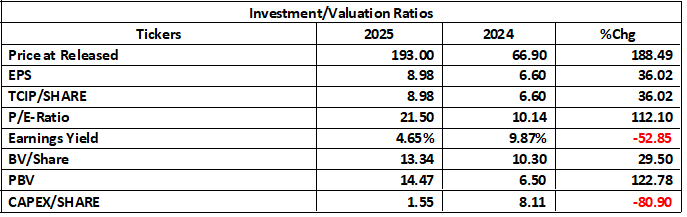
- Share Price Growth: 2025: ₦193.00 and 2024: ₦66.90 for a percentage change of 188.49%: This is a massive price rally within the two financial years compared, showing a strong market confidence in the stock. The stock is already re-rated significantly.
- Earnings Per Share (EPS): 2025: 8.98 and 2024: 6.60 for a percentage change of positive 36.02%. Earnings are growing solidly. It is important to understand that the real fundamental growth supports price increase, the move is not just speculative rally
- P/E Ratio: 2025: 21.50x and 2024: 10.14x for a percentage change of positive 112.10%: Valuation has expanded sharply. Meaning that, investors are paying more than double for the same ₦1 earnings. The stock is becoming expensive. Nevertheless, it can also be interpreted as heightened investors’ confidence in the company’s shares.
- Earnings Yield: 2025: 4.65 and 2024: 9.87%- a change of negative 52.85% points to declining attractiveness which confirms the lower return relative to price and less appealing versus fixed income alternatives.
- Book Value Per Share: 2025: 13.34 and 2024: 10.30 for a percentage change of positive 29.50% is a strong equity growth. Which simply means that the company is building intrinsic value.
- Price-to-Book Value (PBV): 2025: 14.47x and 2024: 6.50x- a change of 122.78% is Very high indeed and shows that the market is pricing the stock far above its net assets. Depends on how it is viewed, it can also suggests overvaluation risk.
- CAPEX per Share: 2025: 1.55 and 2024: 8.11 for a change of 80.90%: This shows a significant drop in investment. Lower reinvestment in assets could boost short-term profit, but it may affect long-term growth if sustained
Overall Investment / Valuation Verdict: The strengths include: Strong EPS growth, rising Book Value, and the fact that market confidence is high, while major concerns points are: The stock is heavily re-rated, High P/E and PBV signifies expensive valuation, and falling earnings yield, and declining CAPEX (growth sustainability risk) are also points of concerns.
Dividend Information
NAHCo reported a modest increase in cash dividend to ₦6.25 in 2025, while its payout ratio declined to 69.62% from 89.99% in 2024, indicating a shift towards a more sustainable dividend policy, with the company retaining a greater portion of earnings to support future growth. Although the headline dividend yield dropped significantly to 3.24%, this is largely driven by the sharp increase in share price rather than a deterioration in dividend capacity. The strong rise in sustainable growth rate to 20.45% further reinforces that NAHCo is now better positioned to grow internally while still maintaining shareholder rewards.
Importantly, the 1-for-7 scrip issue changes the interpretation of these ratios. While the cash dividend yield appears lower, shareholders also received additional shares, effectively boosting total return beyond what the yield alone suggests. This reflects a balanced capital allocation strategy where the company combines cash payouts with equity distribution to preserve liquidity and fund expansion. Overall, NAHCo’s dividend profile has evolved from a high cash payout model to a more growth-oriented approach, offering a mix of income and capital appreciation, which is positive for long-term investors but less attractive for those focused purely on immediate yield.

Final Verdict on NAHCo’s Performance Indices
Nigerian Aviation Handling Company Plc (NAHCo) demonstrates a fundamentally strong performance profile, underpinned by excellent profitability, solid operational efficiency, and improved financial discipline. The company’s margins, returns on equity, and asset utilization indicate a high-quality earnings base, while better cost control and working capital management support operational resilience. Additionally, it’s evolving dividend strategy—combining cash payouts with a 1-for-7 scrip issue reflects a deliberate balance between rewarding shareholders and preserving capital for growth.
Overall, NAHCo represents a high-quality business with strong growth prospects and efficient capital management, but its current market pricing introduces downside risk in the short term. As such, the stock is best viewed as a HOLD, with a bias towards profit-taking for existing investors and a wait-and-see approach for new entrants, pending the impending price correction.