
Says Fiscal Discipline, Regional Integration Buffers Against Shocks
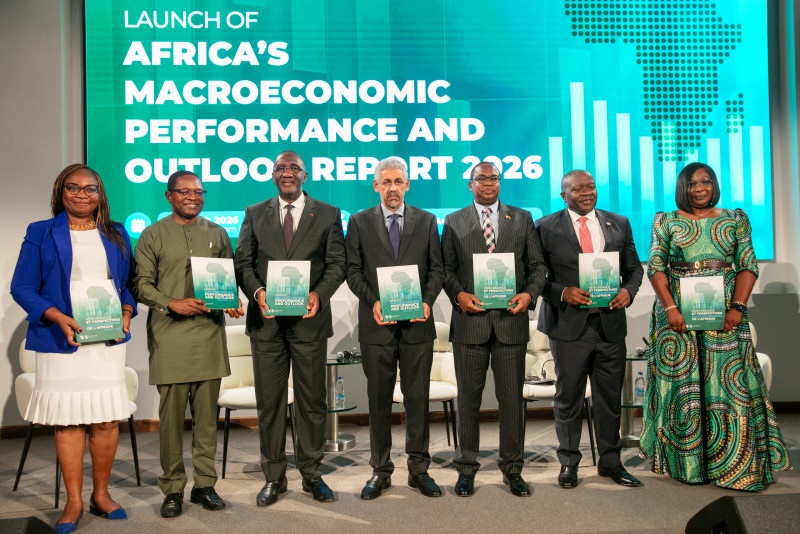
Amid the raging regional and global headwinds, the 2026 Africa Macroeconomic Performance and Outlook (MEO), a new report by the African Development Bank Group (AfDB), says Africa continues to demonstrate impressive resilience and maintains its status as a global growth frontier.
According to the report released at the Bank Group headquarters in Abidjan, the continent’s GDP is forecast to remain stable at 4.3% this year, before hitting 4.5% next year, from its 4.2% which outpaced the 3.1% global average growth of 2025.
A key finding in the report, according to the statement by AfDB Group is the “broad-based” surge, with growth exceeding 5 per cent in 22 African countries, and topping 7 per cent in six, bolstered by easing inflationary pressures, improved macroeconomic management and favourable agricultural conditions.
The report further showed that 12 of the 20 fastest-growing economies in the world in 2025 were African, even as East Africa maintained its lead as the continent’s fastest-growing region at 6.4 percent GDP growth. The region’s expansion was mainly driven by the surge in growth performances of 9.8 per cent in Ethiopia, 7.5 per cent in Rwanda, and 6.4 per cent in Uganda.
Similarly, Africa’s GDP per capita growth rose from 0.9% in 2023 to 1.1% in 2024 and 1.9% in 2025, which ]remains too low to propel rapid poverty reduction on the continent.
Inflation is declining, the MEO noted, with average inflation estimated at 13.6 percent in 2025, down from 21.8 percent in 2024; further reductions are projected for 2026 and 2027 it added.
Foreign direct investment rebounded sharply in 2024, rising by more than 75% to reach $97 billion; just as remittance flows rebounded strongly in 2024, rising by more than 14 percent to $104.6 billion, enough to offset the 6 percent decline recorded in 2023 and making remittances the largest single source of external non-debt financing, surpassing foreign portfolio investment.
Speaking at the launch, the President of the African Development Bank Group, Dr Sidi Ould Tah, said the continent faces an “important moment when the world is changing, not always in favour of the African continent.”
Citing a difficult landscape of increasing geopolitical fragmentation, trade tensions, and declining global development finance flows, he positioned the Bank Group’s Four Cardinal Points agenda as a vital strategic shield, explaining that “each one speaks directly to the challenges this Macro Economic Outlook report has identified and quantified.”
In light of recent developments in the Middle East, Dr Ould Tah noted that the 2026 MEO analysis and projections “were prepared before the current crisis” began.
The Bank Group and partners including the United Nations Development Programme, he added, are currently assessing the potential consequences of the crisis on the continent.
In his detailed presentation, the Bank Group Chief Economist and Vice President for Economic Governance and Knowledge Management, Prof Kevin Urama, expressed optimism that the current crisis would have a limited impact on Africa’s macroeconomic landscape in 2026.
Africa, he noted, “has held strong in previous shocks, and has the capacity to bounce back after, provided we do not panic and we instead apply the right policy levers. In our estimates, if the crisis lasts beyond three months, it might cause a dip of 0.2 percentage point in Africa’s economic growth rate in 2026.”
An expert-led panel followed the presentation and explored the report’s findings and policy recommendations aimed at sustaining growth, strengthening financial systems, and mobilising development finance at scale. Panellists included Souleymane Diarrassouba, the Minister of Planning and Development of Côte d’Ivoire; Augustine Kpehe Ngafuan, Minister of Finance and Development Planning of Liberia; Prof Mthuli Ncube, Minister of Finance of Zimbabwe; Dr Retselisitsoe Matlanyane, Minister of Finance and Development Planning of Lesotho; and Mrs Aminata Toure, the International Monetary Fund Resident Representative for Côte d’Ivoire.
The panelists emphasised the importance of sustaining reforms linked to domestic resource mobilisation, including deepening local equity and fixed-income markets, and scaling digitalisation efforts to improve the efficiency of tax collection.
They also shared success stories from ongoing reforms in their respective countries. A consensus emerged that Africa’s experiences with shocks can position the continent to draw on valuable lessons to weather current and future challenges.
The African Development Bank Group publishes the Macroeconomic Report biannually to complement its annual Africa Economic Outlook. Dr Ould Tah described the series as a demonstration of “the Bank’s commitment to provide our member countries, our partners and our investors with the most rigorous, timely and actionable analysis.”