
Market Update For January 26, 2026
The Nigerian equities market began the new trading week on a subdued and cautious note, reflecting a lack of strong conviction among market participants. Trading activities were largely mixed as investors continued to balance short-term profit-taking with selective bargain hunting, particularly in stocks that have corrected to technically attractive levels. The overall tone of the market suggested consolidation rather than a clear directional move, as participants awaited stronger catalysts to guide positioning.
Sectoral performance underscored the mixed sentiment across the market. The Banking sector closed marginally positive, supported by renewed demand for some tier-one names amid expectations of sustained earnings resilience and dividend prospects. This mild accumulation indicates that investors are still positioning defensively in fundamentally strong stocks, even as overall liquidity remains thin. The Consumer Goods sector also closed slightly higher, aided by selective buying in stocks with relatively stable demand outlooks, despite lingering cost pressures and cautious consumer spending.
In contrast, the Insurance sector recorded notable losses, as investors continued to rotate out of stocks perceived to be lagging in earnings momentum. The Oil & Gas sector ended the session marginally lower, reflecting cautious sentiment and mild profit-taking, despite supportive movements in the global energy market. This divergence suggests that local positioning is still driven more by technical factors and liquidity conditions than by global price movements.
Market activity remained soft throughout the session, reinforcing the cautious tone. Total traded volume and value declined sharply, pointing to reduced participation from both retail and institutional investors. The slowdown in trades indicates that many market players are staying on the sidelines, waiting for clearer signals before committing fresh funds. Nonetheless, activity in select stocks, particularly within the banking space, highlighted ongoing interest in counters with strong fundamentals and liquidity.
On the global stage, the oil market provided a relatively supportive macro backdrop, even though its impact on local equities remained muted. Crude prices steadied after posting solid gains in the previous week, underpinned by supply disruptions in key U.S. producing regions following severe winter weather. These outages temporarily reduced output, tightening physical supply and supporting prices. At the same time, geopolitical tensions between the United States and Iran continued to inject a risk premium into the market, as investors remained wary of potential supply-side shocks.
While Kazakhstan moved to restore production at its major oilfields and export terminals, output levels were still reported to be below normal, limiting downside pressure on prices. As a result, Brent crude hovered comfortably above recent support levels, while WTI remained firm, reinforcing expectations that oil prices could stay range-bound but elevated in the near term. For Nigeria, stable oil prices are broadly supportive of fiscal stability and foreign exchange inflows, although domestic equity prices are yet to fully reflect this macro benefit.
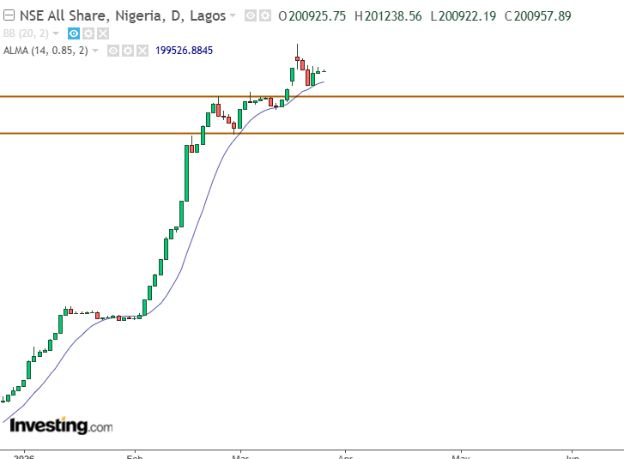
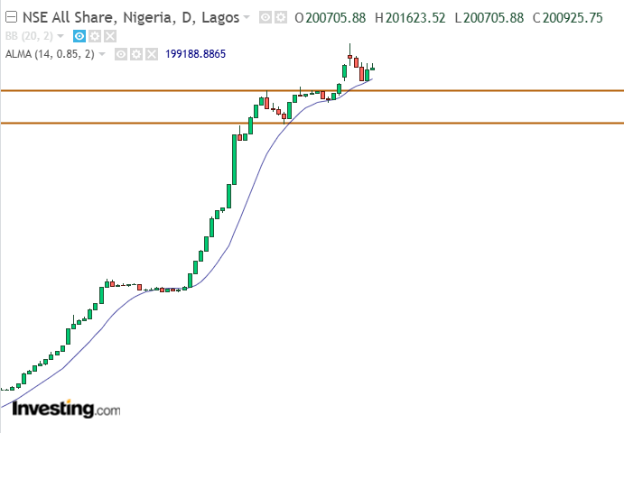
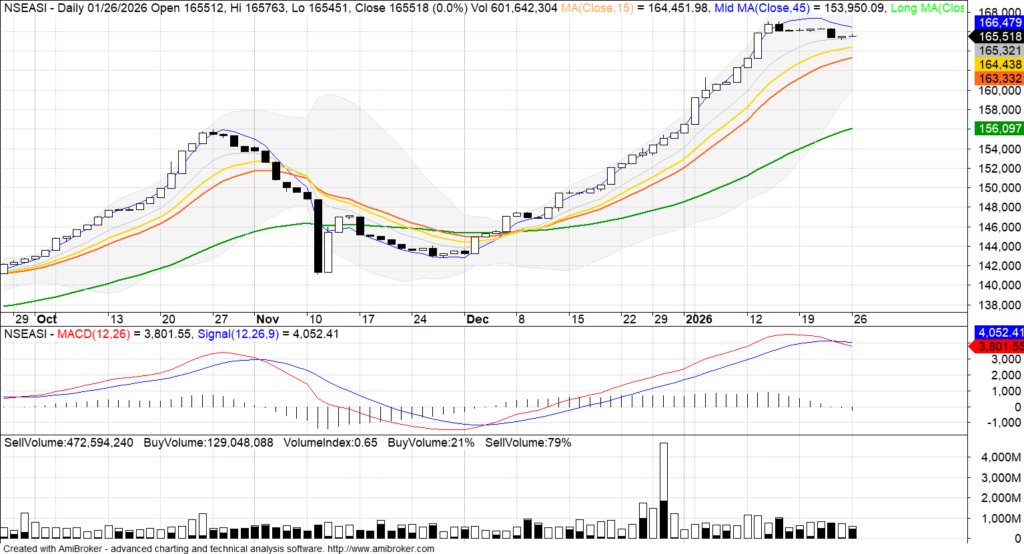
From a technical perspective, the Nigerian market remains firmly in a consolidation phase. The All-Share Index continues to trade within a narrow band, reflecting indecision and weak momentum. The index has successfully held above the 165,000 psychological support zone, suggesting that downside risk is currently limited by bargain hunters stepping in at lower levels. However, repeated failures to break above the 166,500–167,000 resistance region point to the absence of strong buying pressure.
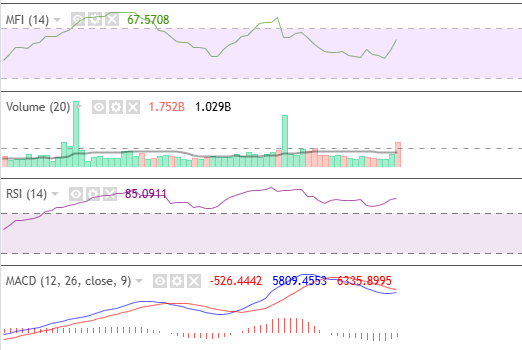
Momentum indicators remain mixed, with declining volume confirming the lack of strength behind recent price movements. This pattern typically precedes either a breakout or a pullback, depending on the direction of the next surge in liquidity. Until volume improves significantly, the market is likely to remain range-bound, with short-term traders exploiting price swings while long-term investors selectively accumulate fundamentally strong stocks.
Outlook:
In the near term, we expect the Nigerian equities market to continue trading sideways, with intermittent pullbacks providing entry opportunities in stocks with solid earnings outlooks and strong technical support. A sustained breakout above resistance will require improved liquidity, stronger market breadth, and positive earnings or macroeconomic triggers. Investors and traders are advised to remain selective, manage risk carefully, and align positions with both technical signals and fundamental strength.
At the close, the All-Share Index (ASI) ended marginally higher by 0.003% to 165,517.56 points from 165,512.18 points, lifting market capitalisation by ₦3.45bn to ₦105.96trn. Market breadth closed flat with 35 gainers and 35 losers. Top gainers were MORISON (+9.97%), DEAPCAP (+9.94%), UHOMREIT (+9.95%), SCOA (+9.87%) and SKYAVN (+9.85%), while the top losers included MAYBAKER (-10.00%), NEIMETH (-9.81%), CWG (-9.05%), ABCTRANS (-9.33%) and SOVRENINS (-8.97%).