
The Nigerian equities market recorded a mixed but largely positive performance last week, closing with solid gains despite bouts of profit-taking, continued portfolio rebalancing and sector rotation ahead of the oncoming earnings reporting season.
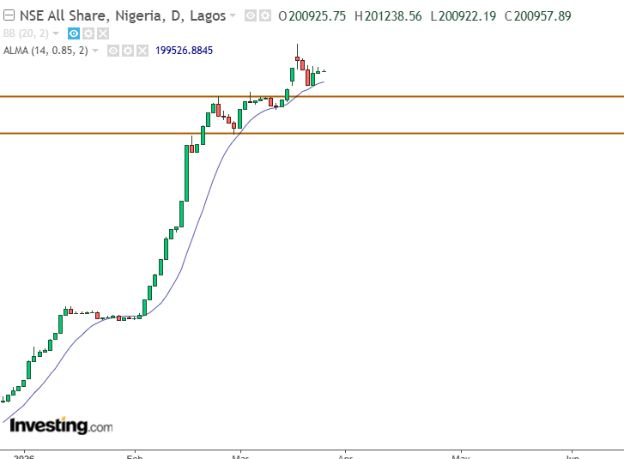
NGXASI Daily Chart
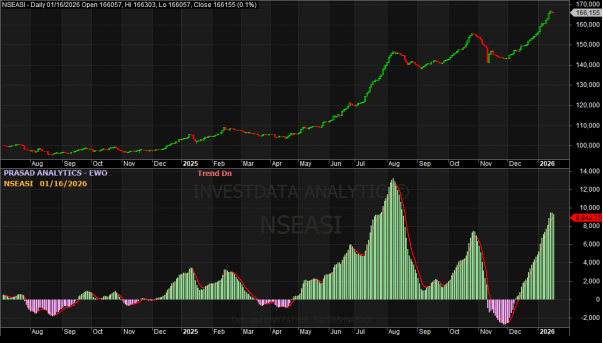
Trading for the week opened strongly on Monday as the All-Share Index (ASI) climbed 0.58% to 163,244.69 points, lifting investors’ wealth by ₦744.99 billion. Sentiment was clearly upbeat, with 49 gainers against 19 losers. Trading activity was robust, with 1.15 billion shares valued at ₦19.23 billion changed hands. Sovereign Trust Insurance dominated by volume, while Fidelity Bank led in value.
Midweek’s momentum remained intact, with the ASI advancing 0.56% to 166,771.95 points and adding ₦598.41 billion to market capitalisation. Market breadth stayed positive, as 47 stocks gained compared with 26 decliners. However, activity eased, with 761.94 million shares worth ₦29.85 billion traded. Access Holdings topped volume, Aradel led value, while stocks such as NCR, McNichols and Multiverse traded above their 52-week highs.
On Thursday, the market pulled back as profit-taking set in, dragging the ASI down by 0.43% to 166,057.29 points and erasing ₦457.58 billion in market value. Losses in Ikeja Hotel, Eterna, Aradel and MTN Nigeria weighed on the market, although stocks like Nestlé, NCR and Jaiz Bank remained above their 52-week highs. Trading activity improved, with Sovereign Trust Insurance leading volume and Zenith Bank dominating value.
The market ended the week on a modest positive note on Friday, as the ASI edged up 0.04% to 166,129.50 points, adding ₦30.46 billion to investors’ wealth. Market sentiment stayed favourable, with 41 gainers against 26 losers. NCR and May & Baker led the gainers, while activity slowed to 539.88 million shares valued at ₦16.72 billion. Zenith Bank topped both volume and value for the session.
Overall, trading activity improved on a week-by-week basis, with total turnover rising to 4.607 billion shares worth ₦130.64 billion across 263,439 deals, compared with 4.164 billion shares valued at ₦94.03 billion in the previous week. The Financial Services sector dominated activities, accounting for 67.84% of total volume and 36.15% of total value, followed by the Services and ICT sectors. Sovereign Trust Insurance, Access Holdings and Linkage Assurance were the most actively traded stocks for the week.
Market performance was broadly positive, as the NGX All-Share Index gained 2.36% to close at 166,129.50 points, while market capitalisation rose 2.48% to ₦106.35 trillion. All sectoral indices closed higher, except the NGX AFR Dividend Yield Index, which declined marginally by 0.15%.
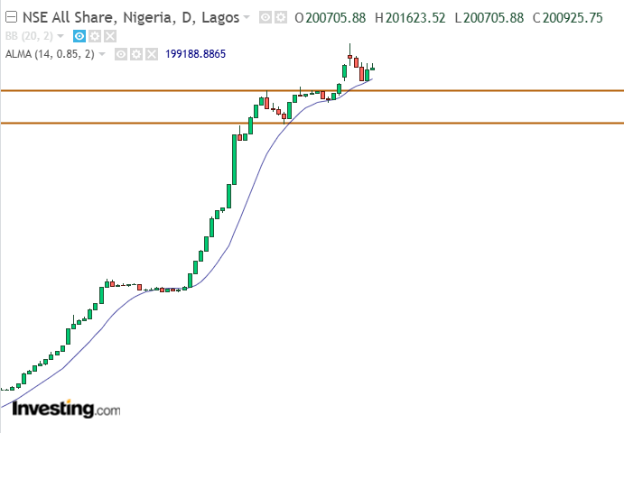
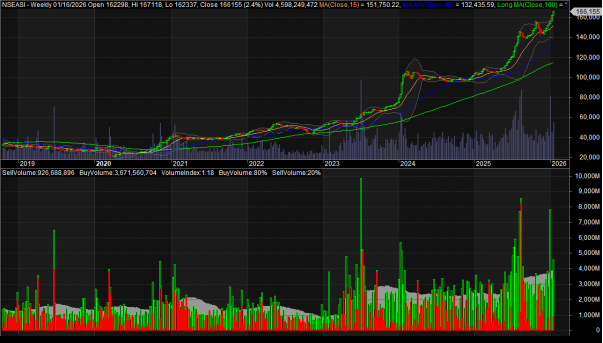
NGXASI Weekly Chart
The Nigerian equities market remains structurally bullish, despite short-term profit-taking and slowing momentum. Price action across the week shows a market that is digesting recent gains, not reversing trend.
The NGX All-Share Index (ASI) continues to trade above its key short, medium and long-term moving averages, confirming that the primary uptrend is intact. The sequence of higher highs and higher lows remains unbroken, while recent pullbacks have been shallow and quickly absorbed, signalling sustained demand.
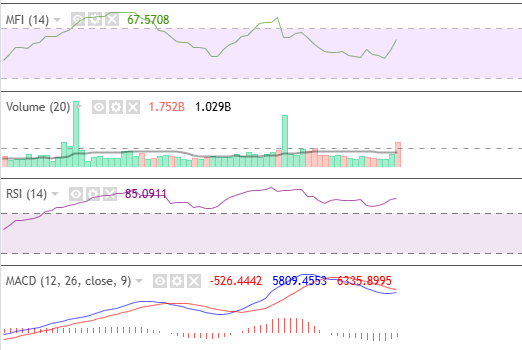
Momentum indicators point to cooling, rather than weakness. The RSI has eased from overbought levels but stays above neutral, while the MACD remains positive though flattening. This setup typically precedes consolidation or a mild retracement, rather than a broad sell-off. Volume patterns further support this view, as up-days continue to attract stronger participation than down-days, indicating that selling pressure is largely profit-driven.
Technically, the market is consolidating near resistance around 166,800–168,000 points, with immediate support seen at 164,000–165,000 points. A deeper but healthy retracement could test the 160,000–162,000 zone, which aligns with prior breakout levels and represents a strong demand area. As long as the ASI holds above this region, the broader bullish structure remains valid.
Market internals are encouraging. Breadth has stayed positive, new 52-week highs continue to outpace lows, and sectoral rotation is evident rather than wholesale risk-off behaviour. Financial services stocks still dominate liquidity, while accumulation is gradually shifting toward earnings-driven and defensive names, a pattern typical of a mid-cycle bull phase.
Market Outlook:
The base-case scenario is continued sideways-to-slightly-bullish consolidation, followed by a potential upside breakout if volume expands. A clean break above resistance could open the way toward higher targets, while any pullback toward support is likely to attract buyers. Overall, the technical bias remains positive, with selectivity and disciplined risk management becoming increasingly important at this stage of the rally.
NCR Plc Chart
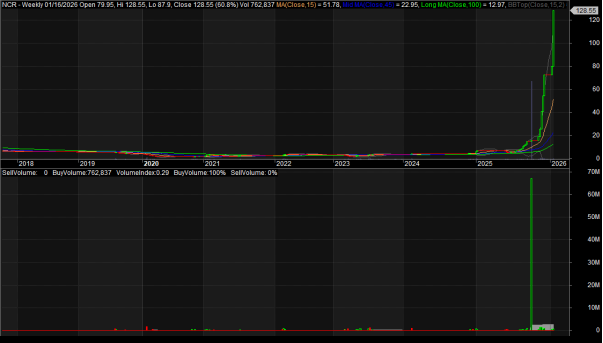
On the price movers’ chart, NCR (Nigeria) Plc topped the gainers with a 60.79% surge to ₦128.55, driven by renewed investor interest in the payments and digital banking technology provider. SCOA Nigeria Plc followed with a 59.36% rise to ₦14.90, as buying momentum returned to the diversified industrial and automotive company. Deap Capital Management & Trust Plc gained 48.67% to ₦4.46, supported by speculative activity in the investment and financial services firm. Jaiz Bank Plc advanced 45.73% to ₦8.19, reflecting sustained accumulation in the non-interest bank with a growing retail and SME banking footprint, while Omatek Ventures Plc added 38.28% to close at ₦1.77, boosted by renewed interest in the IT and computer hardware company.
Ikeja Hotel Plc Chart
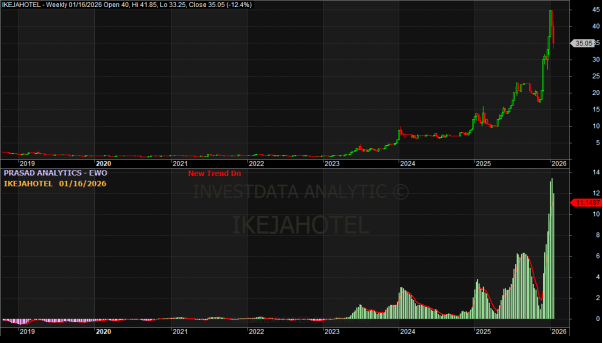
On the losing side, Ikeja Hotel Plc led the declines, falling 12.38% to ₦35.05, as profit-taking hit the hospitality company that operates the Sheraton Lagos Hotel. Austin Laz & Company Plc dropped 9.20% to ₦3.75, reflecting weakness in the engineering and construction services provider. Eterna Plc lost 7.71% to ₦32.30 amid cautious sentiment in the downstream oil marketing sector. Universal Insurance Plc fell 7.69% to ₦1.20, while Eunisell Interlinked Plc slipped 7.57% to close at ₦156.95, as investors booked profits in the industrial chemicals and engineering solutions company.
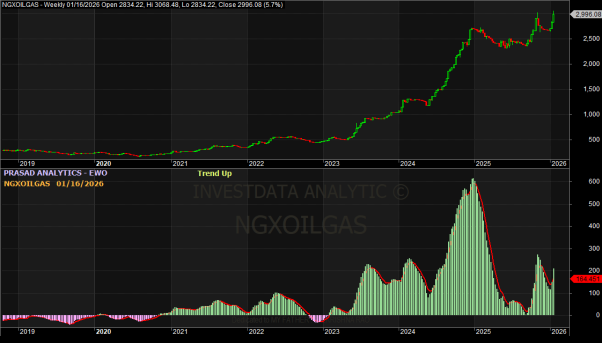
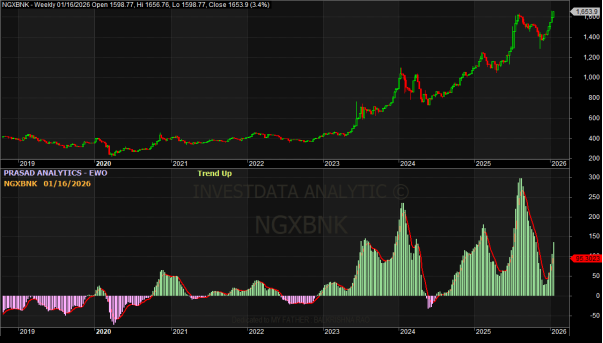
Week-to-date, the All-Share Index has gained 2.36%, NGX 30 is up by 2.26%, the Banking Index has increased by 3.45%, the Pension Index increased by 2.99%, the Insurance Index inclined by 1.78%, the Consumer Goods Index increase by 1.59%. However, the Oil and Gas Index recorded a positive return of 5.71%. Year-to-date, the All-Share Index has gained 6.76%, NGX 30 is up by 6.26%, the Banking Index has increased by 9.11%, the Pension Index index increased by 8.92%, the Insurance Index inclined by 10.98%, the Consumer Goods Index increase by 4.61%. However, the Oil and Gas Index recorded a positive return of 12.20%. In terms of market breadth, 80 stocks advanced, while 17 declined.
Trending in the Economy: The federal government plans to spend ₦92.9 billion on electricity and diesel for its agencies in 2026, with Defence, Health and Education taking the largest share. The allocation reflects the continued dependence on generators as unreliable grid power persists, highlighting the slow pace of improvement in electricity supply to public institutions despite ongoing reforms.
Nigeria’s headline inflation eased to 15.15% in December 2025 from 17.33% in November, following the rebasing of the Consumer Price Index by the National Bureau of Statistics. Month-on-month inflation slowed to 0.54%, driven mainly by lower food prices, especially staples such as tomatoes, garri, eggs, grains and vegetables. Core inflation also moderated to 18.63%. Urban inflation stood at 14.85%, while rural inflation was 14.56%. At the state level, Abia recorded the highest inflation at 19.03%, while Sokoto had the lowest at 8.61%. The NBS said the revision aligns Nigeria with international standards and advised caution when comparing inflation figures across states.
Global Market and Oil: Wall Street closed Friday with mild weekly losses despite strong earnings from major technology firms and U.S. banks. The U.S. dollar remained near a six-week high after President Donald Trump suggested he may not appoint a known rate-cut advocate as the next Federal Reserve chair, adding to market uncertainty.
Investor sentiment has been shaky just two weeks into 2026, following a series of geopolitical and policy shocks including U.S. involvement in Venezuela, Trump’s stated interest in Greenland and renewed threats against Fed Chair Jerome Powell, all of which have raised concerns about the independence of the central bank.
U.S. stocks briefly turned lower and Treasury yields rose after Trump said he might keep economic adviser Kevin Hassett in his current role, reducing expectations that Hassett would succeed Powell. By the close of trading, the Dow Jones Industrial Average fell 83.11 points, or 0.17%, to 49,359.33, while the S&P 500 slipped 4.46 points, or 0.06%, to 6,940.01. The Nasdaq Composite also eased, losing 14.63 points, or 0.06%, to finish at 23,515.39. Over the week, the S&P 500 declined 0.38%, the Nasdaq dropped 0.66% and the Dow fell 0.29%.
Market activity remained subdued as investors waited for more earnings reports. According to Anthony Saglimbene of Ameriprise Financial, markets have largely been flat as traders position ahead of upcoming results, with many viewing the S&P 500 holding close to the 7,000 level so early in the year as a positive outcome.
Interest in artificial intelligence stocks picked up again after strong results from chipmaker TSMC, although some investors rotated out of heavyweight technology names into smaller-cap stocks in search of better value. Financial stocks underperformed during the week, partly due to Trump’s proposal to cap credit card interest rates, despite solid quarterly earnings from major U.S. banks that pointed to underlying economic strength. Defensive sectors such as consumer staples, real estate and utilities fared better. Netflix, Johnson & Johnson and Intel are among major companies set to report earnings next week.
Speculation around Federal Reserve leadership intensified after Trump praised Hassett but said moving him could be counterproductive. Betting markets responded by pushing the probability of former Fed Governor Kevin Warsh becoming the next Fed chair up to 57% from 44%. Treasury yields moved higher following the comments, with the benchmark 10-year yield rising 6.7 basis points to 4.227% from 4.16% late Thursday.
In currency markets, the dollar index edged up 0.03% to 99.38, while the euro slipped 0.05% to $1.1599. The index had touched a six-week high a day earlier after stronger-than-expected U.S. jobs data reduced expectations for near-term interest rate cuts. Markets are now pricing only a 20% chance of a rate cut in March, down from about 50% a month ago. The Japanese yen strengthened after Finance Minister Satsuki Katayama said authorities would not rule out measures to counter currency weakness.
Oil prices rose as traders covered short positions ahead of the U.S. long weekend for Martin Luther King Jr. Day and continued to monitor supply risks linked to unrest in Iran, despite easing fears of U.S. intervention. Brent crude settled at $64.13 a barrel, up 37 cents or 0.58%, while U.S. West Texas Intermediate ended at $59.44 a barrel, up 25 cents or 0.42%. Potential increases in Venezuelan supply helped limit gains.
Gold eased after its recent safe-haven surge as investors locked in profits. Prices fell more than 1% earlier in the session before recovering some ground to trade up 0.44% at $4,593.28 an ounce, though the metal still appeared set for a second consecutive weekly gain.
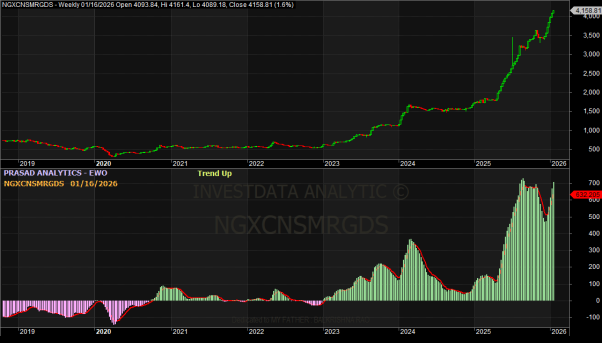
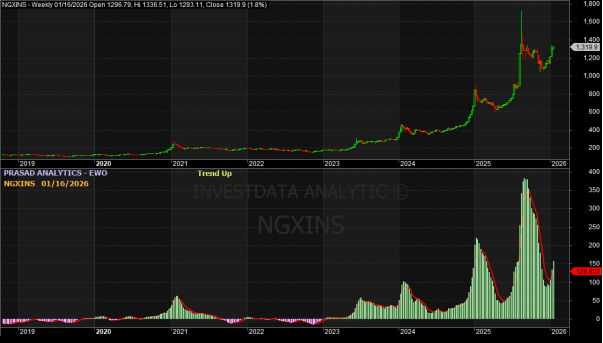
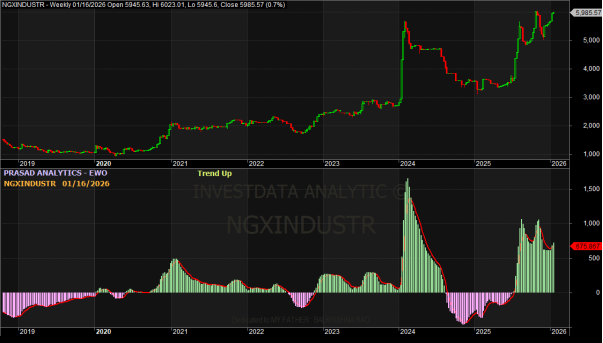
Sectorial Indexes Weekly Charts
NGX Banking Index
NGX Consumer Goods Index
NGX Insurance Index
NGX Industrial Goods Index
NGX Oil & Gas Index