

Market Update For March 26, 2026
The Nigerian equities market sustained its gradual ascent on Thursday, March 26, 2025, as persistent liquidity and targeted accumulation in fundamentally strong counters kept the benchmark index in positive territory. The session marked another extension of the ongoing rally, albeit at a slower pace, reflecting a market that is advancing cautiously while contending with intermittent profit-taking and weakening internal breadth.
From the opening bell, trading sentiment leaned mildly positive, supported by renewed interest in bellwether and mid-tier stocks across key sectors, particularly banking, consumer goods, and industrial names. Investors continued to rotate into counters with strong earnings resilience, attractive dividend prospects, and relative price stability, reinforcing the defensive undertone currently shaping market behaviour. At the same time, speculative positioning in select low-cap stocks added momentum to the upside, as traders sought to capitalize on short-term price inefficiencies.
However, beneath the surface, the market painted a more nuanced picture. While the index closed higher, the distribution of gainers and losers revealed persistent fragility in market internals. The negative breadth underscores the narrowing leadership of the rally, with gains concentrated in a handful of stocks, while a broader segment of the market faced selling pressure. This divergence typically signals caution, suggesting that the current uptrend may be approaching a near-term inflection point if broader participation does not improve.
Market activity provided a more encouraging signal, as both volume and value traded recorded a notable uptick. This increase reflects heightened engagement from both institutional and retail investors, likely driven by portfolio rebalancing and tactical positioning. The dominance of high-cap, liquid stocks in value turnover highlights a preference for safety and stability, especially in a market environment still influenced by macroeconomic uncertainties and global risk factors. Meanwhile, strong volume in financial services stocks further confirms the sector’s central role in driving overall market liquidity.
In the global macro landscape, oil prices staged a strong rebound, reversing prior session losses as geopolitical tensions in the Middle East intensified. Brent crude surged above $107 per barrel, while West Texas Intermediate climbed close to $94 per barrel, as concerns over supply disruptions resurfaced. The evolving situation has introduced renewed volatility into global markets, prompting a cautious shift in investor sentiment toward safer assets. For Nigeria, the uptick in oil prices provides a supportive macro backdrop, given its implications for foreign exchange earnings and fiscal stability, although inflationary risks remain a key concern.
Technical Analysis & Outlook:
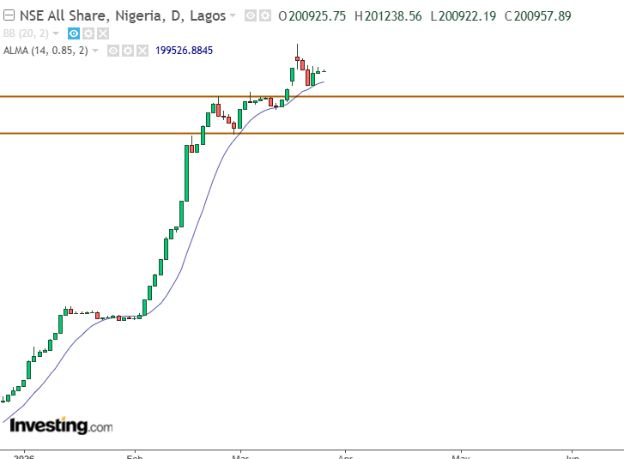
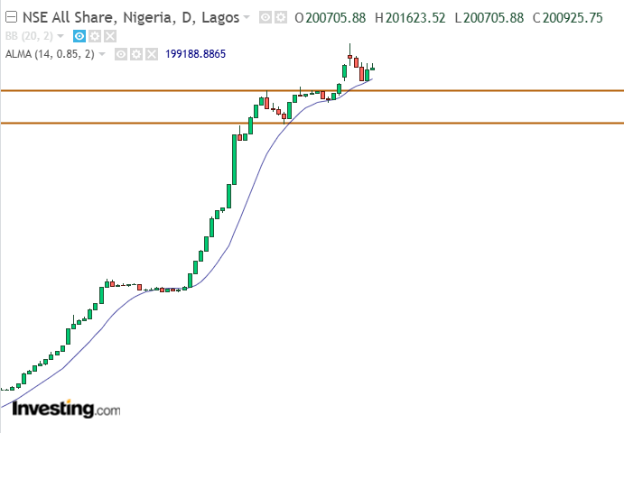
From a technical standpoint, the Nigerian market continues to trade within a bullish framework, with the All-Share Index holding firmly above the critical 200,000 psychological threshold. This level has now been reinforced as a major support zone, underpinning the market’s resilience despite intermittent pullbacks. The prevailing uptrend remains intact, supported by sustained liquidity inflows and selective institutional participation.
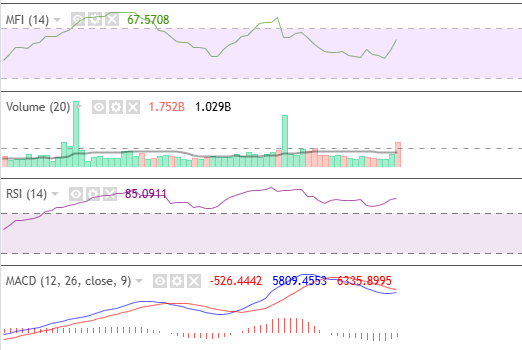
That said, the marginal nature of recent gains, combined with consistently weak market breadth, points to declining momentum. Oscillators and trend indicators suggest that the market may be entering an overbought region, increasing the likelihood of consolidation or a mild corrective phase in the near term. The divergence between price action and underlying participation remains a key concern, as it indicates that the rally lacks the broad-based support required for a strong breakout.
In the sessions ahead, the market is likely to trade with a cautious bullish bias, characterized by intermittent gains and profit-taking. Investors are expected to remain highly selective, focusing on stocks with strong technical setups, earnings visibility, and dividend appeal. Sector rotation will persist, with funds flowing into undervalued opportunities and defensive names, while speculative trades may continue to drive volatility in smaller-cap stocks. External factors, including oil price dynamics, geopolitical developments, and currency stability, will continue to shape investor sentiment and influence market direction.
The benchmark All-Share Index (ASI) rose by 0.02% to close at 200,957.89 points, up from 200,925.75 points, while market capitalisation advanced by N21bn to N129trn, lifting the year-to-date return to 29.14%. Market breadth remained negative, with 36 decliners against 30 gainers, highlighting weak internal strength. Leading the gainers’ chart were PREMPAINTS (+10.00%), REDSTAREX (+9.53%), CWG (+5.53%), MAYBAKER (+3.23%), NB (+1.88%), ZENITHBANK (+1.53%), GTCO (+0.74%), TRANSCORP (+0.73%), MTNN (+0.15%), and FIRSTHOLDCO (+0.10%), while UPL topped the losers’ list. Trading activity strengthened significantly, with total volume rising by 26.05% to 678.13 million shares valued at N33.14bn across 42,222 deals, as ACCESSCORP led volume traded and MTNN dominated value turnover.