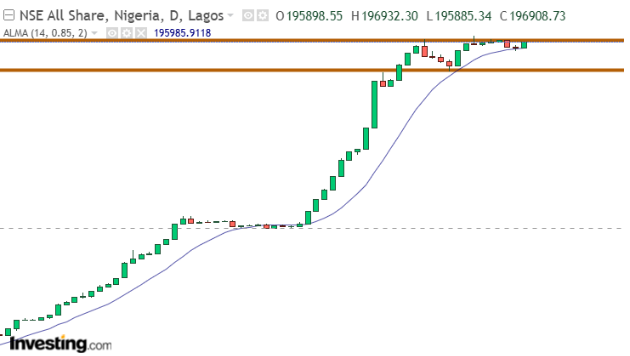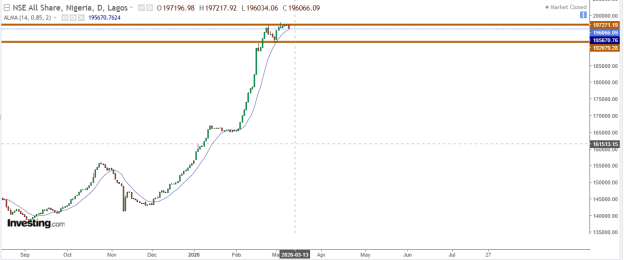

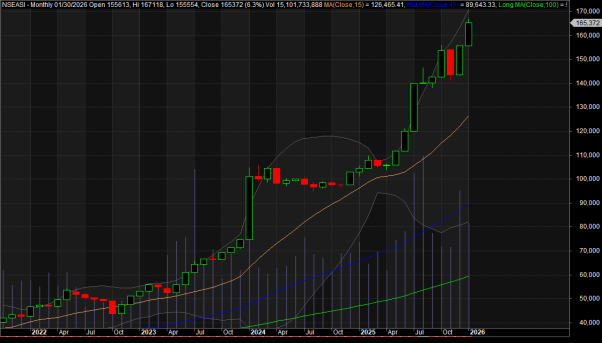
Trading on the Nigerian Exchange delivered a robust but increasingly selective performance across January 2026 to close in the green, recording an average of 10.1% since 2020 to maintain a positive pattern that made the month one of the most profitable periods on exchange.
Market structure clearly reveals phases of accumulation, markup and distribution which was equally experienced in the last trading week of the month, as trend structure was oscillating with buying position, momentum expansion, and consolidation to close in the red.
The month opened with strong risk appetite, peaked at the mid-month on heavy inflows, and closed with mild profit-taking, while overall price levels, market value and technical structure remained supportive of a strong market, especially with the recent corporate scorecards determining the next direction of the NGX in the new month of February.
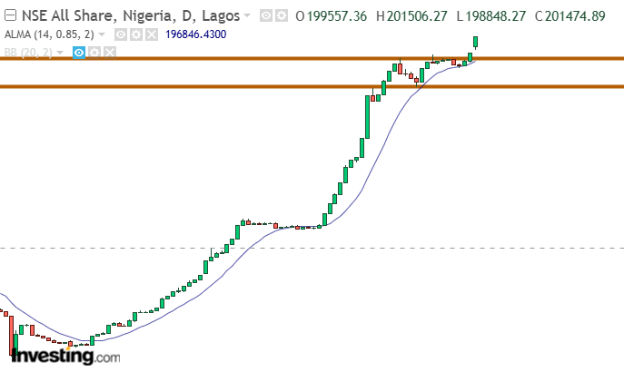
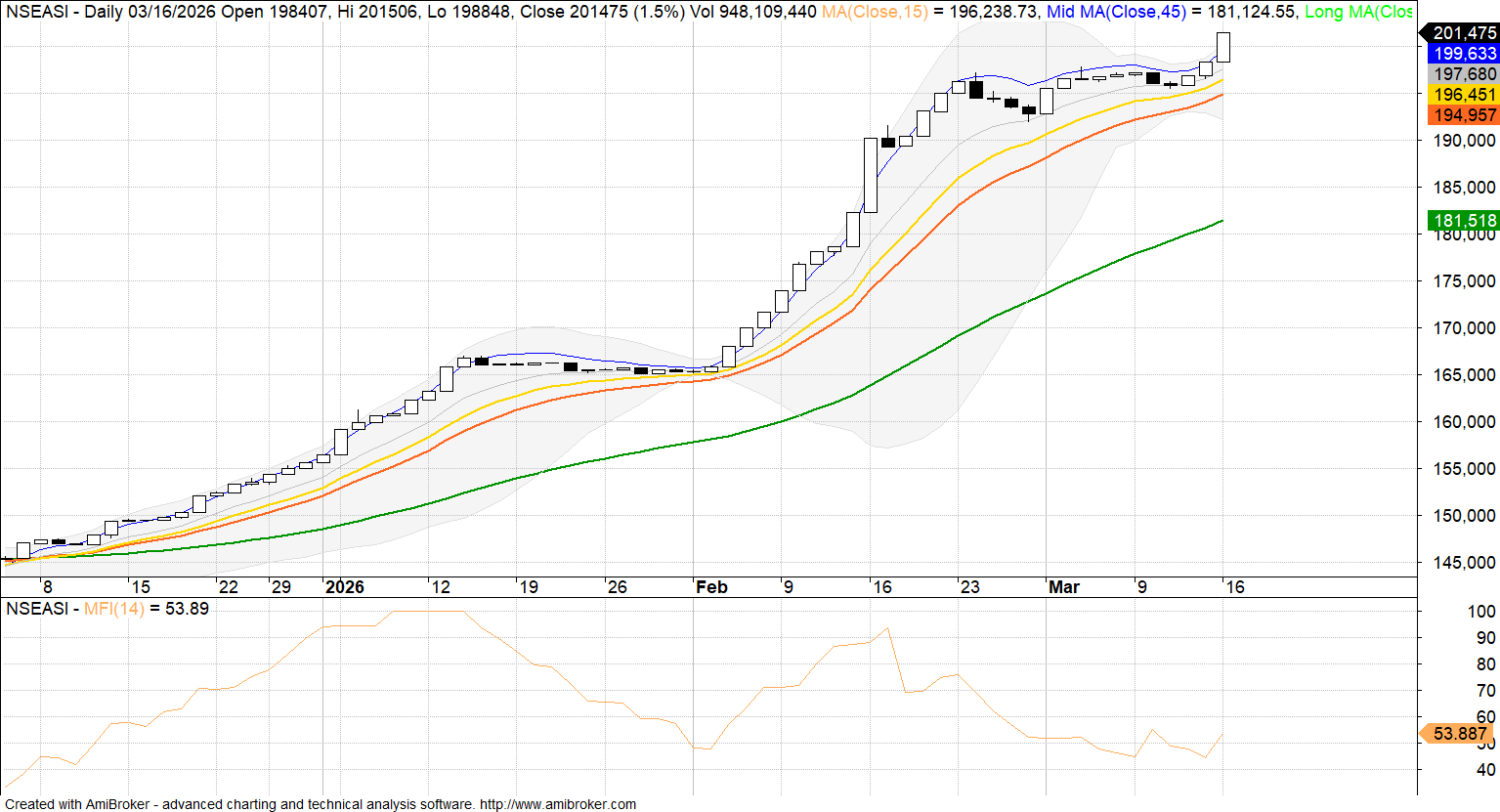
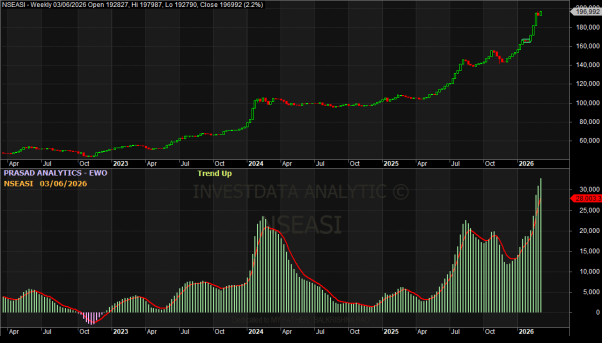
NGXASI Weekly Chart
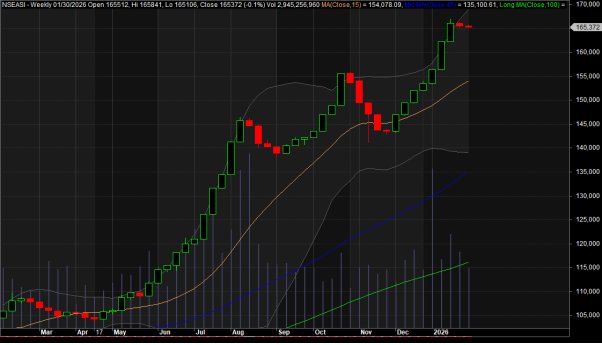
In the first trading week of January, the market kicked off on a positive note despite a shortened trading calendar. The NGX All-Share Index rose by 1.92 percent week-on-week, opening the year around 153,540 basis points and closing at 156,492.36 points. Market capitalisation expanded by about ₦2.05 trillion to close at ₦99.94 trillion, reflecting the renewed investor confidence. Trading activity was elevated, with a total of 7.82 billion shares exchanged at a market value of ₦134.47 billion across 150,799 deals, driven largely by bargain hunting in large-cap financial stocks. Market breadth was also strongly positive, with 52 advancers against 10 decliners. Price action showed strong momentum in Austin Laz, which gained over 45 percent in that week alone, alongside Aluminium Extrusion Industries, Eunisell Interlinked, Associated Bus Company and Honeywell Flour Mills. On the downside, E-Tranzact, First HoldCo, CAP and Champion Breweries shed between 5 percent and 12 percent as early profit-taking emerged in select counters.
Momentum accelerated sharply in the second week, marking the strongest performance of the month. The All-Share Index gained 3.71 percent to close at 162,298.08 points, adding 5,805.72 points in a single week. Market capitalisation surged by ₦3.84 trillion to ₦103.78 trillion, decisively crossing the ₦100 trillion mark for the first time in its history. Total market turnover moderated but remained strong at 4.16 billion shares valued at ₦94.03 billion in 248,254 deals. Market breadth stayed firmly positive, supported by broad-based buying in insurance, banking, healthcare and industrial stocks. Multiverse Mining rallied by over 60 percent to trade above ₦6.00, while McNichols, May & Baker, Deap Capital Management and Neimeth Pharmaceuticals posted weekly gains ranging between 25 percent and 45 percent. Conversely, Aluminium Extrusion Industries and Austin Laz corrected by double digits after their sharp prior-week rallies, while Ikeja Hotel and Juli also closed lower.
The third week sustained the bullish tone but with increasing volatility, as the All-Share Index advanced by 2.36 percent to close at 166,129.50 points, while market capitalisation rose by ₦2.57 trillion to ₦106.35 trillion. Total volume traded increased to 4.61 billion shares, valued at ₦130.64 billion in 263,439 deals, indicating renewed participation as investors rotated into mid-cap and penny stocks. Market breadth remained positive, although narrower than earlier weeks. NCR Nigeria climbed by over 35 percent to trade above ₦7.00 per share, SCOA Nigeria gained nearly 30 percent, while Deap Capital Management, Jaiz Bank and Omatek Ventures also posted strong price appreciation. On the losing side, Ikeja Hotel, Eterna, Universal Insurance and Austin Laz declined between 7 percent and 15 percent, reflecting growing profit-taking pressure.
In the fourth week, the market entered a consolidation phase as gains moderated amidst increased selling pressure. The All-Share Index dipped by 0.39 percent to close at 165,512.18 points, shedding about 617 points, while market capitalisation eased by ₦390 billion to ₦105.96 trillion. Trading activity slowed to 3.75 billion shares valued at ₦99.87 billion in 237,179 deals. Market breadth turned mixed, with gainers and losers almost evenly matched. Despite the pullback, selective stocks continued to record fresh 52-week highs. Deap Capital Management added another 20 percent to trade above ₦1.50, SCOA Nigeria and NCR Nigeria extended gains, while Zichis Agro Allied Industries rallied sharply. Declines were notable in Eterna, which fell below ₦22.00, Secure Electronic Technology, Industrial and Medical Gases, Aluminium Extrusion Industries and UPDC, each losing between 8 percent and 18 percent during the week.
The fifth and final trading week of January saw deeper consolidation but no major technical breakdown. The All-Share Index slipped marginally by 0.09 percent to close the month at 165,370.40 points, while market capitalisation edged up slightly by ₦190 billion to ₦106.15 trillion, suggesting that value erosion was limited. Total turnover declined further to 3.09 billion shares valued at ₦81.51 billion in 222,185 deals, reflecting reduced speculative activity. Market breadth was broadly neutral. Zichis Agro Allied Industries emerged as a standout performer, gaining over 40 percent week-on-week, while Omatek Ventures, UH REIT, Morison Industries and SCOA Nigeria also closed higher. On the losing side, Neimeth Pharmaceuticals fell below ₦3.00, LivingTrust Mortgage Bank, May & Baker, Livestock Feeds and Austin Laz recorded declines ranging from 6 percent to 20 percent.
On an overall monthly basis, the benchmark index of the market closed January with a gain of roughly 6.27 percent, as the All-Share Index moved from about 153,540 points at the start of the year to 165,370.40 points. Market capitalisation expanded by over ₦6.2 trillion during the month to close at N106.153 trillion.
Deap Capital Plc Chart
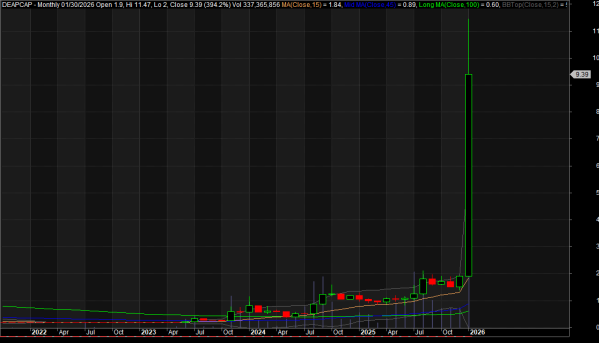
In January 2026, the top five gainers table on the Nigerian Exchange were led by DEAPCAP, which surged 394.21% to close at ₦9.39 each. DEAPCAP, is a financial services company primarily involved in investment management, portfolio advisory, and capital market operations, catering to both retail and institutional investors. Other notable gainers included SCOA, up 345.07% to ₦31.60, NCR rising 173.73% to ₦199.00, OMATEK gaining 165.49% to ₦3.00, and REDSTAREX increasing 139.08% to close at ₦20.80.
Ikeja Hotel Plc Chart
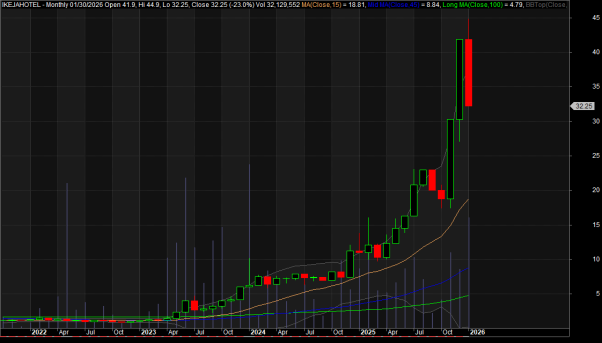
Among the top five losers for the month, IKEJAHOTEL led the decliners league falling 23.03% to close at ₦32.25. Ikeja Hotel Plc operates in the hospitality sector, managing hotels and catering services in Lagos, with a focus on accommodation, conferencing, and event services. Other major decliners included JULI, down 9.93% at ₦7.26, CONOIL falling 9.72% to ₦169.00, AUSTINLAZ losing 8.24% to ₦3.90, and SOVRENINS down 8.12% at ₦3.51 per share.
Technical View
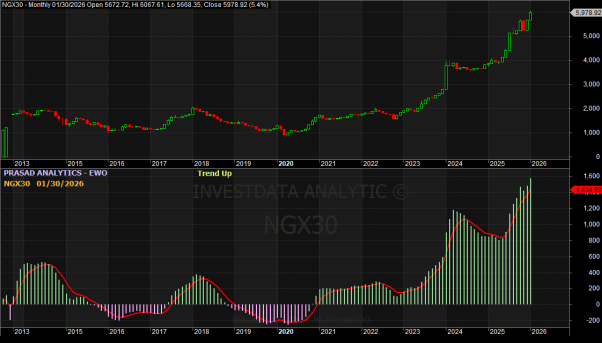
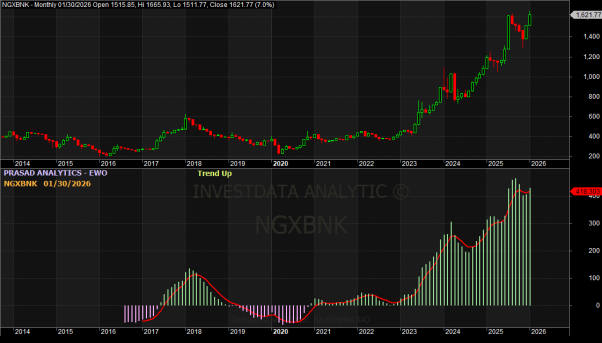
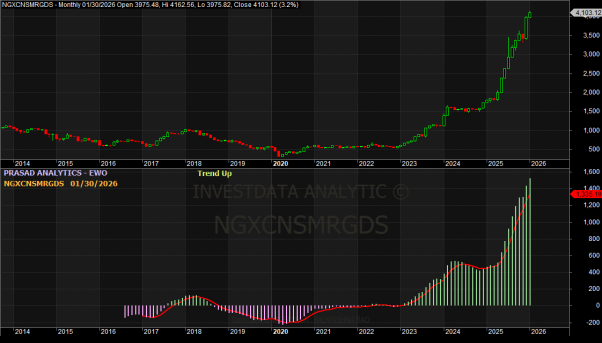
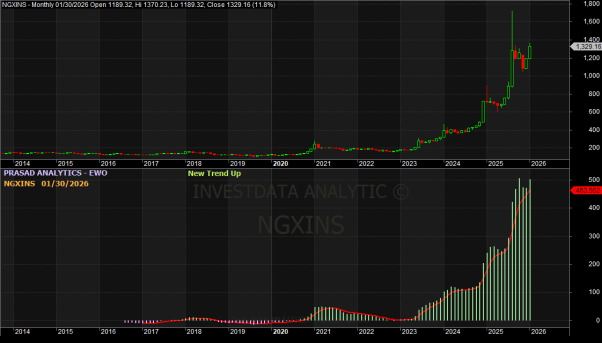
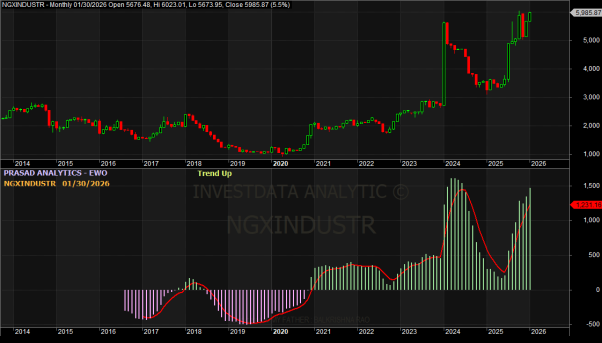
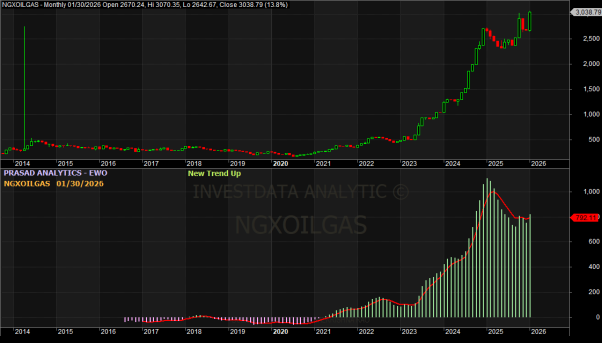
From a technical perspective, the All-Share Index closed firmly above its 20-day, 50-day and 200-day moving averages, confirming that the medium- to long-term uptrend remains intact. Momentum indicators such as the RSI cooled from overbought territory above 75 to around 63 by month-end, signalling consolidation rather than trend reversal. Immediate resistance lies around 166,800 to 168,000 points, while strong support is seen between 160,000 and 162,000 points. As long as prices remain above this support zone, the bullish structure remains valid. Month-to-date, the All-Share Index has inclined by 6.27%, NGX 30 is up by 5.40%, the Banking Index has increased by 6.99%, the Pension Index increased by 8.19%, the Insurance Index inclined by 11.76%, the Consumer Goods Index increased by 3.21%. However, the Oil and Gas Index recorded a positive return of 13.80%.
Year-to-date, the All-Share Index has gained 6.27%, ahead of the NGX 30’s 5.40% notch, while the Banking Index increased by 6.99%. The Pension Index took an 8.19% leap, just as the Insurance Index inclined by 11.76%. The Consumer Goods Index gained 3.21%=, while the Oil and Gas Index recorded a positive return of 13.80%.
Market Outlook In February
January’s price, volume and capital flow dynamics suggest that the Nigerian equities market is transitioning into a more earnings season and valuation-driven phase. While short-term volatility may persist in the weeks ahead, especially against the backdrop of profit-taking and macroeconomic data releases, the broader market continues to be supported by liquidity, sector rotation and improving risk appetite, positioning equities for a potentially positive continuation in the months ahead.
Trending in the Economy: Nigeria experienced another electricity grid collapse on Tuesday, causing a nationwide blackout—the second such failure in a week. Power generation dropped to zero around 11:00 am, cutting supply to all major distributors. While some areas have started receiving limited electricity, the incident has raised serious concerns about the reliability of the country’s power system.
Meanwhile, Nigeria’s crude oil exports are set to decline by about 14% in March, largely due to deep cuts in Bonga and Forcados grades, despite small increases in the Qua Iboe and Bonny Light. This drop could affect the country’s oil revenue and foreign exchange earnings, highlighting ongoing operational and security challenges in the Niger Delta. Crude oil remains the country’s top foreign exchange earner, contributing N37.7 trillion in the first nine months of 2025.
Global Market and Oil; U.S. stock markets ended lower on Friday as investors reacted to President Donald Trump’s nomination of former Federal Reserve Governor Kevin Warsh to succeed Jerome Powell as Fed Chair. Warsh is seen as a moderately hawkish pick, expected to favor lower interest rates but less aggressive monetary easing than some other candidates. With Powell’s term ending in May, Warsh, if confirmed, would lead a central bank he has suggested should scale back its economic interventions and reconsider its policy approach.
Market sentiment was further dampened by concerns over high inflation, mixed corporate earnings, ongoing U.S. tensions with countries like Iran, and renewed uncertainty over a potential government shutdown after obstacles emerged in the Senate funding talks. “Markets are adjusting to Trump’s choice for the Fed chair and the potential implications for monetary policy,” noted Michael Hans, Chief Investment Officer at Citizens Wealth, pointing to gains in the U.S. dollar and sharp declines in precious metals.
In earnings, Apple shares rebounded 0.4% after earlier losses, following its quarterly report. Producer prices in December also came in higher than expected, signaling persistent inflation pressures. Angelo Kourkafas, senior strategist at Edward Jones, noted that investors are balancing Fed news, mixed tech results, inflation concerns, and the government funding uncertainty.
Benchmark indexes closed lower, with the Dow Jones Industrial Average down 179.09 points (0.36%) to 48,892.47, the S&P 500 falling 29.98 points (0.43%) to 6,939.03, and the Nasdaq Composite dropping 223.30 points (0.94%) to 23,461.82. The small-cap Russell 2000, which has outperformed recently, lost 1.6% for the day but ended January up over 5%, compared with gains of 1.4% for the S&P 500, 0.9% for the Nasdaq, and 1.7% for the Dow, which recorded its longest nine-month winning streak since 2018. For the week, the S&P 500 rose 0.3%, while the Dow and Nasdaq slipped 0.4% and 0.2%, respectively.
Sector performance was mixed. The S&P 500 Materials index led declines with a 1.9% drop as U.S.-listed gold and silver miners fell alongside plummeting precious metal prices. Consumer staples rose 1.4%, with Colgate-Palmolive surging 5.9% after projecting annual sales above expectations, supported by steady demand in markets including Latin America and Europe.
Tech giants delivered mixed results this week. Apple forecasted up to 16% revenue growth for the March quarter but cautioned that rising memory-chip costs could pressure margins. Microsoft fell 0.7% after a 10% drop on Thursday, following underwhelming cloud revenue. Meta shares declined 3%, while Tesla rose 3.3% after reports that SpaceX is exploring deals with Tesla and other Elon Musk ventures. Verizon gained 11.8% after forecasting annual profit and free cash flow above expectations, boosted by strong holiday promotions and record wireless subscriber growth. SanDisk climbed 6.9% on a strong third-quarter forecast driven by AI storage demand, but KLA Corp fell 15.2% despite beating profit and revenue estimates.
Market breadth showed more declining than advancing stocks, with a 1.59-to-1 ratio on the NYSE and 2.02-to-1 on the Nasdaq. The S&P 500 recorded 19 new 52-week highs and 10 lows, while the Nasdaq posted 72 new highs and 205 lows. Trading volume totaled 23.88 billion shares, above the 20-session average of 19.42 billion.
In the oil market, prices are expected to hover near $60 per barrel in 2026 amid oversupply concerns offsetting geopolitical risks. A Reuters poll of 31 analysts forecast Brent crude at $62.02 per barrel, slightly above December’s $61.27 projection, while U.S. crude is expected to average $58.72 per barrel. Geopolitical tensions, U.S. trade policies, China’s demand, and OPEC+ decisions will continue to influence prices, despite recent threats to Iran, expanded sanctions on Russia, and unrest in the Middle East.
Sectorial Indexes Monthly Chart Position
NGX Banking Index Chart
NGX Consumer Goods Index
NGX Insurance Index
NGX Industrial Goods Index
NGX Oil & Gas Index
NGX 30 Index