
Profit booking on the Nigerian Exchange halted the seventh successive week of bullish momentum and technical rally in the face of sector rotation and earnings expectations, as unaudited numbers from insurance companies like NEM, International Energy Insurance and Fortis Global Insurance were mixed, while those of mortgage banks came impressive ahead of their full year audited financials.
The first earnings report from the consumer goods sector- Unilever, showed strong performance, just as the newly listed Zichis Agro-Allied posted impressive top and bottom lines in its nine months results made available to the market. The company’s 600 million ordinary shares were listed by introduction at N1.81 per share.
The NGX suffered its first weekly loss in 2026 ahead of more corporate earnings that are likely to support a rebound that would help close the month positively thereby sustaining its historical pattern.
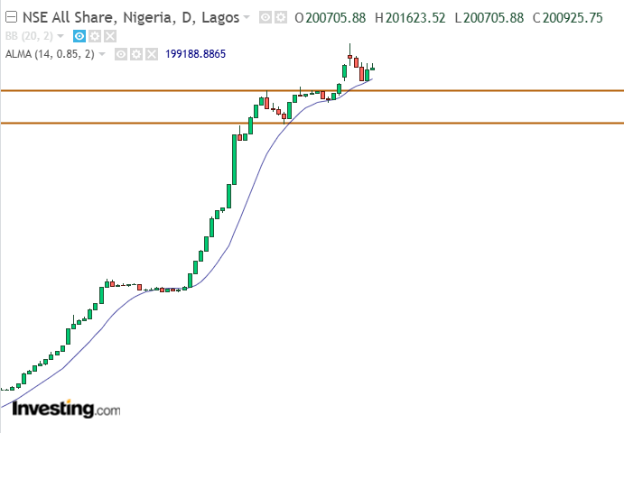
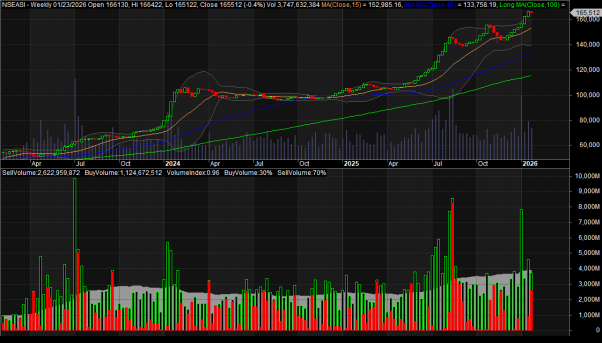
NGXASI Daily Chart
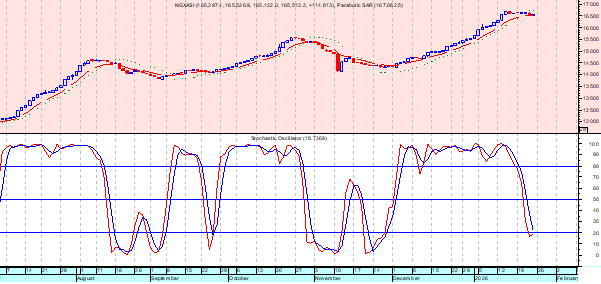
Trading for week opened on a cautious note with the All-Share Index (ASI) slipping 0.01% to 166,112.50 points, trimming investors’ wealth by about ₦10.90 billion to ₦106.34 trillion. The mild decline came amid profit-taking in stocks such as IMG, IKEJAHOTEL, and Nigerian Breweries, although market breadth remained positive, with 43 gainers against 23 losers. Selective buying was evident as stocks like NCR, NEIMETH, and SCOA touched new 52-week highs, signaling pockets of investor optimism. Trading activity picked up with volumes rising 16.62% to 629.60 million shares valued at ₦14.75 billion, led by NSLTECH in volume and ZENITHBANK in value.
By Tuesday the market recovered, with the ASI chalking 0.09%, just as gainers outpaced decliners at a ratio of 43 to 23, reflecting renewed investor confidence. Activities improved further as seen in the 795.46 million shares worth ₦19.98 billion that changed hands during the session, led in volume by TANTALIZER and in value by GTCO. Overall sentiment stayed bullish.
At the midweek session, the bourse modestly continued its up cautious trend, with the ASI gaining 0.01% to close at 166,267.60 points, adding about ₦6.88 billion to market capitalisation which ended the day at ₦106.44 trillion. Market breadth remained positive, buoyed by strong performance from NCR, RTBRISCOE, and MCNICHOLS, while UPDCREIT led the decliners. Trading picked up further, with 822.74 million shares valued at ₦24.93 billion exchanged, dominated by ZICHIS in volume and STANBIC in value. Several stocks reached fresh 52-week highs, underlining sustained investor interest in select counters.
The market turned bearish on Thursday, as the ASI shed 0.52% to 165,397.37 points, erasing approximately ₦557.11 billion from market capitalisation to close at ₦105.89 trillion. Decliners outnumbered gainers as selloffs in NEM, WAPCO, NASCON, and ACCESSCORP weighed on the market. Nonetheless, some stocks, including UHOMREIT, NCR, and INFINITY, continued to trade above their 52-week highs. Trading remained active with 822.74 million shares valued at ₦24.93 billion changing hands, led in volume by ACCESSCORP and in value by GEREGU.
Friday’s session offered a mild recovery with the ASI gaining 0.07% to 165,512.18 points, adding ₦73.50 billion to market capitalisation, which closed at ₦105.96 trillion. Gainers were led by UHOMREIT, SCOA, BERGER, and WAPCO, while NEIMETH topped the losers’ chart. Several stocks continued to trade above 52-week highs. Market activity slowed slightly, with 731.67 million shares worth ₦19.05 billion changing hands, dominated in volume by CHAMS and in value by ZENITHBANK.
Overall, trading activities across the week moderated with investors exchanging 3.75 billion shares valued at ₦99.87 billion in 237,179 deals, down from the previous week’s 4.61 billion shares worth ₦130.64 billion in 263,439 transactions. The Financial Services sector led turnover, accounting for 1.74 billion shares valued at ₦44.89 billion across 90,589 deals, nearly half of total market activity. The Services sector followed with 707.62 million shares worth ₦4.38 billion, while the ICT sector recorded 303.22 million shares valued at ₦5.93 billion.
Notably, trading in Secure Electronic Technology Plc, Tantalizers Plc, and Access Holdings Plc contributed significantly to market volumes, exchanging a combined 734.09 million shares worth ₦5.72 billion, representing about 20% of total traded volume and roughly 6% of overall market value.
The composite NGXASI closed the week 0.39% lower at 165,512.18 points, while market capitalisation eased by 0.37% to ₦105.96 trillion. Sector performance for the period was largely negative, though the Oil & Gas, Lotus II, Growth, and Commodity indices posted gains of 1.36%, 0.37%, 6.27%, and 0.79% respectively, highlighting selective strength amid broader market caution.
Deap Capital Plc
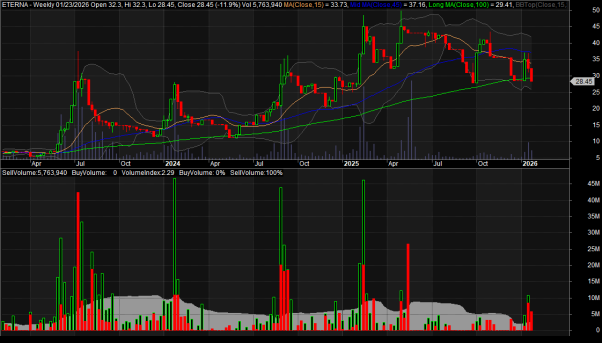
The week’s top gainer showcased significant value appreciation. The share price of Deap Capital Management and Trust Plc which specialises in the provision of asset management and financial advisory services to retail and institutional clients led the rose from ₦4.46 to ₦7.14, a 60.09 percent gain. SCOA Nigeria Plc, listed on the Nigerian Exchange in January 1977, and now into building materials, electrical products, and industrial equipment distribution across Nigeria and West Africa, advanced from ₦14.90 to ₦23.80, representing a 59.73 percent leap. NCR Nigeria Plc appreciated from ₦128.55 to ₦188.15, gaining 46.36 percent. The company is a leading provider of automated teller machines, payment solutions, and technology services to banks and retailers. Zichis Agro Allied Industries Plc rose from ₦1.81 to ₦2.62, an increase of 44.75 percent. It specializes in food processing and agro-allied products including cereals, grains and packaged foods. Daar Communications Plc gained 41.67 percent, rising from ₦1.08 to ₦1.53 each. It operates television, radio and digital content services.
Eterna Plc
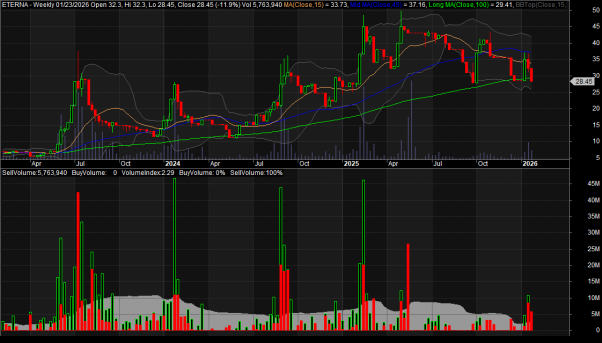
On the decliners’ side, the share price of Eterna Plc dropped from ₦32.30 to ₦28.45, losing 11.92 percent. The company operates in the oil marketing sector, providing petroleum products, lubricants, and refining services. Secure Electronic Technology Plc declined from ₦1.08 to ₦0.97, down 10.19 percent. It is into the offering of fintech solutions for secure payments and transactions. Industrial and Medical Gases Nigeria Plc fell from ₦38.70 to ₦34.85, supplying industrial and medical gases including oxygen, nitrogen, and acetylene to healthcare, manufacturing, and energy sectors. Aluminium Extrusion Industries Plc dropped from ₦19.10 to ₦17.20, a 9.95 percent loss, manufacturing aluminium products for construction and industrial use. UPDC Plc closed at ₦5.70 from ₦6.20, down 8.06 percent; the company is a real estate developer focused on residential, commercial, and mixed-use properties across Nigeria.
Technical View
The market displayed mixed signals this week with marginal early-week gains eroded by midweek profit-taking and selective selling, particularly in industrial and consumer staples stocks. Support levels are currently around 165,200 to 165,400 points, while resistance levels hold at 166,500 to 166,700 points, reflecting recent intraday highs. Market breadth indicates a cautious bullish trend, with pockets of strength in high-performing counters and ongoing volatility in cyclical stocks. Trading volumes suggest investors are rotating strategically into mid- and small-cap stocks, particularly in Financial Services and select industrial names.
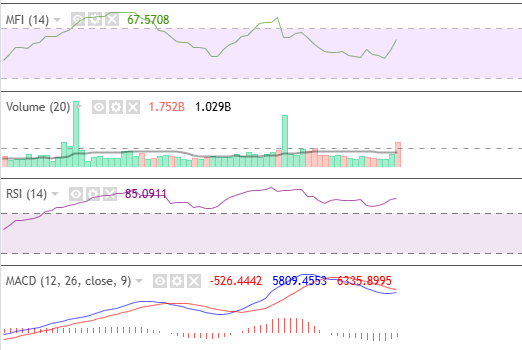
Short-term bullish momentum is evident in counters such as NCR, SCOA, and UHOMREIT, while bearish pressure persists in Eterna, Aluminium Extrusion, and UPDC, which may require consolidation before resuming upward trends. Moderate RSI levels suggest the market is not overbought, leaving room for measured gains if sentiment strengthens.
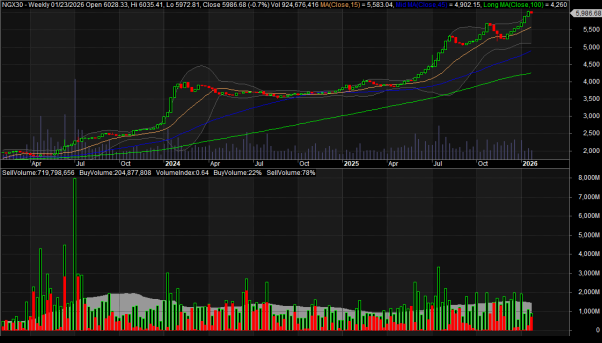
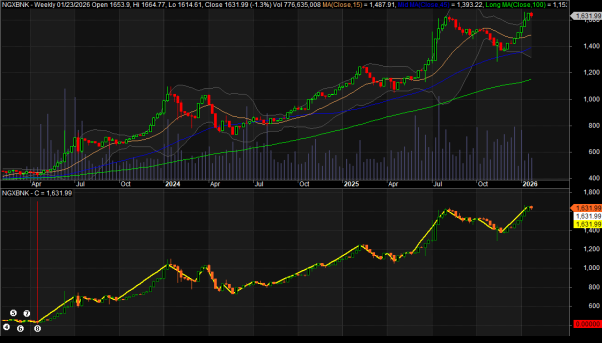
Week-to-date, the All-Share Index has declined by 0.37%, NGX 30 is down by 0.69%, the Banking Index has decreased by 1.32%, the Pension Index decreased by 0.26%, the Insurance Index declined by 0.10%, the Consumer Goods Index decreased by 2.02%. However, the Oil and Gas Index recorded a positive return of 1.36%. Year-to-date, the All-Share Index has gained 6.36%, NGX 30 is up by 5.53%, the Banking Index has increased by 7.66%, the Pension Index index increased by 8.64%, the Insurance Index inclined by 10.87%, the Consumer Goods Index increase by 2.50%. However, the Oil and Gas Index recorded a positive return of 13.73%. In terms of market breadth, 58 stocks advanced, while 40 declined.
Market Outlook
The NGX is expected to trade cautiously in the near term, as investors monitor the combination of earnings inflow, macroeconomic developments, and domestic policy initiatives. However, positive catalysts influencing sentiments in the market include the IMF’s upgrade of Nigeria’s 2026 GDP forecast to 4.4 percent, reflecting the expected impact of the recent fiscal reforms, productivity gains, and macroeconomic stability. Government efforts to boost domestic revenue, reduce borrowing, and maintain access to global capital markets, combined with moderating inflation and potential interest rate easing, could further support the equity market, particularly in the consumer-facing sectors. However, ongoing geopolitical risks and the likelihood of profit-taking in high-performing stocks may temper aggressive advances.
Trending in the Economy: The IMF has slightly upgraded Nigeria’s 2026 economic growth outlook to 4.4% from 4.2%, pointing to gains from ongoing fiscal reforms, improved macroeconomic stability, and better productivity. The revision comes amid a wider recovery across Sub-Saharan Africa and underscores optimism around the medium-term benefits of recent policy actions, reinforcing confidence in Nigeria’s growth path.
Meanwhile, Finance Minister Wale Edun said the government is prioritising domestic revenue mobilisation and plans to reduce its reliance on borrowing, while keeping access to global capital markets open if necessary. Key reforms—ranging from tax restructuring and the removal of fuel subsidies to liberalising the foreign exchange regime—are aimed at boosting revenue and strengthening long-term stability. Edun added that moderating inflation could create room for lower interest rates, helping to ease debt servicing pressures.
Global Market and Oil: Global financial markets closed the week on a cautious note as investors balanced earnings expectations, central bank signals and rising geopolitical risks across several regions. Sentiment remained fragile, with participants largely avoiding aggressive positioning while waiting for clearer direction from policymakers and corporate results in the days ahead.
Monetary policy expectations remained firmly anchored around a pause by the U.S. Federal Reserve. Fed funds futures continued to price in an overwhelming likelihood that rates will be held steady at the next policy meeting, with market-implied probabilities hovering near certainty. This expectation has helped limit volatility in both equities and bonds, even as investors debate the timing and pace of any eventual rate cuts later in the year.
U.S. equities delivered a mixed performance. Technology and growth stocks provided some support, while pockets of weakness emerged following company-specific developments. Intel shares slid sharply after the chipmaker issued a disappointing outlook, reigniting concerns over margins and competitive pressures within the semiconductor space. More broadly, investors remained on the sidelines ahead of earnings reports from heavyweight names such as Microsoft, Meta Platforms and Caterpillar, which are expected to provide fresh insight into corporate profitability, capital spending trends and demand conditions across key sectors of the economy.
At the close on Wall Street, the Dow Jones Industrial Average fell 0.58% to 49,098.71, weighed down by losses in industrial and cyclical stocks. The S&P 500 managed to eke out a marginal gain of 0.03% to finish at 6,915.61, while the Nasdaq Composite outperformed, rising 0.28% to 23,501.24 on support from select technology names. For the week as a whole, however, the tone was softer, with the Dow shedding 0.53%, the S&P 500 declining 0.35% and the Nasdaq slipping 0.06%.
Beyond the U.S., global equity markets showed limited direction. MSCI’s broad index tracking stocks worldwide edged up 0.15%, but remained on track for a modest weekly decline, reflecting persistent uncertainty around geopolitics and global growth. In Europe, the pan-European STOXX 600 index slipped 0.1%, bringing an end to a five-week winning streak that had been its longest run since May. Despite a midweek rebound, the index closed the week down 1.1%, as investor sentiment was dampened by renewed geopolitical tensions and concerns over the regional economic outlook.
Geopolitical developments remained a key overhang for markets. Investors closely followed U.S.-brokered trilateral talks involving Russia and Ukraine, which took place in Abu Dhabi. Negotiations focused heavily on the sensitive issue of territory, but there were no clear signs of compromise. At the same time, intensified Russian airstrikes further strained Ukraine’s infrastructure, pushing the country into what officials described as its worst energy crisis since the start of the conflict. The lack of progress on diplomacy and the escalation on the ground added to broader risk aversion across asset classes.
Heightened uncertainty continued to drive strong flows into safe-haven assets, particularly precious metals. Silver surged to an unprecedented milestone, breaking above $100 an ounce for the first time, while gold extended its record-breaking rally and edged closer to the psychologically important $5,000 per ounce level. Spot gold rose 0.91% to $4,981.43 an ounce, while U.S. gold futures gained 0.55% to $4,936.00. The rally underscored investors’ growing preference for hard assets as protection against geopolitical risk, inflation concerns and potential market volatility. Industrial metals also benefited from improved sentiment, with copper jumping 2.92% to $13,128.50 a tonne, while three-month aluminium on the London Metal Exchange rose 1.31% to $3,173.50 a tonne.
In fixed income markets, U.S. Treasury prices firmed as investors positioned ahead of the Federal Reserve’s policy update due next week. Yields moved modestly lower across the curve, reflecting steady rate expectations and continued demand for safe assets. The benchmark 10-year Treasury yield fell 2 basis points to 4.231%, while the 30-year bond yield eased to 4.8305%. The policy-sensitive 2-year note yield, which closely tracks expectations for Fed action, slipped 1.6 basis points to 3.598%, reinforcing the view that near-term rate stability is firmly priced in.
In energy markets, oil prices ended the session sharply higher, rising almost 3% and climbing to their highest level in more than a week. The rally followed renewed geopolitical tension after former U.S. President Donald Trump intensified pressure on Iran, including fresh sanctions targeting vessels involved in transporting Iranian oil and comments about an “armada” moving toward the region. These developments stoked concerns over potential supply disruptions and served as a warning to Tehran amid unrest and nuclear-related tensions. U.S. crude settled up 2.88% at $61.07 a barrel, while Brent crude gained 2.84% to close at $65.88 per barrel.
Sectorial Indexes Weekly Chart Position
NGX Banking Index Chart
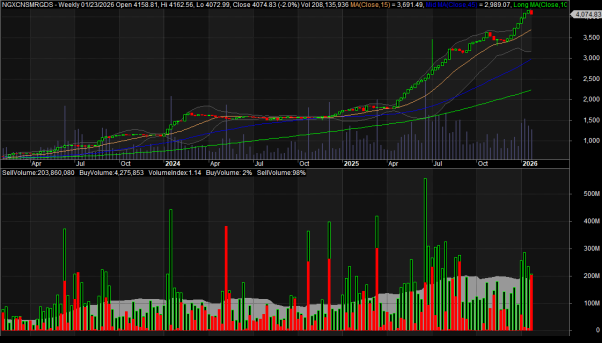
NGX Consumer Goods Index Chart
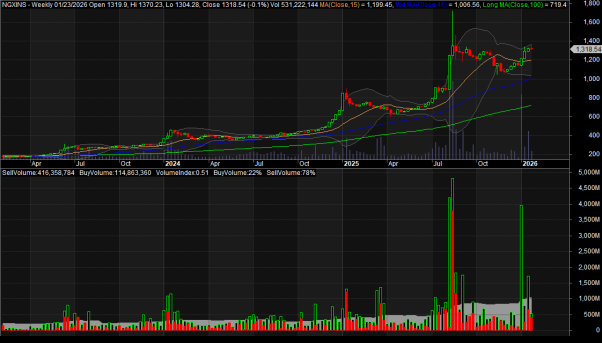
NGX Insurance Index Chart
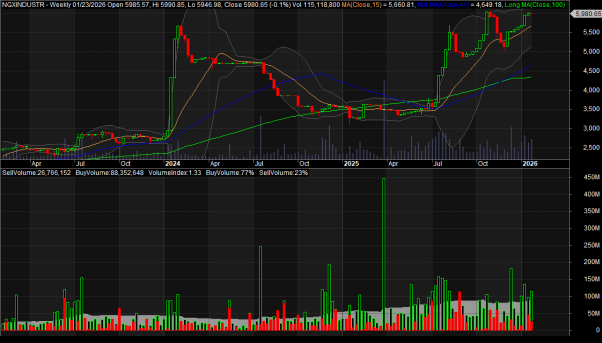
NGX Industrial Goods Index Chart
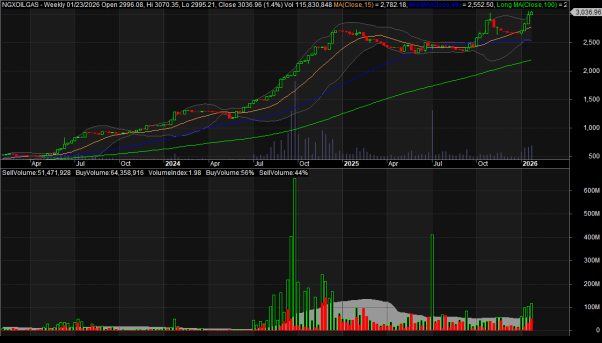
NGX Oil & Gas Index Chart
NGX 30 Index Chart