

Market Update For December 2, 2025
The Nigerian equities market opened the second trading day of December on a much stronger footing, shaking off the mild negative sentiment that shaped Monday’s close. From the early hours of Tuesday’s session, it became clear that investor appetite had returned to the market, particularly in heavyweight counters capable of swaying the All-Share Index in a meaningful way. The renewed strength was led by a decisive surge in Dangote Cement, a stock whose dominance in the industrial goods space makes it a bellwether of broad market direction. The positive spillover from this move was evident across most sectors, from consumer goods to insurance, suggesting the presence of both institutional repositioning and retail bargain-hunting ahead of expected end-of-year portfolio rebalancing.
The broader market tone on Tuesday was significantly more constructive than what was observed in the previous session. Optimism was driven by bargain entries across key sectors, improved liquidity in large-cap names, and renewed confidence in companies with strong fundamentals and reliable earnings histories. The banking sector, which has remained a cornerstone of market activity for much of the year, saw steady flows as investors positioned for full-year numbers and potential dividend announcements. At the same time, the consumer goods sector attracted renewed attention, with particular emphasis on breweries after the heavy sell-off on Monday. Investors appeared determined to take advantage of the discount created by the previous decline, and this was reflected in solid performances across Guinness, Nigerian Breweries, Champion Breweries, and INTBREW, which staged an impressive rebound after recording a steep loss in the previous session.
Industrial goods were the undisputed driver of the day’s performance, as the strong demand for Dangote Cement served not only to lift the index but also to confirm that institutional investors were beginning to rotate back into heavyweight positions. The industrial sector has historically attracted defensive capital during periods of macroeconomic uncertainty, and Tuesday’s moves underscored that trend. The heavy inflows into Dangote Cement were complemented by gains in other industrial names, creating a ripple effect across the entire market. The session’s performance in this sector helped restore broader investor confidence and recalibrated market direction for the week.
The oil and gas sector experienced a more subdued session, although this was consistent with global market conditions rather than local dynamics. Investors continued to watch global oil prices with caution, especially given the prevailing geopolitical tensions that have shaped the energy market in recent weeks. SEPLAT attracted significant value-driven trades, which was no surprise given the company’s established track record and the increased institutional interest that typically flows into the counter during periods of global market uncertainty. Nonetheless, overall sentiment in the sector remained modest, with investors waiting for clearer signals from the international oil market before committing heavily to local oil and gas stocks.
The insurance sector extended its steady run, benefiting from speculative interest and the renewed confidence in several counters that have shown resilience despite macroeconomic pressure. Insurance companies have lately become attractive to investors seeking short-term opportunities, particularly as regulatory reforms and capital requirements continue to strengthen the sector’s long-term prospects.
The divergence between market volume and value on Tuesday revealed much about the structure of investor participation. Although total market volume declined compared to the previous session, the traded value increased sharply, a sign that institutional investors were more active than retail traders. High-value transactions dominated the session, particularly through SEPLAT, ACCESSCORP, and ZENITHBANK, which together accounted for the majority of liquidity turnover for the day. Such a pattern has become increasingly common in high-volatility environments where institutional investors drive the narrative while retail investors adopt a more cautious or opportunistic stance.
From a macroeconomic standpoint, the market’s rebound on Tuesday occurred against a backdrop of persistent inflationary pressure, elevated interest rates, and cautious consumer sentiment. While these factors ordinarily constrain equity market liquidity, they also create pockets of opportunity for investors seeking to hedge against inflation through exposure to resilient companies with strong fundamentals. Corporate earnings for the third quarter have generally been robust, particularly in the banking and industrial sectors, and investors appear increasingly confident that the final quarter of the year will deliver similarly stable results. Moreover, the relative stability in the foreign exchange market has provided some relief, allowing investors to price earnings more confidently and reducing the risk of currency-induced valuation distortions.
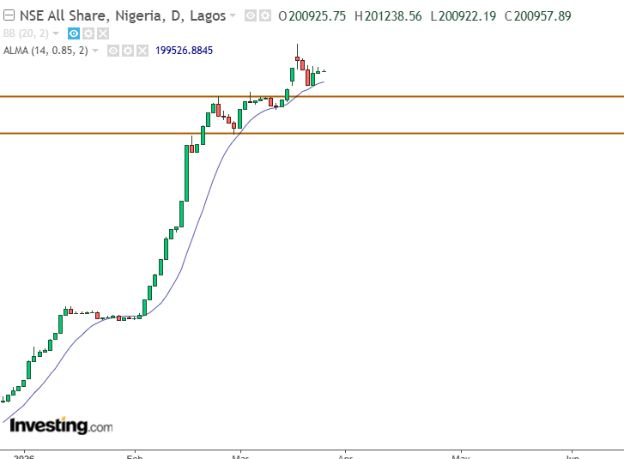
Technical analysis of the NGX All-Share Index on Tuesday reinforces the view that the market is in a short-term bullish phase. The index successfully broke above a critical resistance point around 144,500 points, a level that had previously capped upward momentum. Closing above this range signals a potential continuation of the uptrend, especially if strong buying interest persists in the coming sessions. The index remains above its key moving averages, including the 20-day, 50-day, and 100-day averages, which collectively confirm the strength of the current upward momentum. Momentum indicators such as the Relative Strength Index continue to move upward without breaching overbought conditions, indicating that the market still has room to climb. The Moving Average Convergence Divergence indicator remains firmly supportive of the short-term uptrend, while the Money Flow Index shows a steady inflow of capital into the market, a positive signal for near-term price stability.
Globally, oil markets remained relatively steady on Tuesday, Brent crude hovered around the $63 per barrel mark, down slightly from the previous session but still supported by the ongoing geopolitical tensions affecting supply chains. Ukrainian drone attacks on Russian energy infrastructure continued to inject a risk premium into oil markets, mitigating some of the downward pressure created by oversupply concerns. At the same time, tensions between the United States and Venezuela added another layer of uncertainty, with analysts watching closely for potential sanctions that could disrupt supply from the region. The Caspian Pipeline Consortium’s announcement that one of its Black Sea mooring points had resumed operations following earlier drone attacks provided some relief, but the overall landscape remained fragile. The combination of oversupply and geopolitical conflict has created an environment where oil prices are caught in a delicate balance, responding to short-term disruptions while navigating long-term structural pressures.
In the Nigerian context, oil price stability remains critical, both for macroeconomic management and for equity market performance. The oil and gas sector continues to be a vital contributor to overall market liquidity, especially through high-cap stocks like SEPLAT, and the company’s heavy trading on Tuesday reflected continued investor confidence. However, local investors remain attuned to the possibility that global price shocks could influence domestic valuations, particularly as the federal government continues to navigate the complex terrain of revenue stability, external reserves, and exchange rate management.
Looking ahead, the outlook for the Nigerian equities market remains cautiously optimistic. The improved sentiment observed on Tuesday suggests that investors are beginning to re-enter the market more confidently after the brief pullback that characterized the previous session. The combination of technical support, improving momentum, and renewed institutional activity positions the market favorably for additional upside in the coming sessions. Nonetheless, investors should remain mindful of the potential for short-term volatility, especially as global markets digest geopolitical events and domestic macroeconomic conditions continue to evolve.
The final weeks of the year typically attract strong buying interest as fund managers rebalance portfolios, lock in gains, and position for the coming year. If historical patterns repeat, the market may benefit from sustained accumulation in fundamentally strong counters, particularly those in the industrial goods, banking, and consumer goods sectors. The resilience demonstrated by the market on Tuesday strengthens this view, suggesting that the path toward the 147,000 to 148,000 index region remains achievable, provided that buying interest continues and macroeconomic conditions remain relatively stable.
In summary, Tuesday’s session demonstrated not only the strength of heavyweight counters but also the market’s capacity to attract broad-based support when investor confidence returns. The improved sentiment, increased value turnover, robust technical indicators, and constructive global context all worked together to create a positive market environment. While challenges persist, the market’s performance on December 2, 2025, offered a compelling reminder of the resilience and depth of the Nigerian equities market.
The benchmark All-Share Index (ASI) advanced by 1.20 percent to close at 144,928.36 points, up from 143,210.33 points recorded in the previous session. Total market capitalization rose by N1.29 trillion to finish at N92.38 trillion, while year-to-date return strengthened to 40.81 percent. Market breadth closed positive with twenty-six gainers and twenty losers, led by Dangote Cement with a 9.99 percent increase, followed by NCR at 9.98 percent and Guinness at 7.78 percent, while Ikeja Hotel topped the losers’ chart. AccessCorp recorded the highest trading volume with 310.25 million units, while SEPLAT dominated the value chart with N22.48 billion traded.
Invest 2026 Traders & Investors Summit
Theme: Pre-Election Year Investment Opportunities & Risks
Sub-Topics
1. Comprehensive Earnings Guide for Profitable Investing and Trading in 2026, by Mr Peter Sunday Adebola, Managing Director/CEO Edgefield Capital Management Ltd
2. Pre-Election Year Rally: How Economic Events & Tax Reforms Fuel Bull Or Bear Cases In 2026, by Mr Teriba Adeboye, MD/CEO, Qualinvest Capital ltd
3. NGX Pre-Election Year Performance & Historical Patterns:10 Golden Stocks For Profitably Investing, by Mr Ambrose Omordion, CRO. Investdata Consulting Ltd
4. Nigeria Infrastructural Gap & Fiscal Policy Reforms: Where are Investment Opportunities in 2026, by Mr Tope Ojo, Managing Partner, Tope & Tunde Estate Surveyors & Valuers
5. Investment Opportunities In The Alternative Markets In 2026 & Beyond, by Dr Sylvester Anaba (PhD, FCS) Head Research, United Capital Plc
6. The Pre-election Economy & 2016 Budget: Implementation and Impact On NGX, by Mr Abiola Rasaq, Former Head, Investor Relations & Portfolio Investments United Bank For Africa Plc
7. NGX New Highs & Correction: The Power Of Price Action, Time & Momentum In Profitable Trading In 2026 & Beyound, by Mr Abdul-Rasheed Oshoma Momoh, ED Operations, TRW Stockbrokers Ltd
8. Strategies For Equity Investing & Trading In A Pre-Election Year, by Mr Kebira Jimoh Aruna, MD/CEO GlobalView Capital Ltd
Riding the tide of pre- election Years in Nigeria, 2026 is not just any year—it’s part of a powerful historical trend or pattern that should be known to smart traders or discerning investors in any investment window, market or exchange in Nigeria today. It comes with tradable opportunities and risks that are associated with elections and post-elections. The ability to navigate between politics and economy creates the wealth to makes the difference in your investment. The reading of a nation’s electoral cycle and how investors perceive whether there could be a change in leadership or continuity, is a major factor that results in much of the uncertainty in pre-election years have been known for. This, it is believed can, and does spike market volatility and businesses, especially when it is seen that a new party may take power. This summit will help market players to navigate 2026 profitably by maximizing gains and minimize losses
Take away from this summit includes:
How to construct a resilient and Powerful Portfolio that adapts to market and economic changes.
● What to expect from the market and economy as the new tax reforms kicks off in 2026.
● Why historical patterns and trends in Nigerian election cycle is important when taking your investment decision in 2026 and beyond.
● The power of liquidity and corporate earnings in price movement.
● How to anticipate big sector moves and recovery in 2026 with ongoing reforms
● Understanding the cycle of 4 years opportunities time frames that comes with election preparation in Nigeria
● 10 golden stocks for 2026
Date: December 6, 2025
Fee: N75,000
Venue: Zoom
If you want to be among the winning investors and traders in 2026, send Yes to: 08028164085, or 08179547605 now.