
Market Update For April 8, 2026
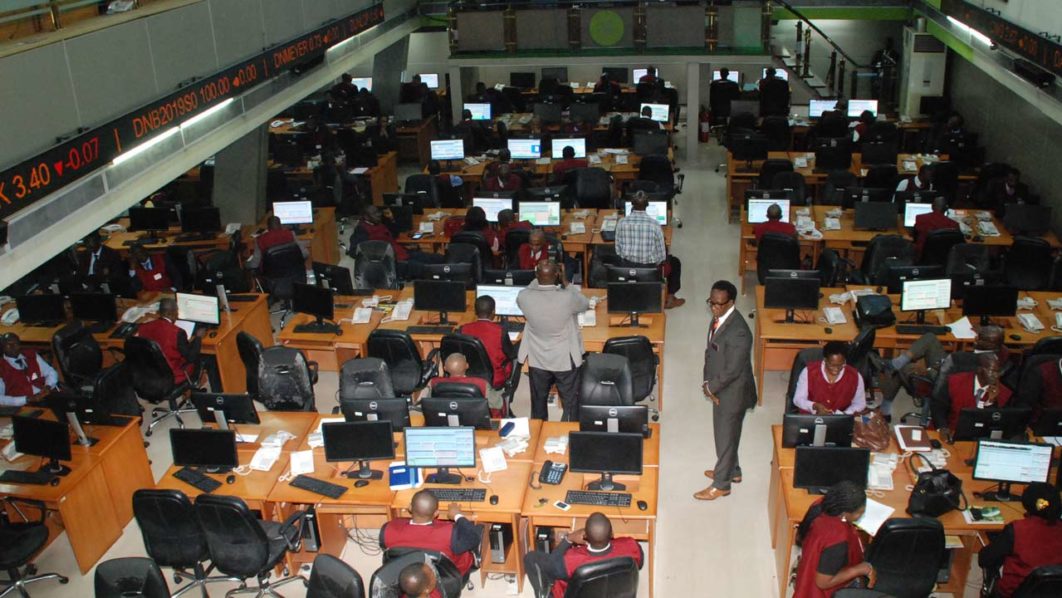
The Nigerian equities market closed in positive territory on Wednesday, April 8, 2026, extending its bullish momentum as investor sentiment remained firmly supported by FTSE Russell’s decision to reclassify the market to frontier status. The upgrade has continued to trigger portfolio rebalancing and renewed positioning by both domestic and offshore investors, particularly in fundamentally strong, liquid counters with attractive valuation profiles.
The session was largely driven by sustained buying interest in large-cap and export-oriented stocks, with Seplat Energy standing out as a major catalyst. The stock advanced significantly and traded above its 52-week high, reinforcing strong institutional demand and positioning within the energy space. This performance reflects continued confidence in upstream players, even amid heightened volatility in global crude oil markets.
Similarly, the banking sector maintained its leadership role in the ongoing rally, with notable gains recorded in Guaranty Trust Holding Company and Zenith Bank. These tier-1 banks continue to attract investors due to their strong earnings outlook, capital buffers, and dividend yield potential, especially in a high-interest-rate environment. Additional support came from United Bank for Africa and Stanbic IBTC Holdings, while NGX Group and NASCON Allied Industries also contributed to the positive close.
However, beneath the surface, the market reflected a more cautious undertone. Despite the positive index performance, market breadth remained negative, indicating that a larger number of stocks closed lower. This divergence highlights a growing phase of profit-taking, particularly across mid- and small-cap stocks that have experienced significant price appreciation in recent weeks. The pattern suggests a rotation strategy, where investors are locking in gains in speculative counters and reallocating capital into fundamentally sound and defensive plays.
Trading activity during the session further reinforced this cautious sentiment, as both volume and value of transactions declined compared to the previous session. Lower turnover typically signals reduced conviction in the current trend, especially after a sustained rally. Access Holdings Plc dominated trading by volume, reflecting continued retail and institutional engagement, while Zenith Bank led in value terms, underscoring its status as a key institutional favourite. Fidelity Bank Plc and Wema Bank Plc also posted notable activity levels, indicating sustained interest in tier-2 banking stocks.
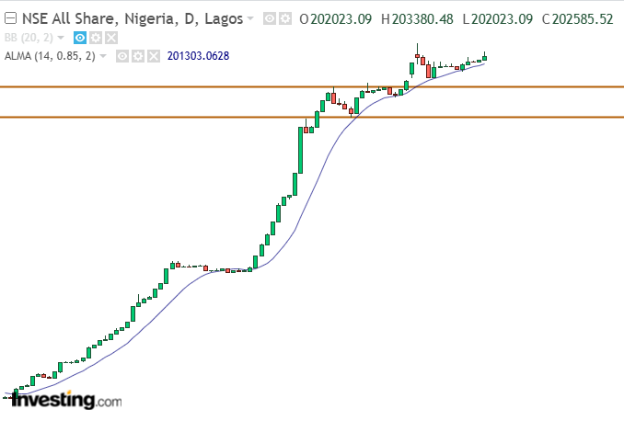
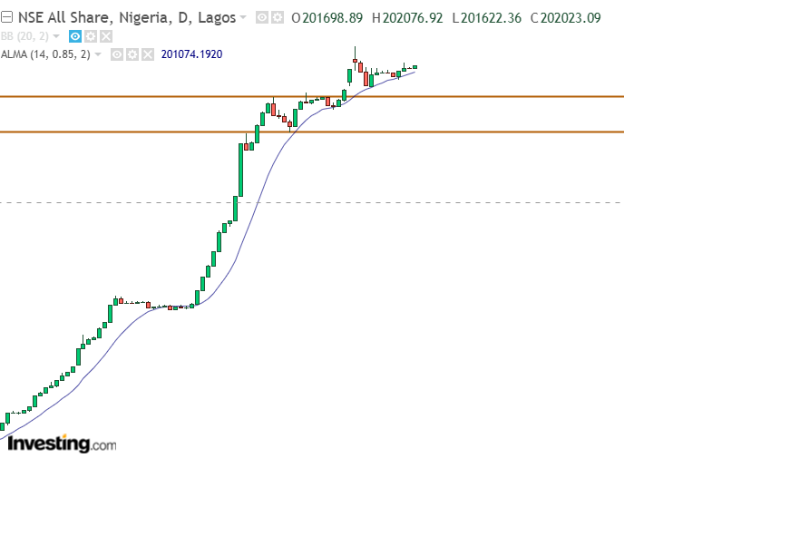
From a technical standpoint, the market remains firmly in bullish territory. The All-Share Index continues to trade above the critical 202,000 psychological level, maintaining a pattern of higher highs and higher lows that defines a strong uptrend. The index is currently positioned within an ascending channel, supported by consistent demand in large-cap stocks. However, early signs of momentum fatigue are emerging, as indicated by declining volume and weakening breadth.
This suggests that while the primary trend remains positive, the market may be approaching a near-term consolidation phase. Such consolidation is healthy after an extended rally and could provide a base for the next leg up, especially if supported by fresh catalysts such as earnings releases or increased foreign portfolio inflows. Key support is expected around the 200,000 level, while resistance lies slightly above current levels, where profit-taking pressure may intensify.
Looking ahead, market direction will likely be shaped by a combination of domestic and global factors. On the domestic front, interest rate dynamics, liquidity conditions, and corporate earnings expectations will play a crucial role. On the external side, crude oil prices, exchange rate stability, and foreign investor participation will remain key determinants of sentiment.
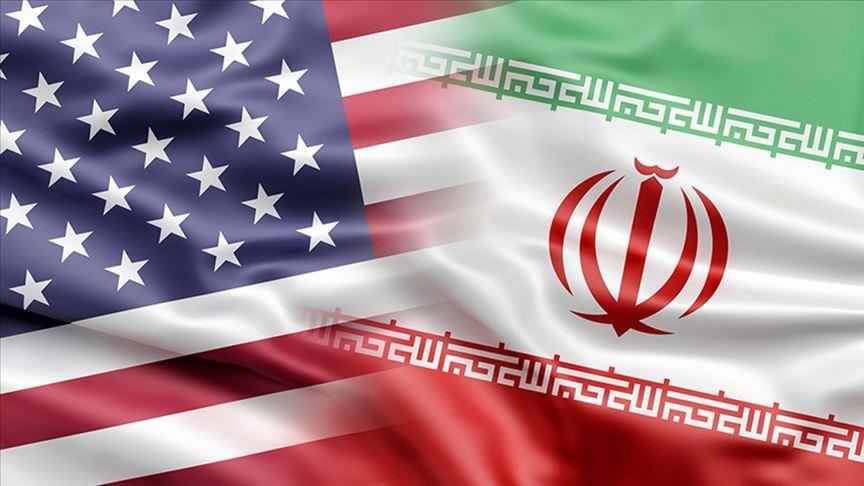
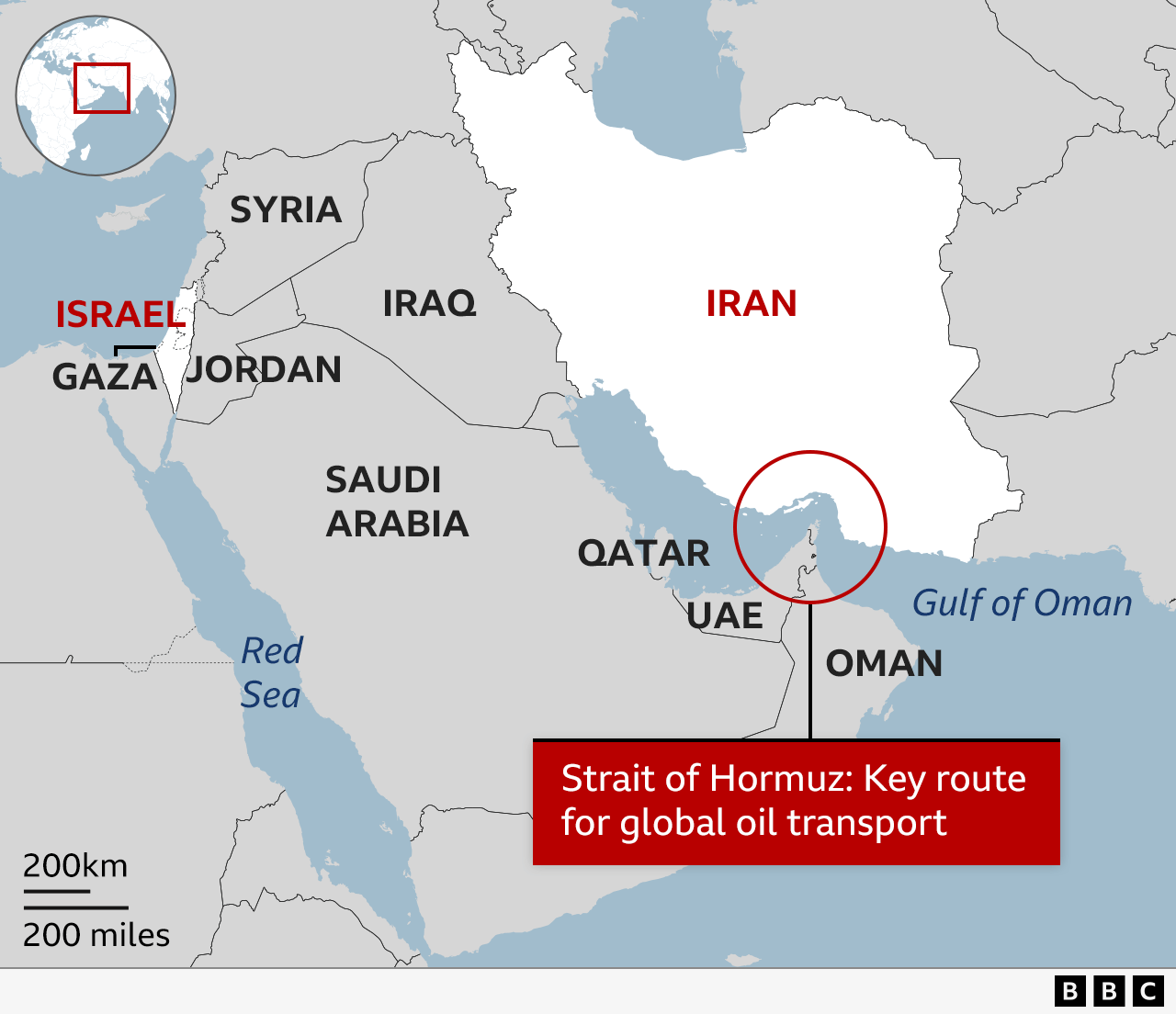
Meanwhile, the global oil market witnessed a sharp reversal, introducing a new layer of uncertainty for oil-dependent economies like Nigeria. Crude prices plunged below the $100 per barrel threshold following signs of de-escalation in geopolitical tensions between the United States and Iran. Donald Trump signalled a potential two-week ceasefire agreement, alongside plans for the reopening of the Strait of Hormuz, a critical artery for global oil supply.
The market reacted swiftly, with Brent crude falling to around $91 per barrel and WTI settling near $92. The decline reflects expectations that previously disrupted supply—estimated at over 10 million barrels per day—could gradually return to the market. While the ceasefire remains tentative, the shift in sentiment from supply disruption to potential oversupply has triggered aggressive selling across energy markets.
For Nigeria, this development presents a complex outlook. On one hand, lower oil prices could ease global inflationary pressures and reduce input costs. On the other hand, it poses downside risks to government revenue, foreign exchange earnings, and fiscal stability. Given Nigeria’s heavy reliance on crude exports, sustained weakness in oil prices could impact investor sentiment in the equities market, particularly in oil-linked and FX-sensitive sectors.
At the close of trading, the All-Share Index gained 0.28% to settle at 202,584.88 points, up by 561.78 points from the previous session. Market capitalisation rose by ₦389.53bn to ₦130.40trn, while the year-to-date return strengthened to 30.19%. Market breadth closed negative, with 22 gainers against 39 losers, highlighting underlying weakness despite the positive headline performance. Total volume traded declined by 12.64% to 1.01bn units, valued at ₦40.57bn across 52,723 deals. Access Holdings Plc recorded the highest volume with 232.98m shares, while Zenith Bank topped the value chart at ₦6.47bn. The top gainers for the session were Universal Insurance (+10%), Omatek (+9.78%), VFD Group (+9.71%), CWG (+9.64%), and Livestock Feeds (+9.56%), while the top losers included UPDC REIT (-10%), FTG Insurance (-9.92%), Deap Capital (-9.85%), Chams (-9.47%), and Japaul Gold (-8.82%).