
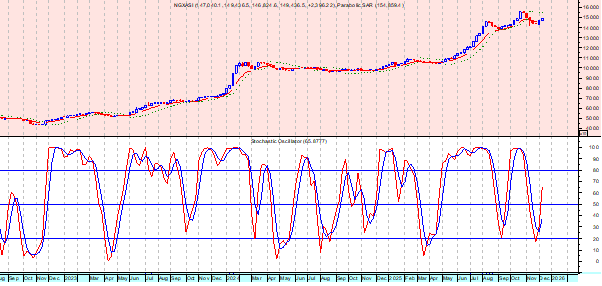
For the second consecutive week, trading on the Nigerian Exchange extended its recovery from the loss reported in November on increased position taking in low priced stocks, growth companies, and blue chip equities, among others. Sector rotation and end of the year portfolio rebalancing persisted on the NGX during the period, ahead of the Santa Claus rally and January effect seasonal trends that create value for discerning investors and smart traders. This recovery indicates market players taking advantage of these pullbacks to reposition ahead of corporate earnings and actions in the new year.
The benchmark NGX All-Share index closed the week on a positive note, gaining 1.63% at 149,433.25 basis points, after breaking out the two psychological lines of 147,000 and 148,000 respectively. This lifted market capitalization to ₦95.26 trillion as Investor sentiment stayed broadly optimistic, driven by gains in Guinness, NASCON, and MTN Nigeria, while AccessCorp and Transpower recorded the highest volume and value traded, respectively.
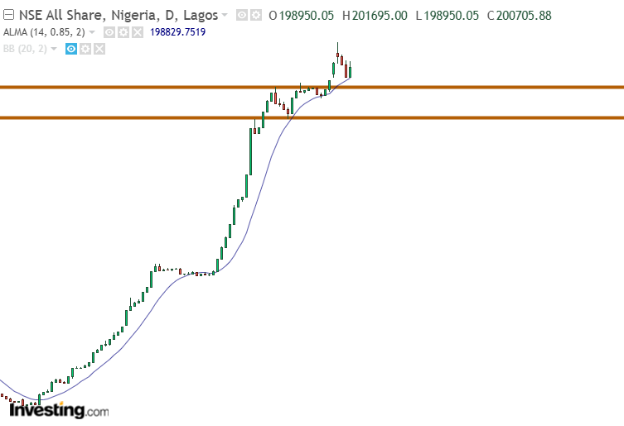
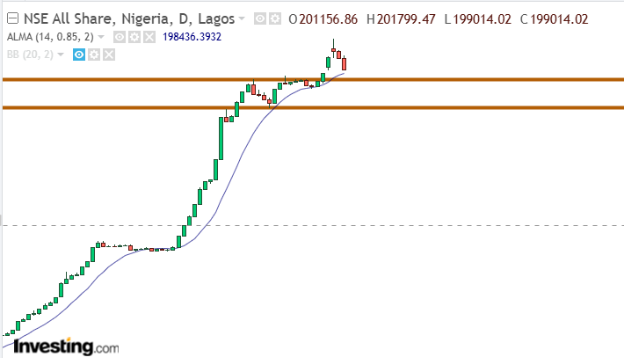
NGXASI Daily Chart
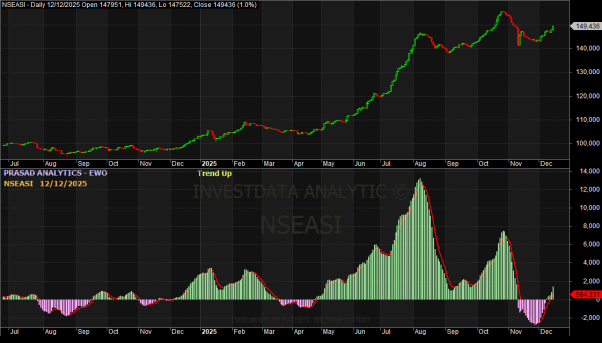
Trading started on a strong note as the NGXASI rose by 0.26% on Monday to 147,426.95 points, supported by buying interests in Zenith Bank, Cadbury, and GTCO, with FCMB leading in transaction volume. Profit-taking pulled the market lower on Tuesday, after the ASI dipped 0.33% to 146,940.29 points, weighed down by losses in Eterna, Transcorp Hotels, and Ikeja Hotel, while E-Tranzact topped trading activity in both volume and value.
At midweek, the market extended its weak posture, as the index recorded a marginal decline of 0.05% to 146,862 points, despite positive market breadth, as gains in Japaul Gold was offset by Chams’ losses. Thursday’s session marked a rebound, as the composite NGXASI gained 0.74% to close at 147,950.59 points, lifted by Berger, PZ, Mecure, and Nigerian Breweries, while AccessCorp led trading activity. The last trading day of the week, sustained optimism that pushed the NGXASI higher by 1%, thereby rounding up the week on a positive momentum.
The volume of transactions moderated during the week with a total turnover of 4.37 billion shares valued at ₦97.78 billion changing hands across 110,736 deals, compared with 6.62 billion shares worth ₦113.22 billion traded the previous week. The Financial Services sector dominated market activity, accounting for over half of the total traded volume and about 48% of market value, followed by the ICT and Oil & Gas sectors. E-Tranzact, Access Holdings, and FCMB were the most actively traded stocks, as they together for 44% of total volume and 23% of value traded.
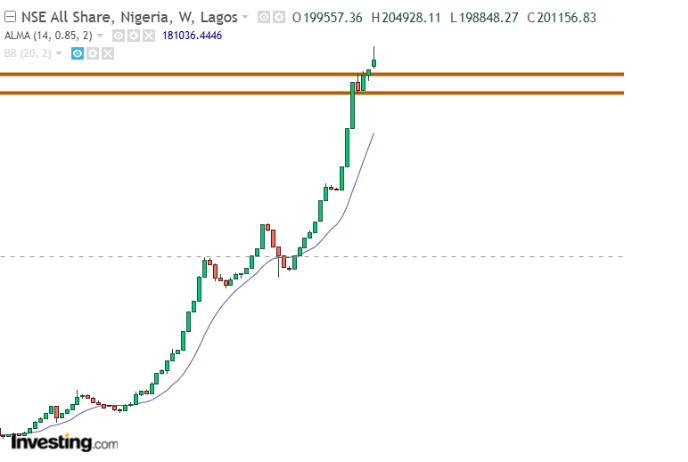
NGXAS Weekly Chart
Technical View
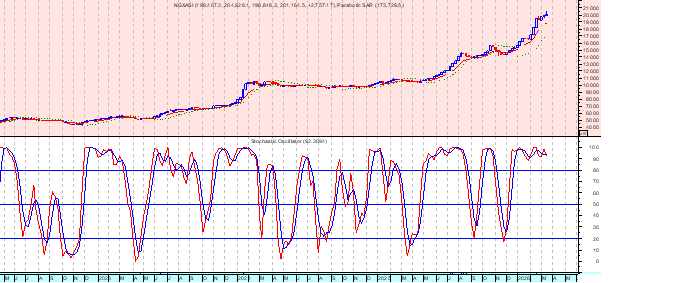
From a technical perspective, the ASI has maintained strong support around 146,800–147,000 points, with resistance near 150,000 points. Momentum indicators point to a bullish bias, reinforced by sector rotation into consumer goods and telecommunications. Investors are expected to consolidate positions in blue-chip stocks while keeping a close watch on the Banking and Oil & Gas sectors for potential pullbacks.
Overall, the market’s performance during the week highlights growing investor confidence, supported by strong sectoral gains and improved trading activity, though cautious monitoring of profit-taking and sector shifts remains essential as year-end approaches.
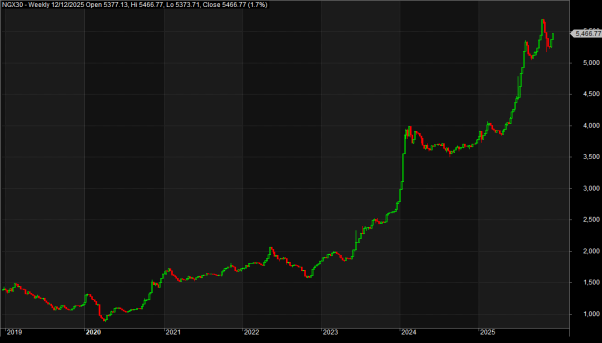
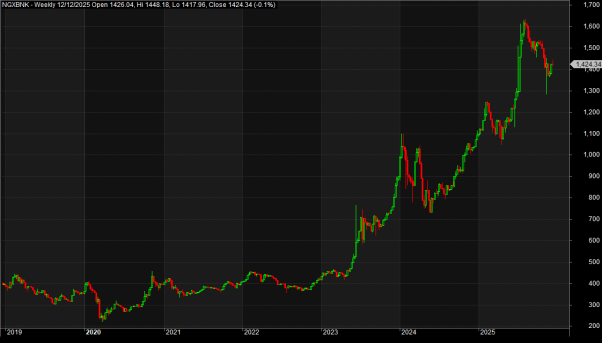
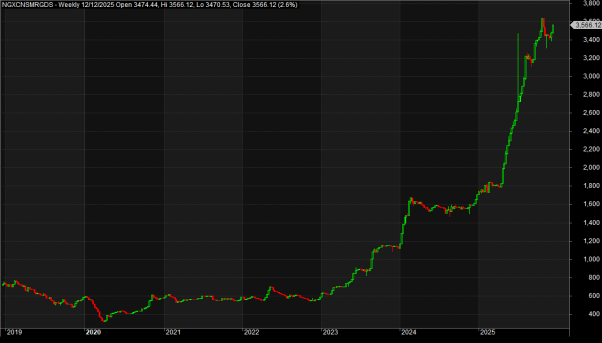
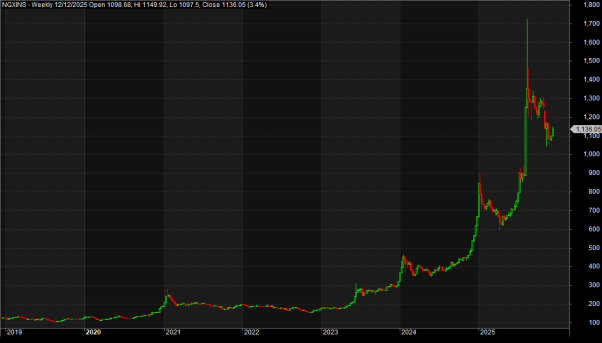
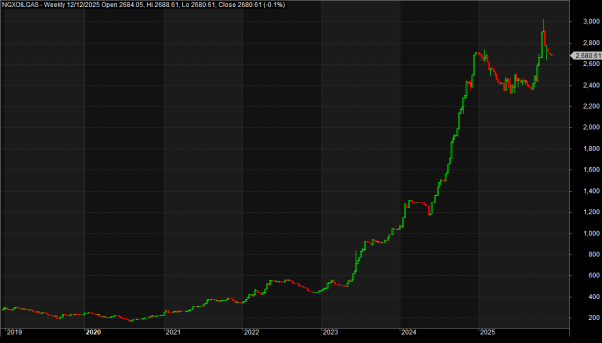
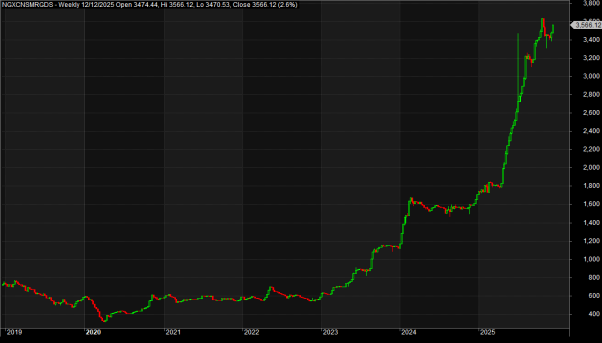
Week-to-date, the All-Share Index has increased by 1.63%, with the NGX-30 rising by 1.67%. The Banking Index posted a loss of 0.12%, the Pension Index increased by 1.33%, the Insurance Index inched by 3.40%, and the Consumer Goods Index increased by 2.64%. Oil and Gas Index decreased by 0.13%.
On a year-to-date basis, the All-Share Index is up 45.18%, while the NGX 30 has gained 43.41%, The Banking Index surged 31.33%, the Pension Index jumped 51.91%, the Insurance Index rose 58.22%, and the Consumer Goods Index posted a robust 105.94% increase. However, the Oil and Gas Index declined by 1.16%. Market breadth is positive, with 49 stocks advanced and 41 declined.
Morison Industries Chart
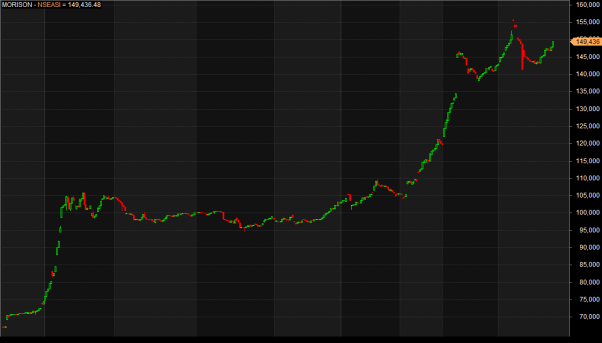
On the gainers’ table, Morison Industries, a Nigerian company that makes and sells hygiene, healthcare, and medical products, rallied from ₦3.54 to ₦4.69, appreciating by 32.49%. Mecure Industries climbed from ₦29.80 to ₦37.95, gaining 27.35%, while Japaul Gold & Ventures advanced from ₦2.10 to ₦2.66, up 26.67%. Sovereign Trust Insurance rose from ₦2.90 to ₦3.40, adding 17.24%, and PZ Cussons Nigeria increased from ₦40.45 to ₦47.00, up 16.19%.
Eterna Chart
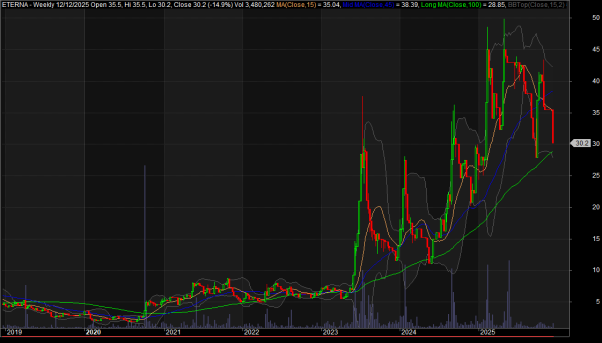
On the losers’ side, Eterna, a Nigerian energy company involved in the production, marketing, and distribution of petroleum products, declined from ₦35.50 to ₦30.20, shedding 14.93%. UACN dropped from ₦96.80 to ₦83.00, down 14.26%, while E-Tranzact International fell from ₦14.00 to ₦12.60, losing 10.00%. Transcorp Hotels slipped from ₦172.80 to ₦155.60, a decline of 9.95%, and Chellarams closed lower at ₦13.20 from ₦14.65, down 9.90%.
Trending in the Economy: Nigeria’s daily petrol consumption eased to 52.9 million litres in November 2025 from 56.74 million litres in October, despite higher overall supply driven by increased local output and imports. Dangote Refinery accounted for 23.52 million litres per day, while NNPC refineries were still not producing. Fuel imports jumped to 52.1 million litres daily, and Dangote has indicated plans to fully supply domestic demand from December 2025, targeting 57 million litres per day by February 2026.
Meanwhile, Nigeria’s total trade climbed to ₦38.9 trillion in Q3 2025, an 8.7% year-on-year increase. Exports stood at ₦22.8 trillion, largely supported by crude oil, while imports rose to ₦16.12 trillion, resulting in a trade surplus of ₦6.69 trillion.
Although non-oil exports improved, weaker agricultural exports highlighted ongoing structural challenges beyond the oil sector. China remained Nigeria’s largest source of imports, while India, Spain, France, the Netherlands, and Italy were the leading export destinations.
Global Market and Oil: Global markets ended Friday on a weaker note as renewed pressure on technology stocks dragged major indexes lower, while the dollar firmed and U.S. Treasury yields climbed. Investor caution around artificial intelligence-related trades deepened after a series of disappointing corporate updates. Technology stocks were the worst-performing segment of the S&P 500, sliding 2.9%. Broadcom sank 11.4% after flagging margin concerns, Oracle fell another 4.5% following a sharp drop the previous day, and Nvidia declined 3.3%, extending the pullback in AI-linked names.
Rising bond yields also weighed on equities. U.S. Treasury yields jumped as investors digested comments from Federal Reserve officials who opposed this week’s rate cut, citing inflation that remains too elevated to justify looser policy. The 10-year U.S. Treasury yield rose 5.1 basis points to 4.19%, marking a second straight weekly increase.
Despite the market volatility, expectations for additional U.S. rate cuts in 2026 remain intact after the Fed trimmed rates by 25 basis points earlier in the week, even as policymakers signaled a near-term pause. Concerns persist over sticky inflation and signs of a cooling labor market, reinforced by a sharp rise in weekly jobless claims.
U.S. equities closed broadly lower, with the Dow Jones Industrial Average down 0.51% at 48,458.05, the S&P 500 falling 1.07% to 6,827.41, and the Nasdaq Composite dropping 1.69% to 23,195.17. Global stocks also retreated, with MSCI’s world index down 0.63%, while Europe’s STOXX 600 slipped 0.53%. In bond markets, German yields moved higher as investors increasingly price in tighter policy across the euro zone. Germany’s 30-year yield climbed to a 14-year high of 3.498%, reflecting long-term fiscal concerns.
Currency markets were mixed. The dollar edged higher against major peers, though it remained on track for a third weekly decline. Sterling dipped 0.2% to $1.3375 after data showed the UK economy unexpectedly contracted. The dollar rose slightly against the yen to 155.93 ahead of a closely watched Bank of Japan meeting, while the euro held steady at $1.1735. The dollar index inched up 0.1% to 98.44.
Commodities also came under pressure. Copper slumped more than 3% from a record high as fears of an overheated AI trade triggered a selloff in risk assets. On the London Metal Exchange, three-month copper fell to around $11,540 per tonne. Oil prices closed lower and recorded a roughly 4% weekly decline, weighed down by ample supply and hopes of easing geopolitical tensions. U.S. crude settled at $57.44 a barrel, while Brent ended at $61.12.
Sectorial Indexes Chart Positions For The Week
NGX Banking Index Chart
NGX Consumer Goods Index Chart
NGX Insurance Index Chart
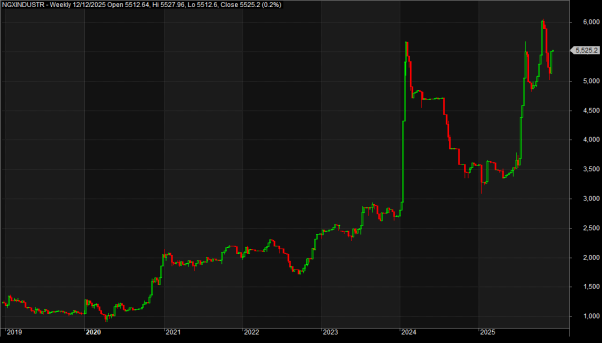
NGX Industrial Goods Index Chart
NGX Oil & Gas Index Chart
NGX Commodity Index Chart
NGX 30 Index Chart