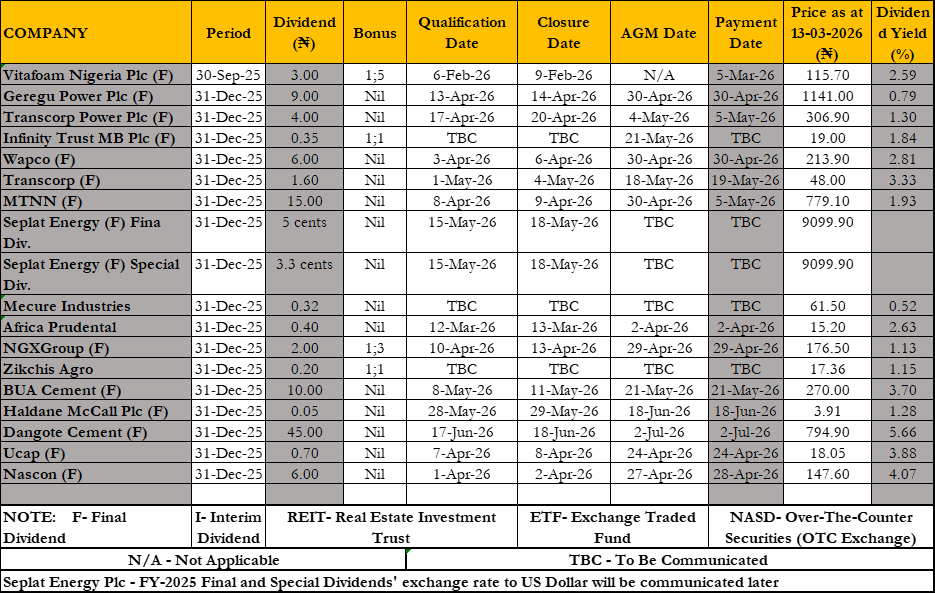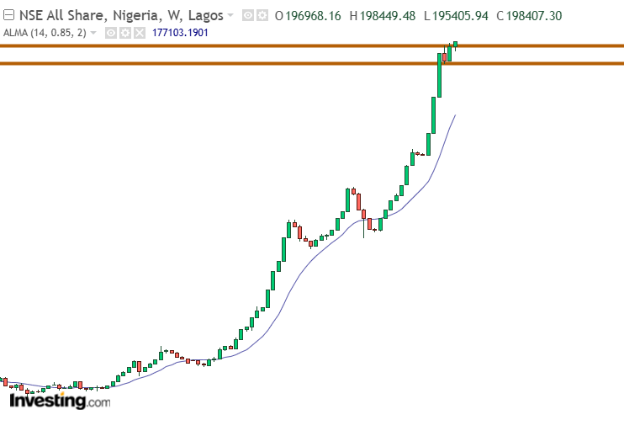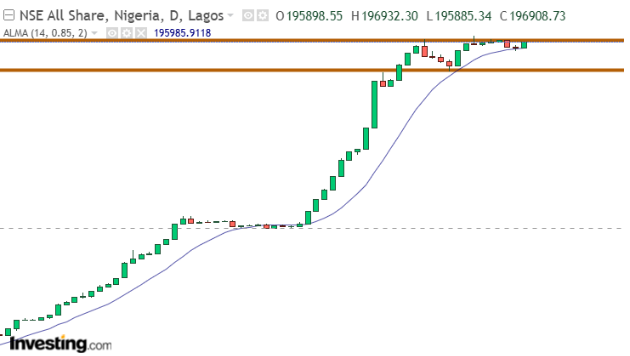

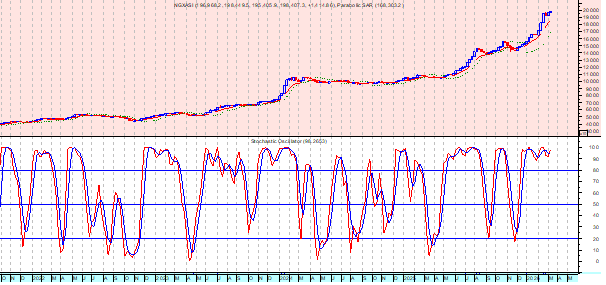
Trading for the second week of March was mixed on the Nigerian Exchange, as its composite All-Share index closed on a bullish note, extending the previous week’s positive sentiment and gains, with the market composite Index NGXASI hitting a new all-time high to trade above the T-line on a daily and weekly time frame.
NGXASI Daily Index Chart
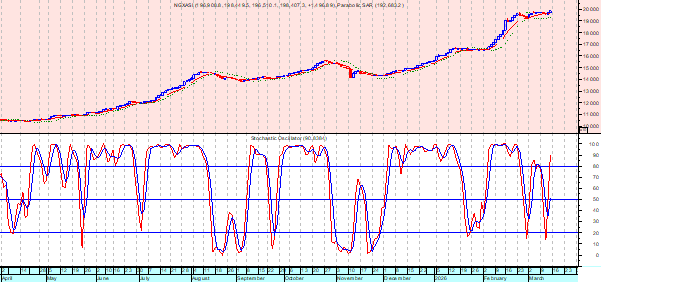
Activities for the week kicked off on a positive note when the NGX All-Share Index (ASI) rose 0.12% to 197,196.97 points, while lifting market capitalisation by ₦146.87 billion to ₦126.58 trillion and pushing the year-to-date return to 26.72%. Despite the gains, market breadth was weak, with 43 decliners against 26 advancers. Conoil Plc, Legend Internet Plc, and Omatek Ventures Plc led the gainers, while Alexandria Real Estate Equities Plc fell the most. Trading strengthened with 762.53 million shares worth ₦31.23 billion changing hands, led in volume by FTN Cocoa Processors Plc and in value by Aradel Holdings Plc.
On Tuesday, the market reversed course, with the ASI dropping 0.57% to 196,066.11 points. Market capitalisation fell by ₦725.94 billion to ₦125.86 trillion, and the year-to-date return eased to 26.00%. Market breadth remained negative with 42 losers and 33 gainers. CONOIL, LEGENDINT, and PREMPAINTS led the gainers, while NASCON and MBENEFIT were top decliners. Trading slowed slightly, with 746.85 million shares worth ₦27.85 billion exchanged, led in volume by ACCESSCORP and in value by ZENITHBANK.
The bearish trend continued on Wednesday, with the ASI slipping 0.09% to 195,898.53 points, bringing market capitalisation to ₦125.75 trillion and YTD return to 25.89%. Market breadth saw 40 decliners against 29 gainers. NGXGROUP topped the gainers, while PRESCO led the losers. NGXGROUP, PREMPAINTS, and BUACEMENT traded above their 52-week highs. Trading volume declined to 671.27 million shares worth ₦26.13 billion, with WEMABANK recording the highest volume and value, followed by ACCESSCORP, MBENEFIT, Aradel, and DANGCEM.
Thursday saw a market rebound as buying interest in FIDSON, STERLINGNG, CAP, TRANSCOHOT, and BUACEMENT lifted sentiment. The ASI rose 0.52% to 196,908.76 points, and market capitalisation increased by ₦648.46 billion to ₦126.40 trillion, taking the YTD return to 26.54%. Market breadth was balanced at 30 gainers and 30 losers, led by FTNCOCOA and ETERNA. Trading slowed with 549.78 million shares worth ₦44.74 billion exchanged, as FTGINSURE led in volume and DANGCEM in value.
The week ended on a strong note on Friday, with the ASI gaining 0.76% to 198,407.30 points and market capitalisation reaching ₦127.36 trillion. Investor optimism was supported by significant gains in GUINNESS (+10%), MAYBAKER (+9.93%), and BUACEMENT (+9.18%). Market breadth showed 35 gainers against 20 losers, with GUINNESS and BUACEMENT trading above 52-week highs. Trading activity picked up to 591.04 million shares valued at ₦35 billion, led in volume by FIRSTHOLDCO and in value by MTNN.
For the week, a total of 3.321 billion shares worth ₦164.85 billion changed hands in 318,907 deals, slightly lower than the previous week’s 3.695 billion shares valued at ₦177.69 billion in 370,980 deals. The Financial Services sector dominated trading with 2.179 billion shares worth ₦59.81 billion across 124,992 deals, followed by Oil & Gas (207.69 million shares worth ₦27.61 billion) and Consumer Goods (189.63 million shares worth ₦11.85 billion). The most active stocks by volume were Access Holdings Plc, Fortis Global Insurance Plc, and First Holdco Plc, accounting for 20.39% of total market volume and 8.83% of value traded.
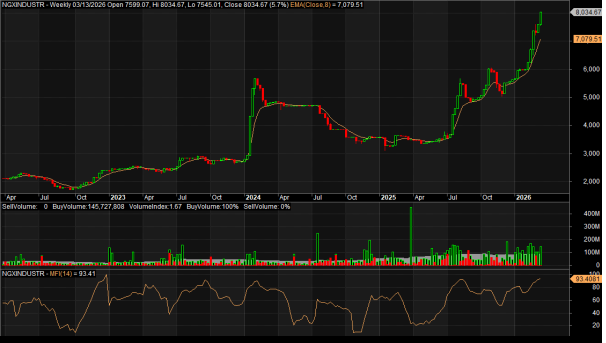
The benchmark NGX All-Share Index for the week gained 0.73% to 198,407.30 points, with market capitalisation rising to ₦127.36 trillion. While most sector indices dipped, gains were recorded in the NGX Main Board, NGX 30, Consumer Goods, Oil & Gas, Industrial Goods, Sovereign Bond, and Insurance indices.
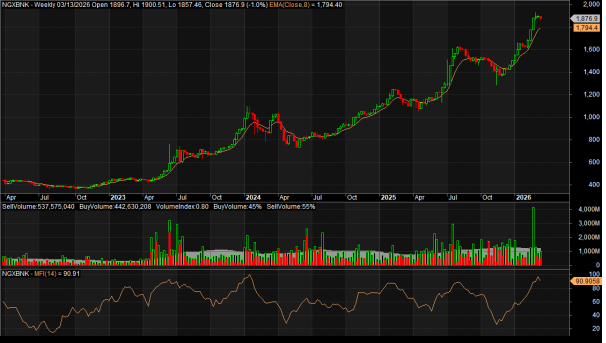
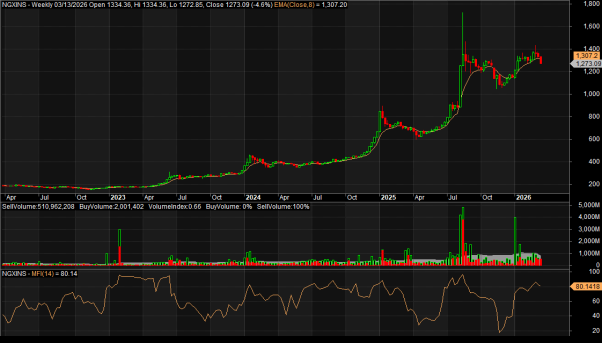
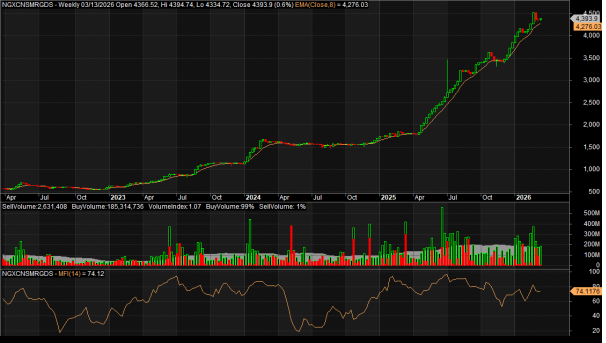
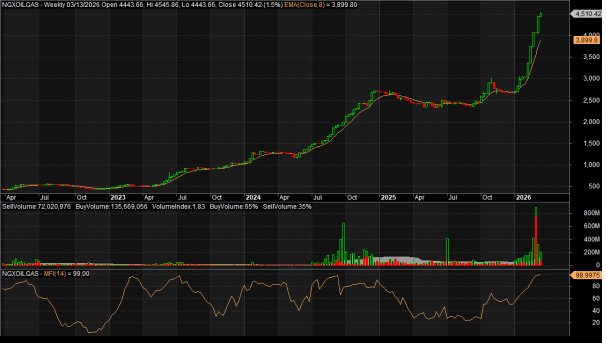
Week-to-date, NGX 30 is up by 0.80%, the Banking Index has decreased by 1.04%, the Pension Index decreased by 0.09%, the Insurance Index declined by 4.59%, the Consumer Goods Index increased by 0.63%. However, the Oil and Gas Index recorded a positive return of 1.50%. Year-to-date, the All-Share Index has gained 27.50%, NGX 30 is up by 26.74%, the Banking Index has increased by 23.82%, the Pension Index index increased by 35.53%, the Insurance Index inclined by 7.04%, the Consumer Goods Index increase by 10.53%. However, the Oil and Gas Index recorded a positive return of 68.91%. In terms of market breadth, 34 stocks advanced, while 61 declined.
Premier Paints Plc
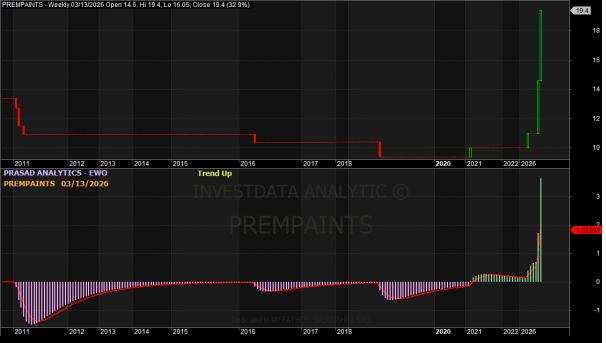
Among the week’s top performers, Premier Paints Plc a Nigerian paint and coatings manufacturer, rose from ₦14.60 to ₦19.40, gaining ₦4.80 or 32.88%. Conoil Plc appreciated from ₦169.00 to ₦204.40, adding ₦35.40 or 20.95%, while BUA Cement Plc climbed from ₦225.00 to ₦270.00, up ₦45.00 or 20.00%. Fidson Healthcare Plc also advanced from ₦88.50 to ₦105.35, representing a 19.04% gain, while Omatek Ventures Plc increased from ₦2.20 to ₦2.60, reflecting an 18.18% rise.
SCOA Nigeria Plc
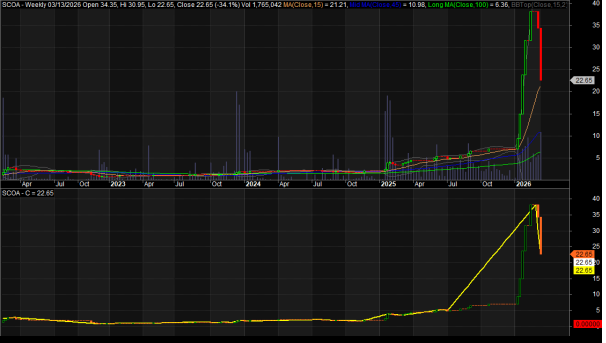
On the downside, SCOA Nigeria Plc, another Nigerian company that operates in motor vehicles, industrial equipment, and construction, distributing, maintaining, and leasing vehicles and machinery, declined from ₦34.35 to ₦22.65, shedding ₦11.70 or 34.06%. Fortis Global Insurance Plc dropped from ₦1.49 to ₦1.18, representing a 20.81% loss, while Sovereign Trust Insurance Plc fell from ₦2.66 to ₦2.11, down 20.68%. Aluminium Extrusion Industries Plc slipped from ₦15.50 to ₦12.60, losing 18.71%, while LivingTrust Mortgage Bank Plc declined from ₦5.87 to ₦4.85, dropping 17.38% over the week.
Technical Analysis View & Position
The ASI broke above the 198,000-resistance level on Friday, signalling a potential short-term bullish trend. Technical indicators show the 50-day moving average maintaining an upward slope, supporting momentum in the mid-cap and large-cap stocks. RSI levels around 62 suggest the market is moderately overbought but not excessively, leaving room for further gains. Key support levels lie near 196,000 and 195,500 points, while resistance is projected around 199,500–200,000 points.
Looking ahead, market activity is expected to be guided by investor appetite for blue-chip stocks, earnings announcements, and sector rotation. The Financial Services and Consumer Goods sectors may continue to attract attention, while high-performing mid-cap stocks like BUA Cement, Conoil, and Fidson Healthcare could see sustained momentum. Caution is advised near the 200,000-point psychological barrier, as profit-taking may intensify if the ASI tests this level. It was a bullish week, despite pockets of sectoral weakness and selective profit-taking.
Trending in the Economy: Nigeria’s power sector is under severe strain, with only eight out of more than 30 plants currently generating electricity, producing a mere 1,212MW—far below the peak demand of 20,000MW. Hydropower facilities like Kainji, Zungeru, and Shiroro account for most of the output, while many gas-fired plants are underperforming due to fuel shortages, maintenance issues, and financial constraints. Several major plants reported no generation at all. Analysts warn that sustained low output could lead to widespread blackouts, exposing persistent structural weaknesses in the electricity system. The NNPC’s Gas Master Plan 2026 seeks to increase gas supply and stabilize power generation.
Nigeria recorded a trade surplus of ₦1.71 trillion in Q4 2025 despite weaker export performance, according to the National Bureau of Statistics (NBS). Total trade reached ₦36.21 trillion, with exports at ₦18.96 trillion (52.36% of total trade) and imports at ₦17.25 trillion. The drop in export earnings was largely due to lower crude oil revenues, but overall, exports still outpaced imports. China remained the largest source of imports, while top export destinations included the Netherlands, India, Spain, France, and Canada.
Global Market and Oil: U.S. equities closed lower on Friday, capping a week of sharp swings driven by erratic crude oil prices and escalating geopolitical tensions in the Middle East. All three major U.S. stock indexes recorded declines for both the day and the week. The small-cap Russell 2000 ended the session at its lowest close of the year, reflecting investor caution amid market uncertainty.
Crude oil markets experienced heightened volatility throughout the week. Front-month WTI crude futures settled at $98.71 per barrel, up $2.98 or 3.11% on the day, while Brent crude for May closed at $103.14 per barrel, rising $2.68 or 2.67%, marking the first time Brent surpassed $100 since August 2022. Analysts note that the energy market has shown swings rivaling even the most volatile two-week periods in cryptocurrency markets, suggesting prices are being driven more by sentiment than fundamentals.
Geopolitical developments in Iran contributed to market jitters. U.S. President Donald Trump’s statement that he would “hit Iran very hard over the next week,” coupled with reports that the conflict had spread to Lebanon, Kuwait, Iraq, the UAE, Bahrain, and Oman, has diminished hopes of a near-term de-escalation. In response, Iran tightened control over the Strait of Hormuz, a crucial oil transit route responsible for one-fifth of global crude shipments. The International Energy Agency warned that the conflict could trigger the largest-ever disruption in global oil supply.
Earlier in the week, crude prices briefly dipped on an incorrect report that an Indian-flagged tanker had sailed through the closed Strait of Hormuz. Once clarified that the vessel sailed from Oman without passing through the strait, oil prices rebounded, turning positive before midday. Since March 6, Brent has surged 11.27% while WTI is up 8% from a week ago.
On the economic front, the U.S. Commerce Department sharply revised fourth-quarter GDP growth downward, while other reports highlighted weakening demand for durable goods. The Personal Consumption Expenditures (PCE) index, the Federal Reserve’s preferred inflation gauge, showed little movement, maintaining pressure on the central bank’s monetary stance. Despite softer economic data, the Fed is expected to keep interest rates unchanged at the conclusion of next week’s policy meeting, as rising energy costs could feed into inflation. Peter Cardillo, chief market economist at Spartan Capital Securities, noted, “Inflation remains elevated, and with the possibility of energy prices eventually moving into the pipeline, the Fed is likely to stay on hold for a longer period of time.”
Market performance was mixed across sectors. Technology stocks posted the largest losses, while utilities enjoyed the biggest gains. Key movers included Adobe, which dropped 7.6% after CEO Shantanu Narayen announced he would step down once a successor is appointed, raising concerns about AI disruption. Meta Platforms slid 3.8% after delaying the release of its AI model “Avocado” to at least May. The financial sector fell 3.4% over the week amid mounting credit-quality concerns.
The Dow Jones Industrial Average lost 119.38 points, or 0.26%, closing at 46,558.47. The S&P 500 fell 40.43 points, or 0.61%, to 6,632.19, while the Nasdaq Composite dropped 206.62 points, or 0.93%, to 22,105.36. On the NYSE, declining issues outnumbered advancing stocks by a 1.9-to-1 ratio, with 71 new highs and 185 new lows recorded. On the Nasdaq, 1,714 stocks rose, 2,966 fell, and declining issues outpaced advancers 1.73-to-1. The S&P 500 posted 13 new 52-week highs and 11 new lows, while the Nasdaq recorded 33 new highs and 193 new lows. Total trading volume on U.S. exchanges was 18.12 billion shares, slightly below the 20-day session average of 19.84 billion.
Looking ahead, investors remain cautious as the conflict in Iran shows no signs of immediate resolution and energy prices continue to fluctuate. With WTI at $98.71 and Brent above $103 per barrel, oil remains a key driver of market volatility, potentially influencing inflation expectations, Fed policy, and equity performance in the coming weeks.
Sectorial Indexes Weekly Chart Position
NGX Banking Index Chart
NGX Insurance Index Chart
NGX Consumer Goods Index Chart
NGX Industrial Goods Index Chart
NGX Oil & Gas Index Chart
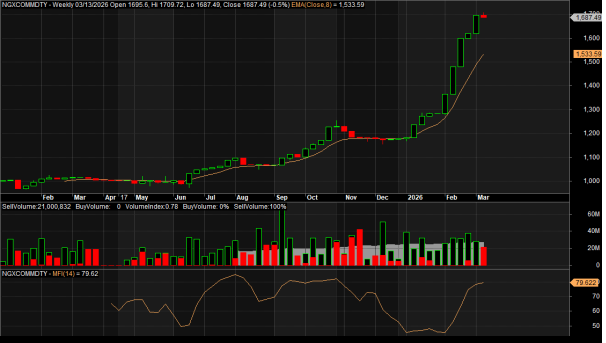
NGX Commodity Index
NGX 30 Index Chart