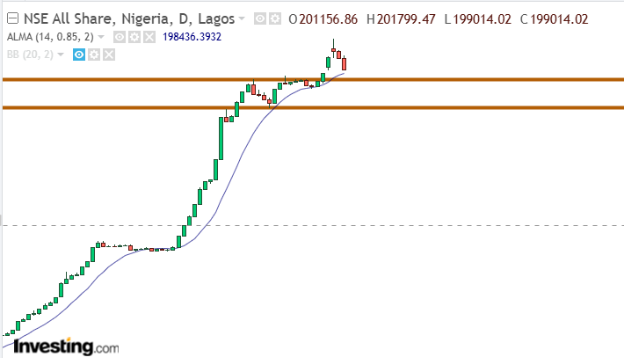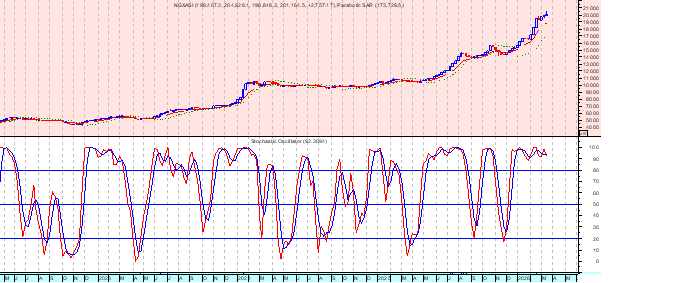

The Nigerian equities market opened last week Monday on a bearish note as investors offloaded key stocks including GTCO, MTN Nigeria, and Zenith Bank. Specifically, the composite NGX All-Share Index in the week following the Eid-el-Fitr break fell by 1.07% to 199,014.02 basis points, while market capitalization dropped to ₦127.75 trillion. Year-to-date returns also moderated to 27.89%. Despite the decline, market breadth was positive, parading more gainers than losers, with Presco Plc leading the advancers, while Conhall Plc topped the losers. Trading activity was notably weak, as volume fell sharply. UBA Plc dominated in volume, while MTN Nigeria led in value traded.
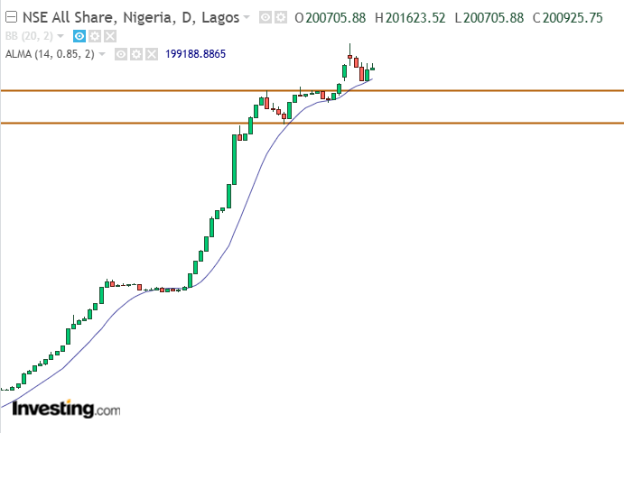
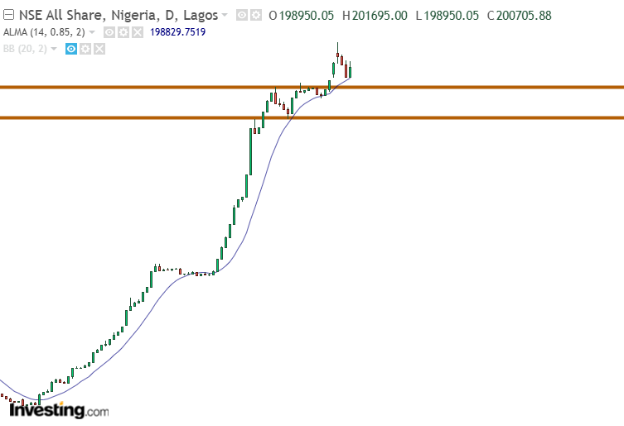
On Tuesday the market rebounded, driven by renewed buying interests in telecommunications giant- Airtel Africa and GTCO, following which the NGX All-Share Index recovered 0.85%, closing at 200,705.88 points, just as market capitalization inched to ₦128.84 trillion, improving the NGXASI’s YTD returns to 28.98%. Market sentiment stayed positive, but this time with stronger trading activity. Access Holdings led in volume, while GTCO dominated value traded.
Midweek’s trading saw a modest uptick as the NGX All-Share Index gained a further 0.11%, supported by selective buying in names like Premier Paints and GTCO. Market capitalization increased to ₦128.98 trillion, with YTD returns edging up to 29.12%. Market breadth was neutral, while trading activity slowed, with Wema Bank leading by volume and MTN Nigeria accounting for the highest value traded.
On Thursday, the market posted a marginal gain of 0.02%, buoyed by continued interest in stocks such as Premier Paints and Zenith Bank. Market capitalization rose slightly to ₦129 trillion, and YTD returns improved to 29.14%. However, market breadth turned negative even as trading activity picked up, with Access Holdings leading volume and MTN Nigeria maintaining dominance in value traded.
The week closed on a slightly bearish note as profit-taking emerged in stocks like Cadbury Nigeria and eTranzact International. The NGX All-Share Index declined by 0.02% to 200,913.06 points, while market capitalization slipped to ₦128.97 trillion and YTD returns eased to 29.11%. Market breadth was negative, and trading activity slowed, with Wema Bank leading in volume and MTN Nigeria dominating value traded.
Overall, weekly market activity weakened compared to the previous week, with total traded volume and value declining significantly, after investors exchanged 3.95 billion shares worth ₦201.31 billion in 359,642 deals, down from 8.76 billion shares valued at ₦267.25 billion in the prior week.
The Financial Services sector remained the most active, accounting for 2.88 billion shares worth ₦102.26 billion—representing 72.94% of total volume and 50.80% of total value. The ICT sector followed with 230.54 million shares valued at ₦45.17 billion, while the Agriculture sector recorded 191.93 million shares worth ₦6.63 billion.
Wema Bank, Access Holdings, and United Bank for Africa were the most traded stocks, jointly accounting for 1.45 billion shares valued at ₦43.19 billion across 28,436 deals, contributing 36.65% of total volume and 21.45% of total value.
The NGX All-Share Index ultimately closed the week down 0.12% at 200,913.06 points, with market capitalization settling at ₦128.97 trillion. Most sector indices ended in negative territory, although the NGX Main Board, Insurance, AFR Div Yield, Oil & Gas, Lotus II, Growth, and Commodity indices recorded gains, while the Sovereign Bond Index closed flat.
Week-to-date, the All-Share Index lost 0.12%, the NGX 30 is down by 0.11%, Banking Index has decreased by 2.47%, the Pension Index lost 0.64%, the Insurance Index shed 2.22%, the Consumer Goods Index suffered a 0.91% slide. However, the Oil and Gas Index recorded a positive return of 1.93%, in what may not be unconnected with the ongoing global turmoil in the aftermath of the ongoing face-off involving the U.S and Israel on one side, and Iran.
Year-to-date, the All-Share Index has gained 29.11%, NGX 30 is up by 28.39%, the Banking Index has increased by 25.97%, the Pension Index index is still leading with 35.06%, while the Insurance! Index inclined by 8.96%, the Consumer Goods Index is up by 9.42%. However, the Oil and Gas Index is king of the pack with its positive return of 63.93%. In terms of market breadth, 47 stocks advanced, while 45 declined.
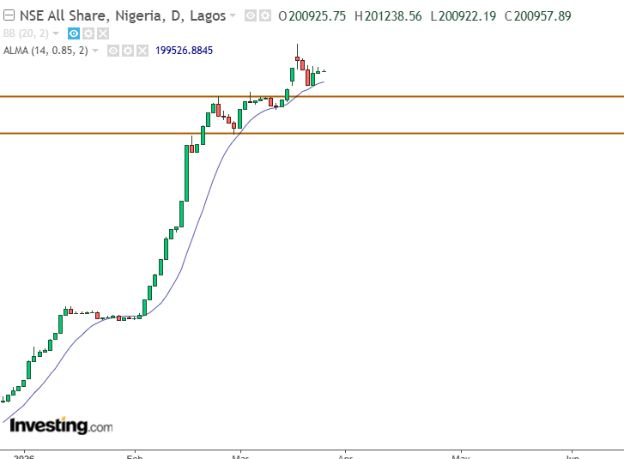
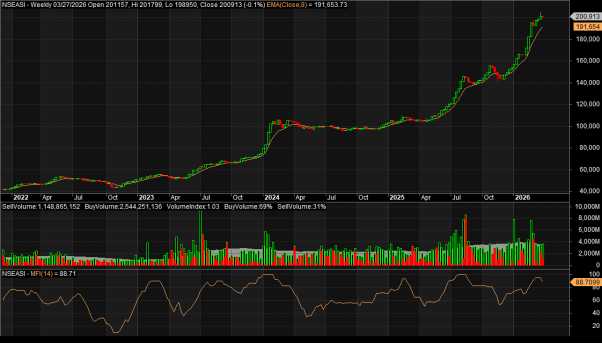
The Nigerian equities market, as captured by the NGX All-Share Index, displayed a mixed but slightly weak technical structure over the week, characterized by alternating bullish and bearish sessions. Price action showed that the index attempted to sustain its broader uptrend but struggled to maintain consistent momentum following intermittent bouts of profit-taking, particularly in high-capitalization stocks.
The index hovered around the psychologically important 200,000 level, managing to close slightly above it despite midweek’s fluctuations. This behaviour suggests that the market is currently in a consolidation phase rather than a decisive trending move. The presence of lower highs during the week indicates a waning bullish momentum, while the inability to sustain strong breakouts points to resistance pressure near recent highs.
Trading volume declined noticeably compared to the previous week’s, reflecting reduced participation and a more cautious stance among investors. Liquidity remained concentrated in a few key stocks especially within the financial services space, where names such as Wema Bank Plc, Access Holdings Plc, and United Bank for Africa Plc continued to dominate activity. This concentration of trades suggests selective accumulation rather than broad-based market enthusiasm.
Market breadth was mixed throughout the week but turned negative towards the close indicating that decliners slightly outpaced advancers in the final sessions. This divergence between index performance and breadth is a subtle signal of underlying weakness, as gains were not widely supported across the market. Sector performance also reflected this uneven sentiment, with sporadic strength in select counters failing to offset profit-taking in others.
Large-cap stocks such as GTCO Plc, Zenith Bank Plc, and MTN Nigeria Communications Plc continued to exert significant influence on index direction, reinforcing the market’s sensitivity to movements in a handful of heavyweight names. Their price stability or weakness often dictated intraday and sessional trends across the broader index.
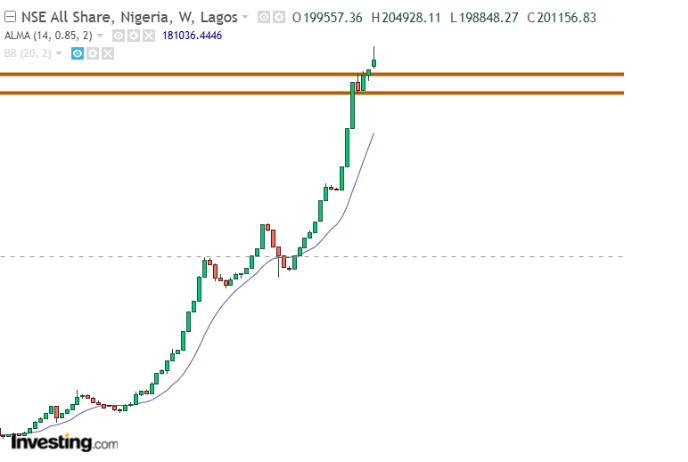
NGXASI Weekly Chart
From a technical standpoint, the market appears to be trading within a tight range, with resistance forming around recent highs near the 201,000 to 202,000 zone, while support is observed around the 198,000 to 199,000 area. The inability to decisively break above resistance suggests that bullish momentum is not yet strong enough to trigger a sustained rally, while the presence of support indicates that downside risk remains contained in the short term.
Market Outlook
Looking ahead, the near-term outlook points to continued consolidation with a slight bearish-to-neutral bias, driven by profit-taking, reduced volume, and selective investor participation. However, the broader medium-term outlook remains cautiously positive, supported by the market’s year-to-date performance and the potential for renewed inflows into fundamentally strong stocks.
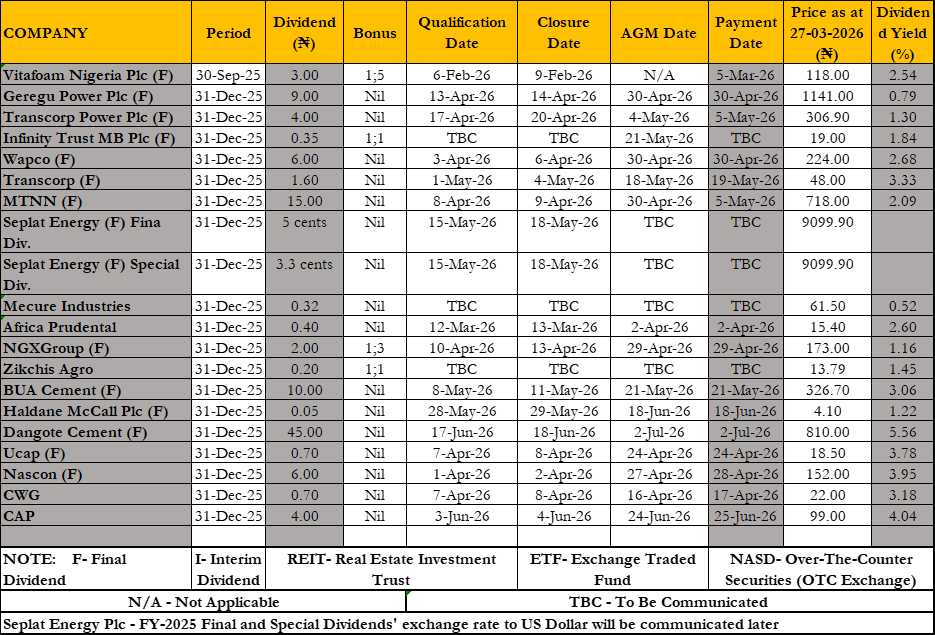
Going forward, market direction will likely be influenced by corporate earnings releases, dividend announcements, and liquidity conditions, particularly within the banking and telecom sectors. A sustained increase in buying interest, especially across a wider range of stocks, would be required to confirm a breakout above current resistance levels. Until then, the market is expected to oscillate within its current range, with stock-specific movements playing a more dominant role than broad market trends.
Zichis Agro Allied Industries Plc
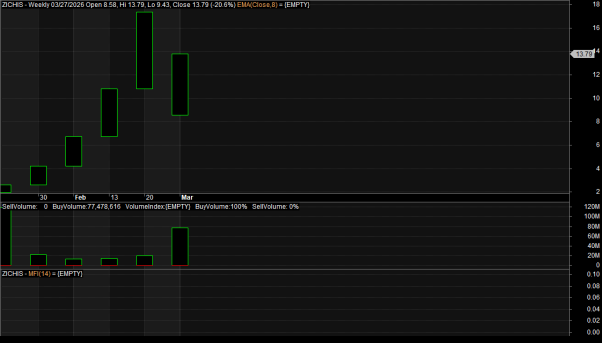
Top gainers for the week were led by Zichis Agro Allied Industries Plc, which rose 60.72% from ₦8.58 to ₦13.79 each. Followed by Premier Paints Plc from ₦23.40 to ₦37.50, up 60.26%, while John Holt Plc climbed from ₦11.85 to ₦18.95, representing a 59.92% increase. Legend Internet Plc also appreciated from ₦6.00 to ₦7.50, gaining 25.00%, and McNichols Plc rose from ₦6.15 to ₦7.42, up 20.65%.
Livestock Feeds Plc Chart
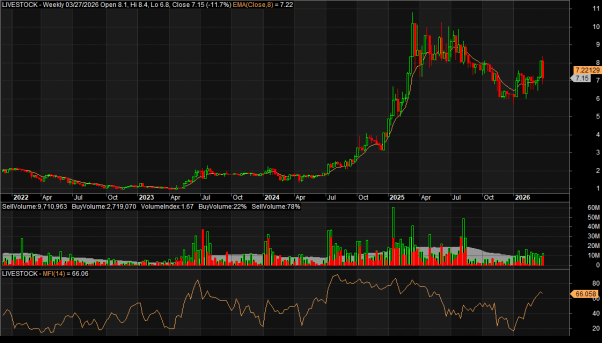
On the losers’ side, Livestock Feeds Plc declined from ₦8.10 to ₦7.15, down 11.73%. Fidson Healthcare Plc dropped from ₦105.35 to ₦94.85, losing 9.97%, while Cadbury Nigeria Plc fell from ₦69.95 to ₦63.00, shedding 9.94%. Austin Laz & Company Plc slipped from ₦4.45 to ₦4.01, down 9.89%, and Learn Africa Plc decreased from ₦9.35 to ₦8.50, losing 9.09%.
Trending in the Economy: Sunday Oduntan of the Association of Nigerian Electricity Distributors noted that weak hydro power output has forced greater dependence on gas-fired plants, contributing to more frequent supply disruptions. The Nigerian Independent System Operator attributed the shortfall in generation to gas supply constraints, while a ₦20.33 billion refund directive from the Nigerian Electricity Regulatory Commission has added financial strain on distribution companies. He emphasized that boosting generation capacity and enforcing better payment discipline are critical to stabilising the power sector.
Nigeria’s capital importation climbed to $6.44 billion in Q4 2025, representing a 26.6% year-on-year increase and a 7.1% rise quarter-on-quarter, based on official figures. Portfolio investments accounted for more than 85% of total inflows, while foreign direct investment remained relatively weak. The banking sector attracted the largest share of funds, reflecting investor preference for short-term assets. The United Kingdom was the leading source of capital, followed by the United States and South Africa, underscoring continued reliance on major global financial hubs.
Global Market and Oil: U.S. equities extended their slide on Friday, closing at levels not seen in over seven months as persistent geopolitical tensions in the Middle East continued to dampen investor appetite for risk. The selloff pushed all three major indexes deeper into negative territory, with the Dow Jones Industrial Average confirming a correction after falling more than 10% from its recent peak.
The Dow dropped 793.47 points, or 1.73%, to settle at 45,166.64. The S&P 500 declined 108.31 points, or 1.67%, ending at 6,368.85, while the Nasdaq Composite led losses with a 2.15% fall, shedding 459.72 points to close at 20,948.36. The downturn marked the fifth consecutive weekly decline for all three benchmarks, the longest losing streak in nearly four years.
Market sentiment remained fragile despite political signals aimed at de-escalation. U.S. President Donald Trump’s warning to Iran over reopening the Strait of Hormuz failed to reassure investors, while ongoing uncertainty surrounding the conflict—sparked by U.S.-Israeli airstrikes—continued to weigh on global risk assets. U.S. Secretary of State Marco Rubio maintained that Washington could achieve its objectives without ground troop deployment and suggested the operation could conclude within weeks, even as military presence in the region has increased.
Energy markets reflected the heightened uncertainty. U.S. crude oil rose 5.46% to $99.64 per barrel, while Brent crude gained 4.22% to $112.57 per barrel. Despite the daily gains, both benchmarks were relatively unchanged on a weekly basis, with Brent futures later trading at $110.86 per barrel (up $2.85, or 2.64% intraday) and West Texas Intermediate at $97.01 per barrel (up $2.53, or 2.68%). Notably, Brent has surged more than 50% since late February when the conflict began, while WTI has climbed roughly 45%, though both benchmarks still recorded modest weekly declines of around 1%.
Volatility spiked alongside the equity selloff, with the CBOE Volatility Index rising 3.61 points to 31.05, its highest close since April, signaling increased market anxiety. Breadth remained weak, as decliners significantly outpaced advancers across major exchanges.
Large-cap technology stocks were among the biggest contributors to the downturn. Shares of Nvidia fell 2.2%, reflecting pressure on the semiconductor sector, while Amazon dropped 4%, adding to the drag on the S&P 500. Broader weakness in software names pushed the S&P 500 software and services index to its lowest level since November 2023.
Consumer discretionary stocks also underperformed, falling 3.1% as a sector. Within the group, Carnival declined 4.3% after cutting its annual adjusted profit forecast, while Norwegian Cruise Line tumbled 6.9%, reflecting concerns over demand and cost pressures in the travel segment.
Investor sentiment has also been affected by shifting expectations around U.S. monetary policy. Rising oil prices and associated inflation risks have reduced the likelihood of interest rate cuts in the near term. Market pricing now suggests no rate cuts from the Federal Reserve this year, a notable shift from earlier expectations of multiple reductions. There is even a growing, though still limited, probability assigned to a potential rate hike later in the year.
Economic indicators have added to the cautious outlook. U.S. consumer sentiment slipped to a three-month low in March, highlighting growing concerns about the broader economic impact of geopolitical instability. Market breadth data reinforced the bearish tone, with declining stocks outnumbering advancing ones by more than 3-to-1 on both the NYSE and Nasdaq. Meanwhile, the S&P 500 recorded 22 new 52-week highs and 27 lows, while the Nasdaq Composite posted 25 highs and 355 lows.
Trading activity was also relatively subdued compared to recent averages, with total U.S. exchange volume reaching 18.13 billion shares, below the 20.4 billion average over the past 20 sessions.
Overall, the combination of geopolitical uncertainty, rising energy prices, tighter financial conditions, and weakening investor confidence has created a challenging environment for equities, with markets now grappling with the risk of further downside if conditions fail to stabilize.