
Quarter Under Preview: 12-Month Unaudited 2025
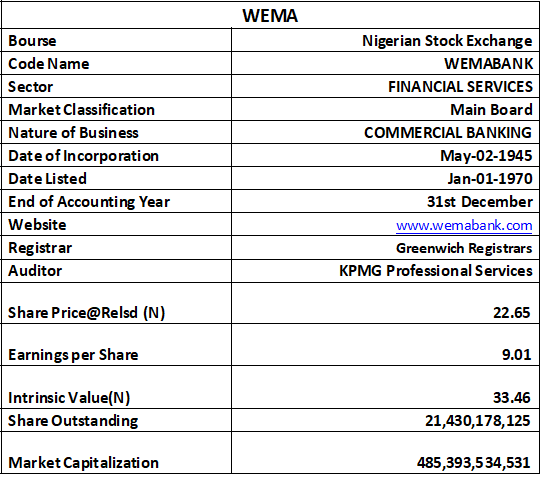
Current Share Price: N26:00
Price At Release Date: N22.65
Latest Final Dividend: N1.00
Latest Interim Dividend:
Estimated Beta Value: 0.36x
Estimated Intrinsic Value: N33.46
Rating: Strong Buy
Analyst: Jeariogbe Tunde Segun
The Company
Regarded as Nigeria’s most resilient bank and the longest surviving indigenous financial institution in Nigeria, Wema Bank Plc (the Bank) has over the years diligently offered a range of value-adding banking and financial advisory services for 78 years. Incorporated in 1945 as a Private Limited Liability Company under the name: Agbonmagbe Bank Limited and commenced banking operations in the same year. Wema Bank subsequently transformed into a Public Limited Liability Company (PLC) in April 1987 and was listed on the Nigerian Exchange Limited now Nigerian Exchange Limited (NGX) in January 1990.
On February 5, 2001, Wema Bank Plc was granted a universal banking license by the Central Bank of Nigeria (CBN), thus enabling it provide the Nigerian public with a diverse portfolio of financial and business advisory services. In 2009, the bank underwent a strategic repositioning exercise which culminated in the decision to operate as a commercial bank with regional authorization. Upon the successful turnaround, Wema Bank applied to the Central Bank of Nigeria (CBN) for, and was granted a national banking license in 2015.
Wema Bank offers retail banking, SME banking, corporate banking, treasury, trade services and financial advisory to its ever-expanding clientele. Operating a network of over 150 business offices backed by a robust ICT platform across the country.
The Released Numbers
Going by the unaudited numbers released recently, representing the full year 2025 business session, the management of Wema Bank achieved Gross Earnings of N653.280 billion, compared to N433.434 billion in the corresponding period of 2024. Interest Income stood at N577.101 billion, versus N354.633 billion, while Interest Expenses stood at N216.996 billion against the previous N177.569 billion. Operating Expenses through the 12 months stood at N178.777 billion, compared to N122.957 billion in the preceding year. Profit before Tax estimate stood at N222.068 billion versus N102.517 billion in the prior year. Total Tax Expense reported for the year is 28.879 billion against N16.237 billion.
Thus, profit for the period stood at N193.189 billion, representing a 120.14% growth over the N87.757 billion posted at the end of the 2024 financial year. See the below table for details.
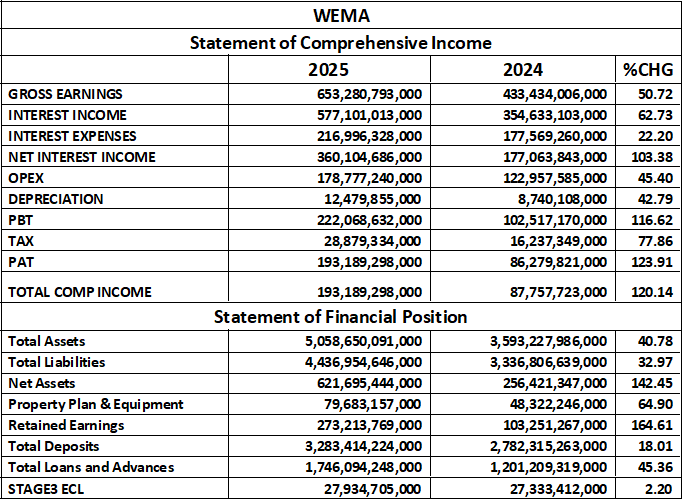
Total Assets for the 12 months is valued at N5.058 trillion, compared to the N3.593 trillion in the corresponding year. Total Liabilities stood at N4.436 trillion versus N3.336 trillion. Net Assets is now valued at N621.695 billion from N256.421 billion, while Retained Earnings also increased by 164.61% to stand at N273.213 billion against N103.251 billion in the comparable year. Total Deposits for the period was valued at N3.283 trillion, a growth of 18.01% above the last year number. Total Loans and Advances dispensed through the year is same as N1.746 trillion versus N1.201 trillion in the corresponding year. The reported stage 3 ECL was stable through the two years compared, it moved slightly by 2.2% to stand at N27.934 billion against N27.333 billion of 2024. See the above table for details.
Financial Strength
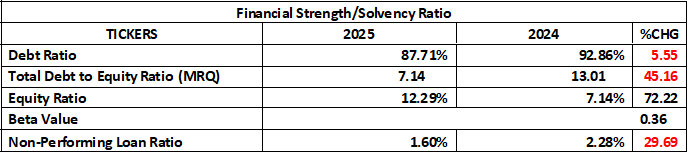
- Debt Ratio: (87.71% Vs 92.86%): The decline from 92.86% to 87.71% is a significant improvement, meaning the bank is now less leveraged and less dependent on borrowed funds. Nevertheless, it should be noted that, for banks, high leverage is normal, but a reduction of over 5% points indicates stronger balance sheet discipline and possibly improved capital retention.
- Total Debt to Equity: (7.14x Vs 13.01x): The movement in this ratio is a major improvement and means that for every N1 of equity, debt has reduced from N13.01 to N7.14 each. The sharp reduction suggests that equity increased significantly and liabilities reduced. This is a very positive signal for solvency and long term stability.
- Equity Ratio: (12.29% Vs 7.14%): The rise in Equity Ratio from 7.145 to 12.29% shows that the bank is now better capitalized, just as it aligns with the drop in the leverage ratios above and confirms the stronger capital base, and better ability to absorb shocks or losses. It is noteworthy that this is a key strength, especially in Nigeria’s volatile macro environment.
- Beta Value: (0.36x) indicates a low volatility relative to the broader market and that Wema Bank’s stock is less sensitive to market swings. This makes it a defensive banking stock, in other words, the stock is good for risk-averse investors.
- Non-Performing Loans: (1.60% Vs 2.28%): This is a strong improvement as it is also well-below the CBN’s regulatory threshold of 5%. This tells us that the quality of Wema Bank’s loan book has further improved, signifying a better credit risk management and even a lower risk of future write offs. Note that this is a very strong indicator of asset quality.
Overall Verdict on Financial Strength: Wema Bank Plc displayed a clearly improved financial strength position in 2025, and this performance is characterized by: stronger capital base, reduced leverage risk, improved asset quality and stable and low-risk stock profile.
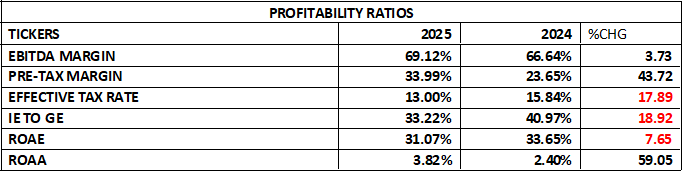
Profitability Ratios
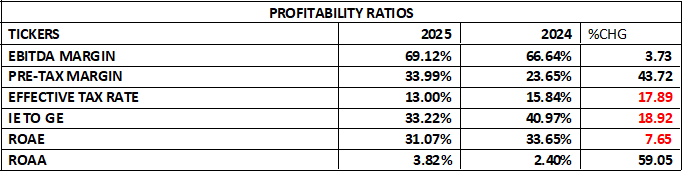
- EBITDA Margin: (69.12% Vs 66.64%): The movement in the ratio shows an improvement of about 2.5 percentage point, which indicates stronger operating efficiency before interest and taxes. The bank is generating more operating profit per Naira of revenues. This suggests a better cost management and stronger revenue growth, and it is a positive signal.
- PreTax Margin: (33.99% Vs 23.65%): This is a very strong jump (over 10% points), which indicates a significant improvement in bottom-line strength before tax. Factors driving this performance includes: a higher interest income, strong non-interest income, lower impairment charges (supported by lower NPL ratio), and reduced funding costs. In general, it is a major profitability expansion.
- Interest Expenses to Gross Earnings: (33.22% Vs 40.97%) This shows that the bank is spending less of its income servicing deposits and borrowings. It shows improved funding efficiency, possibly better deposits mix (more low-cost deposits) and this contributes directly to improved margins. Please understand that this aligns with higher EBITDA and pretax margin.
- Return on Average Equity: (31.07% Vs 33.65%): Although this ratio suffered a decline, it is important to note that this is not necessarily negative because, equity ratio increased significantly and Dent-to-Equity reduced sharply. When equity increases faster than profit, ROE naturally moderates, and this is what is played out in this ratio. In-fact, this decline supports the fact that the earlier observation that capital base has expanded strongly. In other words, this is a healthy dilution, not weakness.
- Return on Average Assets: (3.82% Vs 2.40%) This is equally a very strong improvement. The bank is generating more profit per unit of asset, indicating improved asset utilization. It also supports lower NPL and improved margin story above.
Final Verdict on Profitability Ratios: The Unaudited numbers of Wema Bank for the 12 months of 2025 shows a strong margin expansion, improved funding efficiency, better asset utilization, high but slightly moderated ROE, and strong pretax profitability growth. Thus, we say, profitability quality has improved significantly, and the slight ROE dip actually supports the narrative of stronger capitalization.
Efficiency Ratios
- Operating Expenses to Gross Earnings: (27.37% Vs 28.37%) This is a decline of 1%, and can be interpreted as: The bank is spending less to generate income. It indicates improved cost discipline and operational efficiency, and also suggests that revenue is growing faster than operating expenses. This is a positive gain.
- Gross Earnings to Total Assets: (12.91% Vs 12.06%) This is a modest increase. The bank is generating more revenue from its assets base. It indicates better asset yield and utilization. This supports the earlier improvement in ROA above.
- Loan-to-Deposit Ratio: (53.18% Vs 43.17%) This is a notable increase of about 10 percentage point. The bank is deploying more of its deposits into loans. Indicates stronger inter-mediation function, and could drive higher interest income going forward. However, it also means: slightly higher liquidity risk compared to last year, but still very comfortable (well below regulatory threshold of 65-80%)
Final Efficiency Verdict: The bank demonstrated an improved cost control, better asset utilization, stronger revenue generation from asset, plus a healthy and expanding loan deployment. We therefore conclude that, operational efficiency has clearly improved and is supporting the strong profitability growth seen earlier.

Investment/Valuation Ratios
- Earnings per Share (EPS) (N9.01 Vs N4.03). EPS has more than doubled (over 120% growth). This reflects a strong profit growth attributable to shareholders and confirms the earlier improvement seen in pretax margin and ROA. It is a very strong earnings expansion.
- Price to Earnings Ratio (P/E): (2.51x Vs 2.66x) A slight decline despite the fact that EPS more than doubled. This shows that that market has not fully adjusted to the strong earnings growth. The stock remains deeply undervalued relative to earnings power. This is a classic opportunity signal.
- Earnings Yield: (39.80% Vs 37.63%). This remains extremely high. Investors are effectively earning approximately 40% return on the current share price. This is far above treasury yields and typical market averages. It reinforces our undervaluation thesis.
- Book Value per share: (N29.01 Vs N11.97) This is a massive increase of over 140% growth. It shows strong retained earnings accumulation, supports earlier findings on improved equity ratio, lower leverage, and stronger capital base.
Overall Investment View: Wema bank Plc currently exhibits: strong fundamentals, improving balance sheet quality, high profitability, operational efficiency gains, and deep valuation discount. This is a fundamentally strong, improving bank that appears significantly undervalued at the current market pricing. Based on the full fundamental view of Wema Bank Plc 2025 unaudited 12-month result, we hereby rated the stock a Strong Buy, both for medium and long term investors.