
Quarter Under Preview: 9-Months 2025
Current Share Price: N77.45
Price At Release Date: N77.00
Latest Final Dividend: N1.25
Latest Interim Dividend: Nil
Estimated Beta Value: 0.22x
Estimated Intrinsic Value: N20.06
Analyst: Jeariogbe Tunde Segun
The Company
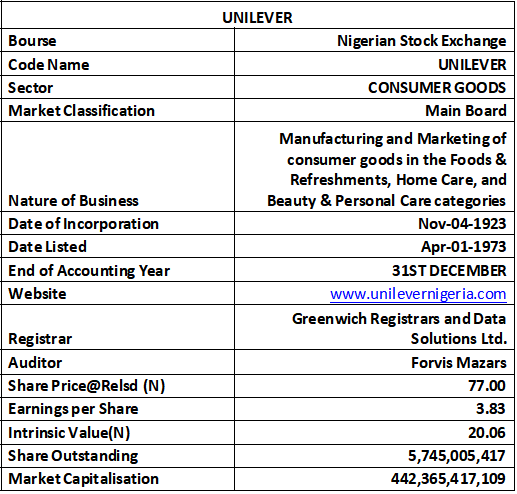
Unilever Nigeria Plc, established in 1923, originally as Lever Brother West Africa, a soap manufacturing company, is a member of the global Unilever Plc family, one of the world’s leading consumer goods companies. It is today the longest surviving manufacturing organization in the country. Unilever Nigeria commemorated its centenary-long milestone in 2023 to acknowledge the partnership of stakeholders – consumers, regulators, partners, key distributors and community leaders. The company, many of whose brands are household names and very much a part of Nigeria’s history: Knorr, Closeup, Pepsodent, Royco, Rexona, Vaseline and Pears, was quoted on the Nigerian Stock Exchange (now Nigerian Exchange Limited) in 1973.
The Released Numbers
At the end of the 2025 nine-month financial session, the management of of Unilever Nigeria reported a Turnover of N155.410 billion as against N103.848 billion in the corresponding quarter of 2024. Direct Cost of Sales was estimated at N91.445 billion, higher than the N60.955 billion reported in the similar quarter of last year. Operating Profit stood at N30.462 billion, against N10.131 billion. Operating Expenses through the nine months was valued at N34.582 billion versus N30.047 billion.
Finance Cost for the period stood at N710.402 million, compared to 2.943 billion of the corresponding quarter. Profit before Tax is N37.410 billion from N13.960 billion. After factoring in the Tax expenses of N15.429 billion, Total Profit for the period came to N21.981 billion, this is almost double the N11.009 billion achieved in the corresponding quarter of 2024.
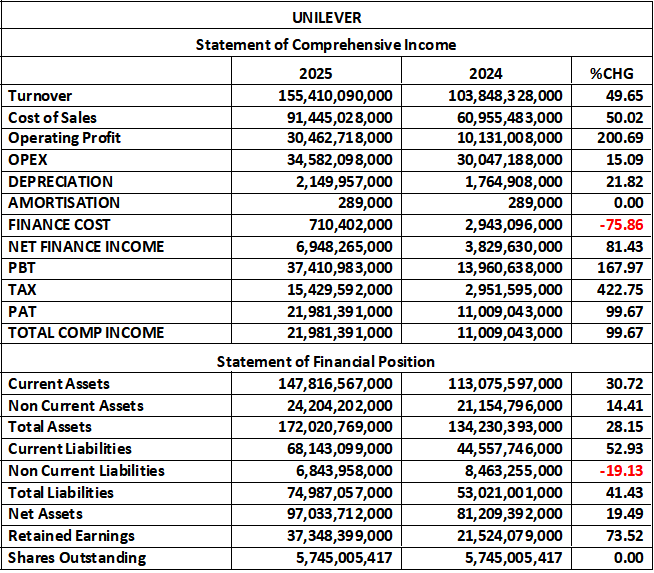
Current Assets for the period is valued at N147.816 billion, representing an increase of 30.72% over that of the comparable period’s N113.075 billion. Non-Current Assets is N24.204 billion, up from N21.154 billion, following which Total Assets of Unilever Nigeria at the end of the period under review was valued at N172.020 billion, up from N134.230 billion in the comparative nine months of last year. Current Liabilities stood at N68.143 billion versus N44.557 billion, while the Non-Current Liabilities is N6.843 billion against N8.463 billion, bringing the Total Liabilities to N74.987 billion at the end of the quarter under review. Net Assets was therefore estimated at N97.033 billion, a 19.49% growth over the N81.209 billion reported in the similar quarter of 2024. Retained Earnings equally improved appreciably to N37.348 billion from N21.524 billion. See the above table for details.
Financial Strength
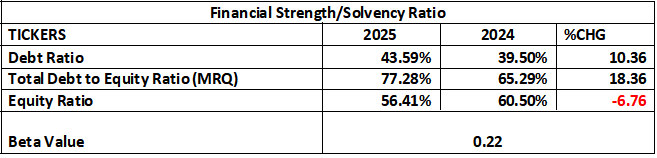
- Debt Ratio: (43.59% Vs 39.50%): The increase to 43.59% indicates that Unilever Nigeria is now relying more on debt financing than in the previous quarter. While this is still below 50%, which suggests assets are not over leveraged, the upward movement signals a gradual increase in financial risk. We can, therefore safely concluded that this is still within a safe zone but leverage pressure is piling.
- Total Debt to Equity Ratio: (77.28% Vs 65.29%): The jump to 77.28% confirms that debt is growing faster than equity. It is however noteworthy that for a consumer goods company like Unilever, this level is moderate, not alarming. That notwithstanding, it does reduce financial flexibility, because a higher debt-to-equity means greater sensitivity to interest rate changes and cash flow shocks.
- Equity Ratio (56.41% Vs 60.50%): The decline shows that equity now finances a smaller share of total assets. Though 56.41% still represents a strong equity base, the downward movement mirrors the rising debt ratios. Understand that a falling equity ratio slightly weakens the company’s shock absorbing capacity.
- Beta Value (0.22x): A beta value of 0.22x indicates very low market risk. The stock is largely defensive, meaning price movements are far less volatile than the broader market. This aligns well with Unilever’s status as a stable Fast Moving Consumer Goods business with predictable demand.
Overall Verdict on Financial Strength: Unilever Nigeria remains financially stable and defensively positioned. Supported by a strong equity base and extremely low market risk. However, the quarter three performance shows a clear shift towards higher leverage, evidenced by rising debt ratios and a declining equity ratio. While not at an alarming stage just yet, we warn that a continued debt build-up without corresponding earnings growth could gradually weaken balance sheet resilience.
Profitability Ratios
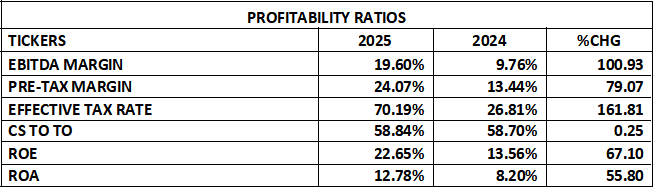
- EBITDA Margin (19.60% Vs 9.76%): This is a standpoint improvement. EBITDA Margin has doubled, showing a major recovery in core operating profitability. This suggests better pricing power, cost discipline, or Fx gains, especially in Nigeria’s inflationary environment. We are of the opinion that a near 20% EBITDA margin is very strong, signaling a return of operational efficiency.
- Pre-Tax Margin (24.07% Vs 13.44%): Pretax Margin expanding to 24.07% shows that operating gains are flowing through to the bottom line. This also suggests lower financing cost, relative to earnings or an improved non-performing income. Such a margin level places Unilever Nigeria among the most profitable consumer goods firms in the domestic environment.
- Cost of Sales to Turnover (58.84% to 58.70%): This ratio is largely flat. The slight increase indicates that input costs remain sticky. However, despite the higher cost pressure, profitability still surged, meaning that pricing, volume growth, or operational efficiency offset the ensuring cost pressures. This reinforces the argument that margin expansion came above the gross profit line, not just from cheaper input.
- Return on Equity (22.65% Vs 13.65%): ROE at above 20% signals an efficient deployment of shareholders’ funds. The sharp rise shows earnings growth is outpacing equity growth, the higher leverage notwithstanding. This level of ROE is very attractive in the Nigerian equity market.
- Return on Assets-ROA (12.78% Vs 8.20%): This confirms the improved assets utilization efforts. ROA improvement shows that the company is generating more profit per naira of assets. This is especially positive given the rising debt level. Assets are being used more efficiently. A double digit ROA is excellent for a fast moving consumer goods company.
Overall Profitability Verdict: Unilever Nigeria’s third quarter profitability ratios show a clear and convincing turnaround. Margins have expanded sharply, just as returns on equity and assets have improved significantly, and profitability growth has outpaced rising leverage. Cost pressures remain, but management has demonstrated strong power and operational control.
Efficiency Ratio
- Operating Expenses to Turnover (22.25 Vs 28.93%): This is a major efficiency win. Operating expenses has dropped sharply as a percentage of revenue, showing strong cost control by management. This suggests better management of the distribution, marketing, administrative, and overhead costs. In a fast-moving consumer goods environment where margins are usually tight, cutting Opex by over 6 percentage points is significant.
- Turnover to Total Assets (90.34% Vs 77.37%): The rise to 90.34% shows that Unilever is generating N0.90 of revenue for every N1 of assets. This indicates improved utilization of factories, inventory, and working capital. Higher asset turnover complements the improved ROA that we saw earlier.
Overall Efficiency Verdict: Unilever Nigeria’s third quarter efficiency ratios shows clear operational tightening. Lower operating expenses and better asset utilization are core reasons behind the sharp improvement in profitability. Management appears to be extracting more value from the same asset base, and spending less to do so.

Investment Ratios
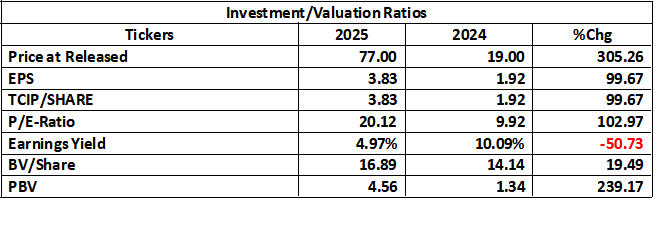
- Share Price at Release date (N77.00 Vs N19.00): This is a very strong price re-rating by the market. The share price has risen by over 300%, showing that the market has repriced Unilever Nigeria aggressively, while reflecting a renewed investor confidence following from its profit recovery, margin expansion, and operational efficiency. However, such a sharp price increase also raises valuation risk going forward.
- Earnings per Share-EPS (N3.83 Vs N1.92): EPS has almost doubled, confirming that profit growth is real, even as it is shareholder-accretive, thereby supporting the higher share price and validating the operational improvements seen earlier. However, EPS growth is lower than price growth, which affects valuation comfort.
- PE-Ratio (20.12x Vs 9.92x): The PE has doubled, meaning investors are now paying more than twice as much per naira of earnings. A PE above 20x suggests high expectations for future growth. For a fast moving consumer goods’company in Nigeria, this is on the expensive side, unless growth remains strong and consistent.
- Earnings Yield (4.97% Vs 10.09%): This is a true mirror of the PE movement seen above. Earnings yield has fallen sharply, meaning investors are accepting lower current returns for anticipated future growth. At 4.97% the yield is below Nigerian rsik-free rates, making the stock less attractive to income-focused investors.
- Book Value per Share (N28.42 Vs N20.01): The increase shows retained earnings are strengthening equity and offers some fundamental support for the higher share price. However, the market price (N77) is now trading at over 4.5x book value, which is rich.
Overall Investment Verdict: Unilever Nigeria has transitioned from a deep value stock to a growth-priced stock. The quarter three fundamentals justify a re-rating, but the speed and magnitude of the price increase have pushed valuation into expensive territory. Future returns will now depend heavily on sustained earnings growth, not further multiple expansion.
Final Verdict on Unilever Nigeria Plc: Unilever Nigeria delivered a strong and credible quarter three turnaround. Profitability rebounded sharply, driven by excellent cost control and improved operational efficiency, while asset utilization and returns (ROE, ROA) improved materially. The business retains its defensive fast moving consumer goods strength, supported by low market risk (beta) and stable demand.
However, the market has moved faster than the fundamentals. Rising leverage slightly weakens financial strength, and pushed valuation into expensive territory, reducing earnings yield and margin of safety. Our rating for Unilever Nigeria Plc is a Hold/Selective accumulation on pullbacks, as against the aggressive buy at current levels.