

Quarter Under Preview: YEAR ENDED DECEMBER 2025
Current Share Price: N103.00
Price At Release Date: N103.00
Latest Final Dividend: N8.75
Latest Interim Dividend: N1.25
Estimated Beta Value: 0.55x
Estimated Intrinsic Value: N139.65
Rating: Buy (With Moderate Risk)
Analyst: Jeariogbe Tunde Segun
The Company
Zenith Bank Plc was established in May 1990 at a time of financial sector liberalization in Nigeria, and commenced operations in July 1990 as a commercial bank. It quickly distinguished itself through a strong focus on corporate banking, technology adoption, and efficient service delivery.
Zenith Bank Plc evolved from a single commercial banking entity into a diversified financial services group with clearly defined business operating segments. Its core operations are structured around Corporate and Investment Banking, Retail and Commercial Banking, Treasury and Financial Markets, and Digital/Transaction Banking services. The corporate and investment banking division remains the bank’s dominant revenue driver, focusing on large corporates, multinationals, and government institutions, while the retail and commercial banking segment has expanded significantly through branch networks and digital platforms. In addition, Zenith Bank has strengthened its treasury operations, engaging in foreign exchange trading, fixed income securities, and liquidity management, supported by a growing digital banking arm that reflects the sustained investment in electronic channels, mobile banking, and payment solutions, reinforcing its technology-driven strategy.
Zenith Bank has successfully met and exceeded the new capital requirement for banks with international licenses in line with the recent industry-wide recapitalization exercise announced by the Central Bank of Nigeria (CBN) in March 2024. The regulation requires banks in the category of Zenith to have a minimum capital base of ₦500 billion by the compliance deadline of March 2026. To achieve the target, the bank successfully raised about ₦350 billion through a hybrid of rights issue and public offer, increasing its total share capital to about ₦614 billion, thereby surpassing the regulatory threshold.
The Released Numbers
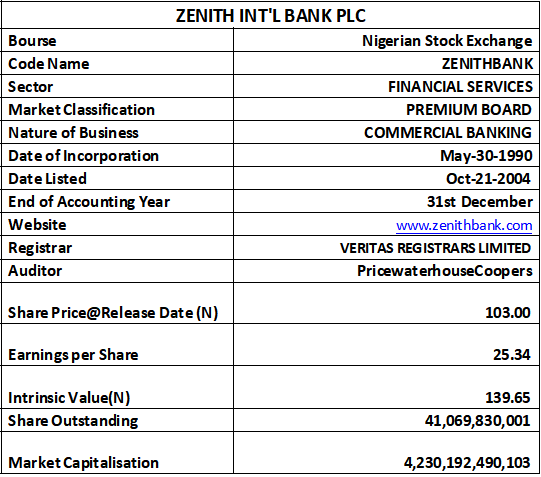
Zenith Bank’s 2025 performance is underpinned by strong core revenue growth, particularly from interest-earning assets, as interest income rose significantly, driving a 52.67% increase in net interest income. However, this strong momentum was partly moderated by elevated impairment charges on financial instruments, reflecting a more cautious credit environment and possible deterioration in asset quality. While non-interest income lines, such as fees and commissions remained supportive, volatility in trading income and other operating lines suggests that earnings quality was largely anchored on core lending activities rather than diversified income streams.
On the cost side, the bank faced notable pressure from operating and personnel expenses, alongside increases in depreciation and amortization, indicating sustained investment in infrastructure, technology, and human capital. These cost increases, combined with impairment charges, weighed on profitability, resulting in a decline in profit before tax despite the strong revenue growth. This highlights a tightening efficiency position, where revenue expansion was not sufficient to fully offset rising operating and risk-related costs during the period.
At the bottom line, profit after tax remained broadly resilient, supported by a lower tax expense, but overall performance was significantly impacted at the comprehensive income level. The sharp decline in total comprehensive income was driven primarily by negative foreign currency translation differences from foreign operations, reflecting the impact of exchange rate volatility on the bank’s international subsidiaries. Although there were modest gains from fair value movements on financial instruments, these were insufficient to offset FX-related losses. Overall, the results indicate a strong core banking performance constrained by macroeconomic pressures, rising costs, and significant foreign exchange headwinds.
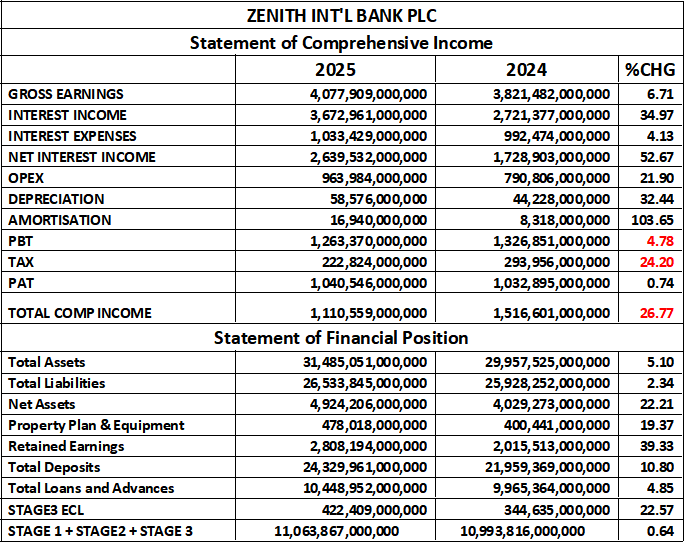
Total assets increased by 5.10% to ₦31.49 trillion, driven largely by growth in loans and advances (+4.85%) and customer deposits (+10.80%), indicating improved funding capacity and sustained customer confidence. The loan book expansion, though moderate relative to deposits, suggests a cautious lending approach, consistent with the elevated impairment environment observed in the income statement. This balance between asset growth and risk control highlights a disciplined credit strategy.
On the liability and capital side, total liabilities grew modestly by 2.34%, while net assets (equity) rose significantly by 22.21%, reflecting strong internal capital generation and earnings retention. Retained earnings increased sharply by 39.33%, reinforcing the bank’s capital base and loss-absorbing capacity. This is further supported by the growth in net assets to ₦4.92 trillion, indicating improved solvency and positioning the bank strongly within regulatory capital thresholds. The relatively slower growth in liabilities compared to assets also suggests improving balance sheet strength and reduced leverage pressure.
From an asset quality and risk perspective, Stage 3 Expected Credit Loss (ECL) rose by 22.57%, pointing to a deterioration in non-performing exposures. However, total loan growth remained controlled, and the slight increase in total ECL (0.64%) indicates that impairment pressures, while present, are being actively managed. Additionally, the 19.37% increase in property, plant, and equipment reflects continued investment in infrastructure and digital capacity. Overall, the bank demonstrates a resilient balance sheet with strong capital growth, stable funding, and manageable, though with rising credit risk pressures.
Financial Strength/Solvency Ratio
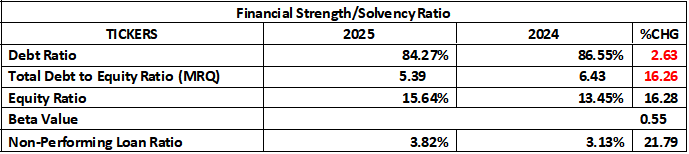
Zenith Bank’s solvency profile in 2025 shows a moderate improvement in capital structure, as reflected in a decline in the debt ratio from 86.55% to 84.27%. This indicates a slight reduction in the proportion of assets financed by liabilities, suggesting improved balance sheet strength. Consistent with this, the debt-to-equity ratio declined significantly from 6.43x to 5.39x, highlighting a reduction in financial leverage and a stronger equity cushion relative to total obligations. This aligns with the growth in retained earnings and net assets observed in the financial position.
The equity ratio increased from 13.45% to 15.64%, reinforcing the bank’s enhanced capitalization and improved loss absorption capacity. This upward movement suggests that a larger portion of the bank’s assets is now funded by shareholders’ funds, which is a positive indicator for long-term solvency and regulatory compliance. The improvement in these capital ratios reflects both internal capital generation and the broader recapitalization efforts within the Nigerian banking sector, positioning the bank more favorably against regulatory thresholds.
However, from an asset quality perspective, there is a notable deterioration in credit risk, as the non-performing loan (NPL) ratio increased from 3.13% to 3.82%. While still within regulatory tolerance levels, the upward trend signals the rising stress in the loan portfolio, consistent with the increase in Stage 3 exposures and impairment charges seen in the financial statements. The beta value remained relatively stable, indicating no significant change in market risk volatility. Overall, the bank maintains a strong solvency position with improving capital buffers, albeit with emerging credit risk pressures that require close monitoring.
Profitability Ratios
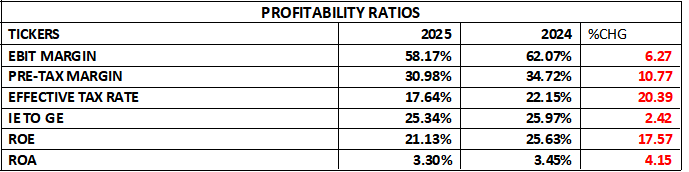
Zenith Bank’s profitability profile in 2025 indicates a moderation in earnings efficiency despite the strong revenue growth. EBIT margin declined from 62.07% to 58.17%, while pre-tax margin fell from 34.72% to 30.98%, reflecting pressure on operating profitability. This trend is consistent with the earlier observed increase in operating expenses, impairment charges, and cost of funds, which collectively eroded margins. The decline suggests that, although the bank generated higher income, a larger proportion was absorbed by costs and risk-related expenses.
At the tax level, the effective tax rate dropped significantly from 22.15% to 17.64%, providing some relief to net earnings and helping to stabilize profit after tax. Meanwhile, the interest expense to gross earnings ratio (IE to GE) remained relatively stable, declining slightly from 25.97% to 25.34%, an indication that funding costs, though elevated, were reasonably controlled relative to income generation. This stability suggests that the bank maintained a balanced funding structure despite the high interest rate environment.
However, returns weakened across key shareholder value metrics, with return on equity (ROE) declining from 25.63% to 21.13% and return on assets (ROA) easing from 3.45% to 3.30%. The drop in ROE is particularly notable, reflecting both reduced profitability margins and an expanded equity base following strong retained earnings growth. Overall, the bank delivered resilient but softer profitability, characterized by strong core income generation offset by rising costs, leading to reduced efficiency and lower returns.
Efficiency Ratios
Zenith Bank’s cost efficiency weakened in 2025, as reflected in the increase in operating expenses to gross earnings (OPEX/GE) from 20.69% to 23.64%. This indicates that a larger portion of income was consumed by operating costs, consistent with earlier observations of rising personnel expenses, infrastructure investments, and general cost pressures. The upward trend suggests declining cost discipline or cost-to-income efficiency, which contributed to the compression in profitability margins during the period.
Asset utilization, however, remained relatively stable, with gross earnings to total assets (GE/TA) increasing slightly from 12.76% to 12.95%. This marginal improvement indicates that the bank was able to generate slightly more income per unit of assets, reflecting efficient deployment of earning assets, particularly in interest-generating instruments. Despite this, the improvement was not strong enough to offset the impact of rising costs, highlighting a gap between revenue generation and cost management.
Liquidity and asset conversion efficiency showed some moderation, as the loan-to-deposit ratio (LDR) declined from 45.38% to 42.95%, suggesting a more conservative lending stance relative to deposit growth. While this enhances liquidity and reduces risk exposure, it may also indicate under-utilization of available funding for income generation. Additionally, capex per share declined significantly from 2.55 to 1.89, reflecting either a reduced capital expenditure intensity, or the effect of an expanded share base. Overall, the bank demonstrated a stable asset efficiency, but weakening cost efficiency and more cautious lending posture.

Investment/Valuation Ratios
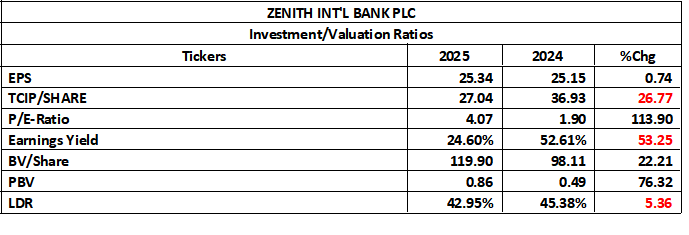
Zenith Bank’s market valuation metrics in 2025 reflect a significant re-rating by investors, despite relatively stable earnings per share (EPS), which increased marginally from 25.15 to 25.34. The price-to-earnings (P/E) ratio rose sharply from 1.90x to 4.07x, indicating that the market is now willing to pay a higher multiple for the bank’s earnings. This re-rating suggests improved investor confidence, likely driven by stronger capital positioning, earnings resilience, and positive sentiment around the banking sector recapitalization. However, the sharp decline in earnings yield from 52.61% to 24.60% reflects this higher valuation, as returns available to investors per naira invested have reduced.
On the other hand, total comprehensive income per share (TCIP/share) declined from 36.93 to 27.04, indicating weaker overall shareholder returns when broader income components are considered. Despite this, book value per share increased significantly from 98.11 to 119.90, reflecting strong growth in shareholders’ equity driven by retained earnings and balance sheet expansion. Consequently, the price-to-book value (PBV) ratio rose from 0.49x to 0.86x, showing that the market is beginning to price the bank closer to its intrinsic value, although it still trades below book value, suggesting residual undervaluation.
Overall, Zenith Bank presents a mixed but improving investment profile, characterized by strong equity growth and a notable upward re-rating in valuation multiples, albeit declining income yield and weaker comprehensive income performance. The moderation in the loan-to-deposit ratio (LDR) to 42.95% further supports a conservative risk posture, which may appeal to risk-averse investors. In summary, the bank appears to be transitioning from deep undervaluation towards fairer valuation levels, supported by fundamentals, but with reduced immediate yield attractiveness.
Dividend Ratios
Zenith Bank’s dividend performance in 2025 reflects a significant enhancement in shareholder distribution, with total dividend doubling from ₦5.00 to ₦10.00 per share, representing a 100% increase. This substantial growth underscores management’s strong confidence in earnings sustainability and cash flow generation, even within a challenging operating environment. It also signals a clear commitment to delivering higher direct returns to shareholders, reinforcing the bank’s reputation as a consistent dividend-paying institution.
This is further evidenced by the sharp rise in the dividend payout ratio from 19.88% to 39.47%, indicating that a much larger proportion of earnings is now being returned to investors rather than retained. While this enhances immediate shareholder value, it also suggests a strategic shift toward rewarding investors, possibly influenced by improved capital adequacy and the need to maintain investor attractiveness amid recapitalization trends. However, a higher payout ratio may moderately limit retained earnings available for future growth and expansion if sustained at elevated levels.
Despite the increase in absolute dividend, the dividend yield declined from 10.46% to 9.71%, primarily due to the rise in market price of the stock, consistent with the earlier observed re-rating in valuation. This indicates that while investors are receiving higher nominal dividends, the return relative to market price has slightly weakened. Overall, Zenith Bank maintains a strong and attractive dividend profile, characterized by higher payouts and solid yield levels, though marginally compressed by upward share price movements.

Final Investment Verdict/Rating
Zenith Bank demonstrates a fundamentally strong and resilient financial position, supported by improving capital adequacy, solid asset growth, and consistent earnings generation. The bank’s solvency metrics show strengthening buffers, while its profitability, though slightly compressed, remains robust relative to peers. The balance sheet expansion and growth in book value highlight strong internal capital generation, positioning the bank well within the ongoing recapitalization landscape.
From an investor standpoint, the bank has undergone a notable market re-rating, with valuation multiples improving significantly while still trading below intrinsic book value. This suggests that Zenith Bank remains moderately undervalued with further upside potential, especially if earnings stability is sustained. Additionally, the significant increase in dividend payout reinforces its attractiveness as an income-generating stock, even though yield has slightly moderated due to price appreciation.
However, the outlook is not without risks. Rising cost pressures, declining efficiency, and a slight uptick in non-performing loans indicate emerging operational and credit risks that require close monitoring. Also, the higher payout ratio may constrain retained earnings if sustained over time.
Overall Rating: BUY (with Moderate Risk)
Zenith Bank is recommended as a BUY, given its strong fundamentals, improving valuation outlook, and attractive dividend profile, balanced against manageable but rising risk factors.