

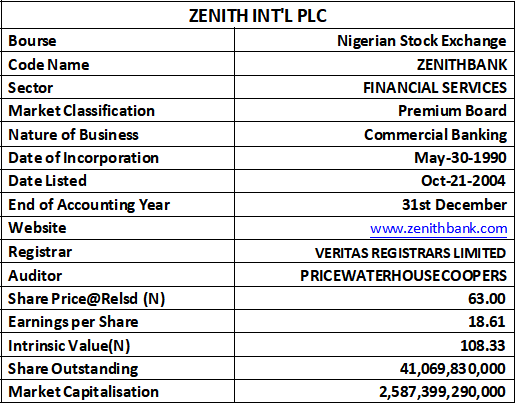
Quarter Under Preview: 9 Months
Current Share Price: N63.00
Price At Released: N63.00
Latest Final Dividend: N4.00
Latest Interim Dividend: N1.25
Estimated Beta Value: 0.51x
Estimated Intrinsic Value: N108.33
Analyst: Jeariogbe Tunde Segun
Zenith Bank Plc is engaged in the business of providing banking and other financial services to corporate and individual customers with services such as mobilising deposits frm customrs and granting loans and advances, corporate finance and money market activities.
These activities are carried out through business segments like Corporate, Public sector, Retail Banking, Pension Custodial and Nominee services within and Outside Nigeria, across Africa, and in Europe. The Corporate, Public, Retail Banking, Pension Custodial services and Nominee-Nigeria segments offer banking and pension custodial services to financial institutions, investment funds, governments, and individuals.
Released Financials
At the end of the 9-months covered by this report, the management of Zenith Bank reported a Gross Earnings income of N3.371 trillion, which is 16.29% above the N2.899 trillion achieved at the end of 2024 nine months. Interest Income stood at N2.740 trillion, against N1.947 trillion in the comparable period of 2024. Meanwhile, Interest Expenses was valued at N814.227 billion against N666.436 in the corresponding period of last year. Operating Expenses equally grew by 14.71% to stand at N714.198 billion against N622.638 billion. Thus, Profit before Tax was estimated at N917.412 billion from N1.002 trillion in the corresponding period. It is noteworthy that the decline in Profit before Tax and PAT is traceable to the slide in the Trading gains from N686.341 billion in the similar period of last year to N277.654 billion in the current year.
Having considered the Tax Expenses for the period, The Total Profit for the Period stood at N764.204 billion slightly below the N827.677 billion earned at the end of the corresponding quarter last year.
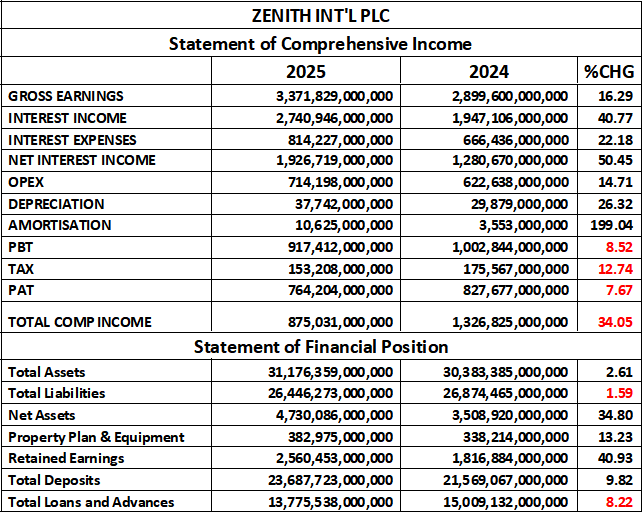
Total Assets is estimated at N31.176 trillion, a marginal improvement over the previous estimate of N30.383 trillion, while total liabilities amounted to N26.446 trillion, versus N26.874 trillion at the end of 2024. Thus, Net Assets was estimated at N4.730 trillion, same as 34.80% above the N3.508 trillion in the corresponding period of 2024. Retained Earnings is now N2.560 trillion against N1.816 trillion. Total Customer deposits through the nine months under review was N23.687 trillion. This is fairly above the N21.569 trillion of 2024, and Total Loans and Advances dispensed through the period is valued at N13.775 trillion, below the N15.009 trillion of the comparable periods of 2024.
Financial Strength
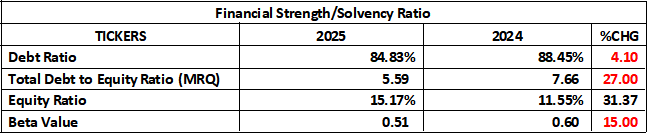
- Debt Ratio (84.83% Vs 88.45%)- Improved Asset Financing Structure
The Debt Ratio has declined, an indication that the bank now relies slightly less on external liabilities to finance its assets
- Although still high (as typical for banks due to the deposit liabilities). This reduction signals:
- Better balance sheet management capacity
- Reduced vulnerability to liquidity pressure
- Improved stability in funding sources
- The implication is that Zenith Bank has marginally strengthened its asset funding mix, reducing dependence on borrowed funds
- Total Debt to Equity Ratio (5.59x Vs 7.66x)- Stronger Capital Position
- The ratio fell significantly, meaning that the equity has grown relative to liabilities. This can result from:
- Retained earnings build-up from prior profit periods
- Revaluation gains (especially from Fx asset revaluation seen in earlier quarters in the banking sector)
- Possible capital optimization strategy
- The ratio fell significantly, meaning that the equity has grown relative to liabilities. This can result from:
The implication is that the bank now has more capital backing each naira of liability, making it better cushioned against credit losses and regulatory stress tests.
- Equity Ratio (15.17% Vs 11.55%)- Enhanced Shareholder Safety Margin
- Equity Ratio increased, meaning shareholders now own a bigger portion of the bank’s asset base, possibly an outcome of its recent capital raising exercise. This strengthens:
- Confidence in the bank’s solvency position
- Ability to absorb future shocks
- Regulatory capital buffers under Basel II/III requirements
- Equity Ratio increased, meaning shareholders now own a bigger portion of the bank’s asset base, possibly an outcome of its recent capital raising exercise. This strengthens:
The implication is that Zenith bank is showing stronger internal capital strength, even though short-term profit declined
Final Verdict on Financial Ratios: Despite the drop in profit due to a lower trading income (a market-driven and temporary performance item), Zenith Bank’s Financial Strength Ratios have improved, pointing to: an Improvement in balance sheet stability, stronger equity base, reduced dependence on debt financing and better resilience against market and credit risk.
This means that: The drop in profitability does not reflect weakening fundamentals, but rather the outcome of short-term fluctuations in trading performance, while Zenith Bank continues to strengthen its long-term financial position.
Profitability Ratios
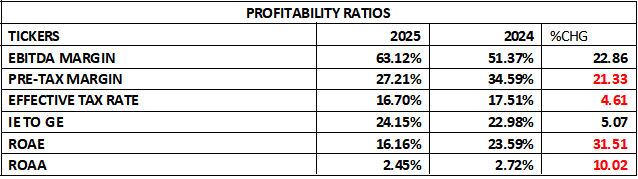
- EBITDA Margin (63.12% Vs 51.37%) – Core Banking Operations Strengthened
- The EBITDA Margin rose, showing strong performance in core earnings (net interest income plus non-interest income, excluding trading volatility).
- This indicates better cost efficiency, improved gross earnings quality, and tighter expense control.
The implication of this is that Zenith Bank’s day-to-day operations remain robust, notwithstanding the profit dipped.
- Pre-Tax Margin (27.21% Vs 34.59%)- Affected by lower Trading Gains
- Pre-Tax margin declined due to:
- Drop in trading/investment gains
- Possibly higher impairment or revaluation adjustments
- This confirms that the profit drop was not operational, but rather from market-sensitive trading income.
- Pre-Tax margin declined due to:
The implication is that, the decline is cyclical and reversible not structural.
- Interest Expenses to Gross Earnings (24.51% Vs 22.98%)- Funding environment tightened
- The slight rise suggests:
- Higher interest cost on deposits and borrowing due to rising interest in the economy
- Competition for liquidity among banks
- The slight rise suggests:
The implication of this is that Cost of funds increased. However, the rise is marginal and manageable.
- Return on Average Equity (ROAE): (16.16% Vs 23.59%)- Lower Returns to Equity Holders
- ROAE decline mirrors reduced net profit
- Notably, equity increased (as seen earlier), so returns were further diluted.
The implication is that Return to shareholders dropped, while capital strength improved- a Trade-off common in periods of balance sheet consolidation.
- Return on Average Asset (ROAA): (2.45% Vs 2.72%)- Slight dip in Asset Efficiency
- This shows;
- Assets earned slightly less profit
- Again, this is associated with lower trading gains and not weaker asset performance
- This shows;
The implication is that Zenith Bank’s asset base remains productive, but the short-term profit impact from non-recurring income lowered the ratio.
Final Verdict on Profitability Ratios: Despite the decline in headline profit and return metrics, core operations improved slightly, Cost efficiency strengthened, while operational resilience remains intact. Profitability pressure came mainly from market-based trading activities, just as shareholder and asset returns declined but remain at strong industry levels. It is important that this is a temporary profit dip, not a weakening of operational fundamentals.
Efficiency Ratios
- Operating Expenses to Gross Earnings (21.18% Vs 21.47%)- Cost management remains strong and stable.
- This ratio shows how effectively the bank controls its operating expenses relative to revenue.
- The slight improvement (lower ratio) indicates a marginal increase in operational efficiency.
- The bank is maintaining strong cost discipline, despite inflationary pressures and rising regulatory/compliance costs in the financial sector.
The implication is that Zenith Bank continues to run a cost-efficient operation which supports profit stability.
- Gross Earnings to Total Assets (10.82% Vs 9.54%)- Improved productivity on Assets
- This suggests:
- Stronger interest-earning asset performance (loans, fixed-income instruments)
- Improved non-interest income streams (fees, commissions, FX related income)
- This suggests:
The implication of this is that Zenith Bank’s asset base is more productive this period, which is a positive operational signal, especially in a high-interest environment where it operates through the period.
- Loan to Deposit Ratio (58.15% Vs 69.59%)- More conservative lending/liquidity preservation
- This could be due to;
- Risk conscious credit stance in response to economic uncertainty
- Increased deposit inflows outpacing loan growth
- A shift towards lower-risk investment assets (e.g. government securities)
- This could be due to;
The implication is that the bank is holding more liquidity and prioritizing risk management to protect itself against loan defaults in a volatile economy, while maintaining capital adequacy. However, this may limit interest income growth going forward, if loan growth remains subdued.
Final Verdict on Efficiency Ratios: Although profit declined due to lower trading gains, Zenith Bank’s efficiency metrics indicate a well-managed core banking operations, cost are controlled, while Assets are generating more earnings. Similarly, risk and liquidity management is cautious and strategic, reflecting a strong operational discipline and resilience, while positioning the bank well for a rebound once market-driven trading income normalizes.

Investment Ratios
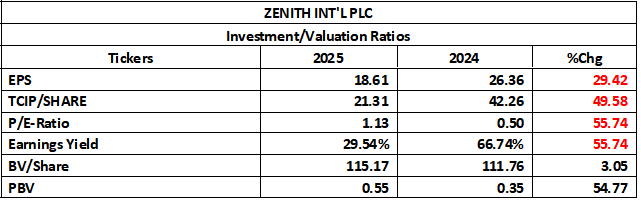
- Earnings per Share (N18.61 Vs N26.36): Profitability per share fell
- This drop reflects;
- The decline in net earnings, which we previously established was due mainly to lower trading income, not weak core banking operations.
- Though, lower returns naturally reduce short-term returns to shareholders, the implication is that this is a temporary earnings pressure tied to non-operational income fluctuations.
- This drop reflects;
- PE-Ratio (1.13x Vs 0.50x)- Market is now pricing the stock higher relative to earnings
- The PE-Ratio increased, meaning the market now values the bank more confidently than before.
- Also, although earnings fell, the stock price has not dropped proportionately. This is a sign of renewed investor confidence.
The implication is that the stock appears still undervalued, although not as deeply undervalued as in the previous quarter. Investors expect earnings normalization, or future growth.
- Earnings Yield (29.54% Vs 66.74%)- Still very attractive returns potential though less than before.
- Even at 29.54%, the yield is very strong when compared to Nigeria’s fixed income yields, indicating that the stock remains attractively priced.
This means that Zenith Bank still offers a high return potential relative to market alternatives.
- Book Value per Share (N115.17 Vs N111.76)- Stronger Shareholder’s wealth
- The increase in BVPS means the intrinsic value of the bank’s net assets per share increased
- This aligns with earlier analysis showing a stronger balance sheet.
The implication is that despite the short-term profit pressure as noted earlier, long-term value and financial resilience improved.
Final Verdict on Valuation Ratios: Despite the decline in EPS also, the bank remains fundamentally strong, with; improved balance sheet strength, strong core earnings capacity, attractive valuation and yield metrics, and increasing intrinsic value per share. The investment case remains favorable, especially for medium-to-long term investors seeking value and strong dividend potential.
Final Recommendations:
Although profitability for the period fell, the bank’s core banking operations remain fundamentally strong, as reflected in improved EBITDA Margin, sustained Cost Efficiency, and stronger Equity and Capital buffer. Asset productivity is rising, book value per share has increased, and the bank continues to maintain a healthy liquidity and risk posture.
The stock remains undervalued on a PE and Book Value basis and still offers attractive earnings yield, even after the recent market re-pricing. Short-term earnings volatility may persist, but the long-term value and dividend potential remain compelling, especially once trading income stabilizes.
Therefore, the stock is recommended as a Hold for conservative investors and a Buy for medium-to-long term value investors seeking capital appreciation and stable dividend flows.