
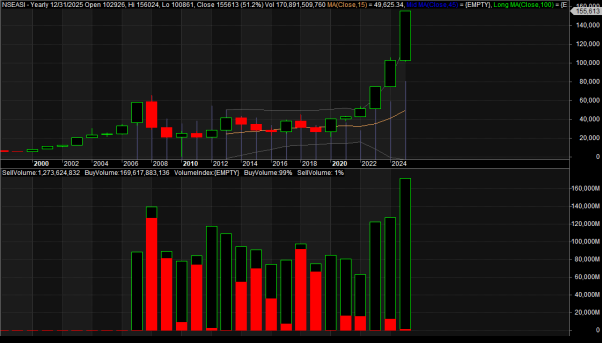
The Nigerian Exchange (NGX) closed 2025 on a historic note, delivering a 51.19 percent full-year return, the highest annual gain since 2007, with the composite All-Share Index (ASI) reaching an all-time high of 155,613basis points, and pushing total market capitalisation close to ₦100 trillion. The month of December alone contributed an 8.43 percent gain, while the final trading day added 0.37 percent, underscoring strong investor demand even at record levels. The second half of the year emerged as the best-performing period, delivering a 29.70 percent return, while the fourth quarter propped the index by 9.04 percent, confirming the market’s resilience after a mixed first half.
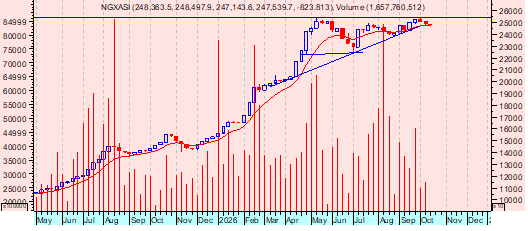
NGXASI Yearly Index Action
Historically, 2025 ranks among the most remarkable years in NGX history, alongside 2020, 2013, 2023, and 2017. Unlike previous bull runs largely driven by select large-cap names, performance for the year under review was broad-based, supported by strong gains across consumer goods, industrials, and insurance sectors. July stood out as the strongest month, rising 16.57 percent, which helped Q3 deliver the highest quarterly return of 18.95 percent. The 2025 gains were second only to 2007’s 74.7 percent surge, further cementing its elite status.
The consumer goods sector emerged as the standout performer, surging 129.57 percent on the back of strong earnings, declining foreign exchange losses, and renewed investor confidence. Leading consumer stocks delivered spectacular returns, with Guinness Nigeria rising 398.08 percent, Vitafoam gaining 300 percent, Champion Breweries up 267.45 percent, Honeywell Flour Mills up 247.62 percent, and NASCON Allied Industries recording a 242.90 percent return. Other well-established names including Cadbury Nigeria and Unilever Nigeria contributed significantly, gaining 178.60 percent and 118.51 percent respectively. The insurance sector followed closely, with 65.64 percent, supported by renewed investor confidence following the passage of the Nigerian Insurance Industry Reform Act (NIIRA 2025). Sovereign Trust Insurance led gains with a 241.07 percent return, AIICO Insurance rose 165.03 percent, and NEM Insurance added 144.75 percent. The industrial goods sector advanced 58.91 percent, with Beta Glass delivering a staggering 470.11 percent return, Berger Paints climbing 140 percent, and BUA Cement gaining 91.94 percent. Banking stocks rose 39.77 percent, recovering from mid-year regulatory pressures, with Wema Bank up 128.75 percent, Stanbic IBTC 73.61 percent, and GTCO 59.12 percent. In contrast, oil and gas stocks were the only sector in negative territory, down 1.54 percent, as losses in Oando, Conoil, and TotalEnergies outweighed modest gains from Eterna, which rose 40.12 percent, and Aradel, which added 12.04 percent.
NCR Plc Chart
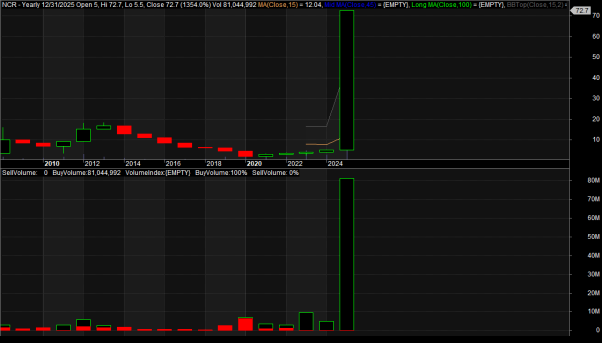
Top individual stock performers highlight the extraordinary gains seen in 2025. NCR led the market with a phenomenal 1,354 percent return, followed by ASOSAVINGS, which climbed 542 percent. Eunisell rose 496.78 percent, Beta Glass 470.11 percent, and TIP advanced 432 percent, showcasing strong mid- and small-cap momentum. MBENEFIT gained 408.20 percent, Guinness added 398.08 percent, MECURE rose 369.06 percent, Ellah Lakes climbed 324.05 percent, and Vitafoam completed the top 10 gainers with a 300 percent increase. These returns underscore how a combination of earnings growth, policy reforms, and renewed investor confidence propelled both established and emerging companies to record highs.
Conversely, some stocks experienced significant declines. VFD Group fell 75.23 percent, Conoil dropped 51.65 percent, and SUNU Assurance shed 48.84 percent. Oando declined 39.09 percent, JohnHolt lost 37.10 percent, and LegendInt dropped 29.47 percent, while Afriprud fell 27.98 percent. Lasaco declined 20.71 percent, GoldBrew lost 17.82 percent, and HMC All ended the year down 16.32 percent. These declines reflect sector-specific pressures, regulatory challenges, and selective profit-taking, particularly in the oil and financial sectors.
From a technical perspective, the ASI remains in a strong long-term uptrend, trading above key moving averages. Momentum indicators suggest the market is approaching overbought territory, which may lead to short-term consolidation, but the prevailing trend remains bullish. Support levels around 150,000–152,000 points are likely to act as key floors in case of market corrections, while resistance is expected near all-time highs of 156,000 points. Broad participation across mid- and small-cap stocks confirms healthy market depth and reduced reliance on heavyweight counters, signaling a more resilient market structure compared to previous bull runs.
Looking ahead to 2026, the market faces both opportunities and challenges. Global oil markets are expected to remain volatile, with geopolitical tensions and excess supply from US shale production keeping crude prices around US$60 per barrel, far below Nigeria’s fiscal breakeven. This could widen budget deficits, increase government borrowing costs, and tighten credit conditions for private-sector borrowers. Despite these challenges, projected GDP growth of 4–4.3 percent could support sustained corporate earnings growth and investor confidence.
Regulatory and infrastructure catalysts are expected to underpin the market. Full implementation of the Investment and Securities Act (ISA 2025) and the transition to a T+2 settlement cycle, with T+1 possible by mid-2026, will enhance market efficiency and reduce settlement risks. Recapitalisation across banks, insurance, and pension sectors is likely to drive strategic mergers, acquisitions, and private placements, reshaping market dynamics. Domestic investor activity is also strengthening, with pension funds increasing equity allocations, insurance companies managing recapitalisation while maintaining investment portfolios, and retail participation rising due to improved digital infrastructure and investor education.
The 2025 rally highlights the importance of execution and intentional transformation. Strong performance, regulatory reforms, sector recapitalisation, and upcoming major listings have created a foundation for sustainable growth. The Nigerian capital market could realistically aim for a ₦300 trillion market capitalisation by 2028–2029, provided execution aligns with policy and political will supports the monetisation of public assets. Major listings such as the Dangote Petroleum Refinery and NNPC Limited will be critical tests of investor appetite and market maturity.
In conclusion, the Nigerian Exchange ended 2025 with historic gains, demonstrating broad-based strength, technical resilience, and renewed investor confidence. While external risks and domestic fiscal challenges remain, the market enters 2026 with robust infrastructure, modernised regulatory frameworks, and a deepening investor base. The challenge now lies in translating plans into execution, policy into action, and market potential into sustainable economic development. The Nigerian capital market is well-positioned to support the country’s economic ambitions, provided reforms are implemented and leadership delivers the necessary impetus to unlock its full potential.