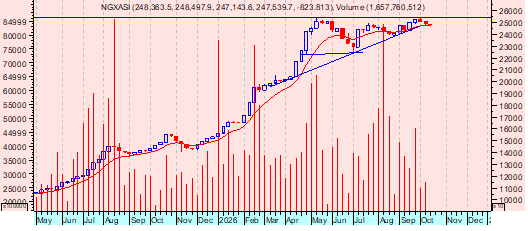

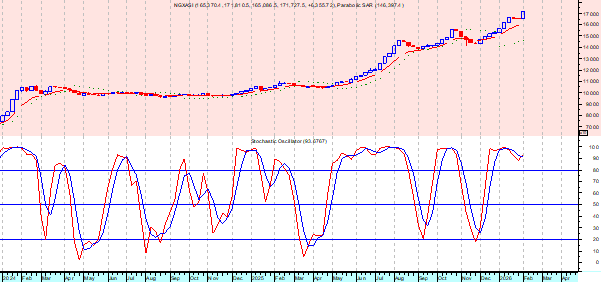
The first trading week of February witnessed a bullish outing to breakout the consolidating levels and the peak of 167,118 points on increased buying interest among the high, mid and low cap stocks that pushed the benchmark NGX All Share index to new all-time high, as market players digest unaudited corporate earnings that were recently released to the market. It was five trading sessions of gains that impacted the All-Share Index (ASI) to close higher by 3.84% week-on-week, finishing at 171,727.49 points, while market capitalisation advanced by ₦1.11 trillion to ₦110.24 trillion. Year-to-date returns now stand at 10.4%, reflecting sustained investor optimism in large- and mid-cap stocks.
This had rekindled sector rotation, portfolio rebalancing and profit booking amidst money flow into equity space after 300% oversubscription in the last Treasury bill primary market auction were the 365days tenor rate decline to 16.89% while the shorter tenors of 91 day and 182 day inched up to 15.84% and 16.65% respectively. Just as all eyes are on expected audited accounts and corporate actions of companies that did not make available Q4 and unaudited 12 months of 2025 financials in January 2026. The state of these numberers and the level of rewards to investors will determine the next direction of the market from this new level of 171,727.50 points.
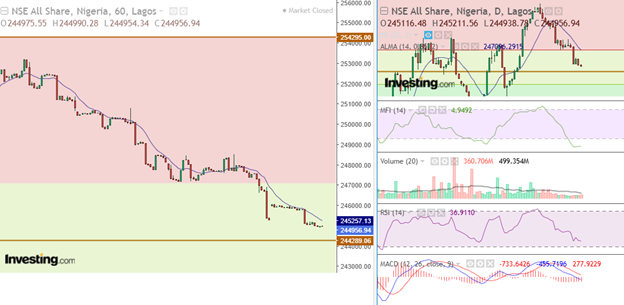
NGXASI Daily Index Chart
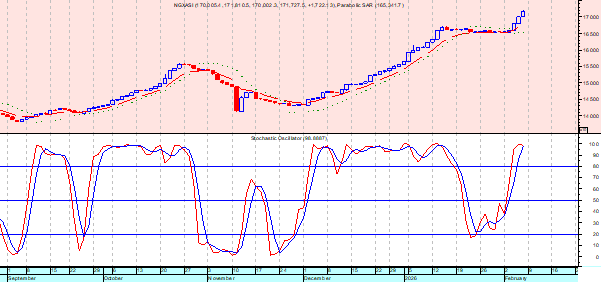
Trading for the week began with marginal gains on Monday as the composite index inched up 0.01% to 165,384.63 points, driven by buying interest in JBERGER, STANBIC, CUSTODIAN, and ARADEL. Despite this, market breadth was negative with 44 decliners against 28 gainers, though trading volumes strengthened to 762.75 million shares valued at ₦18.41 billion.
Tuesday saw the market recover more decisively, with the ASI climbing 0.31% to 165,901.57 points, supported by strong demand for IMG, NGXGROUP, FIRSTHOLDCO, WEMABANK, ZENITHBANK, and GTCO. Market breadth turned slightly positive, with 35 gainers versus 33 losers. Total trading volume moderated to 736.44 million shares worth ₦24.66 billion, led by GTCO in both volume and value.
Mid-week, equities surged sharply as the ASI jumped 1.28% to 168,030.18 points, underpinned by buying in BERGER, FIRSTHOLDCO, ETI, WAPCO, MTNN, and UBA. Market breadth strengthened, with 52 gainers against 25 decliners. CHAMS led volume, while SEPLAT dominated value transactions.
Thursday maintained bullish momentum, with the ASI up 1.18% to 170,005.36 points. Large- and mid-cap stocks such as SEPLAT, TIP, CUSTODIAN, MTNN, and BERGER drove gains, and market breadth improved to 53 advancing stocks versus 18 losers. Trading activity rose to 712.98 million shares valued at ₦22.26 billion. ACCESSCORP led in volume, while GEREGU recorded the highest traded value.
The week closed on a high note Friday as the ASI gained 1.01% to 171,727.49 points. Key movers included NAHCO, SKYAVN, JBERGER, NEM, and HONYFLOUR, lifting investors’ wealth by ₦1.11 trillion. Market breadth remained robust, with 58 gainers against 19 decliners, while trading volumes surged to 953.77 million shares valued at ₦43.08 billion. FIDELITYBK topped volume, and PRESCO led by value.
Market Activity Overview
Investor participation intensified, with 3.86 billion shares worth ₦128.58 billion exchanged across 240,463 deals, up from 3.09 billion shares valued at ₦81.51 billion in the previous week. The Financial Services sector dominated activity, accounting for 56.68% of total volume and 39.24% of market value. Services and ICT sectors followed, recording 466.77 million and 377.80 million shares, respectively. Chams Holding, Access Holdings, and Universal Insurance led the volume chart, jointly accounting for 17.23% of market turnover.
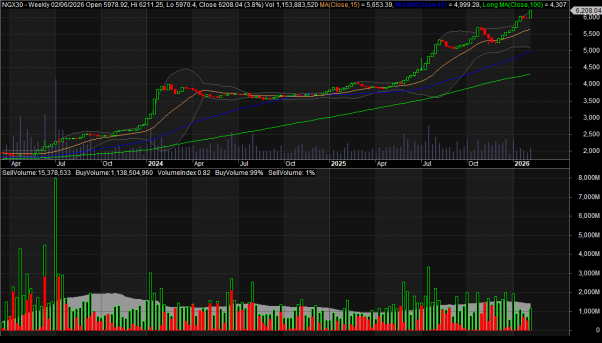
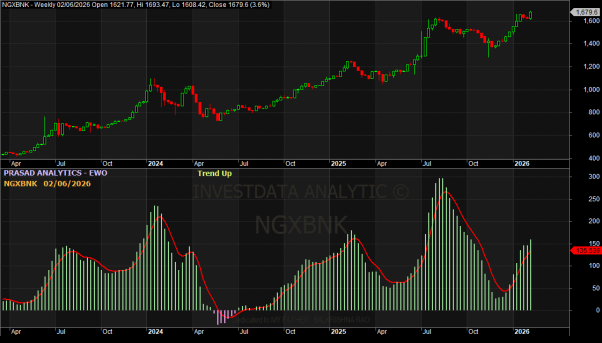
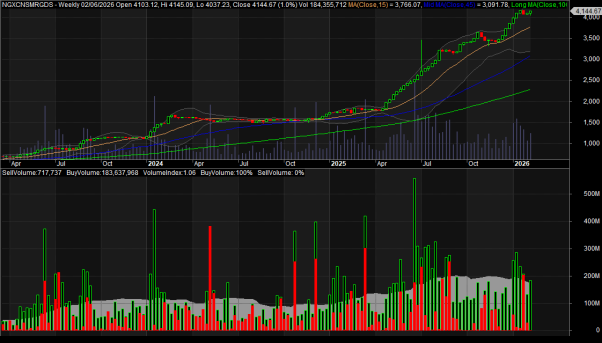
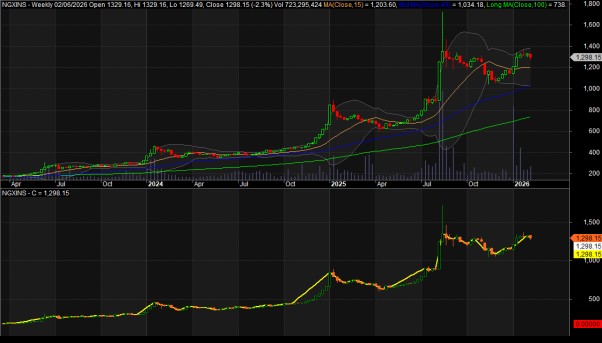
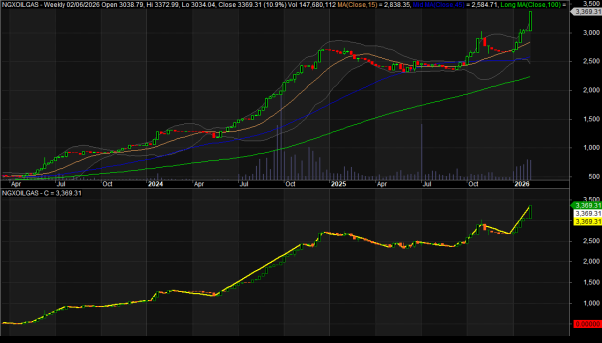
Week-to-date, the All-Share Index has gained 3.84%, NGX 30 is up by 3.83%, the Banking Index has increased by 3.57%, the Pension Index increased by 5.26%, the Insurance Index declined by 2.33%, the Consumer Goods Index increase by 1.01%. However, the Oil and Gas Index recorded a positive return of 10.88%. Year-to-date, the All-Share Index has gained 10.36%, NGX 30 is up by 9.44%, the Banking Index has increased by 10.80%, the Pension Index index increased by 13.88%, the Insurance Index inclined by 9.15%, the Consumer Goods Index increase by 4.26%. However, the Oil and Gas Index recorded a positive return of 26.18%. In terms of market breadth, 71 stocks advanced, while 35 declined
RT Briscoe Plc Chart
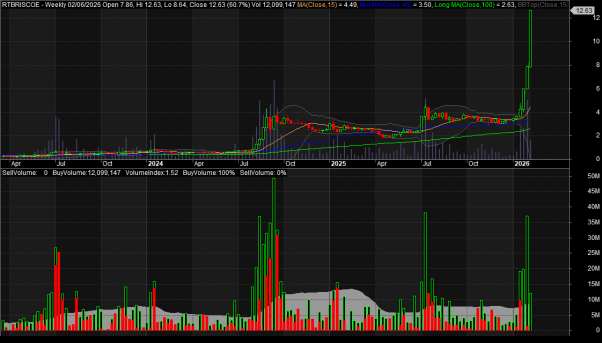
On the gainers’ chart, R T Briscoe Plc, an Automotive and industrial services company, sells and services vehicles and equipment topped the list after rallying 60.69% to close at ₦12.63, followed closely by Zichis Agro Allied Industries Plc, which gained 60.38% to ₦6.72. Abbey Mortgage Bank Plc advanced 59.04% to ₦14.95, Union Dicon Salt Plc rose 49.14% to ₦13.05, while Austin Laz & Company Plc added 38.46% to close at ₦5.40.
Deap Capital Plc Chart
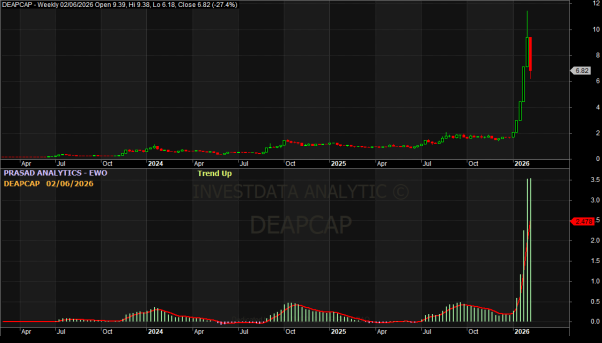
Conversely, Deap Capital Management & Trust Plc, an Investment advisory and portfolio management services led the decliners, shedding 27.37% to ₦6.82. UH Real Estate Investment Trust followed with a 26.99% drop to ₦69.25, while Red Star Express Plc fell 17.55% to ₦17.15. UPDC Real Estate Investment Trust declined by 12.29% to ₦7.85, and Cornerstone Insurance Plc closed lower by 12.24% at ₦5.45.
Technical Analysis and Outlook
From a technical perspective, the ASI remains in a strong uptrend, trading above key moving averages. The 50-day moving average has crossed above the 200-day moving average, signalling a bullish golden cross, while the RSI stands near 68, suggesting moderate overbought conditions. Short-term support is pegged at 169,000 points, with resistance at 173,500 points. Market momentum indicators suggest potential consolidation in the early part of next week before further upside, particularly if investor appetite for large-cap stocks remains steady.
Top sectors like Financial Services, Consumer Goods, and ICT are likely to continue attracting activity, with focus on dividend-paying stocks and companies with strong fundamentals. Mid-cap stocks with strong volume trends may provide tactical trading opportunities, while caution is advised for thinly traded counters given volatility risk.
Market Outlook: The market is expected to maintain a bullish bias in the short term, supported by positive sentiment in key large-cap stocks, improving liquidity, and macroeconomic resilience. Investors should monitor global developments, domestic economic indicators, and sector-specific drivers to capitalize on potential trading and investment opportunities.
Trending in the Economy; Nigeria’s private sector slipped into contraction in January, with the Stanbic IBTC PMI falling to 49.7 from December’s 53.5—the first January dip below 50 since 2014. Weak demand weighed on wholesale and retail, though agriculture, manufacturing, and services continued to expand. Employment edged up, easing backlogs, while rising input and labor costs pushed prices higher, despite modest increases in selling prices. Business confidence softened but remained cautiously optimistic for the year.
Meanwhile, overall economic activity remained robust, as the Central Bank’s composite PMI hit 55.7 points, marking fourteen months of expansion. Growth spanned industry, services, and agriculture, supported by stronger output and stable demand. Persistent challenges—such as insecurity, inflation, high taxes, power issues, and currency volatility—remain, but the data suggest Nigeria’s recovery is strengthening and gaining resilience.
Global Market and Oil: Global markets staged a strong recovery on Friday, with MSCI’s gauge of worldwide equities surging 1.5%—its biggest gain in months after a string of losses. The rebound was supported by renewed buying in U.S. tech stocks, particularly semiconductor shares, which had fallen sharply over the past three sessions due to concerns over AI-driven competition and corporate spending.
Bitcoin and other cryptocurrencies also bounced back after Thursday’s sharp drop, while gold and silver regained ground on bargain-hunting, a slightly weaker dollar, and lingering uncertainty over U.S.-Iran nuclear talks. Oil prices edged higher as investors monitored ongoing discussions between the two countries and assessed the risk of supply disruptions in the Middle East.
Tech sector jitters were heightened earlier in the week after Amazon revealed plans to increase AI spending, contributing to a combined projected $600 billion AI investment by major tech firms including Microsoft, Alphabet, and Meta. Despite this, investors appeared to temper immediate concerns over AI disruption, fueling Friday’s rally.
Chipmakers led the gains, with the Philadelphia Semiconductor Index jumping 5.7% after three consecutive daily losses. The S&P 500’s software and services segment rose 2.4% following a steep seven-session decline. On Wall Street, the Dow Jones Industrial Average soared 1,206.95 points (2.47%) to a record 50,115.67, while the S&P 500 gained 1.97% to 6,932.30. The Nasdaq Composite climbed 2.18% to 23,031.21, marking its largest one-day advance since November. For the week, the Dow rose 2.5%, while the S&P 500 and Nasdaq slipped slightly.
In currencies, the dollar weakened as risk appetite returned, though it remained steady against the yen ahead of Japan’s elections. U.S. Treasury yields showed mixed moves, with the two-year note edging higher ahead of January payroll data, while long-term yields dipped slightly.
Oil prices rose modestly, with U.S. crude up 0.41% to $63.55 per barrel and Brent climbing 0.74% to $68.05, after Iran reported positive progress in nuclear talks with the U.S.
Cryptocurrencies rebounded sharply, with Bitcoin up 10.8% to $69,909 and Ethereum rising 10.9% to $2,048. Gold advanced 3.9% to $4,957.39 an ounce, while silver rose 8.6% to $77.36.
Sectorial Indexes Weekly Chart Position
NGX Banking Index Chart
NGX Consumer Goods Index Chart
NGX Insurance Index Chart
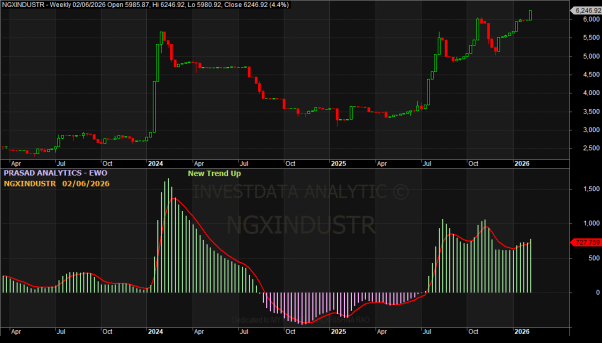
NGX Industrial Goods Index Chart
NGX Oil & Gas Index Chart
NGX 30 Index Chart