
Investors are championing Japan – and are expected to continue doing so on the back of Sanae Takaichi’s landslide election win in the country’s snap general election, a result that has already reshaped global market sentiment and elevated Tokyo to the forefront of risk appetite across equity, currency, and debt markets.
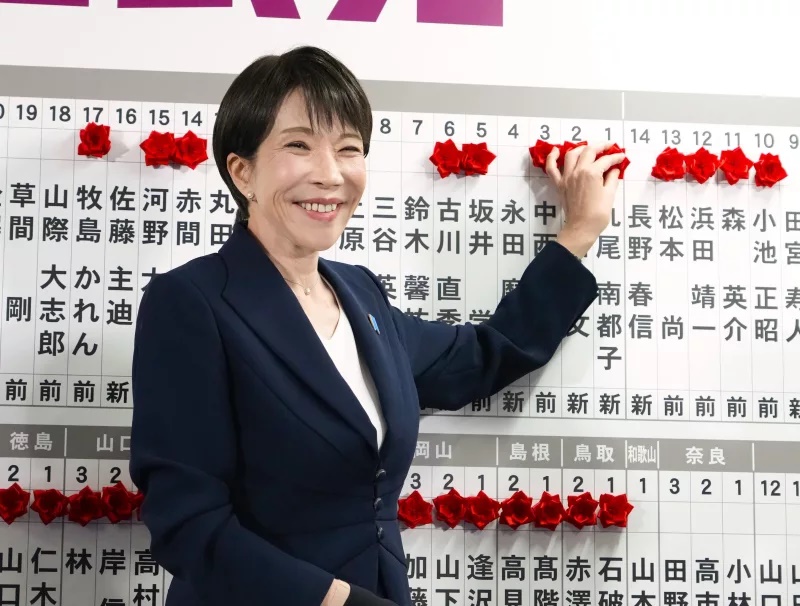
The bullish analysis from Nigel Green, CEO of global financial giant deVere Group, comes following Takaichi’s commanding victory delivered her Liberal Democratic Party a two-thirds supermajority in the Lower House, enabling her to advance her economic agenda with unprecedented political authority and clear policy direction.
Across Asia and beyond, markets have reacted with force. Tokyo’s benchmark Nikkei 225 has surged to all-time highs, briefly topping 57,000, while the broader Topix index also hit new record levels.
Equities in key export and tech sectors showed particularly strong gains as global allocators re-weighted Japan into portfolios.
Nigel Green comments: “The scale of Japan’s electoral outcome fundamentally alters the strategic calculus for international investors.
“Confidence has shifted from tentative to assertive as markets price in a government capable of executing large-scale economic initiatives without debilitating legislative friction.”
Ms Takaichi’s platform, built around fiscal support, targeted tax relief and investment incentives in priority areas such as tech, defence, and infrastructure, has ignited renewed enthusiasm for what many are calling a revived “Japan opportunity.”
These dynamics are reinforced by fresh clarity around policy trajectory – a powerful antidote to the uncertainty that had weighed on asset allocators for much of the past year.
“With such a dominant mandate secured in an open-election environment, Japan stands as one of the few major advanced markets with clear strategic direction.
“That has prompted a redistribution of risk capital into Japanese equities and related assets. Now that policy risk is more knowable, investors are allocating with conviction,” says the deVere CEO.
The rally hasn’t been confined to stocks alone. Shorter-dated Japanese government bond yields have lifted as expectations firm that fiscal initiatives will be accompanied by central bank adjustments; meanwhile, the yen has shown bouts of volatility as currency markets weigh both fiscal expansion and potential official intervention.
“What we’re observing is a realignment of markets around a government with the authority to drive structural economic choices. Equities, yields, and the currency are all reflecting nuanced expectations for growth, inflation, and capital flows.”
International responses have been broad. Global indices opened strongly alongside Japan’s advance, and cross-border capital flows into Asian equities have gained momentum.
Heightened interest in sectors tied to future growth themes – advanced manufacturing, semiconductors, and digital tech – aligns with Japan’s announced priorities.
“The strength of the electorate’s mandate has elevated Japan into a strategic role in global portfolios. Institutional investors are now assessing how this influences their broader Asia and global equity allocations,” notes Nigel Green.
Critically, the market’s reaction has been immediate and substantial because the political backdrop is now a known quantity rather than a source of risk. This contrasts with several major democracies where political fragmentation and policy uncertainty continue to cloud investment horizons.
In contrast, Japan’s electorate has delivered a clear result that enables decisive policy deployment.
“When the governing authority has both political legitimacy and control of legislative instruments, investors can construct risk assessments that factor in probability and timing with far greater precision.
“This underpins the breadth and depth of the capital inflows we are seeing into Japanese assets.”
Market data post-election illustrates the scale of the reaction. Japanese benchmarks have not merely climbed – they have reset valuation benchmarks, triggering what some analysts describe as a fresh structural leg in Japan’s equity ascent. This performance is resonating with global allocators seeking growth exposures backed by economic policy conviction.
The deVere CEO concludes: “Japan’s decisive electoral result changes its investment narrative. It gives markets a reference point around which to model growth, investment incentives, and fiscal policy impacts.
“This alignment of political capital and market expectations is rare among advanced economies today.
“As investors continue to assess the unfolding policy landscape, the strength of Japan’s initial market reaction underscores their confidence in what lies ahead.”