

Market Update for February 10, 2026
The Nigerian equities market continued its upward advance on Tuesday, extending a rally that has steadily gathered pace in recent sessions. Buying pressure remained visible across large- and mid-cap counters, reinforcing the constructive sentiment that has defined the market’s tone in recent weeks. The session was marked by sustained demand rather than sharp speculative bursts, suggesting that the rally is being underpinned by structured capital flows and improving investor confidence.
A closer look at trading behaviour reveals a market transitioning from cautious accumulation to broader participation. Institutional investors appear to be steadily increasing exposure to high-liquidity names, particularly within the banking and industrial sectors. Tier-1 lenders remain attractive on the back of earnings resilience, capital strength and dividend potential, while industrial majors continue to benefit from infrastructure spending themes and pricing advantages. Select consumer and mid-cap growth stocks also joined the rally, pointing to improving risk appetite beyond defensive heavyweights.
Although aggregate volume declined compared to the previous trading session, the quality of turnover remained solid. When price advances occur alongside moderate volume rather than explosive spikes, it often indicates disciplined accumulation. This pattern reduces the likelihood of abrupt reversals and supports the sustainability of the prevailing trend. Value concentration in MTNN and leading banks further highlights the role of institutional positioning in driving market direction.
Market breadth remained decisively positive, confirming that gains were not limited to a narrow cluster of index-heavy stocks. A healthy advance-decline ratio strengthens trend reliability, as widespread participation suggests underlying strength in sentiment. This breadth expansion is particularly important as the index approaches psychologically significant levels.
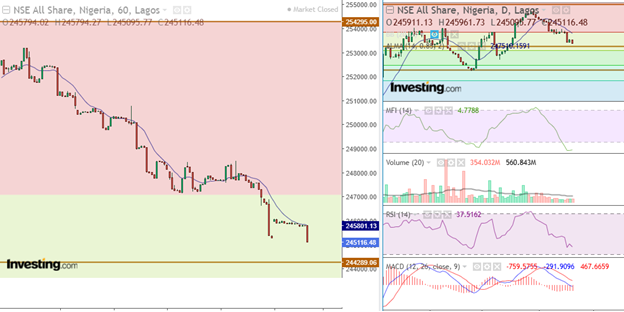
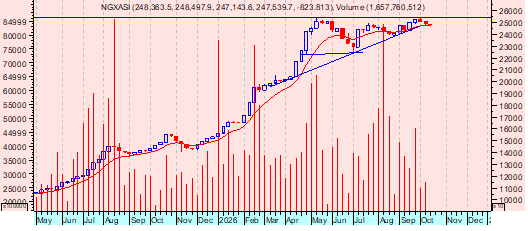
From a technical standpoint, the All-Share Index (ASI) continues to respect its ascending channel, forming a sequence of higher highs and higher lows. The index trades comfortably above its 20-day, 50-day and 100-day moving averages, reflecting alignment across short-, medium- and longer-term timeframes. Such configuration typically signals a well-established bullish phase.
Momentum indicators support this view. The Relative Strength Index (RSI) remains firmly in bullish territory, indicating sustained buying pressure. However, it is gradually approaching overbought levels, which may trigger intermittent consolidation or mild pullbacks. In trending markets, overbought readings often reflect strength rather than imminent reversal, but they do warrant caution for short-term traders.
The next technical hurdle lies within the 178,000–180,000 resistance band. This range represents both a psychological milestone and a supply zone where profit-taking may temporarily intensify. A decisive breakout above 180,000, particularly if accompanied by expanding volume and continued breadth strength, could open the path toward new all-time highs. Conversely, immediate support rests around 173,500 points, corresponding with the previous breakout level and acting as a demand cushion. As long as the index holds above this region, the broader bullish narrative remains intact.
Sector dynamics also suggest rotation rather than exhaustion. Banking stocks continue to anchor performance, but industrial and mid-cap counters are increasingly contributing to index gains. This rotation reduces concentration risk and enhances market depth. Investors appear to be selectively targeting stocks with strong earnings outlooks, balance sheet stability and pricing power in a still-challenging macro environment.
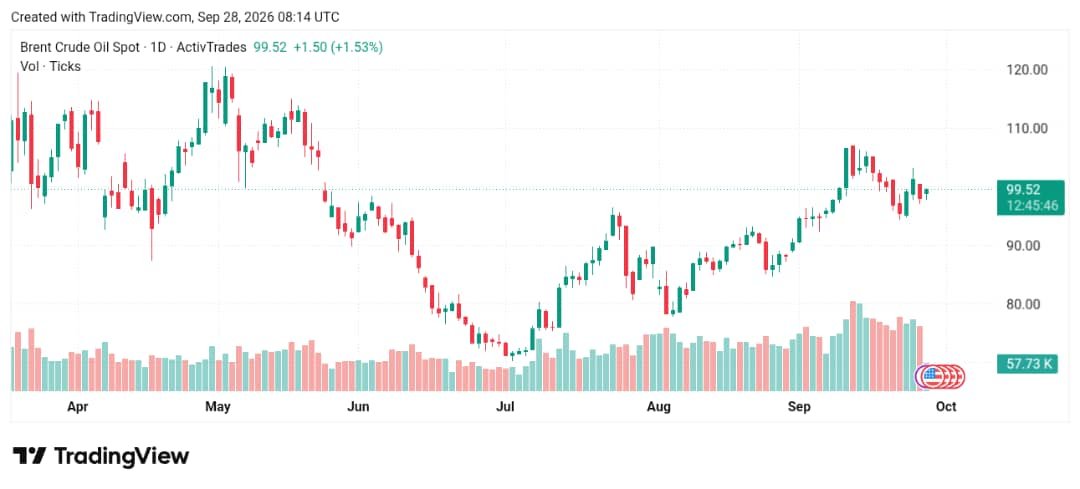
On the global front, crude oil prices ended marginally lower as traders weighed diplomatic signals between the United States and Iran, evolving developments in the Russia–Ukraine conflict and fresh U.S. inventory data. Brent crude settled at $68.80 per barrel, down 0.3%, while West Texas Intermediate eased 0.6% to $63.96. The relatively stable oil environment provides a neutral-to-supportive backdrop for Nigeria’s fiscal outlook, though sustained weakness could temper sentiment in oil-linked equities.
Domestic macro considerations remain central to market direction. Liquidity conditions, inflation trends and currency stability continue to influence asset allocation decisions. With fixed-income yields adjusting and real return considerations in focus, equities remain a preferred avenue for investors seeking growth and income. Dividend-paying blue chips and fundamentally resilient growth stocks are likely to retain investor attention if current conditions persist.
Looking ahead, the near-term outlook remains constructive but measured. The technical structure favors further upside, particularly if resistance levels are breached with convincing volume confirmation. However, traders should anticipate bouts of profit-taking as the market approaches the 180,000 psychological mark. Healthy consolidation phases would strengthen the base for a sustained upward extension rather than signal weakness.
At the close of trading, the All-Share Index advanced 1.65% to settle at 176,809.42 points, lifting year-to-date performance to 13.62% and pushing market capitalization higher in tandem. Market breadth stood strong at 66 gainers against 22 losers. Among the top gainers, DEAPCAP rose 10.00% to ₦1.10, ETRANZACT gained 10.00% to ₦6.60, VITAFOAM advanced 9.98% to ₦29.20, IMG increased 9.96% to ₦37.55, WAPCO appreciated 9.95% to ₦88.40, NGXGROUP climbed 9.74% to ₦39.45, and VFDGROUP added 9.27% to close at ₦98.00. ABBEYBDS led the decliners with a 9.91% drop to ₦5.55. Total traded volume stood at 1.30 billion shares valued at ₦50.43 billion across 58,965 deals, with DEAPCAP dominating volume activity, while MTNN recorded the highest traded value at ₦6.80 billion, followed by GTCO and ZENITHBANK as key market movers.