

Market Update For February 17, 2026
The Nigerian equities market closed Tuesday on a softer note, reversing part of its recent advance as profit-taking resurfaced across major banking and industrial counters. After sustaining a strong upward run in previous sessions, the benchmark index came under pressure from selloffs in highly capitalised stocks, dragging the broader market below the 190,000 psychological threshold.
The decline was largely concentrated in Tier-1 banking names, which have been the primary drivers of the market’s impressive year-to-date performance. ZENITHBANK recorded a sharp pullback, alongside UBA, ACCESSCORP and GTCO, reflecting institutional repositioning and short-term profit booking. Industrial heavyweight WAPCO and telecom giant MTNN also traded lower, further amplifying the downside due to their weight on the index.
Notwithstanding the bearish close, the underlying market structure showed resilience. Market breadth settled positive, indicating that buying interest persisted across several mid- and small-cap counters. The divergence between breadth and index performance underscores rotational flows rather than widespread liquidation. Investors appear to be selectively accumulating fundamentally sound stocks while trimming positions in recently overbought large caps.
Liquidity conditions remained robust throughout the session. Total volume traded rose by 11.52% to 1.20 billion units, while turnover expanded to ₦60.19 billion across 86,607 deals. The increase in both volume and value despite a negative close signals active portfolio rebalancing rather than a contraction in participation.
ACCESSCORP led the activity chart by volume, exchanging 103.49 million units to account for 8.62% of total market turnover. ZENITHBANK dominated the value chart with ₦8.01 billion worth of transactions, representing 13.30% of aggregate traded value. JAPAULGOLD also featured prominently in volume terms, while ARADEL and MTNN ranked closely behind ZENITHBANK in value contribution. Financial services stocks once again served as the primary liquidity anchors, reinforcing their central role in current market dynamics.
Sectoral performance reflected mixed sentiment. Banking and industrial goods indices closed lower, weighed down by profit-taking in bellwethers, while selective strength was observed in transport and certain consumer names. The persistence of bargain hunting in smaller counters suggests that risk appetite remains intact, albeit more tactical in nature.
On the global front, oil prices edged lower as geopolitical risk premium moderated. Brent crude declined by 1.4% to $67.71 per barrel, while West Texas Intermediate hovered at $62.79. The retreat followed diplomatic progress in U.S.–Iran nuclear discussions, easing immediate supply disruption concerns. Nonetheless, the oil market remains vulnerable to headline-driven volatility, particularly regarding developments around the Strait of Hormuz and ongoing Russia-Ukraine negotiations. For Nigeria, sustained weakness in crude prices could shape sentiment in oil-linked equities and influence macro expectations tied to foreign exchange inflows and fiscal buffers.
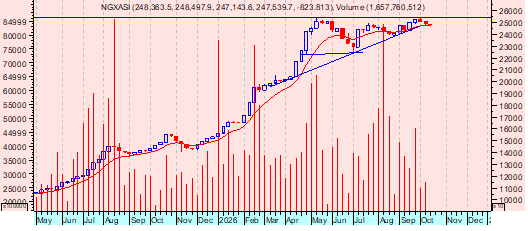
From a technical perspective, the NGX All-Share Index remains in a medium- to long-term bullish trend but is presently consolidating after testing strong resistance around 190,000–190,500 points. The inability to sustain a breakout above this band triggered mild corrective pressure. Momentum indicators suggest cooling overbought conditions, which could allow the market to build a stronger base for the next leg upward.
Immediate support is seen within the 187,500–188,000 zone. A breakdown below this range could invite further retracement toward lower technical levels. However, as long as the index holds above key moving averages and maintains healthy market breadth, the broader uptrend remains structurally intact. A decisive rebound above 190,500 points would likely signal renewed bullish momentum and open the path toward fresh record highs.
Looking ahead, market direction may be influenced by earnings releases, dividend declarations, fixed-income yield movements and global risk sentiment. With year-to-date returns still elevated, intermittent pullbacks are expected as investors rebalance portfolios. Strategic accumulation on weakness, particularly in fundamentally strong counters with earnings visibility, remains a prudent approach.
At the close of trading, the NGX All-Share Index (ASI) declined 0.49% to 189,321.24 points from 190,262.44 points, shedding 941.20 points, while market capitalisation eased in tandem with the benchmark and year-to-date performance moderated to 21.66%. Total transactions stood at 1.20 billion units valued at ₦60.19 billion across 86,607 deals, with market breadth closing positive at 44 gainers against 40 decliners. ABCTRANS led the gainers, appreciating 10.00% to ₦0.99, while JAPAULGOLD advanced 9.92% to ₦1.55 alongside other mid-cap advancers. On the downside, MECURE declined 10.00% to ₦11.70, ZENITHBANK fell 10.00% to ₦51.30, SKYAVN dropped 10.00% to ₦18.90, UBA shed 6.56% to ₦32.00 and ACCESSCORP lost 4.63% to ₦23.70, as banking stocks dominated market movers and trading drivers for the session.