
Market Update For February 23, 2026
The Nigerian equities market extended its bullish advance, reflecting sustained institutional accumulation and renewed retail participation across key sectors. The tone of trade remained optimistic throughout the session, supported by liquidity inflows, earnings-driven positioning, and improved sentiment around energy prices. While profit-taking surfaced in select counters, the broader structure of the market continues to favour the bulls.
Crude oil prices climbed to a six-month high amid heightened geopolitical tension and shifting trade policy signals. Brent crude rose by 0.9% to $72.38 per barrel, while West Texas Intermediate gained 1% to $67.17. The rally was driven by concerns over potential escalation between the United States and Iran ahead of further nuclear negotiations, alongside uncertainty surrounding U.S. tariff adjustments.
For Nigeria, sustained crude strength carries important implications. Higher oil prices improve revenue expectations, support foreign exchange liquidity, and enhance fiscal stability — factors that tend to reinforce investor confidence in oil-linked and banking equities. As energy earnings prospects improve, market participants are increasingly rotating into upstream and integrated oil plays, alongside financial services names positioned to benefit from macro tailwinds.
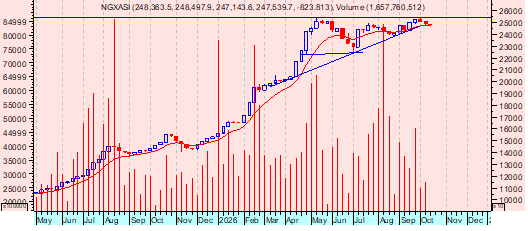
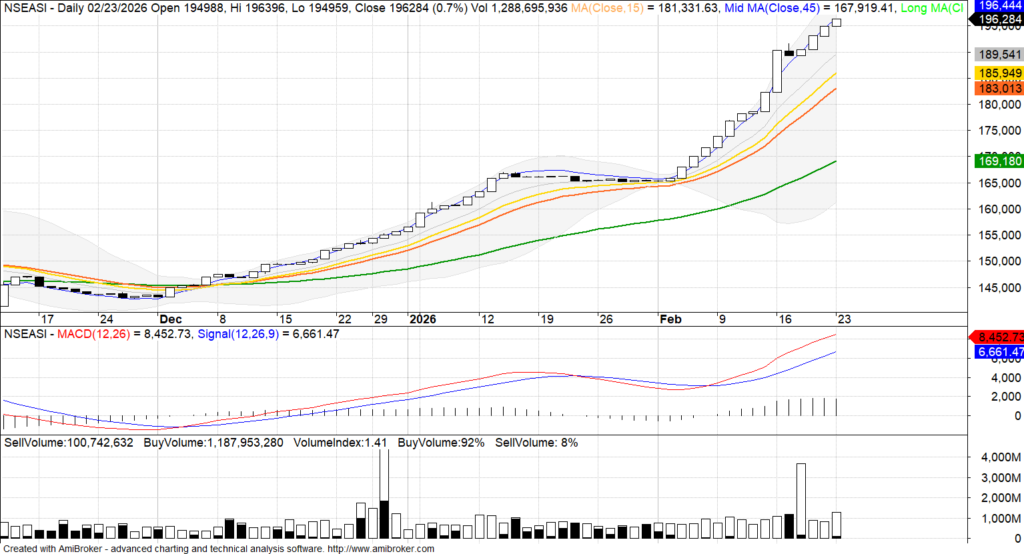
Technically, the All-Share Index (ASI) continues to exhibit a strong bullish configuration. The index remains firmly above its key moving averages, confirming upward momentum across short-, medium-, and long-term time frames. The pattern of higher highs and higher lows remains intact, reflecting sustained demand at every minor dip. Volume expansion during the latest advance adds credibility to the rally, indicating genuine buying interest rather than thin-market spikes.
However, technical indicators are beginning to flash early caution signals. The Relative Strength Index (RSI) is trending toward overbought territory, suggesting that the pace of the rally may moderate in the near term. This does not necessarily imply a reversal but increases the likelihood of short-term consolidation or sector rotation. The 197,000–200,000 psychological range stands as the immediate resistance zone. A clean breakout above this band could open the path toward a fresh leg higher, while support is seen around 192,000–194,000 points where bargain hunters may re-enter.
On the fundamental side, earnings resilience remains a key driver. Banking stocks continue to attract positioning amid elevated interest rates, which have supported stronger net interest margins and improved profitability outlooks. Industrial names are benefiting from cost adjustments and pricing strategies that cushion inflationary pressures. Select consumer goods counters are also drawing interest based on recovery narratives and improving operational efficiencies.
Nevertheless, risks remain. Inflationary pressures, exchange rate volatility, and global geopolitical uncertainties could introduce intermittent volatility. Portfolio managers are therefore adopting a more selective approach — rotating capital into fundamentally sound names while trimming exposure to overheated positions.
At the close of trading, the All-Share Index (ASI) gained 0.65% to settle at 196,263.55 points, up from 194,989.77 in the previous session. Market capitalisation expanded by N804.56bn, reinforcing year-to-date return at 26.12%. Market breadth closed slightly negative, with 34 decliners against 33 gainers, reflecting selective profit-taking beneath the surface of the headline advance.
Top gainers included OKOMUOIL (+10.00%), FIDSON (+9.90%), SKYAVN (+9.83%), MAYBAKER (+8.97%), UCAP (+6.79%), and JBERGER (+5.80%), alongside gains in ZENITHBANK, GTCO, UBA, BUACEMENT, and FIRSTHOLDCO. TIP led the decliners’ chart. Trading activity strengthened notably, with total volume rising 57.07% to 1.29bn units valued at N31.50bn across 95,091 deals. JAPAULGOLD accounted for 36.78% of total volume with 473.98m units traded, while ARADEL dominated value trades at N4.14bn, representing 13.14% of turnover, followed by MTNN.
Outlook: The market’s primary trend remains upward, supported by liquidity, earnings expectations, and favourable crude dynamics. However, with technical indicators approaching stretched levels, intermittent consolidation is likely. Investors should maintain a disciplined, stock-specific strategy — locking in gains where necessary while positioning strategically in fundamentally strong counters on pullbacks. The broader bias remains constructive, but volatility management will be critical as the index approaches key psychological resistance levels.