

Market Update For March 10, 2026
The Nigerian Exchange (NGX) ended Tuesday’s trading session on a negative note, reversing gains recorded in the previous session as investors took profits in several blue-chip and mid-cap stocks. The pullback followed the recent rally that had pushed the market closer to the 200,000-point psychological mark, prompting traders and portfolio managers to lock in gains and rebalance positions.
The session opened on a cautious tone, with early selling pressure across key sectors of the market. As trading progressed, the bearish sentiment persisted, driven largely by declines in consumer goods, banking, and industrial stocks. The downward movement reflected investors’ efforts to secure profits after weeks of sustained upward movement in the market.
Profit-taking was particularly visible among previously strong performers, especially large-cap stocks that had recorded significant price appreciation in recent sessions. This trend is typical in a market that has experienced a prolonged rally, as investors periodically trim positions to manage risk and rebalance portfolios.
Despite the decline in the overall market, selective buying interest remained visible in certain counters, particularly among mid-tier and relatively lower-priced equities. Some stocks continued to attract demand from investors seeking growth opportunities and momentum-driven plays.
Notably, Premier Paints, Eterna, and NPF Microfinance Bank traded above their respective 52-week highs during the session, highlighting strong investor appetite for these counters. The ability of these stocks to sustain upward momentum despite the broader market decline reflects targeted accumulation by investors seeking stocks with positive price trends.
Across sectors, trading sentiment remained mixed. Banking stocks, which have been among the most actively traded and strongest-performing segments of the market in recent months, recorded mild declines as investors took profits following recent gains. Consumer goods stocks also faced selling pressure, reflecting cautious investor sentiment amid persistent macroeconomic challenges affecting consumer spending and corporate margins.
Industrial goods stocks were not spared either, with select counters experiencing downward price adjustments as traders reduced short-term positions. However, the overall sector performance suggested that the market correction was broad but moderate rather than driven by a single sector-specific event.
Market participation remained relatively strong, though slightly lower compared to the previous trading day. The marginal drop in trading activity suggests that some investors adopted a wait-and-see approach as the market digested recent gains and adjusted to new price levels.
In terms of trading volume, Access Holdings Plc emerged as the most actively traded stock for the day, accounting for a significant portion of the total volume exchanged on the market. The banking giant continues to attract strong investor interest due to its liquidity, market capitalization, and consistent participation by both institutional and retail investors.
Other stocks that recorded notable trading volumes included MBenefit and FTG Insurance, both of which contributed significantly to overall market turnover. The active trading in these counters reflects ongoing investor engagement in the financial services and insurance segments of the market.
On the value chart, Zenith Bank Plc led the market, recording the highest traded value during the session. The strong value turnover in Zenith Bank underscores continued investor confidence in Tier-1 banking stocks, which remain attractive due to their earnings resilience, strong balance sheets, and dividend-paying potential.
Energy-related stocks also maintained notable trading activity, with Aradel Holdings featuring among the top contributors to total traded value. The interest in energy stocks continues to reflect investor attention to developments in global oil markets, which remain a key driver of economic and financial market sentiment in Nigeria.
Beyond the domestic market, developments in the global oil market added another layer of volatility to the trading environment. Crude oil prices experienced a sharp decline on Tuesday after surging to nearly four-year highs during the previous session.
The decline followed comments from U.S. President Donald Trump, who indicated that the ongoing conflict in the Middle East could reach a resolution sooner than expected. His remarks helped ease market fears of prolonged disruptions to global oil supply, which had previously pushed prices sharply higher.
Brent crude futures dropped by more than $10 per barrel to trade around $88, while U.S. West Texas Intermediate (WTI) crude also fell significantly to around $84 per barrel. The sharp decline followed Monday’s rally, when oil prices briefly surged above $119 per barrel amid heightened geopolitical tensions and supply concerns.
The earlier spike in oil prices had been fueled by fears of supply disruptions in the Middle East as well as production cuts by major oil-producing countries. These developments had raised concerns about a potential tightening of global oil supply, which triggered strong upward price momentum.
However, the market’s reaction to signs of possible de-escalation demonstrates how sensitive oil prices remain to geopolitical developments. Any signal suggesting a resolution or reduction in tensions can quickly shift market expectations and trigger significant price corrections.
For Nigeria, fluctuations in global oil prices carry important implications. As one of the world’s major crude oil exporters, Nigeria relies heavily on oil revenues to support government spending, foreign exchange earnings, and macroeconomic stability. Changes in oil prices therefore have direct and indirect effects on the country’s fiscal outlook, currency stability, and overall investment climate.
In the equity market, oil price movements can also influence investor sentiment, particularly toward energy-related stocks and sectors that are closely tied to global commodity trends.
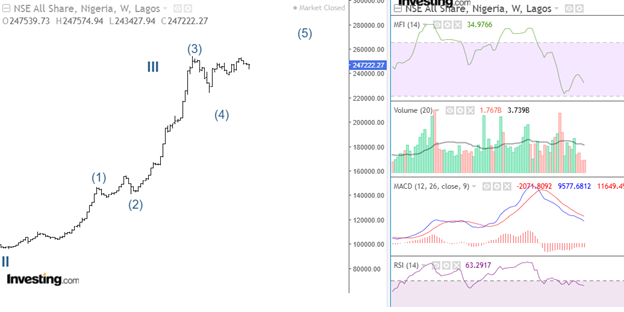
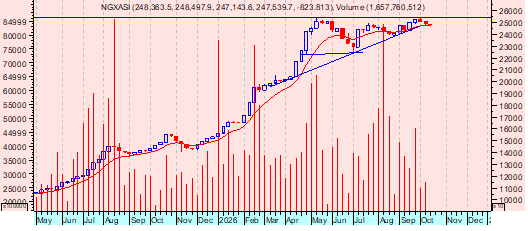
From a technical standpoint, the Nigerian stock market remains within a broader bullish framework despite the current pullback. The recent decline appears to represent a healthy correction following the market’s strong upward trajectory in recent weeks.
The benchmark index continues to trade above key technical support levels, suggesting that the underlying bullish momentum has not been fully reversed. Such corrections are often necessary to stabilize price movements and create new entry opportunities for investors seeking to accumulate fundamentally strong stocks at relatively attractive prices.
Market participants are therefore expected to continue monitoring price movements closely, particularly around key support and resistance levels. Bargain hunting may re-emerge in stocks that experience temporary declines but maintain strong underlying fundamentals.
Going forward, the direction of the market will likely be influenced by a combination of factors including investor sentiment, macroeconomic developments, corporate earnings outlook, and movements in global commodity prices. Sector rotation and selective accumulation are also expected to shape trading activity as investors search for opportunities across different segments of the market.
Market Summary:
The NGX All-Share Index (ASI) declined by 0.57%, losing 1,130.86 points to close at 196,066.11 points, compared with 197,196.97 points in the previous session. Consequently, market capitalisation fell by N725.94 billion to N125.86 trillion, while the year-to-date (YTD) return moderated to 26.00%. Market breadth closed negative with 42 decliners against 33 gainers. Conoil, Legend Internet, and Premier Paints led the gainers’ chart, while major laggards included Nascon (-10.00%), Red Star Express (-9.94%), SCOA (-9.86%), Oando (-7.59%), PZ Cussons (-6.96%), Wema Bank (-5.20%), Lafarge Africa (-4.72%), Custodian Investment (-3.54%), MTN Nigeria (-2.15%), Unilever (-2.08%), Transcorp (-1.71%), UBA (-1.17%), Nigerian Breweries (-1.13%), GTCO (-0.85%), May & Baker (-0.66%), and Stanbic IBTC (-0.15%), alongside other decliners. In terms of trading activity, 746.85 million shares valued at N27.85 billion were exchanged in 65,275 deals. Access Holdings led the volume chart with 80.26 million shares, representing 10.75% of total traded volume, while Zenith Bank recorded the highest traded value at N3.29 billion, accounting for 11.82% of the total value traded during the session.