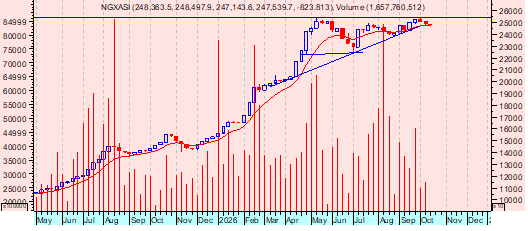

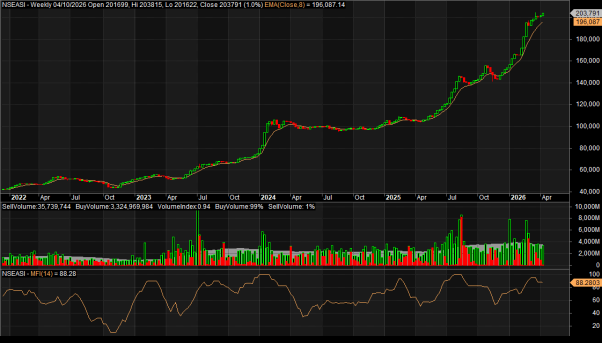
Nigeria’s stock market sustained its bullish trajectory throughout last week with its benchmark NGX All-Share Index advancing steadily from 202,023.10 points to 203,770.42 points, translating to a weekly gain of 1.03%. Market capitalisation for the period rose to ₦131.17 trillion, reflecting a 1.05% increase. This consistent upward movement confirms that the market remains firmly on a broader uptrend, supported by the improving sentiment and sustained investor participation despite intermittent profit-taking pressures and negative market internals.
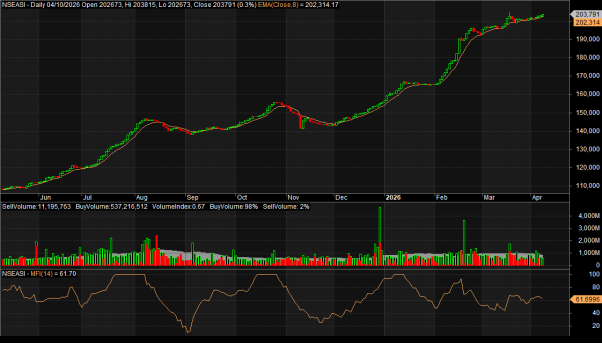
NGXASI Daily Chart
Post Easter holiday trading opened on a positive note Tuesday, with the All-Share Index (ASI) inching up by 0.16% to 202,023.10 points, supported by gains in CADBURY and FIRSTHOLDCO. Market capitalisation rose by ₦208.65 billion to ₦130.01 trillion, bringing the year-to-date return to 29.82%. Despite the uptick, market breadth was weak as 37 stocks declined against 24 gainers. TRANSEXPR led advancers, while ELLAHLAKES topped losers, with both TRANSEXPR and CADBURY hitting new 52-week highs. Trading activity was strong, as volume surged 105.85% to 1.15 billion shares valued at ₦40.28 billion, led by WEMABANK.
The positive trend was sustained at midweek, with the composite index rising by 0.28% and market capitalisation increasing to ₦130.40 trillion (YTD: 30.19%), driven by improved sentiment after FTSE Russell upgraded Nigeria to frontier market status. However, breadth remained negative. SEPLAT hit a new 52-week high, while trading slowed, with ACCESSCORP leading volume and ZENITHBANK dominating value.
The bullish momentum continued on April 9, as the ASI gained another 0.28%, lifting market capitalisation to ₦130.77 trillion and YTD return to 30.56%. Market breadth stayed slightly negative, with losers marginally ahead of gainers. TRANSEXPR again led advancers and reached a new high. Activity softened, with ACCESSCORP topping volume and GTCO leading value traded.
At the last trading session of the week, the market closed higher for the straight fourth sessions of the week under review, as the key performance index rose by 0.30% to 203,770.42 points, while market capitalisation climbed to ₦131.17 trillion (YTD: 30.95%). Market breadth remained negative. TRANSEXPR led gainers, while GUINNESS and WAPCO recorded new 52-week highs. Trading activity declined, with ACCESSCORP leading volume and ARADEL dominating value.
Top Gainers
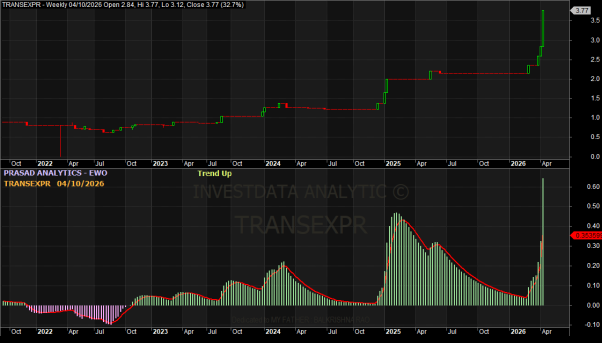
Trans-Nationwide Express, a logistics and courier services company focused on express delivery solutions across Nigeria, surged 32.75% (+₦0.93), rising from ₦2.84 to ₦3.77. Nigerian Exchange Group gained 13.94% (+₦23.00), moving from ₦165.00 to ₦188.00, while GTCO advanced 10.66% (+₦13.00) from ₦122.00 to ₦135.00. Nascon appreciated by 9.52% (+₦14.00), climbing from ₦147.00 to ₦161.00, and Guinness added 9.38% (+₦39.70), increasing from ₦423.20 to ₦462.90.
Top Losers
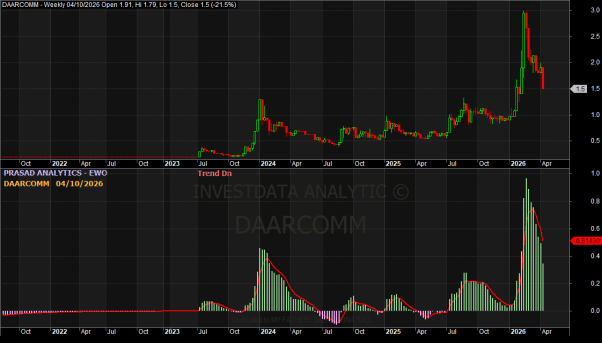
Daar Communications, a Nigerian media and broadcasting company It operates in the media and entertainment sector, providing television, radio, and digital broadcasting services, declined by by 21.47% (-₦0.41), dropping from ₦1.91 to ₦1.50. RT Briscoe fell 20.00% (-₦2.10), sliding from ₦10.50 to ₦8.40, while Deap Capital lost 16.81% (-₦1.01), easing from ₦6.01 to ₦5.00. Ellah Lakes shed 16.67% (-₦2.00), declining from ₦12.00 to ₦10.00, and Japaul Gold dipped 16.29% (-₦0.57), closing lower at ₦2.93 from ₦3.50.
The overall, market transaction for the week after Easter holiday was up to reflect improved Investors participation, with total turnover rising to 3.36 billion shares worth ₦151.95 billion in 229,442 deals, up from 2.86 billion shares valued at ₦113.60 billion in the prior week.
Sectoral performance showed Financial Services dominating activity, accounting for 68.54% of total volume and 59.54% of value. The Services and ICT sectors followed distantly. The most traded stocks—Access Holdings, Wema Bank, and GTCO—jointly contributed over a third of total volume and value, to maintained a positive tone.
Week-to-date, the NGX 30 was up by 1.06%, the Banking Index has increased by 5.10%, the Pension Index increased by 2.74%, the Insurance Index declined by 3.64%, the Consumer Goods Index increased by 1.10%. However, the Oil and Gas Index recorded a positive return of 2.67%. Year-to-date, the All-Share Index has gained 30.95%, NGX 30 is up by 30.44%, the Banking Index has increased by 33.33%, the Pension Index index increased by 40.21%, the Insurance Index inclined by 0.54%, the Consumer Goods Index increase by 8.70%. However, the Oil and Gas Index recorded a positive return of 68.34%. In terms of market breadth, 25 stocks advanced, while 54 declined.
However, a closer examination of market structure reveals weakening internal strength. Although the index recorded consecutive gains across the four trading sessions, market breadth remained persistently negative, indicating that decliners consistently outnumbered advancers. This divergence suggests that the rally is increasingly narrow and driven by selective accumulation in a limited set of stocks rather than a broad-based market expansion. Such a pattern typically reflects a maturing bullish trend where upside momentum persists but underlying participation weakens.
Technical Analysis
From a technical standpoint, the ASI has maintained resilience above the 202,000 psychological support level, reinforcing short-term bullish control. The index’s gradual advance toward the 204,000–205,000 resistance zone places it at a critical inflection area where profit-taking pressure is expected to intensify. A decisive breakout above this region, supported by stronger volume and improved market breadth, would be required to confirm continuation of the bullish cycle into a new expansion phase.
Momentum remains concentrated in a handful of large-cap and high-liquidity equities, with the financial services sector continuing to dominate market direction. Strong performances in GTCO, Access Holdings, and Zenith Bank provided a key stabilising force for the index throughout the week. Outside the banking sector, selective strength was observed in names such as Guinness Nigeria and WAPCO, highlighting pockets of sector rotation into consumer goods and industrial stocks, although participation remained uneven.
Liquidity conditions improved compared to the previous week, with total turnover rising to 3.36 billion shares valued at ₦151.95 billion. However, trading activity remained heavily concentrated in a few high-volume counters, particularly within the banking group. This concentration supports short-term index stability but also increases vulnerability to volatility should momentum in financial stocks weaken.
Sectoral performance continued to reflect a rotational but imbalanced market environment. Financial services remained the dominant driver of both volume and direction, while industrial goods and consumer goods recorded selective gains. In contrast, insurance and growth indices underperformed, reinforcing the ongoing rotation away from weaker or less liquid segments of the market.
Despite the positive index trajectory, market sentiment remains cautiously optimistic due to persistent negative breadth, which signals underlying distribution pressure. The continued lag in broad market participation suggests that the rally is being supported by fewer stocks over time, a condition that often precedes either consolidation or a temporary corrective phase.
Market Outlook
Looking ahead, the market is expected to maintain a bullish bias but with rising volatility as it approaches key resistance levels. The ASI is likely to trade within a tightening range between 200,000 support and 205,000 resistances in the short term. A confirmed breakout above resistance, supported by stronger participation across sectors, would signal continuation of the upward trend. However, if breadth continues to weaken, the market may shift into a sideways consolidation phase or experience mild corrective pressure as investors take profits after recent gains.
Overall, the Nigerian equities market remains structurally positive, but the evolving technical landscape suggests that the next directional move will depend heavily on whether market participation broadens beyond the current leadership of banking and select large-cap stocks.
Trending in the Economy: Nigeria’s VAT collections declined to N2.19 trillion in Q4 2025, marking a 3.78% drop from the N2.28 trillion recorded in Q3, although it still reflected a 12.84% increase year-on-year.
Of the total, local VAT contributed N1.16 trillion, while import VAT and foreign VAT stood at N535.73 billion and N503.13 billion respectively. The manufacturing sector remained the largest contributor, accounting for 25.23%, followed by information and communication and mining activities. Sector performance was uneven, with improvements in water supply and waste management, while agriculture and administrative services recorded declines.
In a related development, the manufacturing sector generated N881.29 billion in Company Income Tax in 2025, up from N663.46 billion in 2024, showing solid annual growth. However, overall CIT collections softened toward the end of the year, as Q4 figures declined across key sectors. Despite the slowdown, total CIT for the year settled at N9.22 trillion, underscoring the continued importance of the sector to Nigeria’s non-oil revenue base, even amid persistent cost pressures and subdued demand conditions.
Global Market and Oil: Global financial markets ended Friday on a cautious and mixed note as investors balanced easing risk sentiment from earlier in the week with renewed uncertainty ahead of scheduled U.S.–Iran talks over the weekend. Oil prices edged lower, equities closed unevenly, and inflation data continued to reflect the growing impact of elevated energy costs on the global economy.
Crude oil remained the central focus of market attention. Prices slipped modestly on Friday but stayed elevated compared to recent averages due to ongoing geopolitical tensions and disrupted supply routes. U.S. crude oil settled down $1.30 at $96.57 per barrel, while Brent crude finished lower by 72 cents at $95.20 per barrel. Despite the daily decline, the energy market remained structurally tight, with traders still wary of supply risks tied to the Middle East conflict and reduced flows through the Strait of Hormuz, a critical passage responsible for transporting roughly one-fifth of global oil and gas supply. Shipping activity through the route has reportedly remained significantly below pre-war levels, underscoring lingering supply chain concerns.
Earlier in the week, oil markets had experienced sharp volatility after geopolitical developments triggered a brief easing in tensions, including a reported cease-fire agreement between the United States and Iran aimed at de-escalating the near six-week conflict. However, sentiment quickly turned cautious again as investors questioned the durability of any diplomatic breakthrough. Market participants remain focused on whether the upcoming weekend negotiations will produce a lasting truce or further escalation.
Equity markets in the United States ended Friday in a mixed fashion but still delivered a strong weekly performance overall. The Dow Jones Industrial Average fell 0.6% to close at 47,916.57, while the S&P 500 slipped slightly by 0.1% to 6,816.89. In contrast, the Nasdaq Composite gained 0.4%, finishing at 22,902.89, supported by continued strength in technology stocks.
Despite Friday’s subdued performance, all three major U.S. indices recorded their strongest weekly gains since November. For the week, the S&P 500 rose 3.6%, the Dow Jones added 3%, and the Nasdaq outperformed with a 4.7% gain. The rally was supported by improving global risk appetite earlier in the week following temporary de-escalation signals from the Middle East conflict and continued strength in large-cap technology names.
Global equities also reflected the improved weekly sentiment. MSCI’s broadest index of Asia-Pacific shares excluding Japan climbed 0.9% on Friday, bringing its weekly gain to 7.3%, its strongest weekly advance since November 2022. European markets were similarly positive, with the pan-European STOXX 600 rising 0.4% by the close of trading.
However, despite the strong weekly performance across global equities, Friday’s trading tone reflected renewed caution as investors positioned ahead of high-stakes diplomatic discussions between Washington and Tehran scheduled for Saturday. Iranian and U.S. delegations are expected to meet in an effort to stabilize tensions, while geopolitical rhetoric remains firm. Iran has reportedly demanded the unfreezing of its assets and an end to Israeli strikes in Lebanon as part of its conditions, while political pressure from the United States continues, with threats of further action if demands are not met.
The geopolitical situation is already feeding into inflation dynamics. Recent data shows U.S. consumer prices rose at their fastest pace in nearly four years in March, largely driven by surging energy costs. In China, factory-gate inflation also turned positive for the first time in 3½ years during the same period, signaling that higher global input costs are beginning to filter through supply chains.
Market analysts noted that uncertainty surrounding the Middle East conflict is increasingly influencing trading behavior, particularly on Fridays, as investors reduce risk exposure heading into weekends when geopolitical developments are more likely to emerge. According to market commentary from investment strategists, earnings guidance from companies has also reflected heightened uncertainty, with many firms offering more cautious forward-looking statements than usual.
Attention is also turning to the upcoming U.S. corporate earnings season, which is expected to provide further insight into the resilience of global businesses amid inflationary pressures and geopolitical instability. Early signals from the technology sector have been encouraging. Taiwan Semiconductor Manufacturing Company (TSMC) reported a 35% year-on-year surge in first-quarter revenue, exceeding market expectations, driven by strong demand for artificial intelligence-related chips. The results provided a boost to global tech sentiment, helping lift the Philadelphia Semiconductor Index by 2.3% on Friday.
In broader global markets, MSCI’s all-country world index rose by 2.01 points to 1,034.64, reflecting a cautiously optimistic global risk tone despite lingering uncertainties. European equities, measured by the STOXX 600, also closed 0.4% higher.
In currency markets, the U.S. dollar weakened slightly, with the dollar index falling 0.2% to 98.68, marking its steepest weekly decline since January. The euro gained 0.25% to trade at $1.1728, while the dollar edged up 0.2% against the Japanese yen to 159.3.
U.S. Treasury yields edged higher across the curve as investors adjusted interest rate expectations. The yield on the 10-year Treasury note rose by 2.4 basis points to 4.317%, while the 30-year yield increased by 1.1 basis points to 4.909%. The 2-year note, which is more sensitive to Federal Reserve policy expectations, climbed 1.9 basis points to 3.802%, reflecting shifting expectations around the timing of potential rate adjustments.
In commodities beyond energy, precious metals traded mixed. Spot gold declined 0.3% to $4,747.88 per ounce, while silver outperformed, rising 1.4% to $76.10 per ounce, supported by broader industrial demand expectations and safe-haven interest.
Overall, global markets closed the week in a state of cautious optimism. Strong weekly gains across equities and improving tech sentiment were offset by persistent geopolitical risks, elevated inflation pressures, and uncertainty surrounding the outcome of critical U.S.–Iran negotiations. Investors now look toward the coming week for clarity on both diplomatic developments and corporate earnings direction, which are expected to set the tone for near-term global market performance.