
April 2026 remains one of the most consequential months in the recent history for the Nigerian equities market, as the composite Nigerian Exchange (NGX) All-Share Index delivered a powerful, well-sustained rally. It reshaped sentiment, redefined valuation expectations, and reinforced the country’s positioning within the global frontier investment space.
The month did not, however, begin with momentum. Instead, it opened on a cautious note amid profit-taking pressure, and uneven trading conditions that reflected investor hesitation after earlier gains. However, as the weeks progressed, the market gradually shifted from consolidation to acceleration, eventually culminating in a broad-based bullish expansion that pushed the index into record territory.
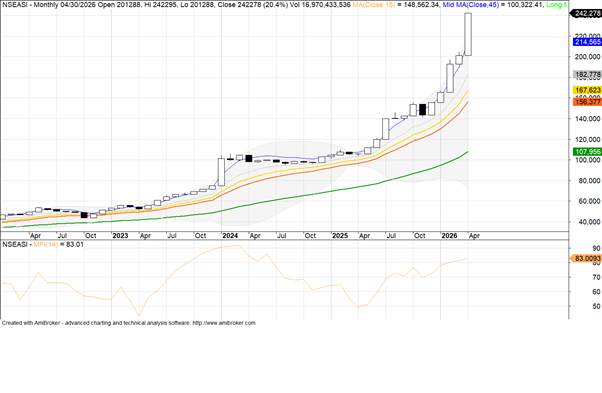
The last trading day of the month recorded a surge, as the composite index hit 242,277.81 basis points, a historic high that underscored the intensity of buying pressure during the month. Market capitalisation also rose sharply to approximately ₦155.99 trillion, representing an expansion of over ₦27 trillion from its March levels. This reflected not just price appreciation but a significant re-rating of equities driven by liquidity inflows, improved sentiment, and structural catalysts. Year-to-date returns strengthened to 55.69%, placing Nigeria among the top-performing frontier markets globally.
However, a key macroeconomic backdrop that contrasts sharply with the equity market’s performance was the deterioration in real economic activity. According to the Central Bank of Nigeria (CBN), Nigeria’s economy slipped into contraction in April 2026 as the Purchasing Managers’ Index (PMI) fell to 49.4, ending a 16-month expansion streak. This marked a clear signal of weakening underlying economic momentum.
The downturn was primarily driven by softer demand conditions, with key sub-indices all falling below the 50-point growth threshold. Output eased to 49.7, new orders dropped further to 48.4, and employment declined to 49.6, indicating broad-based slowdown in business activity. Although agriculture remained marginally in expansion territory at 50.2, both industrial and services sectors weakened. Rising input costs also forced firms to pass higher prices to consumers, adding inflationary pressure even as demand softened. This represented a notable deceleration from March’s 53.2 PMI reading, highlighting fading economic momentum beneath the surface.
Despite this macroeconomic slowdown, the equities market moved in the opposite direction, underscoring a growing divergence between financial market performance and real-sector activity. The early part of April reflected cautious sentiment, with the index fluctuating within a tight consolidation range around 200,000–203,000 points. The 200,000 level acted as a strong psychological support, consistently attracting buyers, but overall market breadth remained weak. Gains were largely concentrated in select large-cap banking and industrial stocks, while most counters traded sideways.
A major turning point emerged in early April following the reinstatement of Nigeria’s Frontier Market status by FTSE Russell. This acted as a powerful sentiment catalyst, reshaping expectations around foreign portfolio inflows. Anticipated inflows estimated between $840 million and over $1 billion triggered early positioning by domestic investors, who began accumulating fundamentally strong and highly liquid equities ahead of potential foreign participation. This helped offset concerns from weakening macroeconomic data, as investors increasingly focused on liquidity-driven market dynamics rather than real-sector softness.
Momentum strengthened further in mid-April as the ASI broke above 202,000 and entered a strong upward trajectory. Between April 13 and 17, the index surged approximately 6.57% in a single week, breaking through the 210,000 resistance level with strong volume confirmation. Market capitalisation rose to about ₦139.83 trillion during this phase, while year-to-date returns approached 40%. This breakout confirmed a shift in market structure from consolidation to expansion, supported by strong institutional participation.
Sector performance was broad-based but led by key segments. Banking stocks such as ACCESSCORP, ZENITHBANK, and GTCO remained dominant drivers, supported by strong earnings expectations and liquidity flows. The industrial goods sector also performed strongly, with cement stocks like DANGCEM and BUACEMENT benefiting from inflation-linked pricing power and infrastructure demand. The oil and gas sector added additional momentum as rising global crude prices supported earnings prospects for companies such as SEPLAT and ARADEL.
Toward the latter part of the month, the market began to show signs of maturity within its bullish cycle. Volatility increased modestly, and intermittent profit-taking emerged, particularly in banking stocks that had led earlier gains. On April 27, the ASI declined by 0.94% as investors locked in profits. However, this correction was short-lived and viewed as a healthy consolidation within a broader uptrend, especially as liquidity conditions remained strong.
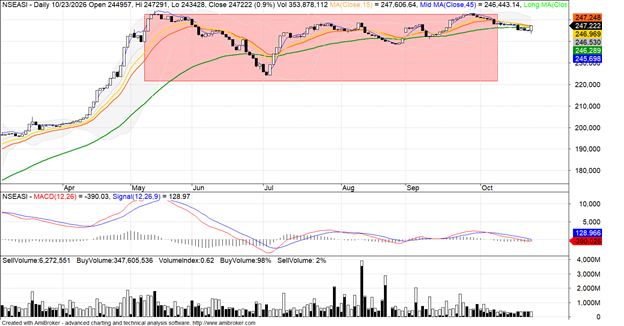
NGXASI Monthly Chart
The market maintained a strong bullish structure throughout the month, consistently forming higher highs and higher lows. The key resistance levels at 210,000, 220,000, and 230,000 were all decisively broken with strong volume confirmation to make higher high. By month-end, the index entered a price discovery phase, although technical indicators suggested mildly overbought conditions, implying potential short-term consolidation. Immediate support is now seen around 235,000 and 220,000, while resistance lies in the 245,000–250,000 range.
The divergence between a weakening real economy and a strongly rising equity market highlights a key feature of April 2026’s market dynamics. While the PMI data pointed to slowing business activity, the stock market remained driven by liquidity expectations, structural reforms, and foreign inflow anticipation rather than short-term macro fundamentals. This disconnect suggests that investor positioning was forward-looking, pricing in medium-term recovery and capital inflow potential rather than current economic softness.
Market Outlook
The month of May remains cautiously positive, though volatility is expected to increase. Profit-taking pressures may intensify, particularly in banking and other outperforming sectors. However, the broader bullish structure remains intact, supported by liquidity, improved investor sentiment, and structural catalysts such as Nigeria’s frontier market status.
If the ASI maintains support above the 237,000–240,000 zone, the market could extend its rally into new price discovery territory. A breakdown below this level may trigger short-term consolidation, but not necessarily a reversal of the broader trend.
In summary, April 2026 represents a pivotal and somewhat paradoxical month for the Nigerian equities market—defined by a powerful stock market rally occurring alongside a weakening real economy. While macroeconomic indicators signaled slowdown and contraction, the equities market remained driven by liquidity, sentiment, and structural inflows. This divergence underscores the complexity of current market dynamics and reinforces April as a foundational month for the next phase of NGX growth.
UACN Plc
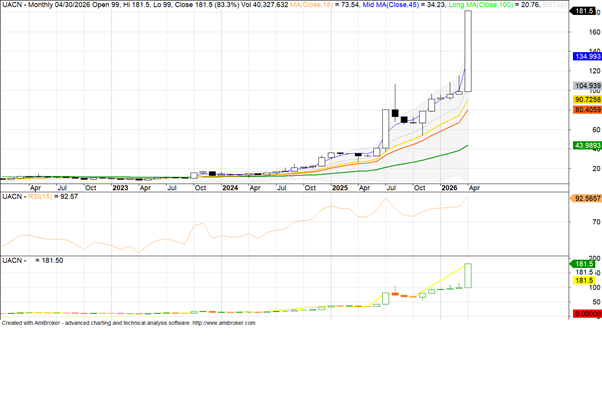
On a stock-specific basis for April MTD, performance has been highly selective. UACN Plc led the gainers with about 42%, driven by renewed interest in industrial and consumer-linked stocks. Nascon Allied Industries and Union Dicon Salt followed closely with around 32% gains each, supported by strong demand in consumer goods. Trans-Nationwide Express gained about 30%, while Lafarge Africa rose roughly 21% on infrastructure-related optimism. Multiverse Mining added about 20%, while PZ Cussons Nigeria and Unilever Nigeria posted mid-to-high teen gains. sector strength, while UPDC REIT advanced about 15% on mild recovery in real estate sentiment.
Infinity Trust Mortgage Bank Plc
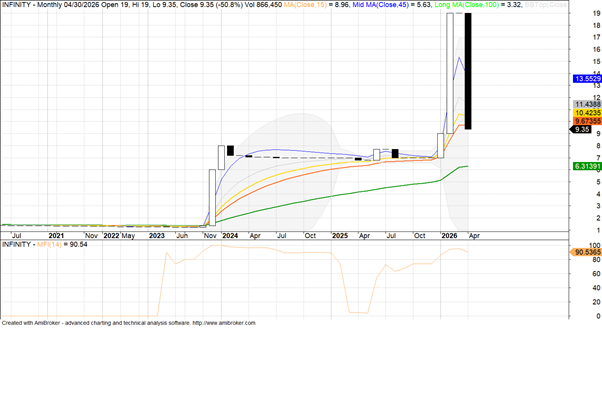
On the losing side, pressure was most visible in the mortgage banking segment. Infinity Trust Mortgage Bank fell sharply by about 50%, reflecting weak sentiment and sustained sell pressure. Abbey Mortgage Bank declined about 33%, while LivingTrust Mortgage Bank dropped around 10%. Stanbic IBTC eased by roughly 13% due to profit-taking, while Sovereign Trust Insurance lost about 10%. Regency Alliance Insurance and Guinea Insurance also remained weak. Transcorp Power slipped around 10%, while NPF Microfinance Bank and Meyer Plc both declined by roughly 9%.
Sectorally, banking remained the strongest driver of the market, supported by earnings strength and high interest-rate benefits. Consumer goods also performed strongly, as investors positioned for defensive exposure and pricing recovery. Industrial goods maintained positive momentum on infrastructure demand, while oil and gas remained mixed due to global price strength offset by local profit-taking. Insurance and mortgage banking sectors continued to lag, weighed down by weak liquidity and poor sentiment.
Overall, market breadth remained positive but leadership was narrow, with gains concentrated in select large-cap stocks. The market is still firmly bullish, but increasingly stock-picking driven, rewarding strong fundamentals while punishing weaker names.
Global Market: April 2026 ended up being a month where markets largely ignored heavy geopolitical tension and still pushed to fresh highs. US–Iran friction stayed in focus, the Strait of Hormuz remained heavily disrupted, and Brent crude climbed above $110 per barrel by month-end. Even with repeated ceasefire talks and diplomatic efforts, stability in the region continued to slip.
Despite that backdrop, investor sentiment turned strongly positive. Global equities rallied in a clear risk-on move, led by a sharp rebound in artificial intelligence-related stocks. The S&P 500 and Nasdaq both set new records, while the Philadelphia Semiconductor Index surged nearly 40% during the month. Emerging markets were the biggest winner, with the MSCI Emerging Markets Index up 14.7%, driven largely by Taiwan (+26.2%) and South Korea (+38.2%)—both central to the global AI supply chain.
The strength of the rally was not just in size but in breadth. Growth stocks outperformed value by a wide margin (12.4% vs 7.2%), showing continued investor preference for AI-linked names. Developed markets returned 9.6%, while small caps also advanced 9.1%, although the gains were mainly concentrated in tech-focused companies rather than a broad economic recovery.
Fixed income delivered more modest but stable gains. The Bloomberg Global Aggregate rose 1.2%, though rising oil prices and inflation concerns pushed yields higher and weighed on government bonds. Credit markets performed better, with investment-grade spreads tightening as risk appetite improved and earnings remained strong.
Commodities also had a positive month, rising 4.2%. Energy led the way (+7.7%) on higher oil prices, while industrial metals (+5.0%) also gained, supported by strong demand linked to ongoing global AI data centre expansion.
Equities
Emerging markets clearly outperformed in April. MSCI Asia ex-Japan rose 16.3%, while broader emerging markets gained 14.7%. Most of the gains were concentrated in Taiwan and South Korea, reflecting their deep exposure to semiconductor and AI hardware production. These markets recovered fully from earlier geopolitical-driven losses, reversing the weakness seen in February and March.
In developed markets, the US led performance. The S&P 500 gained 10.5%, supported by strong earnings across technology and financial sectors. Roughly two-thirds of the index had reported at the time, with year-on-year earnings growth estimated at 14.5%. Results were particularly strong, with 84% of companies beating expectations—well above the long-term average of 73%—and earnings coming in about 28.6% above forecasts, although large gains among mega-cap tech firms helped inflate the figure.
Japan’s Topix rose 6.6%, benefiting from global risk appetite but lacking strong direct exposure to the AI theme. Europe ex-UK gained 5.7%, but momentum faded later in the month as ceasefire optimism weakened and eurozone PMI data pointed to economic contraction, reflecting ongoing pressure from energy supply disruptions.
The UK lagged, with the FTSE All-Share up just 2.8%. Its heavy weighting toward energy, financials, and defensive sectors limited upside in a month dominated by growth and technology. Energy and banking stocks were volatile due to oil price swings and shifting geopolitical expectations. Meanwhile, UK inflation rose to 3.3%, increasing speculation that the Bank of England may still deliver further rate hikes, with markets pricing in just over two additional increases by year-end.
Conclusion
April 2026 was a month where markets looked past geopolitical risk and focused instead on earnings strength and AI-driven growth. Despite ongoing tensions in the Middle East, restricted oil flows, and Brent crude above $110, investor optimism—supported by strong corporate results—drove equities to record levels.
However, the outlook remains finely balanced. A resolution in the Strait of Hormuz could ease energy prices and soften inflation pressures, while continued disruption risks keeping inflation elevated and slowing global activity. In this environment, diversification across regions, sectors, and asset classes remains essential.