
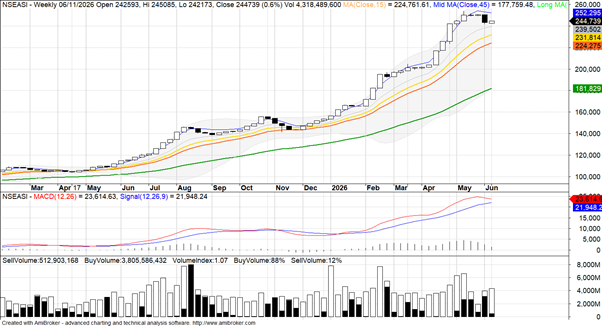
Trading on the Nigerian Exchange started the short trading week on a positive performance supported by sustained renewed buying interest in large- and mid-cap stocks despite a mild pullback in the final session due to profit booking ahead of the holidays declared on Friday to mark the country’s Democracy Day. The benchmark NGX All-Share Index gained with a 0.90% gain, closing the week at 244,738.74 basis points. That left the market’s year-to-date return at 57.27%.
Daily index action movement for the period is as below:
NGXASI Daily Index Action
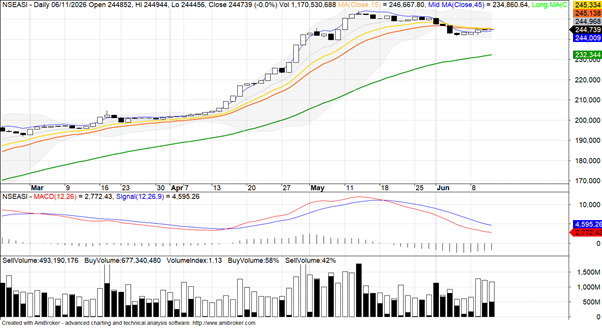
Monday trading commenced with a gain of 0.33%, extending the previous session positive trend on bargain hunting in stocks such as TIP, OANDO, ETERNA, FIRSTHOLDCO, MTNN, ARADEL, ZENITHBANK and GTCO lifted investor wealth by ₦514.97 billion.
The recovery momentum continued on Tuesday, with the index advancing 0.53% and adding ₦834.67 billion to market capitalization, driven by strong demand for AIRTELAFRI, FIRSTHOLDCO, NEM, TRANSCORP, ACCESSCORP and GTCO.
At midweek, the composite index NGXASI extended its gains marginally by 0.06%, supported by buying interest in VITAFOAM, NAHCO, OANDO, UACN and MTNN.
However, on the final trading session for the week ahead of the holiday saw profit-taking in MAYBAKER, UACN, ZENITHBANK and ACCESSCORP, thereby halting the four-day rally on Thursday, leading to a slight 0.05% decline and a loss of ₦72.74 billion.
Market sentiment remained largely positive throughout the week, with gainers consistently matching or surpassing losers. Trading activity was also strong, as investors exchanged 4.964 billion shares worth ₦207.52 billion in 235,966 deals, compared with 3.966 billion shares valued at ₦175.66 billion recorded in the previous week.
Sectoral analysis showed that the Financial Services Industry dominated trading activity with 4.116 billion shares valued at ₦84.61 billion in 96,165 deals, accounting for 82.92% of total volume and 40.77% of total value traded. The Services Industry followed with 232.48 million shares worth ₦4.96 billion, while the Industrial Goods sector recorded 144.99 million shares valued at ₦39.08 billion.
The most actively traded stocks by volume were Sterling Financial Holdings, FCMB Group and Access Holdings, which jointly accounted for 2.883 billion shares worth ₦36.19 billion in 15,533 deals, representing 58.09% of total market volume and 17.44% of total transaction value.
Week-to-date, the All-Share Index gained 0.90%, while the NGX 30 garnered 1.05%, just as the Banking Index increased by 0.95%, just as the Pension Index slipped 0.03%, the Insurance Index inclined by 1.63%, the Consumer Goods Index lost 0.54%. However, the Oil and Gas Index recorded a positive return of 0.50%.
Year-to-date, the All-Share Index has gained 57.27%, NGX 30 is up by 56.50%, the Banking Index has increased by 51.68%, the Pension Index increased by 67.71%, the Insurance Index Inclined by 5.89%, the Consumer Goods Index increase by 20.08%. However, the Oil and Gas Index recorded a positive return of 113.40%.
ABC Transport Weekly Chart
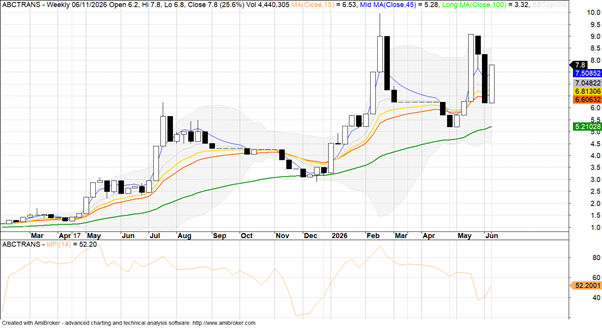
On the gainers’ chart, Associated Bus Company Plc led with a 25.60% appreciation, advancing from ₦6.21 to ₦7.80, a gain of ₦1.59 per share. Consolidated Hallmark Holdings Plc followed, rising by 23.13% from ₦6.70 to ₦8.25, adding ₦1.55. Abbey Mortgage Bank Plc gained 21.93% to close at ₦11.40 from ₦9.35, representing an increase of ₦2.05. Infinity Trust Mortgage Bank Plc appreciated by 20.32%, moving from ₦9.35 to ₦11.25, a gain of ₦1.90, while Austin Laz & Company Plc advanced by 15.16% from ₦3.76 to ₦4.33, adding ₦0.57 each.
Fidson Healthcare Weekly Chart
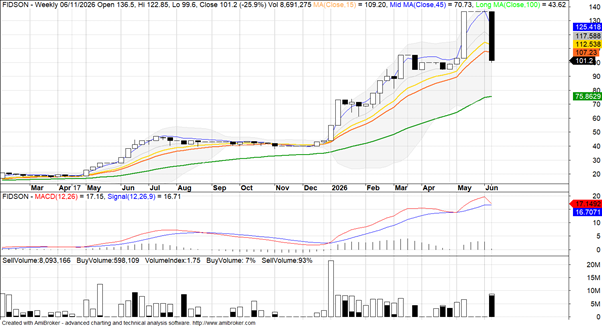
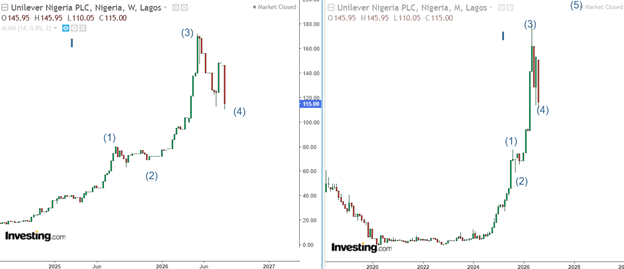
Conversely, Fidson Healthcare Plc topped the losers’ table after shedding 25.86%, closing at ₦101.20 from ₦136.50, a loss of ₦35.30. Neimeth International Pharmaceuticals Plc declined by 19.34% from ₦10.60 to ₦8.55, losing ₦2.05. UH Real Estate Investment Trust fell by 17.36% to ₦70.00 from ₦84.70, a decline of ₦14.70. SUNU Assurances Nigeria Plc dropped 11.38% from ₦4.48 to ₦3.97, losing ₦0.51, while Unilever Nigeria Plc depreciated by 10.26% to ₦140.00 from ₦156.00, representing a loss of ₦16.00 per share.
Comparative Analysis: Last Week vs Previous Week (NGX)
In the week before last, the Nigerian stock market was largely bearish, driven by sustained profit-taking across most sessions. The NGX All-Share Index fell from earlier levels to close at 242,593.31 points, with year-to-date return at 55.90%. On Monday, the index dropped 1.13% to 247,560.66 points, wiping out ₦1.81 trillion off market capitalization, or investors’ worth. Tuesday’sfell 0.35% to 246,686.66 points, losing ₦478.68 billion. Wednesday declined 1.44% to 243,132.61 points, erasing ₦2.28 trillion, while Thursday fell 0.37% to 242,227.31 points, losing ₦580.65 billion. Friday recovered slightly by 0.15% to 242,593.31 points, adding ₦234.73 billion.
Total turnover for the week stood at 3.97 billion shares worth ₦175.66 billion in 343,587 deals, compared with 2.40 billion shares worth ₦111.48 billion in 241,313 deals in the prior week. Financial Services dominated with 2.69 billion shares (67.83%) worth ₦69.98 billion (39.84%), followed by Services with 323.60 million shares (₦6.44 billion) and ICT with 176.04 million shares (₦27.89 billion). Top traded stocks were Access Holdings, Abbey Mortgage Bank, and Sterling Financial Holdings, accounting for 1.29 billion shares (32.53%) worth ₦17.56 billion (10.00%).
The market was more bullish in the just concluded week, supported by sustained buying interests in large- and mid-cap stocks. The NGX All-Share Index rose from 243,396.25 points to 244,738.74 points, while year-to-date return improved to 57.27%. On Monday, the index gained 0.33%, adding ₦514.97 billion, Tuesday rose 0.53%, adding ₦834.67 billion, Wednesday increased 0.06%, while Thursday fell slightly by 0.05%, losing ₦72.74 billion.
Total turnover increased to 4.964 billion shares worth ₦207.52 billion in 235,966 deals, compared with 3.97 billion shares worth ₦175.66 billion last week. Financial Services dominated again with 4.116 billion shares (82.92%) worth ₦84.61 billion (40.77%), followed by Services with 232.48 million shares (₦4.96 billion) and Industrial Goods with 144.99 million shares (₦39.08 billion). The most active stocks were Sterling Financial Holdings, FCMB Group, and Access Holdings, accounting for 2.883 billion shares (58.09%) worth ₦36.19 billion (17.44%).
Forty equities appreciated in price during the week higher than 23 equities in the previous week. Fifty-three equities depreciated in price, lower than 65 equities in the previous week, while 53 equities remained
unchanged, lower than 58 recorded in the previous week. Overall, last week was bearish with heavy losses and volatility, while this week was bullish with higher index gains, stronger liquidity, and improved investor sentiment.
Technical Analysis View
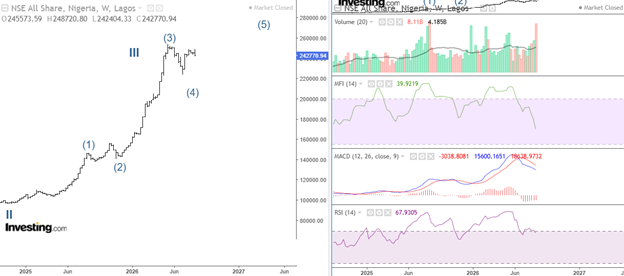
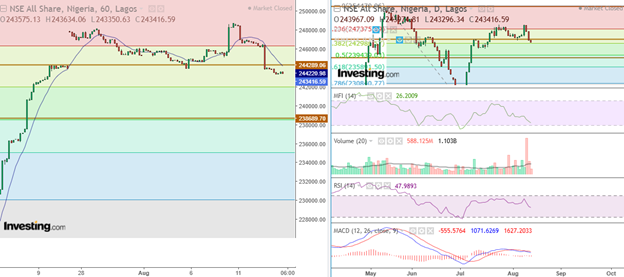
The NGX All-Share Index maintained a short-term bullish structure, sustaining its position above recent support levels around the 243,000 psychological zone. The midweek rally confirmed continued buying interest in large-cap and financial stocks, which helped offset periodic profit-taking pressure. Momentum indicators suggest a mildly positive bias, though the late-week pullback signals the emergence of resistance near the 245,000 level. The market’s ability to recover quickly from intraday and sessional dips reflects underlying liquidity strength and sustained institutional participation, particularly in banking and telecom counters.
However, the mixed performance on Thursday indicates that the market is approaching a short-term consolidation phase after consecutive gains, with traders likely locking in profits ahead of new catalysts.
Market Outlook
In the near term, the market is expected to remain range-bound with a mild bullish bias, as investors continue to reposition portfolios in anticipation of half-year earnings releases and macroeconomic signals.Sustained interests in fundamentally strong large-cap stocks is likely to provide support for the index, while intermittent profit-taking may cap upside momentum. A decisive breakout above the 245,000 level could trigger further upside, while failure to hold the 243,000-support zone may lead to short-term consolidation.Overall, market sentiment remains constructive, supported by strong liquidity, sector rotation within financial stocks, and continued interest in high-volume counters.
Trending in the Economy: The IMF has expressed concern over Nigeria’s proposed $5 billion financing arrangement with First Abu Dhabi Bank, noting that the derivative-based funding structures may lack transparency and carry higher risks. While acknowledging the country’s recent reform efforts, the Fund advised a shift toward clearer funding sources such as Eurobonds and concessional loans.
Meanwhile, Nigeria’s crude oil output climbed above its OPEC quota in May 2026, hitting a 15-month peak. Production averaged 1.53 million barrels per day, slightly above the 1.5 million bpd benchmark, while total output including condensates rose to about 1.7 million bpd. The increase was supported by improved operational stability and fewer disruptions, strengthening potential government revenue.
Global Market and Oil: Global equities closed higher on Friday, extending a week of volatile but broadly positive trading, as investors balanced easing geopolitical tensions with renewed excitement in global IPO markets. The MSCI global equities index rose 1.15% to 1,112.24, reflecting broad gains across major regions, while Wall Street also ended the session in the green despite intraday fluctuations.
Sentiment across financial markets was shaped largely by two competing forces: improving expectations of a possible U.S.–Iran peace deal and a wave of enthusiasm surrounding the blockbuster market debut of Elon Musk’s SpaceX. At the same time, crude oil prices extended sharp declines, falling more than 3%, as traders priced in reduced supply risk from the Middle East.
Earlier in the week, markets had already surged after Donald Trump announced the cancellation of planned U.S. military strikes on Iran and suggested that both countries were close to finalizing an agreement to end a three-month conflict. That announcement triggered a strong risk-on move across equities and commodities. However, by Friday, clarity on the proposed deal remained limited, keeping investors cautious.
A senior U.S. official stated that negotiators from both sides were close to completing a framework agreement that could be signed within days. According to the official, the deal would reportedly include Iran’s commitment not to develop or acquire nuclear weapons, along with provisions to reopen the Strait of Hormuz for normal oil shipping and ease U.S. restrictions on maritime traffic. However, Iranian Foreign Minister Abbas Araqchi countered these claims, saying that nuclear negotiations would be addressed in later stages and insisting that control and management of the Strait of Hormuz would not revert to pre-war arrangements. The mixed signals kept geopolitical risk alive, even as markets continued to price in optimism.
Despite the uncertainty, equity markets maintained a firm tone, supported by strong appetite for risk assets. The biggest catalyst of the day came from the technology and aerospace sector, where SpaceX made a spectacular public market debut. Shares of the rocket and spacecraft manufacturer surged more than 19% on their first day of trading, closing at $161.11 per share. The rally pushed the company’s valuation beyond $2 trillion, marking one of the most significant IPO milestones in history and propelling founder Elon Musk into unprecedented financial territory, with reports describing him as the world’s first trillionaire.
Market participants widely noted that the SpaceX listing had a greater immediate impact on sentiment than geopolitical developments. Analysts argued that repeated speculation around a U.S.–Iran deal had already been priced in several times over recent months, with previous announcements failing to materialize in concrete outcomes. Jake Dollarhide, CEO of Longbow Asset Management in Tulsa, Oklahoma, noted that markets had been “stung more times” by premature optimism on peace talks, adding that the real driver of Friday’s rally was the strength and excitement of the IPO market rather than diplomacy.
He further pointed to the possibility of a broader IPO cycle ahead, especially with artificial intelligence companies such as OpenAI and Anthropic expected to consider public listings later in the year. According to Dollarhide, a healthy IPO pipeline could provide a strong tailwind for equities, particularly if investor demand for high-growth technology firms remains elevated. Chris Zaccarelli, chief investment officer at Northlight Asset Management, described the SpaceX debut as a key indicator of investor risk appetite and overall market health. He said the strong reception reflected confidence in high-growth sectors and suggested that liquidity conditions remained supportive for equities despite macroeconomic uncertainty.
On Wall Street, major indices closed firmly higher. The Dow Jones Industrial Average rose 353.51 points, or 0.70%, to finish at 51,202.26. The S&P 500 advanced 37.16 points, or 0.50%, to close at 7,431.46, while the Nasdaq Composite gained 79.18 points, or 0.31%, ending at 25,888.84. These gains were broad-based, though technology stocks led much of the intraday momentum. Globally, equities also strengthened. MSCI’s world index, which tracks stocks across developed and emerging markets, rose 12.69 points, or 1.15%, to 1,112.24. In Europe, the STOXX 600 index closed up 1.88%, reflecting strong performance across banking, industrial, and energy sectors, even as investors digested mixed macroeconomic data. Fresh inflation readings from France and Spain showed price pressures accelerating in May, while data from the United Kingdom revealed a 0.1% contraction in economic output for April, marking its first monthly decline since August.
In bond markets, U.S. Treasury yields moved higher as traders reassessed risk and positioned ahead of the upcoming Federal Reserve policy meeting. The yield on the benchmark 10-year note rose 1.6 basis points to 4.481%, compared with 4.465% on Thursday. The 30-year bond yield also increased, climbing 1.8 basis points to 4.9705%, while the 2-year yield, which is closely tied to interest rate expectations, rose 1.7 basis points to 4.087%. The move reflected cautious optimism, as investors balanced inflation concerns with expectations of potential policy adjustments under the Fed’s evolving leadership structure.
Currency markets remained relatively stable but showed mild dollar strength. The dollar index edged up 0.05% to 99.78, reflecting slight gains against a basket of major currencies including the euro and Japanese yen. The euro slipped 0.08% to $1.1568, while the dollar strengthened 0.18% to 160.2 yen. The yen remained under close watch by traders, as it hovered near levels many consider a potential intervention threshold for Japanese authorities.
Commodity markets reflected the broader easing of geopolitical tensions. Oil prices continued their downward trend, with U.S. crude falling 3.23%, or $2.83, to $84.88 per barrel after briefly touching a two-month low. Brent crude also declined, falling 3.37%, or $3.05, to $87.33 per barrel. The sell-off reflected growing expectations that a potential Iran–U.S. agreement could ease supply disruptions in the Middle East.
Precious metals were relatively stable but showed mixed movement. Spot gold edged down slightly by 0.03% to $4,212.66 per ounce, as investors rotated into risk assets, while silver outperformed modestly, rising 0.86% to $67.93 per ounce, supported by industrial demand and broader commodity market flows.
Overall, Friday’s session highlighted a market driven less by a single narrative and more by the interaction of geopolitics, corporate innovation, and macroeconomic positioning. While optimism around diplomacy helped ease energy prices and support risk appetite, it was the surge in IPO enthusiasm—particularly around SpaceX—that ultimately dominated investor psychology. As markets move into the new week, attention is expected to shift toward central bank policy signals, further developments in Middle East negotiations, and whether the IPO momentum can sustain broader equity gains.