
Market Update For August 13, 2026
The Nigerian Exchange (NGX) extended its recent decline on Thursday, August 13, 2026, as profit-taking in major stocks continued to weigh on investor sentiment and limit the market’s recovery attempt.
The session reflected a cautious trading environment, with investors appearing more willing to lock in gains following the strong rally recorded across the equities market earlier in the year. Losses in selected large-cap stocks were enough to pull the benchmark lower, despite notable gains in a number of mid- and small-cap counters.
The weakness was also broad-based, with declining stocks comfortably outnumbering gainers. This suggests that the market’s softer performance was not solely the result of declines in a few heavyweight stocks but reflected a wider loss of buying momentum across several segments of the exchange.
Investor behaviour remained largely selective, as market participants continued to reposition portfolios in response to valuation levels, corporate fundamentals and expectations around future earnings. While some counters attracted fresh buying interest, the broader market remained under pressure as investors adopted a more defensive approach.
The latest decline comes after a prolonged period of strong gains on the NGX, which has encouraged investors to realise profits on stocks that have appreciated significantly.
Profit-taking is a normal feature of a strong bull market, particularly when valuations rise rapidly and investors become increasingly sensitive to the risk of a correction. The current weakness therefore does not necessarily indicate a complete reversal of the market’s longer-term trend, but it does highlight the increasing difficulty of sustaining the pace of the earlier rally.
Large-cap stocks remain particularly important to the direction of the ASI because of their weighting and influence on overall market capitalisation. Continued weakness in these names could therefore keep the benchmark under pressure even when there is strong performance in selected smaller counters.
The market is consequently entering a phase where stock selection is becoming increasingly important. Investors may continue to rotate towards companies with stronger earnings visibility, attractive valuations, reliable dividends and clear growth catalysts.
The breadth of Thursday’s trading session provided an important indication of underlying sentiment.
With 40 stocks closing lower compared with only 18 gainers, the market recorded a clearly negative breadth. Three stocks closed unchanged.
Weak breadth is particularly important because it provides insight into the participation behind an index move. A modest decline in the ASI accompanied by widespread losses can signal that selling pressure is more extensive than the headline index suggests.
If this trend persists over several sessions, it could increase the likelihood of further consolidation. On the other hand, a recovery in breadth, particularly if accompanied by stronger trading activity, would provide evidence that buyers are returning to the market.
Trading activity during the session remained relatively moderate, with investors exchanging 396.57 million shares in 39,511 deals valued at ₦18.34 billion.
CHAMS was the most actively traded stock by volume, with 28.35 million shares changing hands. FIRSTHOLDCO led the market by transaction value, reflecting continued investor interest in the counter.
The level of activity suggests that investors remained engaged with the market, although participation was selective. The relatively moderate turnover also indicates that Thursday’s decline was not necessarily driven by aggressive liquidation across the entire market.
Nevertheless, the combination of lower prices, weak breadth and subdued activity warrants caution. A sustained increase in selling volume could signal a stronger distribution phase, while an increase in volume on positive sessions would provide a more constructive indication of renewed accumulation.
Oil Prices
The domestic equities market also faced an unfavourable external backdrop as international oil prices declined during Thursday’s trading session.
Brent crude fell 2.47% to $86.78 per barrel, while West Texas Intermediate declined 2.81% to $80.93. The decline followed a substantial increase in U.S. crude inventories, raising concerns about near-term supply-demand conditions.
U.S. commercial crude inventories recorded their largest weekly increase since January 2023, with weaker exports contributing to the build-up. The development added pressure to oil prices after a period of sustained gains.
However, the downside in crude prices remained partly limited by concerns over supply disruptions around the Strait of Hormuz. Continued disruption in the region could tighten global supply and provide renewed support for crude prices.
For Nigerian investors, the direction of oil prices remains an important macroeconomic consideration. Crude remains central to Nigeria’s fiscal and external position, meaning significant changes in oil prices can affect government revenues, foreign exchange liquidity, investor confidence and the performance of energy-related stocks.
A prolonged decline in crude prices could therefore create additional pressure on Nigerian assets, while a stabilisation or recovery in oil prices would provide a more supportive environment for the domestic market.
Technical Analysis and Outlook
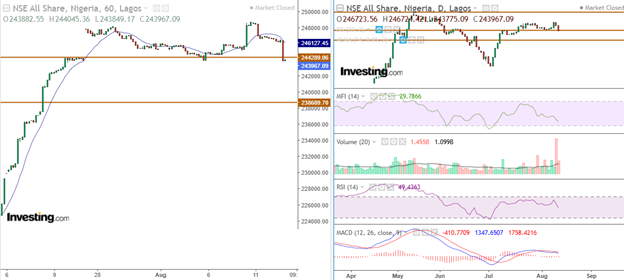
From a technical perspective, the ASI remains in a short-term corrective phase. The benchmark has struggled to regain the momentum recorded during its earlier advance, with selling pressure becoming more visible around higher levels.
The 243,000 region has emerged as an important near-term support zone. A sustained break below this level could signal that sellers are gaining stronger control and potentially expose the index to further downside.
On the upside, the 244,000 area represents an immediate level that the market would need to reclaim to improve the short-term technical outlook. A move above this level accompanied by stronger volume and improved breadth would strengthen the possibility of a recovery.
The relationship between price movement and volume will also be important. If the index declines while turnover remains moderate, the move could continue to represent ordinary profit-taking. However, a sharp decline accompanied by significantly higher volume would suggest stronger distribution and could indicate a deeper correction.
Market breadth will remain another important confirmation signal. A sustained improvement in the number of advancing stocks would strengthen the recovery case, particularly if major banking, consumer and industrial counters begin to participate.
The short-term outlook for the NGX remains cautious to mildly bearish, although the current decline should be viewed within the context of the market’s broader performance.
Investors are likely to remain selective as they balance the potential for further gains against the risk of giving back accumulated profits. This could result in increased rotation between sectors and individual stocks rather than a uniform market direction.
Corporate earnings and company-specific developments could therefore become more important in determining individual stock performance. Companies with resilient earnings, strong balance sheets and attractive valuations may continue to attract demand even as the broader index consolidates.
Macroeconomic developments will also remain important. Interest-rate expectations, inflation, foreign exchange conditions, liquidity and crude oil prices could all influence investor positioning in the coming sessions.
A recovery in market breadth, stronger turnover and renewed buying in heavyweight stocks would improve the outlook and provide evidence that the correction is losing momentum. Conversely, continued weakness in large-cap counters combined with a sustained deterioration in breadth could push the index lower.
For now, investors may continue to favour a measured approach, focusing on fundamentally strong counters while monitoring key technical levels before increasing exposure.
Stock Performance
Despite the broader weakness, several stocks recorded strong gains during the session. INTENEGINS emerged as the best-performing stock, advancing 10.00% to ₦4.84. JOHNHOLT followed closely with a 9.89% gain to ₦10.00, while TRANSEXPR rose 9.75% to ₦2.59.
NEM gained 6.25% to close at ₦34.00, while NEIMETH advanced 6.21% to ₦8.55. The performance of these stocks highlights the continued presence of selective buying interest despite the broader market decline.
On the downside, UNILEVER recorded the steepest loss, falling 9.97% to ₦118.30. CHELLARAM declined 9.66% to ₦10.75, while MCNICHOLS lost 9.65% to close at ₦5.15.
DAARCOMM fell 9.25% to ₦1.57, while CORNERST declined 9.09% to ₦5.00. The sharp declines recorded by several stocks contributed to the weak market breadth and reinforced the prevailing cautious tone.
Overall, Thursday’s session points to a market undergoing consolidation after an extended period of strong appreciation. Profit-taking, weak breadth and pressure on selected heavyweight stocks remain the immediate challenges, although the presence of strong individual gainers indicates that investors continue to identify opportunities beneath the broader market weakness.
The coming sessions will be important in determining whether the current movement develops into a deeper correction or remains a temporary pause within the broader upward trend. A defence of the 243,000 support region, accompanied by improving breadth and stronger turnover, would provide a more constructive signal. However, a decisive break below support could increase downside risk and encourage further profit-taking.
The ASI closed at 243,407.46, down 0.23%, while market capitalisation declined by ₦361.27 billion to ₦157.13 trillion. Total transaction value stood at ₦18.34 billion, with 396.57 million shares traded in 39,511 deals. Overall market performance remained bearish, with 40 decliners against 18 gainers and three unchanged stocks. CHAMS led market movers by volume with 28.35 million shares, while FIRSTHOLDCO recorded the highest traded value. Top gainers were INTENEGINS (+10.00%) to ₦4.84, JOHNHOLT (+9.89%) to ₦10.00, TRANSEXPR (+9.75%) to ₦2.59, NEM (+6.25%) to ₦34.00 and NEIMETH (+6.21%) to ₦8.55. Top losers were UNILEVER (-9.97%) to ₦118.30, CHELLARAM (-9.66%) to ₦10.75, MCNICHOLS (-9.65%) to ₦5.15, DAARCOMM (-9.25%) to ₦1.57 and CORNERST (-9.09%) to ₦5.00.