
The Nigerian Exchange (NGX) maintained its positive momentum in the week ended September 25, 2026, with the All-Share Index (ASI) rising 0.92% to 252,113.41 points, from 249,804.56 points in the previous week. Market capitalisation increased to ₦163.66 trillion, while the year-to-date market return reached 62.01%. The market recorded gains in the first four sessions before a marginal decline on Friday as investors took profits.
Investor sentiment during the week was also supported by Nigeria’s reclassification to FTSE Russell Frontier Market status, effective September 21 with 30 Nigerian quoted companies placed within the FTSE Frontier Index Series. This expectedly increased the market’s visibility among international investors.
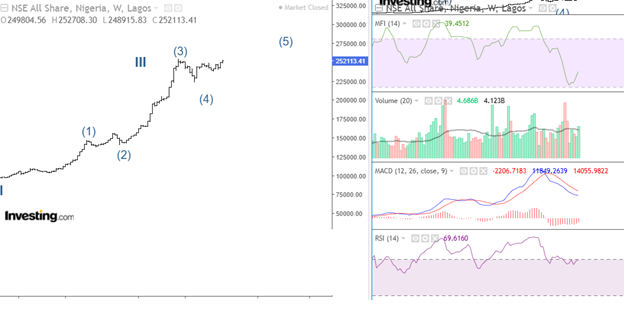
Overall, the week reflected sustained buying interests across key sectors, although momentum moderated toward the close. The ASI’s ability to remain above the 250,000-point level keeps the level as an important technical reference, while 252,150 points represents the immediate resistance area. Friday’s marginal decline, alongside higher turnover and positive market breadth, pointed to profit-taking rather than a broad-based reversal in market sentiment.
Week-to-date, the All-Share Index gained 0.92%, the NGX 30 is up by 2.86%, the Banking Index has increased by 3.06%, the Pension Index increased by 1.66%, the Insurance Index declined by 0.52%, the Consumer Goods Index increased by 2.47%. However, the Oil and Gas Index recorded a positive return of 3.49%. Year-to-date, the All-Share Index has gained 62.01%, NGX 30 is up by 62.12%, the Banking Index has increased by 74.22%, the Pension Index increased by 84.63%, the Insurance Index declined by 7.57%, the Consumer Goods Index increase by 2.36%. However, the Oil and Gas Index recorded a positive return of 125.94%.
Below is NGXASI Daily Index Action:
The week opened with a 0.14% gain on Monday, as the ASI crossed the 250,000-point level. Trading volume stood at 574.12 million shares, while 68,506 deals worth ₦38.04 billion were recorded. Market breadth was positive, with 39 gainers against 25 decliners, supported by activity across banking, consumer goods, industrial goods and insurance stocks.
On Tuesday, the index added 0.18% to 250,614.66 points, as 837.26 million shares were traded in 52,126 deals valued at about ₦48.57 billion. Wednesday extended the advance, with the ASI gaining 0.23% to 251,191.02 points. Trading volume surged to 1.59 billion shares, while turnover stood at ₦45.82 billion. Market breadth improved to 43 gainers against 20 decliners, with Eterna among the leading gainers.
Thursday recorded the strongest daily gain of the week, with the ASI advancing 0.38% to 252,149.78 points. About 978.29 million shares changed hands in 48,558 deals valued at ₦50.16 billion. Market breadth narrowed to 28 gainers and 24 decliners, while Critical Minerals Financing Corp led the gainers with a 10% increase.
Friday brought some profit-taking after the extended rally. The ASI declined marginally by 0.01% to 252,113.41 points, while market capitalisation slipped to ₦163.66 trillion. Trading value, however, increased 16.31% to ₦58.35 billion, although volume fell to 708.85 million shares. A total of 42,496 deals were recorded, with 38 gainers, 27 decliners and 81 unchanged stocks. Zichis gained 10% to lead the gainers, while TotalEnergies declined 10%.
Critical Minerals Financing Corp Plc
The week’s top gainers were led by Critical Minerals Financing Corp, which rose 59.80% to ₦3.26, followed by Thomas Wyatt Nigeria, up 28.26% to ₦2.95, UPDC, which gained 24.19% to ₦3.85, Omatek Ventures, up 23.33% to ₦1.48, and Fortis Global Insurance, which advanced 21.21% to ₦2.00.
Haldane McCall Plc
On the other hand, Haldane McCall led the losers, falling 16.67% to ₦3.00, followed by Champion Breweries, down 11.87% to ₦9.65, TotalEnergies Marketing Nigeria, which declined 10.00% to ₦518.40, Okomu Oil Palm, down 10.00% to ₦1,276.20, and Multiverse Mining & Exploration, which fell 9.86% to ₦19.20.
NGX Weekly Comparative Analysis
The NGX remained bullish, but momentum slowed in the week ended September 25. The ASI gained 0.92% to 252,113.41 points, compared with 2.78% to 249,804.56 points the previous week. Market capitalisation rose to ₦163.66tn from ₦162.157tn, while YTD return increased to 62.01% from 60.53%.
Trading volume increased to about 4.69bn shares from 3.249bn, while turnover stood at about ₦240.94bn, slightly above ₦237.986bn. Deals, however, declined to about 253,686 from 287,919.
The latest week recorded gains in the first four sessions before a 0.01% decline on Friday, unlike the previous week when the market gained in all five sessions, including a 1.42% Friday jump. Market breadth remained positive, while the previous week recorded 52 gainers, 32 decliners and 63 unchanged stocks.
Financial Services dominated the previous week’s activity, accounting for 2.581bn shares, 79.43% of turnover volume and ₦97.212bn in value. Fidelity Bank, Sterling Financial Holdings and Mutual Benefits Assurance jointly accounted for 1.229bn shares, or 37.83% of total volume.
Overall, the latest week showed slower price growth but higher trading volume, with the ASI holding above the 250,000-point level. The 252,150-point area remains an immediate resistance level, while 250,000 points remains an important support/reference level.
Technical Analysis View
The NGX All-Share Index closed the week at 252,113.41 points, gaining 0.92% after reaching an intraday high of about 252,150 points. The index remains in a strong short-term uptrend, supported by four consecutive daily gains before Friday’s marginal pullback.
Momentum remains positive, although the market is approaching an important resistance zone around 252,000–254,250 points. The Relative Strength Index (RSI) is around 70, indicating strong momentum and suggesting that the market is approaching an overbought region. This could increase the possibility of short-term profit-taking or consolidation. The 250,000-point level has emerged as an important psychological support after the index successfully moved above it during the week. Holding above this level would preserve the current bullish structure, while a break below it could expose the index to further consolidation around the 244,000–245,000-point region.
Market Outlook
The near-term outlook remains bullish but cautious. A decisive break above the 252,150–254,250 resistance zone, accompanied by stronger trading volume and broader participation, could create room for the index to advance towards the 260,000-point region.
However, failure to break the resistance zone could encourage profit-taking following the market’s strong year-to-date performance. Friday’s marginal decline, despite turnover rising to ₦58.35 billion and market breadth remaining positive at 38 gainers against 27 decliners, suggests that selling pressure was relatively contained. Overall, 250,000 points remains the key support level, while 252,150–254,250 points represents the immediate resistance zone. The market’s ability to break and sustain levels above this resistance will be important in determining whether the current rally extends further or enters a period of consolidation.
Trending in the Economy: Nigeria’s manufactured goods imports rose 16.9% year-on-year to ₦17.99 trillion in H1 2026, from ₦15.4 trillion a year earlier, according to NBS data. Q2 imports also increased 12.1% quarter-on-quarter to ₦9.51 trillion, highlighting continued import dependence and pressure on local manufacturers. The Manufacturers Association of Nigeria (MAN) said high financing and production costs remain major challenges, calling for stronger support for local producers and measures to curb unfair import competition.
Meanwhile, the CBN cut the Monetary Policy Rate by 350 basis points to 23% at its September 21–22 meeting, citing easing inflationary pressures. The Standing Facilities Corridor was adjusted to +50/-300 basis points, while CRR was retained at 45% for deposit money banks, 16% for merchant banks and 75% for non-TSA public-sector deposits. The new MPR remains 7.61 percentage points above the August inflation rate of 15.39%.
Global Market and Oil: Wall Street closed higher on Friday, with technology and artificial-intelligence stocks leading the advance as investors weighed strong corporate activity against higher Treasury yields, geopolitical uncertainty and elevated oil prices.
Microsoft was among the biggest drivers of the session, rising 3.7% after introducing new capabilities for its Copilot platform, including a coding tool and an always-on artificial-intelligence agent. The gain lifted Microsoft’s 2026 performance to about 7%.
Other technology stocks also advanced. Qualcomm gained 4%, while Dell Technologies rose 5%. Akamai Technologies added 3.2% after announcing an $11.6 billion cloud-services agreement with Anthropic, an AI company. The transaction also includes a warrant that could give Anthropic a stake of up to 5% in Akamai. The strength in AI-related shares helped offset weakness in some other major technology names. Meta Platforms declined 3.3%, although the stock remained one of the week’s stronger performers, gaining about 13% following positive reception to its Muse AI agent. Analysts have linked the growth in AI applications to increased demand for technology infrastructure, while also raising questions about the potential impact of AI on traditional businesses such as banking, online commerce and other consumer-facing industries.
The S&P 500 rose 0.51% to 7,743.41 points, while the Nasdaq Composite gained 0.48% to 27,068.72 points. The Dow Jones Industrial Average advanced 0.93% to 51,828.62 points. Seven of the 11 major S&P 500 sector indexes finished higher. Information technology led the advance with a 0.91% gain, followed by industrials, which rose 0.60%. The broader market also recorded gains for the week, with the S&P 500 up 1.2% and the Nasdaq advancing 2%. The Nasdaq had reached a record closing level on Tuesday.
Despite the weekly gains, investors remained focused on valuation concerns surrounding artificial-intelligence companies and the broader implications of rapid AI investment. The S&P 500 traded at just under 19 times expected earnings, its lowest valuation since 2023, according to LSEG data. AI-related heavyweight companies have accounted for a significant portion of the recent improvement in earnings expectations.
Geopolitical developments also influenced trading. Reports that US and Iranian negotiators were continuing discussions over a possible phased route out of the conflict helped improve sentiment. Any agreement could potentially involve Tehran reopening the Strait of Hormuz, a key route for global energy shipments, while Washington could ease its economic blockade.
Economic data provided another source of support for equities. August figures showed that strong investment in artificial-intelligence infrastructure helped boost demand for key manufactured capital goods, with growth exceeding economists’ expectations. The figures reinforced expectations that AI spending continues to support parts of the broader US economy. However, the bond market remained a major source of concern. The yield on the benchmark 10-year US Treasury note reached a fresh 19-year high, before ending 3.4 basis points higher at 5.196%. Rising Treasury yields can increase borrowing costs for companies and consumers while also affecting the relative attractiveness of equities.
Expectations for US monetary policy also shifted during the week. Traders were pricing a 66% probability of at least a 25-basis-point Federal Reserve rate increase in October, according to CME Group’s FedWatch Tool, compared with roughly 50% earlier in the week. The changing rate outlook added to the pressure on investors to reassess the value of high-growth stocks.
Developments in US-China relations also remained on the radar. US President Donald Trump described his meeting with Chinese President Xi Jinping as “very productive” following a three-day summit. The meeting highlighted personal diplomacy between the two leaders, although it did not produce major breakthroughs in broader economic relations.
Outside the technology sector, People Inc. surged 11% after reports that MGM Resorts International was considering a bid for the magazine publisher. The move showed that corporate deal activity remained another source of support for individual stocks despite broader market uncertainty.
Trading activity on US exchanges was relatively subdued. About 14.9 billion shares changed hands, below the 16.8 billion-share average recorded over the previous 20 trading sessions. Market breadth remained positive, with advancing stocks in the S&P 500 outnumbering declining stocks by a 1.9-to-1 ratio.
Despite the overall rise in the major indexes, the market continued to register a significant number of stocks making fresh lows. The S&P 500 recorded three new highs and 31 new lows, while the Nasdaq recorded 54 new highs and 175 new lows, highlighting the uneven performance beneath the headline index gains.
In the oil market, crude prices declined on Friday as investors weighed diplomatic developments involving the US and Iran against continuing concerns over Middle East supply disruptions. Brent crude fell $2.28, or 2.1%, to settle at $104.32 a barrel, while West Texas Intermediate declined $2.20, or 2.3%, to $92.41 a barrel. Brent remained above the $100-a-barrel level and gained less than 1% for the week, while WTI fell about 8%. The difference between Brent and WTI widened to approximately $11.91 a barrel, reflecting continued uncertainty over global supply and regional geopolitical risks.