
Regency Alliance Insurance Plc is a Nigerian insurance company incorporated on 16 June 1993 and headquartered in Lagos. It operates in the non-life insurance market, serving individual customers, businesses, corporate organisations and institutional clients.
The company’s stated mission is to create wealth for stakeholders and mitigate risks associated with it. Its stated competitive approach emphasises customer service, professional conduct and customer retention.
Current price: N0.82
Rating: Buy
Price projection: N1.30 and N2
Technical Analysis
In this report, we shall use the following tools and analysis methods:
Elliott’s wave theory to understand the overall market sentiment
Fibonacci tools to determine support and resistance levels
The Relative Strength Index and volume to evaluate the market’s strength
The Money Flow Index to determine the market liquidity
Moving average and MACD to understand the nature of the trend
Top-down analysis to know the best investment position
Elliott wave analysis
Weekly chart: Market overview
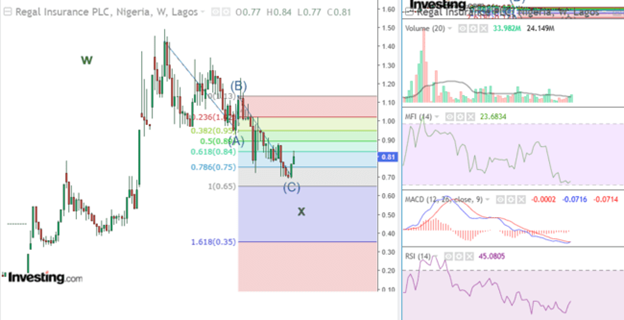
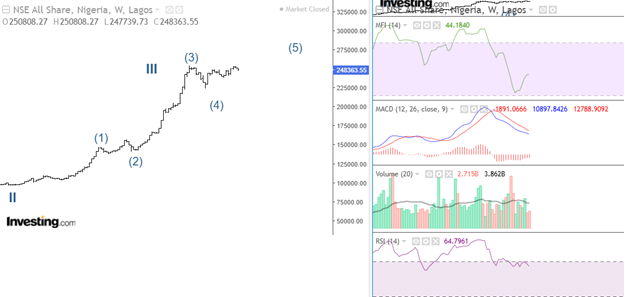
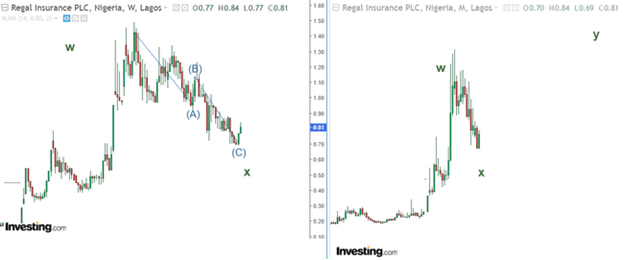
Regal Insurance experienced a 3-3-3 deep corrective phase. In line with this performance, the stock retrace to the 1.0 Fibonacci level in Wave C of the intermediate cycle. This level acted as a support, initiating the stock’s recovery phase. Due to this sentiment, the stock’s liquidity and momentum gradually improved. Also, its volume remained strongly bullish, weakening MACD’s bearish momentum.
Daily chart: Trading opportunity
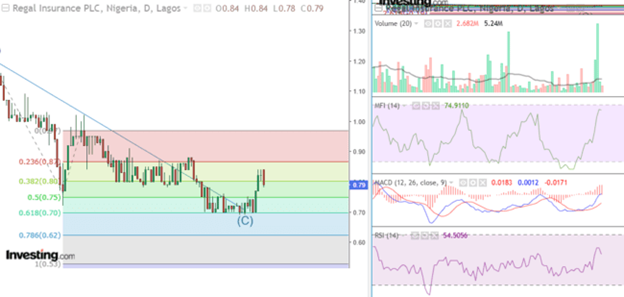
On the daily chart, Regal saw strong bullish momentum. This performance signals a potential market reversal. Thus, investing at a discount is viable. The stock’s volume, liquidity, and momentum remained strong, attracting investment opportunities. Traders should watch N0.70 and 0.60 as potential support levels with prices projected at N1.30 and N2
SWOT Analysis
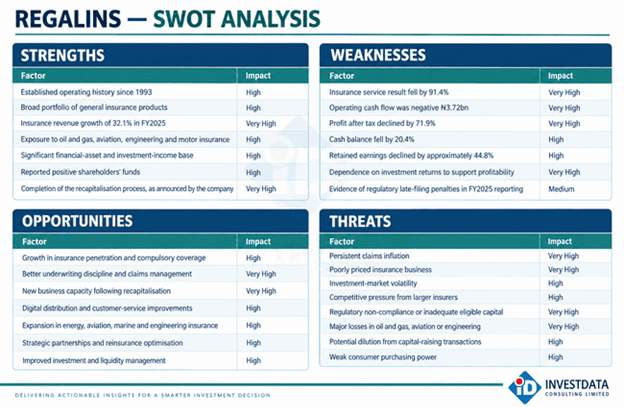
Regency Alliance Insurance Plc combines an established operating history, a broad general-insurance portfolio and growing insurance revenue with significant weaknesses in underwriting profitability, earnings quality and operating cash flow.
Its successful recapitalisation milestone provides an important opportunity to strengthen the business and pursue larger risks, but the long-term benefits will depend on disciplined capital allocation, effective claims management and improved underwriting margins.
For investors, the principal attraction is the potential for a turnaround, while the major concern is that stronger revenue and capital may not translate into sustainable earnings growth. The stock’s investment appeal will improve materially if subsequent results demonstrate stronger insurance service profits, better cash conversion and stable per-share fundamentals.