

For the second consecutive year since it started paying interim dividends to shareholders at the end of the 2015 half-year, Access Holding Company Plc (AccessCorp), a fortnight ago on November 2, 2026, announced that its “board did not propose any interim dividend for the period ended 30 June 2026.” Unlike this year, the directors initially proposed a ₦1.00 interim dividend per share, but did not receive the required regulatory nod from the Central Bank of Nigeria (CBN). The Group Managing Director, Innocent Ike, blamed this on compliance requirements under Section 7.1 of the CBN Guidelines for Financial Holding Companies, which was subsequently taken care of through a private placement.
Our correspondent recalls that the group has until last year paid interim dividend consistently since proposing it for the first time at the end of September 2015.
The board’s regulatory induced decision to step down on interim dividend payment, was to allow for some housekeeping that would bring about better stakeholder value creation in the medium to long-term, given its systemic importance in the Nigerian financial services industry.
Today, among retail and institutional investors, the single biggest driver of share price movement on the Nigerian equity market remains how faithfully a company rewards investors, a situation that has constrained the valuation of Accesscorp in recent times.
It is worthy of note that the decision by the bank to stop interim dividend payment followed the Central Bank of Nigeria (CBN) decision to enforce Section 19(8)(c) of the Banks and Other Financial Institutions Act (BOFIA), which limits a bank’s equity investments in its offshore subsidiaries to a cumulative 10% of shareholders’ funds.
AccessCorp is therefore expected to cut its exposure by as much as ₦215 billion in excess offshore capital off from the total ₦446.6 billion (19.29% of shareholders’ funds). The cut back is programmed to affect six under-performing subsidiaries, including the divestment of a 7.44% stake in its Ghanaian unit, and the proceeds ploughed back into the domestic operations, which in the process turns compliance into an active value-creation booster for the group.
The group has assured that compliance with the CBN directive will happen two months ahead of the March 2027 deadline, thereby removing the primary restriction that halted dividend payment, positioning AccessCorp to resume sustainable cash distributions.
Numbers As Proof
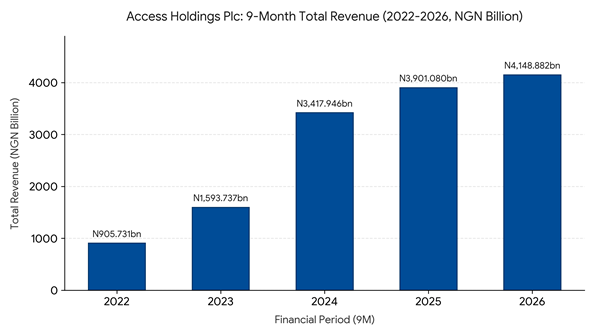
Analysts believe that the proof that the group’s has always had capacity for cash distribution is evident in its nine-month outing as shown in the total revenue of ₦4.148 trillion in, compared to ₦3.901 trillion in the corresponding period of last year. Profit before tax for the period jumped to ₦667.364 billion from ₦616.248 billion, while Profit After Tax closed at ₦474.168 billion from ₦447.548 billion, despite the 14.52 percent rise in income tax for the period.
The numbers also showed that the Nigerian operations continue to account for a significant portion of revenue/interest income and profit. For example, in the first three quarters of this year, its Nigerian business contributed a princely ₦3.096 trillion of total revenue, up from ₦2.688 trillion, while all of the African operation pooled ₦760.889 billion, down from ₦1.108 trillion in the similar period of 2025; while the international operations garnered ₦461.917 billion, compared to ₦395.09 billion.
As Aigboje Aig-Imoukhuede, who led the transformation team that laid the foundation for what is today AccessCorp, recently assured shareholders: for the group, “the era of growth for growth’s sake is over.”
For him, rather than pursuing asset volume, the Group is now refocused on sweating existing infrastructure, reallocating capital into higher-yielding risk assets, and scaling capital-light non-banking verticals to extract juicier value for stakeholders, particularly investors from an entity that has grown into a pan-African financial powerhouse with flags hoisted across key African markets and international financial hubs.
AccessCorp is today, Nigeria’s largest financial services holding company measured by a total asset valued at ₦55.24 trillion, compared to the ₦51.708 trillion (restated) as of December 31, 2025. This is huge, when compared to the ₦34.387 trillion and ₦32.195 trillion reported by its two closest rivals in the period under review.
AccessCorp’s Net loans and advances leaped by 7.4% to ₦14.33 trillion, supported by the ₦6.53 trillion in cash and cash equivalents and a clean loan book following the group’s full exit from the CBN regulatory forbearance exposures in 2025. One after effect of the bank’s exit from the forbearance was the significant 73.5 percent drop in impairment charges year-on-year in the period under review to ₦92.9 billion from ₦349.985 billion in the similar period of last year. Net interest income after impairment, therefore, jumped by 32.1% to ₦1.20 trillion from ₦907.954 billion in 2025.
- Customer deposits improved by 6.6% to ₦36.85 trillion, riding on the back of the group’s low-cost funds mobilized across its extensive retail and digital network that has given it funding advantage that helps moderate net interest margins amid the prevailing high benchmark interest rates.
AccessCorp is also optimizing shareholder value proposition through its non-operating holding company structure by aggressively scaling non-banking subsidiaries that generate high-margin fee income. For example, there is Access ARM Pensions over ₦4.6 trillion in Assets Under Management (AUM), delivering huge value and annuity-style fee revenue; just as the payment and digital lending platforms like ydrogen Payments and Oxygen X Finance tapping into Africa’s expanding digital transaction volumes, while creating scalable earnings streams that require a fraction of the capital intensity of traditional corporate lending.
As shown below, according to numbers tracked by Investdata News, over the past five years, AccessCorp’s 9-month total revenue surged more than fourfold from ₦905.73 billion in 2022 to ₦4.15 trillion in 2026, while Profit After Tax attributable to parent equity holders held resilient at ₦422.73 billion.
Source: Access Holdings Plc 9M 2026 Unaudited Financial Statements, NGX Market Data (November 2026), and analyst computations.
As part of ensuring a disciplined compliance with the CBN directive, and offer sustainable returns on investment, the group hopes to completely exit markets that drag down its profitability by January, by restructuring its international footprint under an intermediate holding company framework.
These numbers are the obvious outcomes of management’s decision to move firmly into its “Scale-to-Value” phase, by ensuring the extraction of better value from the balance sheet, accelerating regulatory compliance, and scaling capital-light revenue engines to unlock durable, long-term shareholder returns, since it is no longer chasing size.
Last lines
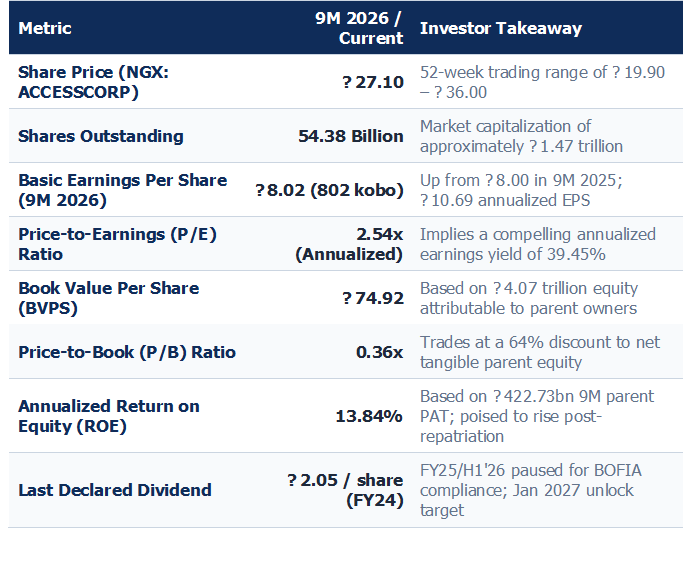
Trading at roughly 0.36x Book Value Per Share (BVPS) and under 3.0x annualized earnings, AccessCorp’s market valuation reflects a substantial discount to its underlying net assets. The stock, therefore, offers substantial re-rating potential once dividend payouts resume as envisaged by the board and management. However, only investors and shareholders who can trust the group enough to deliver on these promise by staying on board will share in the promised bounty.