
Linkage Assurance Plc is a Nigerian non-life insurance company listed on the NGX’s Main Board. It was incorporated in 1991, began operations in 1994, and was listed in 2003. Its business covers motor, fire, marine, aviation, engineering, oil & gas, agriculture, bonds, and general accident insurance.
Current price: N1.60
Rating: Buy
Price projection: N2, N3, and N3.5
Technical Analysis
In this report, we shall use the following tools and analysis methods:
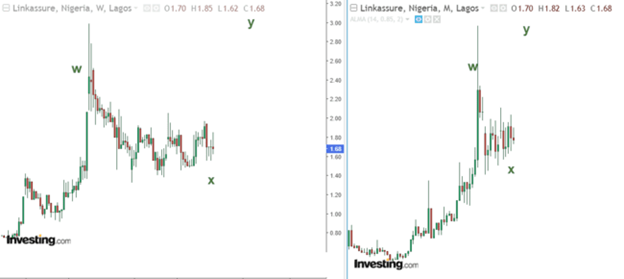
Elliott’s wave theory to understand the overall market sentiment
Fibonacci tools to determine support and resistance levels
The Relative Strength Index and volume to evaluate the market’s strength
The Money Flow Index to determine the market liquidity
Moving average and MACD to understand the nature of the trend
Top-down analysis to know the best investment position
Elliott wave analysis
Weekly chart: Market overview
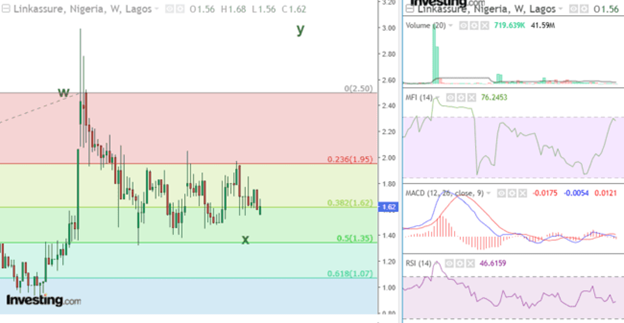
LINKASS retraced to the 0.5 Fibonacci level and attempted recovery on the weekly chart. In line with this performance, liquidity and momentum remained solid amid low volume. Notably, MACD sustained its bearish divergence signal, which prepares investors for a trend reversal. In other words, investors should use this indication to buy into value.
Daily chart: Trading opportunity
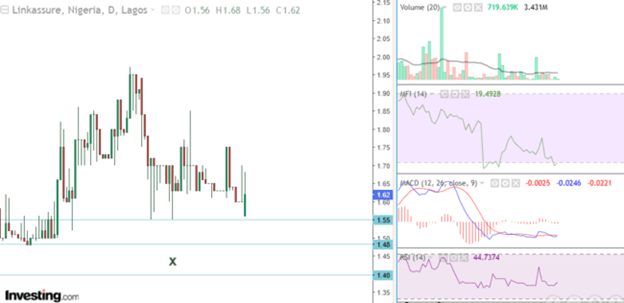
On the daily chart, Linkage consolidated after a sharp pullback. This performance should prepare traders for a trend reversal. In line with this sentiment, the stock’s liquidity, momentum and volume also improved. This indication signifies renewed investor interest.
Thus, traders should watch N1.60, N1.55, N1.48, and N1.40 as potential support levels, with prices projected at N2, N3, and N3.5. Investors can also use these support levels to buy in stages as the stock remains strongly bearish.
SWOT Analysis
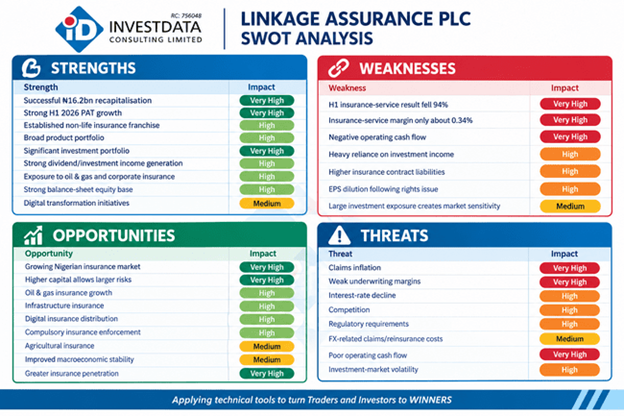
Linkage Assurance enters the post-recapitalization era with a significantly stronger capital base, a diversified non-life insurance portfolio, and exposure to a Nigerian insurance market that is expanding rapidly. Its N16.2bn fully subscribed rights issue removes a major regulatory capital constraint and provides the capacity to pursue larger and more profitable risks.