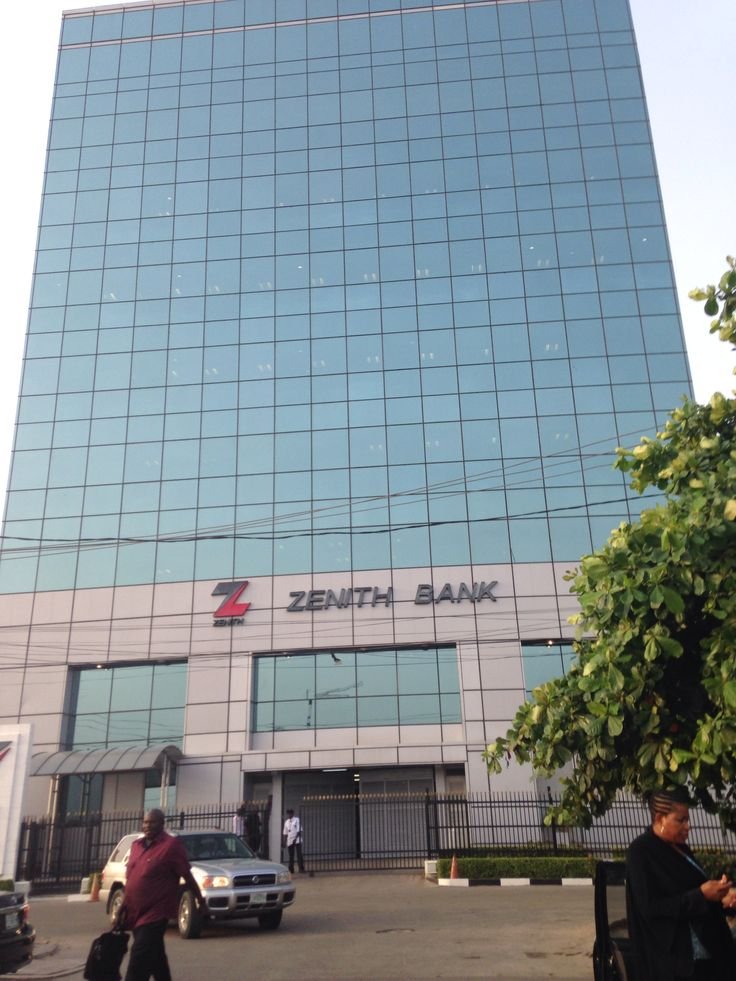


UBA Headquarters building
Period Under Review: 3rd Quarter 2026
Current Share Price: N39.00
Price At Release Date: N38.25
Latest Final Dividend:
Latest Interim Dividend: N
Estimated Beta Value: 0.38x
Estimated Intrinsic Value: N65.80
Rating: BUY
Analyst: Jeariogbe Tunde Segun
The Company
United Bank for Africa Plc is one of Nigeria’s oldest and leading financial institutions with a banking history dating back to 1949, when the British and French Bank Limited (BFB) commenced operations in Nigeria with its first office in Lagos. On February 23, 1961, UBA was incorporated as a limited liability company, taking over the assets and liabilities of BFB. The bank achieved another major milestone in 1970 when it became the first Nigerian bank to undertake an Initial Public Offering (IPO) and list its shares on the Nigerian Stock Exchange (now Nigerian Exchange Limited (NGX).
A significant turning point in the bank’s development occurred in 2005 when it merged with Standard Trust Bank Plc and thereafter acquired Continental Trust Bank Limited, strengthening its capital base, operational capacity and competitive position in the Nigerian banking industry. Following the merger, UBA embarked on an aggressive pan-African expansion strategy, establishing operations across several African countries while extending its international presence to key financial centres, including the United Kingdom, the United States, France and the United Arab Emirates.
Today, UBA has evolved into a major pan-African banking and financial services group, providing retail, commercial and corporate banking, trade finance, treasury, international banking and digital financial services. Headquartered in Lagos, the bank serves individuals, businesses, governments and institutions across Africa and beyond. Its commitment to technological innovation, customer service and cross-border financial transactions has strengthened its position as one of Africa’s prominent banking groups.
Financial Income Analysis
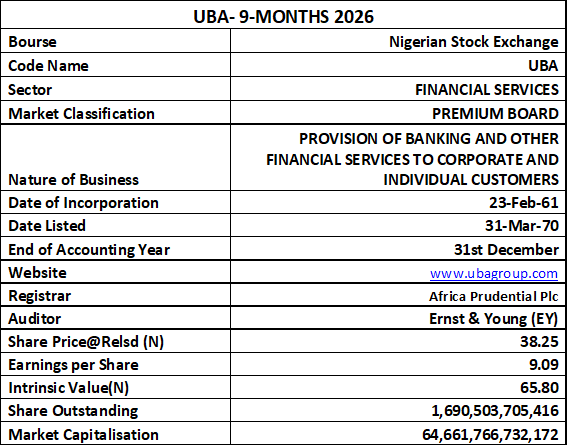
UBA Plc recorded a modest growth in gross earnings for the nine months ended September 30, 2026, rising by 2.83% to ₦2.54 trillion from ₦2.47 trillion in the corresponding period of 2025. Interest income declined by 2.52% to ₦1.93 trillion from ₦1.98 trillion, while interest expenses reduced by 9.90% to ₦738.98 billion from ₦820.22 billion. The stronger decline in interest expenses helped improve net interest income by 2.70% to ₦1.19 trillion, compared with ₦1.16 trillion in the previous year, reflecting some improvement in the bank’s interest margin performance.
Operating expenses increased by 5.87% to ₦847.64 billion from ₦800.65 billion, while depreciation rose slightly by 2.62% to ₦46.69 billion from ₦45.50 billion. Consequently, profit before tax declined by 13.07% to ₦502.98 billion from ₦578.60 billion in the corresponding period of 2025. This performance indicates that the growth in net interest income was insufficient to offset the impact of higher operating expenses and other cost pressures on the bank’s earnings.
However, profit after tax fell significantly by 25.29% to ₦401.60 billion from ₦537.53 billion, despite the increase in tax expense to ₦101.37 billion from ₦41.07 billion, representing a 146.82% rise. Total comprehensive income also declined sharply by 80.04% to ₦149.86 billion from ₦750.83 billion. Overall, UBA maintained modest growth in gross earnings and net interest income, but the significant decline in profit before and after tax, alongside the sharp contraction in total comprehensive income, reflects weaker bottom-line performance during the period.
Financial Position Analysis
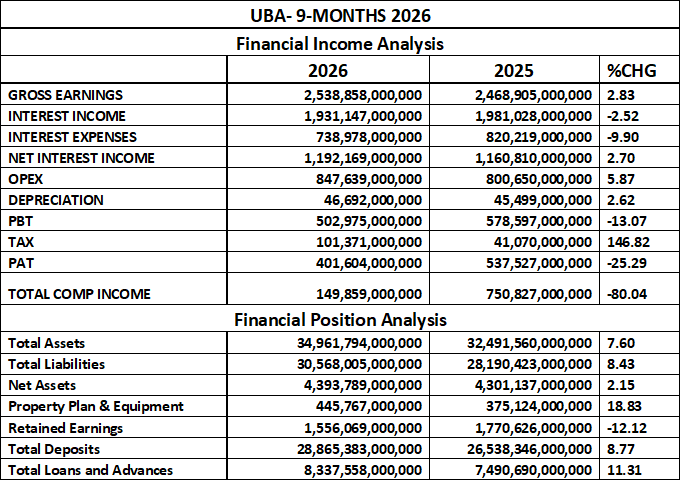
UBA Plc recorded a 7.60% growth in total assets to ₦34.96 trillion as at September 30, 2026, compared with ₦32.49 trillion in the corresponding period of 2025. Total liabilities also increased by 8.43% to ₦30.57 trillion from ₦28.19 trillion, while net assets grew marginally by 2.15% to ₦4.39 trillion from ₦4.30 trillion. Property, Plant and Equipment (PPE) increased by 18.83% to ₦445.77 billion from ₦375.12 billion, indicating an expansion in the bank’s investment in fixed assets. However, retained earnings declined by 12.12% to ₦1.56 trillion from ₦1.77 trillion, reflecting pressure on accumulated earnings during the period.
On the funding and lending side, total deposits increased by 8.77% to ₦28.87 trillion from ₦26.54 trillion, demonstrating continued growth in the bank’s deposit base. Similarly, total loans and advances rose by 11.31% to ₦8.34 trillion from ₦7.49 trillion, indicating an expansion in credit creation and lending activities. Overall, UBA maintained growth in its asset base, deposits and loan portfolio, although the faster growth in liabilities relative to net assets and the decline in retained earnings suggest some moderation in balance-sheet strength.
Financial Strength/Solvency Ratios
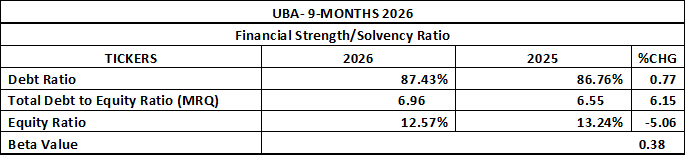
UBA Plc’s financial strength and solvency ratios for the nine months ended 30th September 2026 indicate a slight increase in leverage, with the debt ratio rising marginally by 0.77% to 87.43% from 86.76% in the corresponding period of 2025. Similarly, the total debt-to-equity ratio increased by 6.15% to 6.96x from 6.55x, indicating a higher level of debt relative to shareholders’ equity. The equity ratio declined by 5.06% to 12.57% from 13.24%, suggesting a slight moderation in the proportion of assets financed by shareholders’ funds.
Meanwhile, the bank’s beta value stood at 0.38, indicating relatively low share-price sensitivity to broader market movements. Overall, the ratios reflect a highly leveraged balance sheet, although the relatively low beta suggests lower market-related volatility compared with the general market.
Profitability Ratios
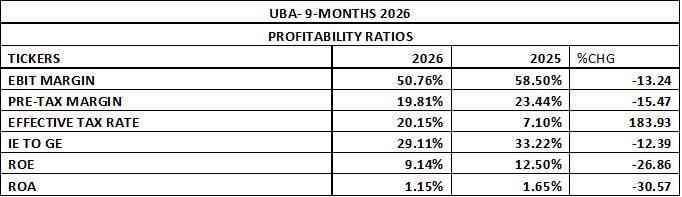
UBA Plc’s profitability ratios for the nine months ended 30th September 2026 indicate a moderation in operating and earnings performance compared with the corresponding period of 2025. EBIT margin declined by 13.24% to 50.76% from 58.50%, while pre-tax margin fell by 15.47% to 19.81% from 23.44%, reflecting reduced profitability relative to revenue. The effective tax rate increased significantly by 183.93% to 20.15% from 7.10%, indicating a higher tax burden on earnings. Similarly, interest expenses to gross earnings (IE to GE) declined by 12.39% to 29.11% from 33.22%, suggesting a reduction in the proportion of gross earnings absorbed by interest expenses.
Furthermore, return on equity (ROE) declined by 26.86% to 9.14% from 12.50%, while return on assets (ROA) dropped by 30.57% to 1.15% from 1.65%, indicating weaker returns generated from shareholders’ funds and total assets. The decline in both ratios reflects reduced earnings efficiency and a moderation in the bank’s overall profitability during the period. Overall, UBA’s profitability weakened across the major performance indicators, with lower operating margins and returns highlighting the pressure on earnings generation in the nine months under review.
Efficiency Ratios
UBA Plc’s efficiency ratios for the nine months ended September 30, 2026 reflect mixed operational performance compared with the corresponding period of 2025. Operating expenses to gross earnings (OPEX to GE) increased to 33.39% from 32.43%, indicating that a higher proportion of gross earnings was absorbed by operating costs, suggesting some deterioration in cost efficiency. Similarly, gross earnings to total assets (GE to TA) declined to 7.26% from 7.60%, reflecting a slight reduction in the bank’s ability to generate income from its asset base. Meanwhile, the loan-to-deposit ratio (LDR) increased to 28.88% from 28.23%, indicating a modest expansion in lending relative to customer deposits. Overall, UBA’s efficiency performance was mixed, with rising operating cost absorption and weaker asset income generation, although the increase in its loan-to-deposit ratio reflects improved deployment of deposit funds towards lending activities.

Investment/Valuation Ratios
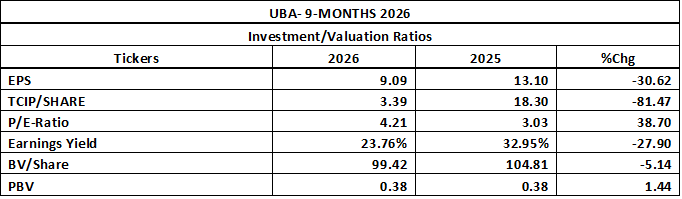
UBA Plc’s investment and valuation ratios for the nine months ended September 30, 2026 indicate a decline in earnings performance compared with the corresponding period of 2025. Earnings per share (EPS) fell by 30.62% to ₦9.09 from ₦13.10, while total comprehensive income per share (TCIP/Share) declined significantly by 81.47% to ₦3.39 from ₦18.30. The price-to-earnings (P/E) ratio increased by 38.70% to 4.21x from 3.03x, reflecting a higher valuation multiple despite the decline in earnings. Similarly, earnings yield dropped by 27.90% to 23.76% from 32.95%, indicating a reduction in earnings return relative to the share price.
Furthermore, the book value per share (BVPS) declined by 5.14% to ₦99.42 each from ₦104.81, while the price-to-book value (PBV) ratio remained relatively stable at 0.38x, compared with 0.38x in the previous year, representing a marginal increase of 1.44%. The low PBV suggests that the shares are trading at a significant discount to their estimated book value. Overall, UBA’s valuation ratios indicate relatively low market pricing against its book value and earnings, but the decline in EPS, comprehensive income per share and earnings yield highlights weakening shareholder earnings performance during the period.
Performance Review/Valuation
UBA’s valuation remains attractive with a P/E of 4.21x and PBV of 0.38x, indicating that the shares trade at a considerable discount to their earnings and book value. Nevertheless, the 30.62% decline in EPS, 25.29% reduction in profit after tax and declining returns on equity and assets are important concerns. The bank’s earnings recovery and ability to improve profitability will be critical to sustaining shareholder value. We have estimated the intrinsic value at N65.80
Final Verdict
UBA Plc presents an attractive valuation proposition based on its relatively low earnings multiple and significant discount to book value. Its estimated intrinsic value of ₦65.80 per share suggests considerable upside potential relative to the approximately ₦38 implied market price. However, the deterioration in profitability, declining retained earnings and rising leverage indicate that the bank still faces earnings and balance-sheet challenges. While its strong deposit base and expanding asset portfolio provide some support for its long-term prospects, improved earnings performance remains necessary to justify a stronger investment outlook.