

Quarter Under Preview: 9-Months
Current Share Price: N4.80
Price At Released: N6.85
Latest Final Dividend: N0.01
Latest Interim Dividend:
Estimated Beta Value: 0.05x
Estimated Intrinsic Value: N0.93
Analyst: Jeariogbe Tunde Segun
The Company
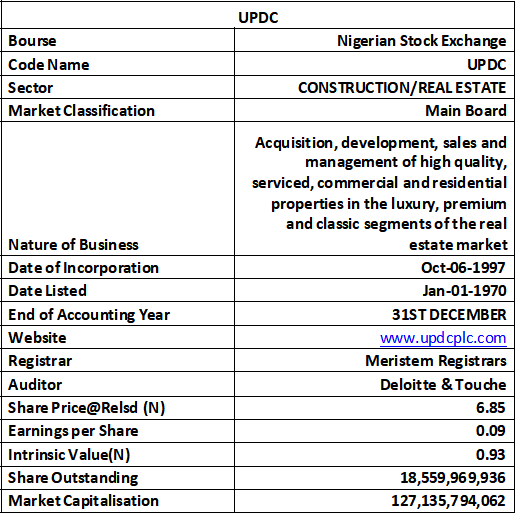
UPDC Plc is a seasoned company in Nigeria with an established record in developing, selling, and managing real estate assets across the country. It is the first real estate company whose shares are traded on the Nigerian Exchange Limited, and offers the most diversified portfolio of residential, commercial, retail, and hospitality assets. The issued and fully paid-up share capital of the Company is N9,279,984,968 divided into 18,559,969,936 ordinary shares of 50 kobo each, of this shares, Custodian Investment Plc owns 51%, UACN owns 42.61%, while the remaining is held by the investing public.
The Released Numbers
At the end of its operations for the first nine month in the year 2025, the management of UPDC reported a turnover of N9.688 billion against N5.025billion in the corresponding quarter of 2024. Direct Cost of sales is valued at N6.492 billion, versus N2.788 billion in the similar quarter of 2024. Thus, Operating Profit is estimated at N1.113 billion against te previous N608.042 million. Operating Expenses for the nine months stood at N2.427 billion, versus N1.782 billion in the comparable quarter of last year. Depreciation value at the end of the Period stood at N212.428 million versus N166.166 million, while Amortization is N4.714 million.
Finance Cost increased to N365.510 million compared to N291.584 million, in both quarters compared, the Net Finance Cost is positive. Thus, Profit before Tax stood at N2.455 billion against N627.869 million last year. Tax Expenses reported is N824.150 million versus N220.632 million. In all, the Profit for the Period is estimated at N1.631 billion compared to the N407.237 million achieved at the end of the corresponding quarter. Total Comprehensive Income for the Period also soared to N1.924 billion as against the N247.141 million in 2024 third quarter business session. See the below table for details.
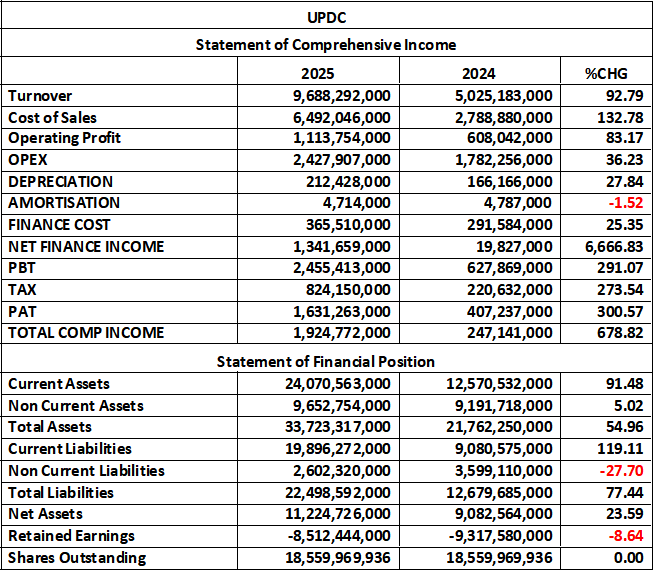
At the end of the period, Current Assets is valued at N24.070 billion, a 91.48% growth over the previously estimated N12.570 billion. Non-Current Assets is valued at N9.652 billion, against N9.191 billion. Thus, Total Assets of UPDC is now N33.723 billion, against N21.762 billion of the similar quarter in 2024. Current Liabilities of UPDC is worth N19.896 billion versus N9.080 billion. Non-Current Liabilities is N2.602billion against N3.599 billion. This brings the Total Liabilities of UPDC to N22.498 billion, versus N12.679 billion.
Plus and minus, the Net Assets of the company is estimated at N11.224 billion against the estimated N9.082 billion at the end of 2024 nine month business session. Note carefully that the Retained Earnings of UPDC is still in the red as shown in the above table.
Financial Strength
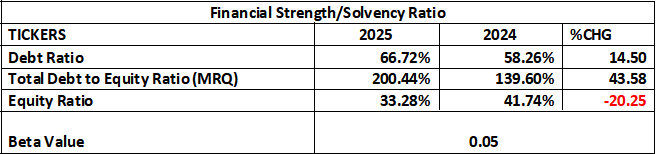
- Debt Ratio: As shown in the table below, Debt Ratio has increased significantly, meaning more of the company’s assets are now financed by debt rather than equity. Please understand that; a rise from 58% to 67% shows:
- Heavier reliance on borrowed funds
- Higher financial obligations
- And reduced asset safety margins.
This suggests a rising leverage risk, especially in the real estate environment with fluctuating property sales and interest rates.
- Total Debt to Equity: UPDC’s debt load is about twice its equity base, up from 1.4x from the year before. This is a strong signal that:
- Debt has expanded faster than equity
- Company growth may now be driven by external financing, following which
- Shareholders now carry a higher financial risk exposure
While we admit that real estate companies often carry huge debt, crossing the 200% zone, however, pushes UPDC into a more aggressive leverage posture.
- Equity Ratio: The fall in equity ratio shows that equity now forms a smaller portion of the asset structure. The implications are a:
- Weaker capital buffer
- Reduced ability to absorb business shocks, and
- Higher sensitivity to earnings volatility
This aligns with the increased debt figures and confirms a trend of structural leverage intensification.
Final Verdict on Financial Strength: UPDC’s latest ratios reveal a balance sheet becoming more debt-dependent with reduced equity support. This paints a picture of:
- Higher gearing
- Lower financial flexibility, and
- Rising exposure to interest rate and repayment posture.
This does not automatically mean negative performance, but it raises the risk profile and places more weight on profitability and cash flow strength.
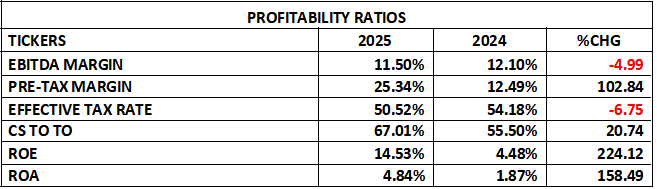
Profitability Ratios
- EBITDA Margin: UPDC’s operating core margin slipped slightly year-on-year, meaning:
- Operating cost pressure increased
- Operating efficiency weakened
- And immediate cash-profit per revenue declined
This drop, although small, indicates that the underlying operating engine is not improving at the same pace as revenue.
- Pre-Tax Margin: UPDC’s Pre-Tax margin more than doubled, an outstanding improvement. This gap between EBITDA margin and pretax margin, implies:
- Non-operating gains (finance income, asset revaluation, or one offs)
- Strong contribution from financial activities rather than pure property operations.
So, profitability strength is driven by of the followings or both:
- Reduced finance costs
- Or significantly increased finance income.
Thus, the profit engine is top-line plus investment returns, not only operating cost control.
- Cost of Sales to Turnover: A major rise in cost ratio shows:
- Weaker cost control
- Inflationary pressure on construction and related materials
- And, possibly lower margin projects being sold
The worsening cost structure confirms why EBITDA margin dipped. UPDC is still profitable, but it’s spending more money to generate each naira of revenue.
- Return on Equity: Return on Equity (ROE) tripled. This is a very positive signal, as it indicates:
- Stronger earnings from the shareholders’ capital base
- Better utilization of equity funds
- And improved bottom-line strength
Given this increasing leverage, ROE expansion is partly debt-driven, meaning returns were magnified by borrowed capital.
- Return on Assets: From the estimated ratios, UPDC is extracting significantly more profit from its assets than last year. This improvement reflects:
- Stronger revenue generation
- Strong asset revaluation, or finance income
- And better utilization of property inventory
The rise in ROA confirms that asset deployment efficiency improved sharply year-on-year.
Final Verdict on Profitability Picture: UPDC is showing, weaker operating margin quality, but exceptional financial profitability growth. The company’s bottom-line success is driven more by:
- Finance income
- Improved asset returns
- And earnings leverage
rather than pure operational efficiency.
Efficiency Ratio
- Operating Expenses to Turnover: This ratio shows a significant reduction in overhead weight which is a very positive signal as it revealed that: UPDC has reduced operating expenses as a percentage of revenue by over 10%. The implications of this are:
- Stronger cost discipline
- Better control of administrative and selling expenses
- Improved operational handling as revenue expands
- And stronger internal efficiency.
Despite weaker cost of sales, this improvement shows management is controlling indirect costs effectively. It means UPDC is spending less overhead per unit of revenue, which supports profitability sustainability.
- Turnover to Total Assets: Asset turnover is much stronger year-on-year. This shows;
- The company is generating more revenue per naira invested in assets
- Asset inventory is being converted faster into sales
- And redevelopment or property sales strategy is working better.
In Real estate business, assets often sit idle until sold, so this jump shows higher efficiency in asset development and monetization.
Overall Efficiency Picture: The efficiency outlook for UPDC is positive, as overhead control has sharply improved, assets are being monetized faster, and internal management discipline appears stronger. This efficiency improvement partially offsets rising cost-of-sales pressures seen earlier.

Investment Ratios
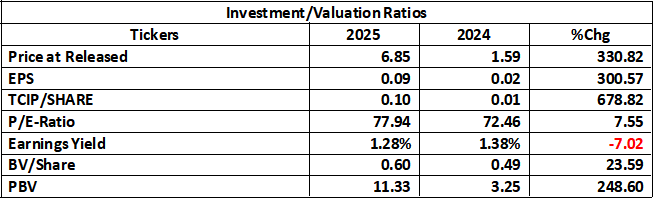
- Share Price at Release Date: The stock shows a dramatic price appreciation between the two periods compared. The price surged by over 330%. This sharp rise suggests;
- Strong market sentiment
- Investor confidence in turnaround momentum
- Speculative expectations on real estate cycles
- Or reaction to improved pre-tax profitability and finance income.
However, the magnitude indicates the price has run faster than the earnings.
- Earnings per Share (EPS): There is a strong improvement in earnings per share, due to the outstanding improvement in earnings. EPS has more that quadrupled. This means:
- Real profitability improvement
- More profit available to each share
- And justification for some degree of price appreciation.
But, the scale of price growth still far exceeds earnings expansion, raising over-valuation concerns.
- Total Comprehensive Income Per Share: The ten times jump suggests;
- Improved fair value movement
- Asset gains
- And stronger company-wide performance
However, comprehensive income includes non-cash gains, which are not always sustainable.
- PE-Ratio: The estimated PE is very high, that is UPDC is trading at;
- A very premium valuation multiple
- Far above market and sector averages
- And significantly higher than earnings justify
A PE of 77x implies investors are paying extremely high prices for current earnings.
- Earnings Yield: The drop indicates weaker earnings return for price paid. This drop also means;
- Investors earn less profit value per naira invested
- Weaker investment attractiveness from a pure earnings standpoint
- And it confirms expensive valuation
At 1.28, the yield is extremely low versus, Nigerian treasury rates, and equity market averages.
- Book Value per Share: The company’s intrinsic value per share increased. The interpretation;
- Equity base strengthened
- Assets per shareholder improved, but
- With a market price of N6.85, the stock trades at over 11x book value, meaning; huge premium over net asset backing, and expectations already baked into the price.
Final Valuation Picture: UPDC appears fundamentally improved but very aggressively priced, as;
- Price jumped massively
- Profitability grew
- But valuation metrics show overheating
- PE and earnings yield indicate low margin safety
- Premium to book value is huge
- Investor expectations are extremely high
- And the stock is positioned for perfection rather than caution.
Final Verdict on UPDC’s third quarter numbers:
UPDC’s Q3 numbers show major profit recovery, stronger asset utilization, and sharply improved ROE/ROA, supported by heavy finance income. However, the balance sheet is now highly leveraged, core margins are thinning, and the share price has already run far ahead of earnings, leaving the stock very expensive at current valuation levels. Nevertheless, we Rated UPDC shares a Hold.