

Quarter Under Preview: -Half Year 2026
Current Share Price: N147.95
Latest Final Dividend: N3.25
Latest Interim Dividend: N2.00
Estimated Beta Value: 0.45x
Estimated Fair Value: N60.00
Analyst: Jeariogbe Tunde Segun
The Company
Unilever Nigeria Plc traces its origins to April 11, 1923, when it was established as the West Africa Soap Company, a soap manufacturing business founded by Lord Leverhulme. The company later became known as Lever Brothers Nigeria Limited and was listed on the Nigerian Stock Exchange in 1973. Over the years, it expanded its manufacturing footprint, commissioning factories in Apapa, Lagos, in 1924, Aba in 1958, Oregun, Lagos, in 1980, and Agbara, Ogun State, in 1983.
The company’s growth was driven by strategic diversification and a series of mergers and acquisitions, including the absorption of Lipton Nigeria Limited in 1985, Cheesebrough Industries Limited in 1988, and Unilever Nigeria Limited in 1996. In 2001, the company adopted its present name, Unilever Nigeria Plc, reflecting its alignment with the broader global Unilever Group. Today, the company is one of Nigeria’s longest-established manufacturing businesses, with operations spanning food, home care, beauty and personal care products, and celebrated its centenary in 2023.
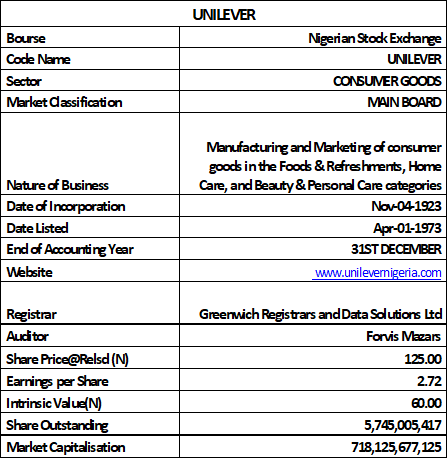
Statement of Comprehensive Income
Unilever Nigeria Plc delivered a strong improvement according to its scorecard for the first-half of 2026, the highpoint of which was the 22.24% turnover rise to ₦119.92 billion, compared with ₦98.10 billion in the corresponding period of 2025. More importantly, cost of sales grew by only 16.43%, slower than revenue growth, indicating an improvement in gross margin and better absorption of production costs. Operating profit increased by 29.48% to ₦24.36 billion, while operating expenses rose by 29.80% to ₦31.16 billion. Despite the increase in operating costs, the faster growth in operating profit suggests that the company maintained a positive operating leverage. The result is particularly encouraging from an investment perspective because the underlying business is growing at a healthy pace in an inflationary environment.
As per the bottom line, profit before tax increased by 20.79% to ₦29.18 billion, while profit after tax rose by just 8.28% to ₦15.60 billion. The key factor behind this weaker conversion of pre-tax profit into net profit was the significant increase in tax expenses for the period. The tax note shows that total tax charged to the income statement rose from ₦9.75 billion in 2025 to ₦13.58 billion in 2026, representing an increase of approximately 39.28%. This was driven mainly by the introduction of a ₦1.39 billion development levy, higher company income tax and the impact of deferred tax adjustments. Consequently, the effective tax burden rose materially, limiting the growth in earnings available to shareholders. Investors should therefore distinguish between the company’s strong operating performance and the relatively modest growth in reported PAT, as the latter was significantly impacted by the higher tax charge rather than a deterioration in the core business.
From an investment standpoint, the results are fundamentally positive but warrant careful monitoring of the tax elements and cost pressures. A revenue growth of 22.24%, operating profit growth of 29.48%, and PBT growth of 20.79% demonstrate that Unilever Nigeria is strengthening its underlying earnings capacity. The 8.28% growth in PAT, however, means that shareholders are not yet benefiting from the full strength of the company’s pre-tax performance. The tax note suggests that part of the higher tax burden is attributable to the new development levy and other tax adjustments, meaning the pressure may not necessarily represent a permanent deterioration in operating efficiency. Overall, the half-year result supports a positive investment outlook, particularly if the company can sustain revenue growth, contain operating costs, and achieve better tax efficiency in subsequent periods. For valuation purposes, I would place greater emphasis on the company’s operating profit and PBT growth, while treating the 2026 PAT growth cautiously until the sustainability of the elevated tax burden becomes clearer.
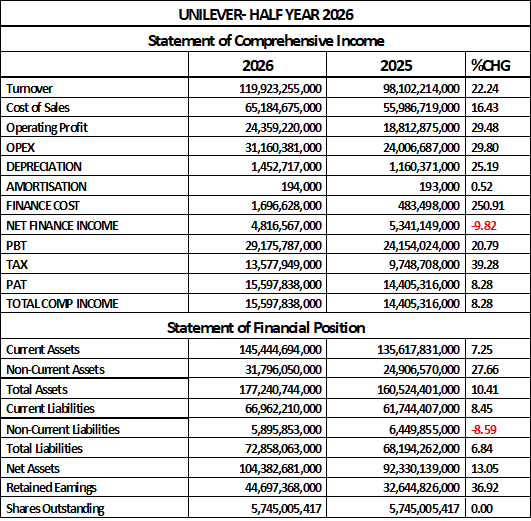
Statement of Financial Position
The statement of financial position presents a strengthening balance sheet for Unilever Nigeria Plc as at the half-year ended June 2026. Total assets increased by 10.41% to ₦177.24 billion, driven largely by a 27.66% increase in non-current assets to ₦31.80 billion, while current assets rose by a more moderate 7.25% to ₦145.44 billion. The growth in the asset base is positive from an investment perspective, as it indicates an expansion in the resources supporting the company’s operations. However, the relatively slower growth in current assets compared with non-current assets suggests that investors should continue to monitor the company’s short-term liquidity position and working-capital efficiency.
The company’s liabilities also increased, but at a slower rate than its assets. Total liabilities rose by 6.84% to ₦72.86 billion, compared with a 10.41% increase in total assets, resulting in a 13.05% growth in net assets to ₦104.38 billion. Particularly encouraging is the 8.59% decline in non-current liabilities to ₦5.90 billion, which points to a reduction in longer-term financial obligations and potentially lower balance-sheet risk. Based on the reported figures, total liabilities represent approximately 41.1% of total assets, while the equity/net asset position accounts for about 58.9%, indicating a reasonably solid capital structure and providing a positive foundation for long-term investors.
Another major positive is the substantial growth in retained earnings, which increased by 36.92% from ₦32.64 billion to ₦44.70 billion. This is a strong indication of improved earnings accumulation and internal capital generation, consistent with the company’s positive half-year profitability. With shares outstanding unchanged at 5.745 billion units, the increase in net assets translates into a rise in estimated Book Value Per Share from approximately ₦16.07 to ₦18.17, representing about 13.1% growth. Overall, the balance sheet supports a positive investment outlook, as Unilever Nigeria combines its expanding assets, growing net assets, declining non-current liabilities and strong retained earnings growth. Nevertheless, investors should assess the stock’s current market price against the improved book value and earnings outlook to determine whether the shares offer sufficient valuation upside.
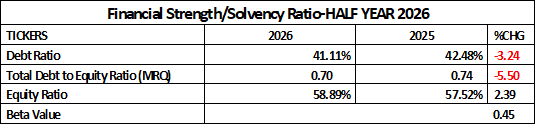
Financial Strength/Solvency Ratio
Unilever Nigeria Plc’s financial strength improved modestly in the first half of 2026, with the debt ratio declining from 42.48% to 41.11%, while the equity ratio increased from 57.52% to 58.89%. This indicates that a larger proportion of the company’s assets is now financed by shareholders’ funds rather than liabilities, representing a positive development in balance-sheet strength. Similarly, the total debt-to-equity ratio declined from 0.74x to 0.70x, suggesting a modest reduction in financial leverage and lower dependence on debt financing. The movement is consistent with the earlier observation that total assets and net assets grew faster than total liabilities during the period.
From an investment perspective, the company’s 0.70x debt-to-equity ratio and 58.89% equity ratio indicate a relatively sound capital structure, providing a reasonable cushion against financial risk. The reported Beta of 0.45 also suggests that the stock has historically exhibited lower volatility than the broader market, which may appeal to investors seeking a relatively defensive consumer-goods investment. Overall, the financial strength indicators are positive and improving, with declining leverage and strengthening equity financing. This provides a supportive foundation for the company’s long-term investment case, although investors should continue to monitor the impact of rising finance costs and the company’s ability to maintain strong cash flows as the business expands.
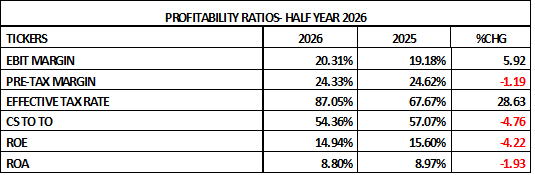
Profitability Ratios
Unilever Nigeria Plc recorded a mixed but fundamentally resilient profit performance in the first half of 2026. The EBIT margin improved from 19.18% to 20.31%, reflecting stronger operating efficiency and confirming that the company grew operating profit faster than revenue. The cost of sales-to-turnover ratio also improved from 57.07% to 54.36%, indicating better gross margin management and some improvement in the company’s ability to control production costs. However, the pre-tax margin declined marginally from 24.62% to 24.33%, partly reflecting the pressure from higher finance costs and other expenses. Overall, the core operating business appears to be becoming more efficient, which is a positive signal for long-term investors.
The major concern is the sharp increase in the effective tax rate from 67.67% to 87.05%, which significantly reduced the conversion of pre-tax earnings into net profit. This explains why ROE declined from 15.60% to 14.94%, while ROA fell from 8.97% to 8.80%, despite the company’s strong revenue and operating profit growth. From an investment perspective, the underlying profitability remains encouraging, particularly given the improvement in EBIT margin and cost efficiency, but the unusually high tax burden is currently suppressing shareholder returns. If the tax impact moderates in subsequent periods, the company’s improved operating margins could translate into stronger PAT, ROE and ROA. Therefore, the profitability outlook remains cautiously positive, with taxation being the key factor investors should monitor closely.
Efficiency Ratio
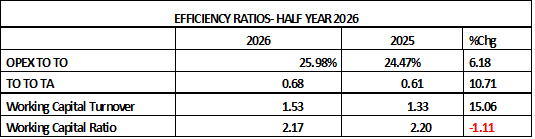
Unilever Nigeria Plc recorded a mixed but generally positive efficiency performance in the first half of 2026. The OPEX-to-turnover ratio increased from 24.47% to 25.98%, indicating that operating expenses grew slightly faster than revenue and therefore exerted some pressure on cost efficiency. However, this was offset by a significant improvement in asset utilisation, with turnover-to-total-assets rising from 0.61x to 0.68x, representing a 10.71% improvement. This suggests that the company generated more revenue from each naira invested in its asset base, an encouraging development given the 10.41% growth in total assets during the period.
The company’s working capital turnover also improved from 1.33x to 1.53x, indicating more efficient utilisation of working capital in generating sales. Meanwhile, the working capital ratio remained strong at 2.17x, despite a marginal decline from 2.20x, suggesting that current assets continue to provide a comfortable cover for short-term obligations. From an investment perspective, the efficiency indicators are broadly encouraging, particularly the improvement in asset utilisation and working capital turnover. However, the rising OPEX-to-turnover ratio requires monitoring, as sustained growth in operating expenses could gradually erode the benefits of stronger revenue and asset productivity. Overall, the company appears to be improving its operational efficiency, although tighter control of operating expenses would further strengthen its investment case.
Investment/ Valuation Ratios
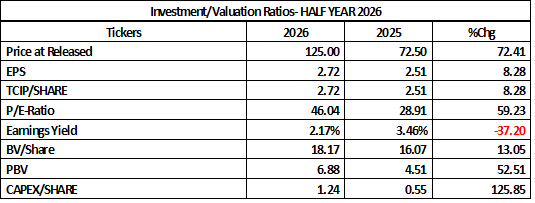
Unilever Nigeria Plc’s investment and valuation indicators present a mixed picture, with strong earnings growth but a significantly higher market valuation. EPS increased by 8.28% from ₦2.51 to ₦2.72, reflecting the company’s growth in profit after tax. However, the share price at the time of the report increased sharply by 72.41% from ₦72.50 to ₦125.00, far outpacing earnings growth. Consequently, the P/E ratio expanded substantially from 28.91x to 46.04x, while the earnings yield declined from 3.46% to 2.17%. This indicates that investors are currently paying a considerably higher price for each Naira earned, suggesting that much of the company’s future growth prospects may already be reflected in the market price.
The valuation based on net assets also points to a premium market valuation. Book value per share improved by 13.05% from ₦16.07 to ₦18.17, supported by the growth in net assets, but the price-to-book ratio rose sharply from 4.51x to 6.88x. In other words, the market price of ₦125 represents a substantial premium to the company’s accounting book value. While this premium may be justified by Unilever Nigeria’s strong brand portfolio, market position, improving operating performance and future growth prospects, the magnitude of the premium means that the stock has become more sensitive to any disappointment in earnings growth. Investors should therefore expect the company to deliver sustained earnings expansion to justify the current valuation.
The increase in CAPEX per share from ₦0.55 to ₦1.24, representing a substantial 125.85% increase, is nevertheless encouraging from a long-term perspective if the additional capital expenditure is directed toward productive capacity, technology and business expansion. Overall, the company presents a strong underlying investment story but an increasingly demanding valuation. The improvement in EPS and book value supports the fundamental case, while the sharp expansion in P/E and PBV raises concerns about the stock’s margin of safety at ₦125 per share.
Interim Dividend Information
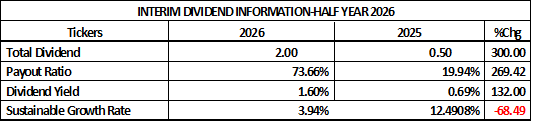
Unilever Nigeria Plc’s dividend profile shows a significant improvement in shareholder returns, with the interim dividend increasing from ₦0.50 per share in 2025 to ₦2.00 per share in 2026, representing a substantial 300% increase. The payout ratio also rose sharply from 19.94% to 73.66%, indicating that the company is distributing a much larger proportion of its earnings to shareholders. While the 1.60% dividend yield at the ₦125 share price remains relatively modest, it has improved from 0.69% in 2025. However, the rise in payout ratio has contributed to a decline in the sustainable growth rate from 12.49% to 3.94%, suggesting that a larger proportion of earnings is being distributed rather than retained to finance future growth. From an investment perspective, the higher interim dividend is a strong positive for income-oriented investors, but the elevated payout ratio and lower sustainable growth rate suggest that investors should balance the attraction of increased dividends against the company’s future capacity to reinvest earnings and sustain long-term growth.
The Intrinsic Value
Based on an independent assessment of Unilever Nigeria Plc’s fundamentals, the company’s intrinsic value is estimated using a two-stage Residual Income/Dividend Discount valuation approach. The valuation considers the current EPS of ₦2.72, full-year 2025 dividend of ₦3.25 per share, ROE of approximately 15%, and an estimated cost of equity of 20%. Given the strong first-half 2026 operating performance, but relatively modest 8.28% growth in PAT due largely to the sharp increase in the tax burden, a more conservative earnings growth assumption of 15–20% is considered appropriate, rather than the 30% growth assumption in the initial model. The valuation also assumes a five-year high-growth period followed by a sustainable long-term growth rate of approximately 7–10%.
On this basis, the estimated intrinsic value of Unilever Nigeria Plc is approximately ₦60 per share, with a reasonable valuation range of ₦55–₦65 per share. Against the reference market price of ₦125 per share, the stock appears to be trading at a substantial premium to its estimated fundamental value, implying a negative margin of safety at the current price. While the company’s strong operating performance, improving margins, growing book value and sound balance sheet provide a positive long-term investment case, the current valuation already appears to discount significant future growth. Investment Recommendation: HOLD/WAIT FOR A BETTER ENTRY PRICE, with ₦60 per share adopted as the central intrinsic value estimate.
Final Investment Verdict
Unilever Nigeria Plc’s half-year 2026 results present a fundamentally improving business with a strong underlying operating performance. Turnover increased by 22.24%, operating profit by 29.48%, and PBT by 20.79%, while the balance sheet strengthened through higher net assets, lower leverage and a stronger equity position. The improvement in EBIT margin, asset utilisation and working capital turnover further supports the quality of the company’s operations. The ₦2.00 interim dividend, compared with ₦0.50 in the previous period, is also positive for shareholders, although the elevated payout ratio and lower sustainable growth rate require monitoring.
However, the major concern is valuation. At a reference price of ₦125, the stock trades at approximately 46x earnings and 6.88x book value, while our independent assessment places intrinsic value at approximately ₦60 per share, with a reasonable range of ₦55–₦65. This indicates that the current market price has already priced in substantial future growth and leaves little or no margin of safety for new investors. My final verdict is therefore HOLD, with a preference to ACCUMULATE only at a significantly lower price. The company remains attractive fundamentally and could deliver strong long-term growth if it sustains its operating momentum and normalises its tax burden, but at ₦125, the valuation appears too demanding relative to its current earnings and intrinsic value.