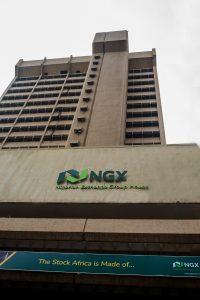


Royal Exchange has a long history in Nigeria. The company was incorporated as Royal Exchange Assurance (Nigeria) Plc and became a public company before listing on the Nigerian Exchange in 1990. In 2008, it changed its name to Royal Exchange Plc and transferred its life and general insurance businesses to separate entities. The 2025 financial statements describe the group’s principal activities as general insurance, health insurance, and credit financing.
Current price: N1.05
Rating: Buy
Price projection: N2, N2.50, and N3
Technical Analysis
In this report, we shall use the following tools and analysis methods:
Elliott’s wave theory to understand the overall market sentiment
Fibonacci tools to determine support and resistance levels
The Relative Strength Index and volume to evaluate the market’s strength
The Money Flow Index to determine the market liquidity
Moving average and MACD to understand the nature of the trend
Top-down analysis to know the best investment position
Elliott wave analysis
Weekly chart: Market overview
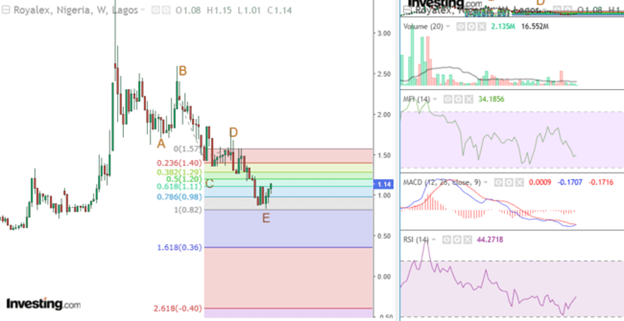
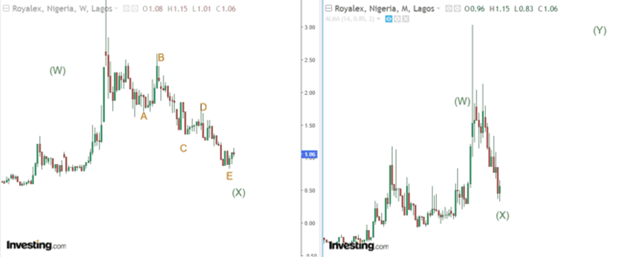
ROYALEX saw a deep ABCDE correction on the weekly chart. This type of correction usually signals strong profit-taking on the higher timeframe. After retracing to 100% of Waves C and D, the stock commenced its recovery. In line with this performance, volume remained solid. Liquidity and momentum also improved, sustaining MACD’s bearish divergence signal.
Daily chart: Trading opportunity
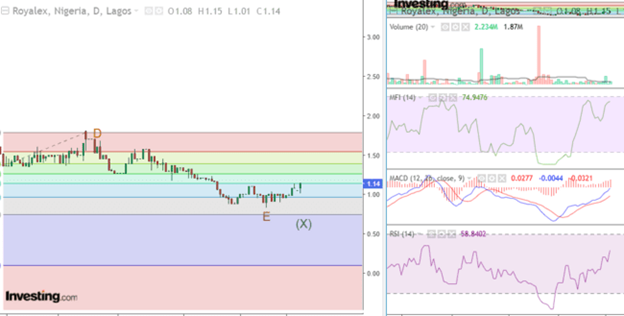
On the daily chart, the recovery phase remained strong with massive liquidity, momentum, and volume. Traders should watch N0.8 and N1 as potential support levels, with prices projected at N2, N2.50, and N3.
SWOT Analysis
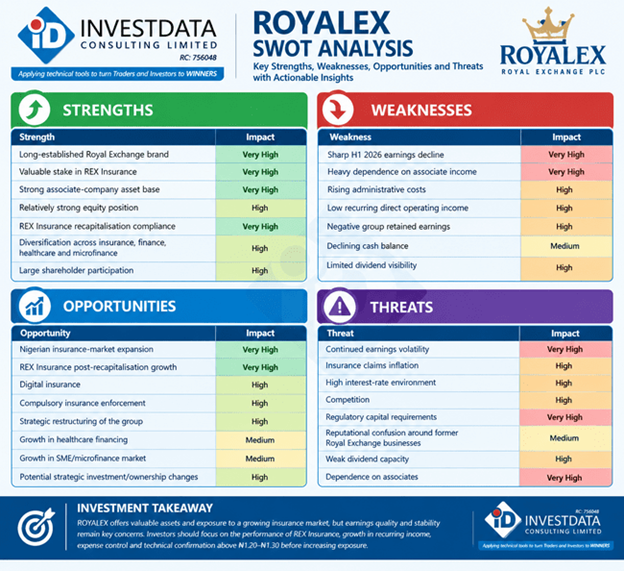
ROYALEX has valuable strategic assets, particularly its stake in REX Insurance, and is positioned to benefit from Nigeria’s expanding insurance market. REX Insurance’s compliance with the new capital requirements also provides a stronger platform for future growth.
The major opportunity lies in REX Insurance converting its stronger capital position and market growth into higher premiums, stronger underwriting performance and sustainable profits. Key risks include continued dependence on associate income, claims inflation, competition and higher regulatory capital requirements.