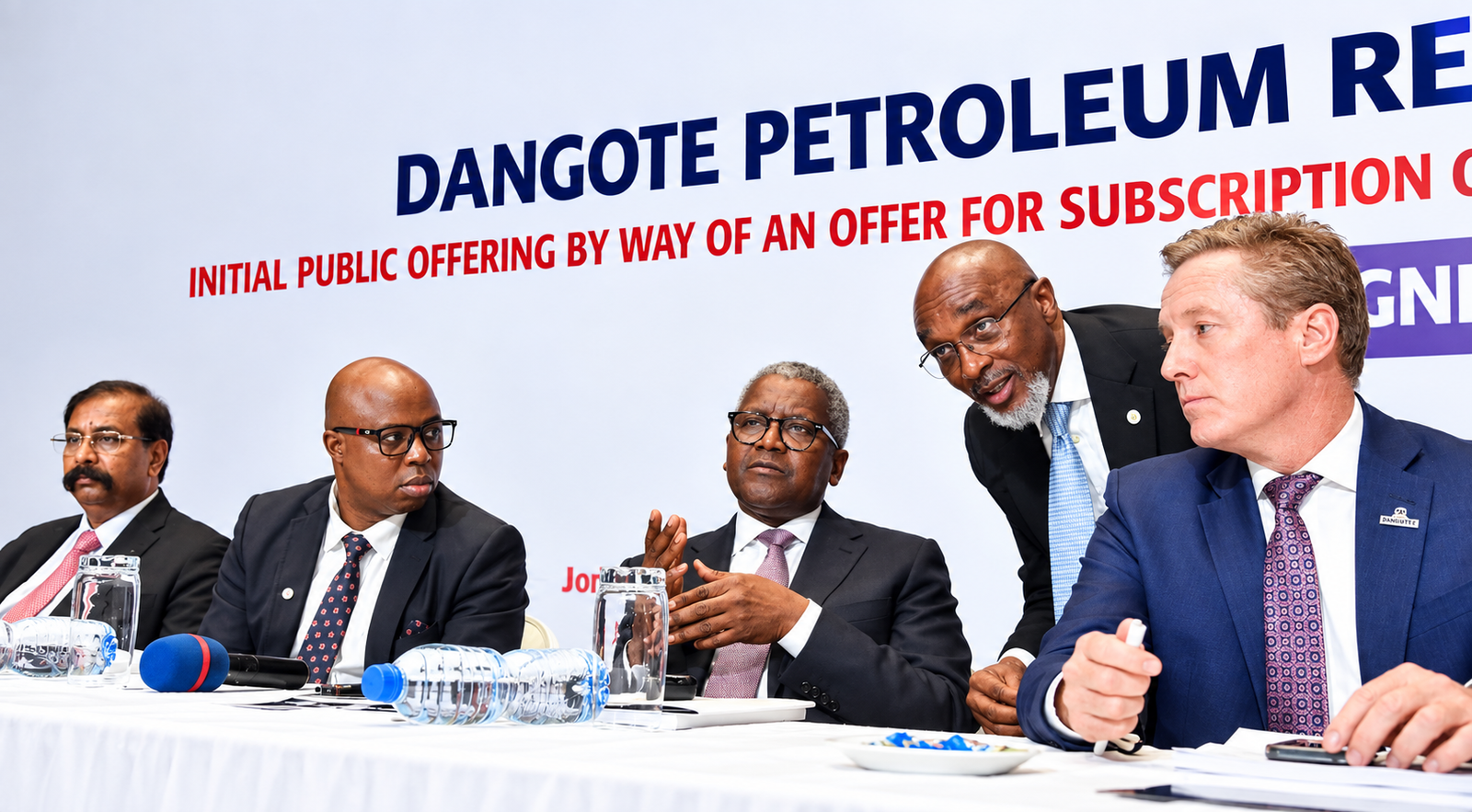


Caption: From left, Group Managing Director/Chief Executive Officer, Vetiva Capital Management Limited, Chuka Eseka; Chief Executive Officer, Nairobi Securities Exchange (NSE), Frank Mwiti; President/Chief Executive Officer, Africa Finance Corporation, Samaila Zubairu; President/Chief Executive, Dangote Industries Limited, Aliko Dangote; and Chairman, Capital Markets Authority, Kenya, Ugas Mohammed, during the Dangote Petroleum Refinery IPO High Level Investor Engagement organised by the Nairobi Securities Exchange in Nairobi, Kenya.
In what is likely an assurance to both domestic and foreign individual and corporate investors of its capacity to more than deliver on its promise, the Dangote Petroleum Refinery, on Tuesday said it surpassed its name-plat capacity, recording an average capacity utilization of 105.21 percent in August 2026.
Citing data released by the Nigerian Midstream and Downstream Petroleum Regulatory Authority (NMDPRA), a statement by Dangote Group said its 700,000 barrels-per-day plant processed an average of 736,470 barrels of crude oil per day within the month, representing what it tagged a substantial increase from 497,000 barrels per day average in July, when utilization stood at 71 percent.
This strong performance, it continued, was supported by a rebound in domestic crude oil supply, with deliveries rising by 16.75 percent to 683,000 barrels per day during the month.
The refinery’s improved throughput, it stressed, translated into average daily production of 84.43 million litres of refined white products, including Premium Motor Spirit (PMS), Automotive Gas Oil (AGO/diesel), and Aviation Turbine Kerosene (ATK), further reinforcing its role as a major supplier of refined petroleum products across Nigeria and the wider West African region.
The Dangote Group said the achievement underscores the refinery’s growing contribution to Nigeria’s energy security, foreign exchange conservation, and industrial growth agenda, even as it continues to significantly reduce Nigeria’s dependence on imported petroleum products during the review period.
Domestic PMS deliveries from the refinery rose by 39 percent month-on-month to 35.87 million litres per day in August, accounting for approximately 71 percent of total domestic petrol supply.
The increased local supply contributed to a sharp decline in fuel imports, with national PMS imports falling by 26 percent to 14.60 million litres per day, highlighting the refinery’s expanding impact on the domestic fuel market.
Beyond meeting a significant portion of Nigeria’s domestic fuel requirements, Dangote Group said the refinery also strengthened the country’s export profile through robust shipments of refined products.
In August, the refinery exported an average of 9.73 million litres of PMS daily, alongside 8.75 million litres of diesel and 21.30 million litres of aviation fuel, volumes it believes, further support Nigeria’s emergence as a net exporter of refined petroleum products and contribute to increased foreign exchange earnings for the country.
The refinery’s growing production capacity, the group stressed further, was particularly evident in the diesel market, where domestic AGO deliveries averaged 12.37 million litres per day. This level of output substantially reduced the need for imported diesel, with national diesel imports declining from 7.90 million litres per day in July to 1.30 million litres per day in August.
The development, it is believed, reflects the refinery’s increasing ability to support critical sectors of the economy, including transportation, manufacturing, agriculture, telecommunications, and power generation.
The refinery’s ability to operate above its nameplate capacity demonstrates the efficiency, reliability, and resilience of its operations. The performance milestone also reinforces investor confidence as the refinery’s ongoing public offering continues to attract significant market attention.
Dangote Group is currently undertaking an Initial Public Offering (IPO) of 4.1 billion units of Dangote Petroleum Refinery at N525 per share, targeting 10 million shareholders, the net proceeds of which is targeted at doubling the capacity to 1.4 million barrels per day by 2029.