

Market Update For September 29, 2026
The Nigerian equities market came under renewed selling pressure on Tuesday, September 29, as investors locked in gains across several large-cap stocks, bringing an end to the previous session’s positive performance.
The session reflected a more cautious mood across the market, with investors reducing positions in some of the stocks that had supported the recent rally. The pressure was particularly visible in heavyweight banking, consumer goods and industrial counters, although selected mid- and small-cap stocks continued to attract buying interest.
UNILEVER recorded one of the sharpest declines among the major stocks, falling 8.55%, while MAYBAKER lost 5.09%. The banking sector also faced broad selling pressure, with GTCO declining 3.29%, ETI dropping 2.86%, ACCESSCORP losing 2.51% and ZENITHBANK shedding 1.03%. BUACEMENT fell 3.10%, while DANGSUGAR, NGXGROUP, NAHCO and OANDO also closed lower.
The movement suggests that investors are becoming more selective after the market’s strong advance in recent weeks. With the broader index trading close to its recent highs, some investors appear to have used the session to secure profits, particularly in counters that had recorded significant gains.
However, the decline was not uniform across the market. Buying interest remained evident in selected financial services, investment and service stocks. LIVINGTRUST and NPFMCRFBK both advanced by 10.00%, while WAPIC, VFDGROUP and ABCTRANS also recorded strong gains. The performance of these counters shows that liquidity has not completely left the equities market, but is instead being redirected towards selected opportunities.
Market activity also slowed significantly during the session. The sharp decline in volume indicates a reduction in overall trading intensity as investors adopted a more cautious approach. The lower activity came amid the broader decline in the index, suggesting that Tuesday’s weakness was driven more by profit-taking in key counters than by an aggressive market-wide exit.
GTCO remained the dominant stock by traded value, recording 88.73 million shares valued at N11.73 billion. Its contribution accounted for a substantial portion of the day’s total value, reflecting continued investor interest in the banking heavyweight despite its decline in price. UBA and FIDELITYBK also featured prominently among the most actively traded stocks by volume, while ZENITHBANK and ARADEL ranked among the leading counters by value.
TRANSCOHOT was one of the standout stocks during the session after breaking above its 52-week high. The counter rose from N265.00 to N290.50, indicating continued demand and renewed investor interest. The performance contrasts with the weakness recorded by several blue-chip stocks and highlights the ongoing rotation across different segments of the market.
The negative market breadth, meanwhile, showed that selling pressure extended beyond a handful of large-cap names. More stocks closed lower than higher, pointing to a relatively broad decline in investor sentiment. Nevertheless, the presence of several stocks posting gains close to the daily limit suggests that pockets of strong demand remain within the market.
Oil Market
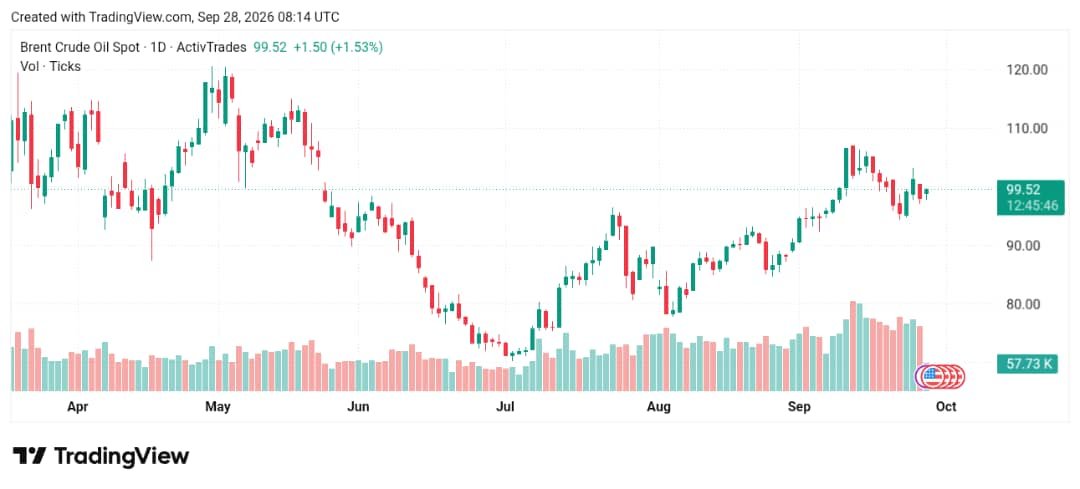
The oil market remained an important external factor for investors as crude prices continued to respond to developments around Middle Eastern supply and the potential disruption of global energy flows.
Oil prices have remained elevated amid geopolitical uncertainty, keeping the commodity market firmly in focus. For Nigeria, movements in crude prices remain particularly significant because of the country’s reliance on oil exports for foreign-exchange earnings and government revenue.
Higher crude prices can provide support for Nigeria’s external position and government finances when production and export volumes remain stable. They can also improve foreign-exchange liquidity and provide a more favourable backdrop for domestic financial assets. However, the benefit to the Nigerian economy depends not only on the international price of crude but also on domestic oil production, export volumes, security conditions around production assets and the government’s ability to translate higher oil receipts into stronger fiscal and external balances.
The current oil environment therefore remains a mixed factor for the domestic market. While elevated crude prices can support Nigeria’s external earnings, persistent geopolitical uncertainty also creates the possibility of sharp price swings. Investors are likely to continue monitoring developments in the international oil market alongside domestic economic indicators and corporate earnings.
For oil-linked equities, the direction of crude prices remains an important consideration, particularly for companies with significant exposure to exploration, production and energy-related activities. A sustained period of higher crude prices could support earnings expectations for some upstream operators, while volatility in the commodity market could create uncertainty around investment and operating costs.
Technical Analysis and Outlook
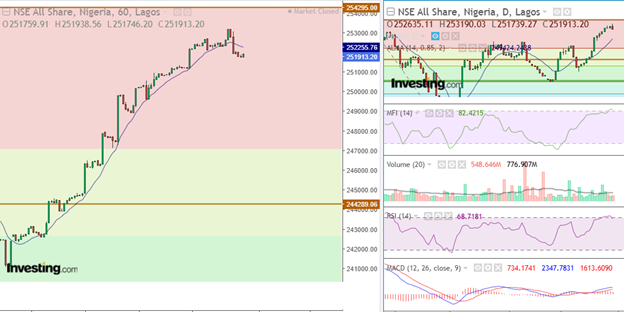
From a technical perspective, Tuesday’s decline represents a pullback after the market’s recent upward movement. The ASI remains close to the 252,000-point level, keeping the broader trend under observation as investors assess whether the recent advance can be sustained.
The 250,000-point area remains the immediate support zone, and its ability to hold could be important for the market’s short-term direction. A successful defence of this level could encourage renewed buying interest and provide the foundation for another attempt at the recent highs.
On the upside, the 252,500–253,000-point region remains a key resistance area. A sustained break above this zone would indicate renewed buying strength, while repeated failure around the resistance area could encourage additional profit-taking and short-term consolidation.
The decline in trading volume alongside negative breadth calls for caution in the near term. A continued fall in volume could indicate that investors are waiting for fresh catalysts before increasing exposure, while an increase in volume on subsequent advances would provide stronger confirmation of renewed buying interest.
The market may therefore remain driven by stock-specific developments rather than a broad-based rally. Corporate earnings expectations, dividend prospects, sector rotation, oil prices, interest-rate conditions and foreign-exchange developments are likely to remain important considerations for investors as the quarter progresses.
For investors already holding positions that have delivered substantial gains, the current environment may encourage profit-taking and portfolio rebalancing. At the same time, the strong performance of selected counters indicates that opportunities remain available, particularly where company fundamentals and earnings expectations continue to attract demand.
The broader market structure remains positive on a year-to-date basis despite Tuesday’s decline. However, the latest session reinforces the need for investors to distinguish between the market’s overall direction and the performance of individual stocks. With the index approaching resistance and breadth weakening, the next few sessions could provide a clearer indication of whether the market is preparing for another leg higher or entering a period of consolidation.
The NGX All-Share Index (ASI) fell 0.29% to 251,913.20 points, from 252,635.11 points, while market capitalisation declined by N468.63 billion. The market’s YTD performance eased to 61.88%. Trading volume dropped 46.46% to 548.67 million shares, while value stood at N34.30 billion across 47,301 deals. Market breadth remained negative, with 32 decliners against 27 gainers. Market movers included TRANSCOHOT, which moved above its 52-week high to close at N290.50, while GTCO dominated traded value with N11.73 billion. Top gainers were LIVINGTRUST (+10.00%), NPFMCRFBK (+10.00%), WAPIC (+9.95%), VFDGROUP (+9.84%) and ABCTRANS (+9.82%), while top losers were SOVRENINS (-8.78%), UNILEVER (-8.55%), NEIMETH (-6.02%), UPL (-6.00%) and INTBREW (-5.45%).