

Quarter Under Preview: Full Year-2025
Current Share Price: N94.70
Price At Released: N94.90
Latest Final Dividend: N3.00
Latest Interim Dividend:
Estimated Beta Value: 0.55x
Estimated Intrinsic Value: N108.42
Analyst: Jeariogbe Tunde Segun
The Company
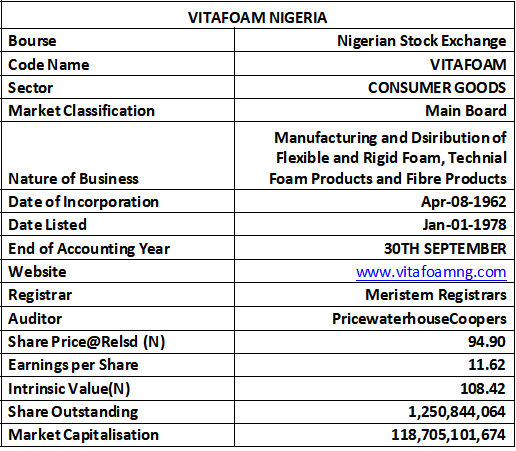
Vitafoam Nigeria Plc is Nigeria’s foremost manufacturer of flexible, reconstituted, and rigid foam products. With the largest foam manufacturing and distribution network in the country. Established on 4 August 1962 and listed on the Nigerian Stock Exchange (now Nigerian Exchange Limited) 16 years later in 1978, Vitafoam has grown into a trusted household name renowned for product excellence, innovation, and customer satisfaction.
Its diverse product portfolio includes mattresses of various firmness levels, profile foam products, contour-cut specialty items, and custom-made mattresses and pillows. Vitafoam also provides versatile foam solutions such as Vitarest and Leisuremats, as well as foam seating products like Vitasolid chair. The company caters to niche segments with foam-based baby and nursing products including cot mattresses, changing mats, pillows, and breastfeeding accessories. To reflect its national presence, Vitafoam operates manufacturing facilities in Aba, Ikeja, Jos, and Kano, supported by an extensive network of distributors and retail outlets nationwide.
The Released Numbers
At the end of the full business session in 2025, the management of Vitafoam reported a growth in its figures as shown in the table below. The turnover improved by 34.78% to N111.379 billion from N82.639 billion in the corresponding year. The direct Cost of Sales for the year is valued at N70.422 billion against N52.333 billion in the previous year. The Operating Expenses was valued at N14.502 billion, as against N11.064 billion in the corresponding year.
Depreciation and Amortisation figure inched up by 8.37% to the current N540.295 million. Finance Cost through the year is N5.810 billion, while the Net Finance Income remained negative at N5.799 billion. Profit before Tax is therefore estimated at N21.480 billion, versus N1.145 billion in the corresponding year, this is an outstanding growth. Tax Expenses is N6.943 billion against N193.134 million of last year. In all, the amount reported as Profit for the year is N14.537 billion, higher than the reported N952.190 million in the corresponding year. After all deductions and additions, the Total Comprehensive Income for the year stood at N12.182 billion as against N9.817 billion in the corresponding quarter.
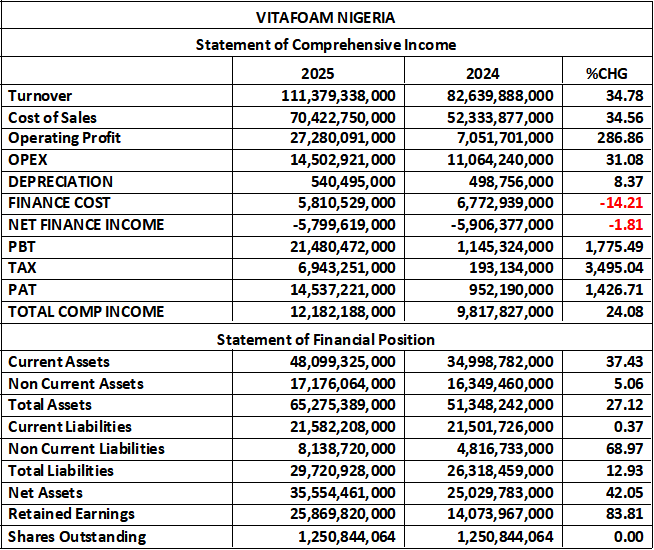
Now, at the end of the 2025 full year, Vitafoam’s Current Assets was valued at N48.099 billion versus N34.998 billion in 2024. Non-Current Assets stood at N17.176 billion versus N16.349 billion. Thus, Total Assets of Vitafoam is currently valued at N65.275 billion, higher than the N51.348 billion of the previous year by 27.12%. On the other hand, the Current Liabilities is estimated to be N21.582 billion against N21.501 billion of 2024 business session. Non-Current Liabilities is N8.138 billion versus N4.816 billion in the corresponding year, thus, Total Liabilities of Vitafoam at the end of the business session is N29.720 billion versus N26.318 billion.
On the strength of the above, Net Assets is now estimated at N35.554 billion compared to N25.029 billion in the similar year. Retained Earnings therefore is N25.869 billion versus N14.073 billion in the comparable quarter of 2024.
Financial Strength
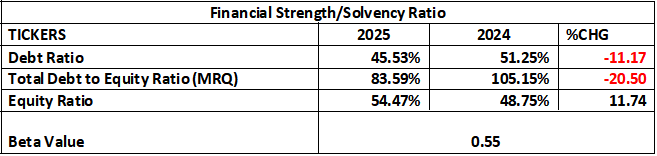
- Debt Ratio: (45.53% Vs 51.52%): At 45.53%, Vitafoam now finances less than half of its assets with debt, down from 51.52% previously estimated. This is a clear improvement in balance sheet health, signaling reduced reliance on borrowed funds. Lower debt exposure means less vulnerability to interest rate shocks, which is particularly important in Nigeria’s high-interest environment. By this, we can say Vitafoam is steadily deleveraging its financial base.
- Total Debt to Equity Ratio: (83.59% Vs 105.15%): It is important to note that this ratio measures how aggressive the company is financed by creditors relative to shareholders. Thus, a drop from 105.15% to 83.59% means debt is now lower than shareholders’ equity, compared to when debt exceeded equity. This shift improves creditworthiness, reduces financial risk, and increases shareholder protection. Also, it gives the company more flexibility to raise funding in the future if needed. We can therefore say that, Vitafoam has moved from a highly leveraged position to a more balanced capital structure.
- Equity Ratio (54.47% Vs 48.75%): An equity ratio of 54.47% means shareholders now fund the majority of the company’s assets. The rise from 48.75% reflects either retained earnings growth, debt reduction, or both. This enhances long-term stability and signals growing internal strength. On this strength, we can say, the company’s asset base is increasingly backed by the owners rather than lenders, and this is a positive sign for long-term investors
- Beta Value (0.55x): A beta of 0.55x suggests that Vitafoam’s stock is less volatile than the overall market. This makes it attractive to risk-averse investors, and also makes it suitable as a defensive stock in uncertain market conditions. Thus, we conclude that, Vitafoam provides relative stability in a volatile equity market.
Overall Verdict on Financial Strength: Vitafoam Nigeria Plc shows clear and meaningful improvement in financial strength. Observed are: the reduced leverage, stronger equity backing, and lower financial and market risk. The company appears more resilient, better positioned to withstand economic pressure, and structurally healthier than the prior year.
Profitability Ratios
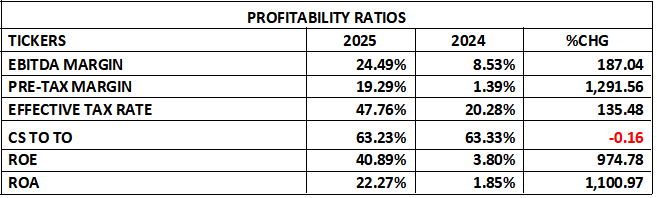
- EBITDA Margin (24.49% Vs 8.53%): An EBITDA Margin jump to 24.49% from 8.53% is extraordinary. It signals:
- Stronger pricing power, cost discipline, or
- A combination of volume growth, Fx management, and operational efficiency.
- This margin level places Vitafoam among top-tier performers in the country’s manufacturing space. Core operation have become highly profitable, not just a marginal improvement.
- Pre-Tax Margin (19.29% Vs 1.39%): Since Pretax margin reflects profit after operating costs and finance charges, the movement from 1.39% to 19.29% shows:
- Finance costs have been absorbed comfortably
- Operating gains are flowing through the bottom line
- This confirms that the EBITDA improvement is real and sustainable, just as it has not been wiped out by interest or Fx losses. Thus we can say that, Vitafoam has transitioned from survival mode to a strong profitability position.
- Cost of Sales to Turnover (63.23% to 63.33%): The cost ratio is essentially flat, improving slightly. This tells us that:
- Margin expansion did not come from drastic cost cuts in production
- Instead, it likely came from better pricing, product mix, scale benefits, or Fx stability.
Thus, we conclude that growth is quality-driven, not artificially engineered by cost suppression.
- Return on Equity-ROE (40.89% Vs 3.80%): Since this ratio measures how effectively the shareholders’ funds is put to use, a 40.89% ROE is outstanding by any standard. The leap from 3.80% reflects: a strong profit growth, improved capital structure, and better asset utilization. This level of ROE significantly exceeds inflation and risk-free returns. By this we can say, the management of Vitafoam is delivering excellent value for shareholders.
- Return on Assets- ROA (22.27% Vs 1.85%): This ratio observes how efficiently the company’s assets generates profit. Thus, rising to 22.27% means that Vitafoam’s assets are now working very hard to produce outstanding profit. This suggests improved plant utilization, better working capital management, and strong demand for products. Assets that were previously underperforming are now highly productive.
Overall Profitability Verdict: Vitafoam Nigeria Plc has delivered a remarkable turnaround in profit level. Operating margins have expanded dramatically, bottom-line profitability is robust, and shareholder and asset reurns are now best-in-class.
Efficiency Ratio
- Operating Expenses to Turnover (13.025 Vs 13.39%): A decline to 13.02% from 13.39% shows better control of overhead costs. Though the improvement looks modest, it is very meaningful at scale, especially in a high-inflation environment where it currently operates. This confirms that management did not allow operating costs to balloon despite revenue and activity growth. By this we say, Vitafoam is growing efficiently and not otherwise.
- Turnover to Total Assets (170.63% Vs 160.94%): An assets turnover of 170.63% means N1 of assets now generates N1.71 in sales, this is up from N1.61. This signals better utilization of production facilities, it shows faster inventory movement, and confirms a more effective deployment of working capital. Thus, we say, Vitafoam is extracting more value from the same asset base.
Overall Efficiency Verdict: Vitafoam Nigeria Plc demonstrates clear operational efficiency gains, as overhead costs are well controlled, assets are working harder and faster than before, and operational improvements support and explain the strong profitability growth. This confirms that the earnings recovery is structurally sound, not accidental.

Investment Ratios
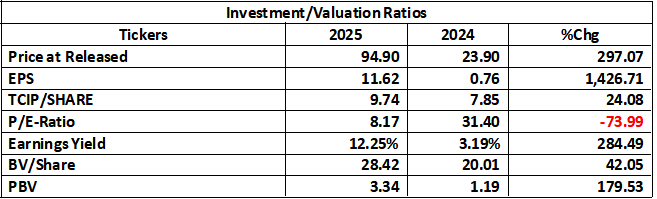
- Share Price at Release Date (N94.90 Vs N23.90): These prices confirmed the deliberate market re-pricing of Vitafoam share price between the two years compared in this report. Investors clearly factored in the robust combination of earnings recovery, balance sheet strengthening, and operational turnaround. Importantly, the price rise is backed by fundamentals and not speculations. At this point, we safely conclude that the market has acknowledged Vitafoam’s improved quality and prospects.
- Earnings per Share-EPS (N11.62 Vs N0.76): EPS growth of over 15x year-on-year is explosive. This mirrors the strong pretax and EBITDA margin expansion observed above. It confirms that profitability gains accrue directly to shareholders.
- Total Comprehensive Income per Share (N9.74 Vs N7.85): Growth here is more moderate, which is healthy. It suggests, lower volatility from Fx or revaluation losses, it also shows more sustainable and repeatable earnings.
- PE-Ratio (8.17x Vs 31.40x): Despite the massive price increase, the PE ratio collapsed. This happened because earnings grew at a faster pace than price. Please note that a PE of 8.17x is below market averages, and its is very attractive for a company with improving margins and ROE above 40%.
- Earnings Yield (12.25% Vs 3.19%): Earnings Yield now significantly exceeds fixed income returns (on risk adjusted basis), it also exceeds those of many consumer and industrial goods peers. This improves Vitafoam’s appeal to income and value-oriented investors.
- Book Value per Share (N28.42 Vs N20.01): At the current price, the stock trades well above book, but this is justified by high ROE and profitability. Shareholder’s equity has grown meaningfully, supporting valuation.
Overall Investment Verdict: Vitafoam delivered an exceptional full year performance across all fronts. The company appears to be a very fundamentally strong, well-managed, and still attractive valued company, even after its significant share price appreciation. The key forward risk to monitor, going forward would be input cost inflation and Fx exposure. But, based on current numbers, Vitafoam stands out as a high-quality turnaround success story, and a compelling medium-term investment.
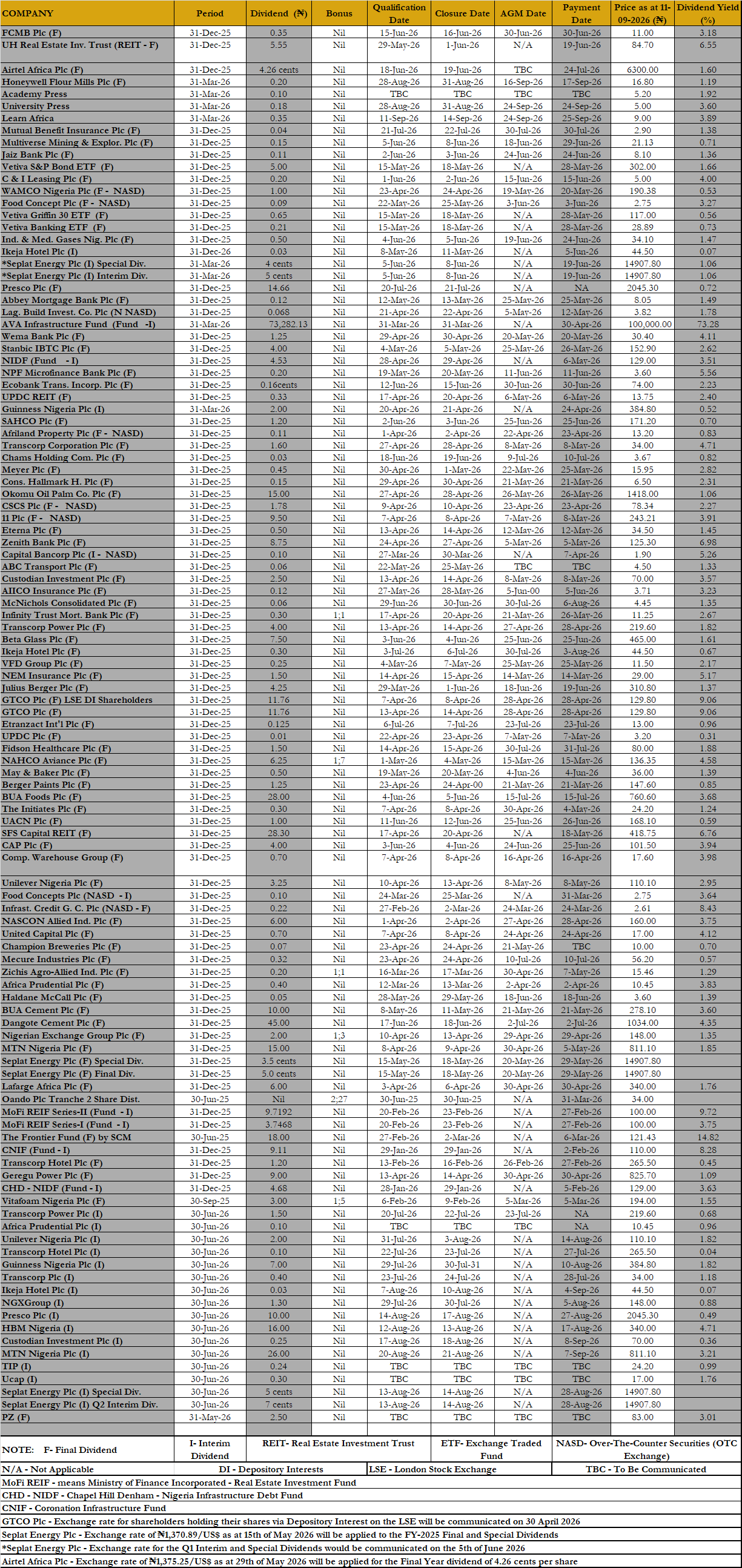
Dividend Information
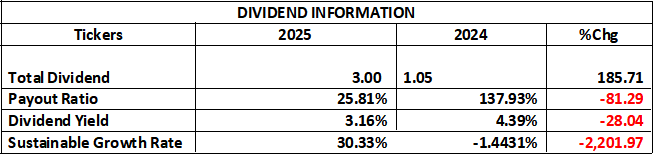
Final Verdict on Vitafoam: This stock has transitioned from a recovery story to a fundamentally strong mid-cap value stock. As noted above, financial strength is improving, profitability is robust and consistent, efficiency is high, as revealed by ROE and earnings yield. And yes, valuation offers moderate upside with a margin of safety. Thus, we have rated Vitafoam a Buy/Hold for value-oriented investors. The stock is also ideal for medium-long term investors seeking earnings strength and dividends. The key risk is earnings sustainability and input cost volatility. The bottom-line is that Vitafoam is no longer cheap, but it is still good for value. A quality Nigerian stock with strong fundamentals and disciplined capital management.