
Market Update For February 3, 2026
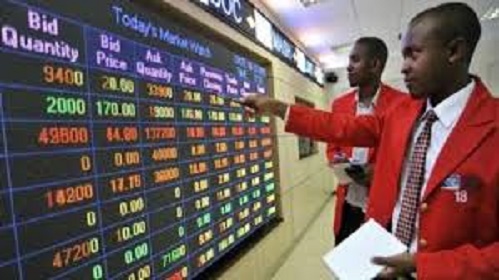
The Nigerian equity market closed Tuesday on a positive note, extending the modest gains recorded in the previous session as investors continued to selectively accumulate stocks with attractive valuations. The day’s performance reflected cautious optimism, driven largely by renewed interest in banking and industrial names, while broader participation across the market remained measured.
Trading activity showed that investors are increasingly focused on stock-specific opportunities rather than broad market exposure. Recent pullbacks in several large-cap and mid-cap stocks created entry points for bargain hunters, particularly in the financial sector, where earnings resilience and dividend expectations continue to support sentiment. While buying interest was evident, it was not aggressive, suggesting that many investors remain watchful amid lingering macroeconomic uncertainties.
Sectoral performance was mixed, underscoring the selective nature of demand. The banking sector led the market higher as investors rotated back into tier-one and mid-tier banks that had corrected in recent sessions. Industrial goods stocks also closed in positive territory, supported by renewed interest in cement and construction-related counters, which continue to benefit from infrastructure spending expectations. In contrast, consumer goods stocks ended the session lower as concerns over weak consumer purchasing power and elevated input costs weighed on sentiment. Insurance stocks also closed in the red, reflecting thin demand and profit-taking, while oil and gas stocks were marginally weaker in line with subdued energy market sentiment.
Market activity painted a picture of cautious participation. Total traded volume declined, indicating reduced retail involvement, while turnover improved as trades were concentrated in high-priced and liquid stocks. This divergence suggests that institutional investors remain active, particularly in large-cap banking stocks, even as overall market liquidity stays relatively tight. The dominance of financial stocks in traded value further highlights the sector’s role in driving near-term market direction.
Global developments also shaped sentiment, particularly movements in the oil market. Crude prices stabilised on Tuesday after posting sharp losses in the previous session. Brent crude hovered around the mid-$66 per barrel range, while West Texas Intermediate traded above $62 per barrel, as investors weighed the global supply-demand balance and signs of easing geopolitical tensions between the United States and Iran. OPEC+’s decision to keep production levels unchanged for March, alongside expectations of gradual demand recovery into the second quarter, helped calm market nerves. However, oil prices remain vulnerable to headline risk, with a stronger U.S. dollar and ongoing geopolitical uncertainties continuing to cap gains.
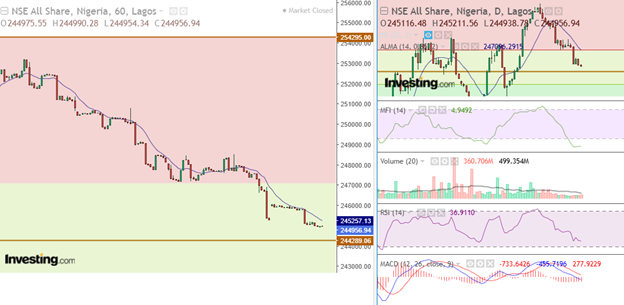
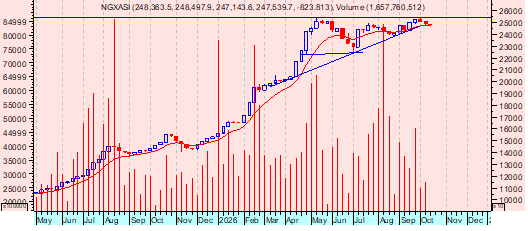
From a technical perspective, the NGX All-Share Index remains in a short-term uptrend, trading above its key moving averages and holding firmly above the 165,000 psychological level. This suggests that underlying buying pressure is still present, despite the slow pace of advances. Momentum indicators, however, point to a moderation in upside strength, implying that the market could experience periods of consolidation or mild pullbacks in the near term. The relatively weak volume profile reinforces this view, as sustained rallies typically require stronger participation. A decisive break above recent resistance levels could attract fresh inflows and extend gains, while a drop below immediate support may prompt profit-taking and short-term corrections.
Looking ahead, market outlook remains cautiously positive. Investors are likely to continue favouring stocks with strong fundamentals, earnings visibility and attractive valuations, particularly within the banking and industrial sectors. Near-term direction will depend on the flow of corporate earnings, dividend expectations, liquidity conditions and macroeconomic signals. Developments in the global oil market will also remain a key factor, given their implications for fiscal revenues, foreign exchange flows and overall investor confidence in the domestic market.
At the close of trading, the NGX All-Share Index rose by 0.31 percent to 165,901.57 points from 165,384.63 points in the previous session, lifting market capitalisation by N332.49bn to N106.49trn. Total traded volume declined by 3.45 percent to 736.44 million shares, while market turnover stood at N24.66bn, reflecting increased value flow into large-cap stocks. Market breadth was marginally positive with 35 gainers against 33 decliners. Price appreciation was led by IMG, which advanced by 10.00 percent, NGXGROUP gained 8.88 percent, FIRSTHOLDCO rose by 8.04 percent on a rebound after recent losses, CAVERTON added 8.33 percent, and WEMABANK climbed by 4.18 percent. On the downside, CUTIX led the losers’ chart alongside other decliners that closed lower on profit-taking. GTCO emerged as the most influential market mover, trading 65.9 million shares valued at N6.53bn, accounting for roughly 9 percent of total volume and 26 percent of total market value, reinforcing the dominance of banking stocks in Tuesday’s session.